Showing posts with label Ruth Downie. Show all posts

Friday, February 1, 2013

A Conversation with "Medicus" series author Ruth Downie


I have enjoyed Ruth Downie's "Medicus" series since I read her very first novel in the series "Medicus: A Novel of the Roman Empire" ("Medicus and the Disappearing Dancing Girls" for you UK readers).  I've followed her hero, Gaius Petreius Ruso, from Roman Britain to Gaul and back again, reviewing his latest adventure, "Semper Fidelis" just a few weeks ago.  Whenever I read a book with a Roman setting and a captivating protagonist, a number of questions about the author's interest in ancient Rome, some of her challenges in character development and research sources invariably arise.  This time, the author has generously offered to answer some of my questions and has allowed me to share her responses with you.

Ruth Downie, author of the "Medicus"
series of novels set in Roman Britain.
Image courtesy of Amazon.
Mary: What aspect of Roman civilization do you find most interesting?

 Ruth: What fascinates me is the contrast between the way Roman culture seems very familiar to us and the ways in which their thinking was so completely different. We can identify with the use of technology, the political bickering, the complex administration, the vast gap between rich and poor – and yet how could they accept slaughter as entertainment? And while there was some tinkering with the law to make the lives of slaves more bearable, the right of one person to treat another as ‘property’ was the basis of the economy and never seriously questioned.

Mary: Why did you choose the early 2nd century CE as the setting for the "Medicus" series?

Ruth: It was a trip to Hadrian’s Wall that sparked my interest in Roman Britain, so it seemed natural to write about the time when it was built. The first novel really didn’t work, but Ruso and Tilla evolved from two minor characters in the backstory. That’s why they ended up meeting some years before the wall appeared. In fact it’s worked out quite nicely, because in SEMPER FIDELIS they can slot into history and meet Hadrian on his only recorded tour of Britannia.

Mary: As a female author what aspect of your male protagonist do you find most challenging to capture?

Ruth: I’ve been racking my brains to remember the instance where I discussed a plot point with my husband, who said, “No, a man wouldn’t do that. A man would…” but I’m afraid neither of us can remember what it was!

Somebody once observed that when a man looks in the mirror he sees a person, whereas when a woman looks in a mirror she sees a woman. I don’t know how true that is now but it was certainly true for the male-dominated ancient world, and I do try to bear it in mind.

Mary: Did you use an historical Roman as a model for Ruso or a modern acquaintance? Who?

Ruth: The character of Ruso is imaginary but his meeting with Tilla was inspired by a real-life dilemma faced by two medic friends. They were stuck in traffic and realised there had been an accident on the motorway ahead of them. They had to decide whether to stay where they were and leave it to the ambulance, or abandon the car, run to the scene and try to help. The trouble was, they were only students, they knew very little emergency medicine and they had no equipment or backup (I left that part out of the novel). Fortunately in real life the ambulance got there first. I didn’t give Ruso that option.

Mary: Do you share particular character traits with Tilla? If so, which ones?

Ruth: Her cooking is possibly slightly worse than mine. Well, somebody’s has to be. Apart from that, she fulfils all my fantasies of one day becoming confident, assertive and decisive.

Mary: Now that Ruso and Tilla are married, how will you maintain the sexual tension between them?

Ruth: Whilst they are indeed man and wife, that’s not irrevocable - divorce was readily available in both their cultures. I think the cultural differences between them will continue to give rise to tensions and while Tilla is married to Ruso, he owes his first allegiance to the Emperor and the Legion. So in a sense she always has to compete for his attention, while he’s torn between his loyalty to the Army and his loyalty to his wife – and of course his duty to his patients.

Mary: In "Semper Fidelis", Ruso is temporarily demoted from an officer to a ranker. This was surprising to me since officers were typically of a higher social class and Roman society usually strictly observed social hierarchy in spite of legal infractions. Did you find an historical precedent for this type of disciplinary action during the imperial period? If so, could you describe the example you found?

Ruth: That’s an interesting point: certainly people of patrician status seem to have been regularly banished rather than suffer a more plebeian punishment. I haven’t found a specific example of demotion of legionary officers, but much of our evidence for military careers comes from tombstones, where failure is unlikely to be recorded. However commanders were able to use their discretion and one of the punishments available to them was demotion.

Secondly, although officers were generally of a higher social class than the men, doctors were an anomaly. Like many skilled trades, medicine was seen to be the province of slaves and Greeks, and its practitioners were rarely held in high esteem in civilian society. The elder Pliny had some very scathing things to say about them, and Ruso’s father was appalled when Ruso was desperate to go and learn medicine from his Uncle Theo rather than be a gentleman farmer. So although Ruso is in a position of authority because he has valuable skills, his social rank isn’t typical of officers – he would have more in common with centurions who had worked their way up through the ranks.

Another point here is that our sparse evidence on military doctors suggests that senior medics may have been appointed on short-term commissions as officers rather than having to serve the 25 years demanded of men in the ranks. There’s some dispute about this but the joy of being a novelist rather than an academic is that you can choose whichever interpretation works best for your story. So I’ve gone with the one that enables me to get Ruso and Valens very conveniently in and out of the Legion. 

Mary: You mentioned on your blog that you have participated in archaeological site excavations. What has been the most interesting site you have helped to excavate and why?

Ruth: Most of my time in the trenches has been spent on a long-term dig of a Roman villa in a scenic location in Northamptonshire – you can see the photos and read more about it at www.whitehallvilla.co.uk. Over the years, what had once been a stony field on a sheep farm was revealed as a large Romano-British villa site. We know from excavated bones that even then, the farm was breeding some very fine sheep.

My favourite day was when we finally dug below what appeared to a mass of rubble from a nearby bath-house and realised the tiles we were beginning to find were the tops of buried stacks. We had found the first heated room of a second, completely unexpected bath complex. Geophysics is a marvellous science but you never really know what you’re going to find until you start scraping away the mud with a trowel. 

Mary: What is one of the most surprising facts about the Romans or early Britons you have discovered in your research?

Ruth: Well, one of the medical textbooks regularly used in the Roman empire offers a cure for earache that involves popping in a boiled cockroach. I can’t say I’ve tried this. Nor have I yet tried to get rid of toothache by shattering the offending tooth with the sting of a stingray. If anyone does, I disclaim all responsibility.

Mary: Who is your favorite author and why?

Ruth: I fear I’m rather fickle – it tends to vary depending on who I’ve just been reading. But Martin Cruz Smith is a firm favourite. His Russian detective, Arkady Renko, is just so cool.

Mary: What Roman (besides Ruso) do you most admire and why?

Ruth: Hadrian. After a wild period in his youth he turned out be an intelligent, ambitious and hugely hardworking man. He was never liked by the Senate – the rumours of a faked succession and the murders of several opponents can’t have helped – but he was respected by his troops and made the effort to travel and see and improve the Empire he governed. Instead of embarking on crazy expeditions into territories Rome couldn’t hold, he drew back and tried to bring peace by consolidating what they already had.

 In the end he became bitter and unpopular, but that was the fate of most Emperors anyway. And I’m mightily grateful to him and his wife for saying insulting things about each other – marital tension is always a wonderful gift to a storyteller.

Enhanced by Zemanta
If you enjoyed this post, never miss out on future posts by following me by email!


Thursday, January 10, 2013

Review: Semper Fidelis by Ruth Downie


A history resource article by Mary Harrsch © 2013


Assimilating conquered warriors into the vanquishing army has been a problem for military commanders for thousands of years.  When Alexander the Great attempted to form an elite cavalry unit composed of the sons of conquered Persian nobles, his own officer corps was so enraged it led to the tragic death of Cleitus the Black, a longtime loyal officer to both Phillip II and Alexander, who was slain by Alexander himself after heated words about Alexander's efforts to incorporate Persians into positions of authority within his army.

It is this issue that forms the foundation for the plot of Ruth Downie's latest novel "Semper Fedelis".  We find our heroic medicus, Gaius Petreus Ruso, trying to find out what is happening to native Briton recruits at the hands of an apparently sadistic much-decorated centurion in second century Eboracum (modern day York).

As is usually the case, his native-born wife, Tilla, tries to help by questioning some of the local townspeople but ends up causing Ruso even more trouble with the commanding tribune who happens to be related to the family-honored centurion.  Ruso is summarily ordered to keep his nose out of things that don't concern him and Tilla receives a less subtle warning in the form of a severed pig's head found between her bedsheets.

But a recruit shows up at the hospital with a nasty infected arm after the young man had attempted to carve off a tribal tattoo to avoid any more abuse.  Then Ruso is further appalled when the man's friend turns up asking Ruso if he could remove the tattoos that embellish his arms as well.

With Tilla's urging, Ruso takes matters into his own hands when the emperor Hadrian shows up to inspect the fort, and Ruso attempts to explain the problem directly to Hadrian.  After all, Hadrian and Ruso served together in Antioch where Ruso was instrumental in saving the life of the emperor Trajan, Hadrian's adopted uncle.  Meanwhile, Tilla is called into the presence of the empress Sabina who thinks conversing with a colorful local would be amusing and Tilla attempts to bring the recruits plight to the empress' attention.
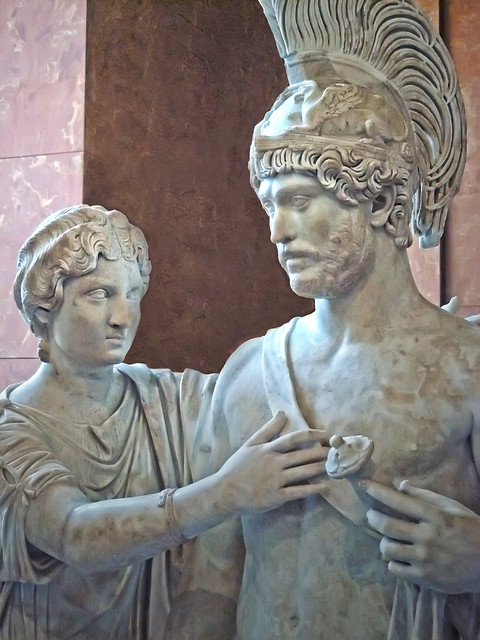
Interesting image of Mars the God of War with the face
of the Roman Emperor Hadrian and a female companion
whose face was resculpted in 170-175 CE to resemble
the Empress Lucille (according to The Louvre), wife of
the Roman emperor Lucius Verus (???) Photographed at The Louvre in Paris, France by Mary Harrsch

Then things take an even more nasty turn and the centurion in question is found murdered.  The related tribune throws Ruso into chains, more out of outrage that Ruso went to the emperor over his head than truly believing Ruso had anything to do with the murder. So Ruso and Tilla must scramble to discover the truth before Ruso is marched off to Deva for what is believed will be a summary trial and execution on the orders of the legate there.

The exciting conclusion involves Praetorian guards, conspiratorial royal secretaries, Tilla's less expert use of one of Ruso's scalpels, near mutiny of the recruits of the 22nd Legion and an ultimate solution devised by a very wise man who happens to be the most powerful ruler of the known world.

Again Downie has given us a mystery with twists and turns that keep readers guessing until almost the very end.  The characterizations of Ruso and Tilla are consistent with previous novels and, as I mentioned in a recent post to the Roman History Reading Group on Facebook, Downie offers each character's thoughts to us to flesh out their personalities.  She also provides a little backstory for tribune Accius letting us imagine his rather lonely childhood and the social importance of having an uncle publicly decorated for valor.  We can then understand, at least partly, the rational for what would normally be seen as outrageous behavior towards a respected medical officer.

The only thing I didn't understand in the plot was why Hadrian, who remained at the fort for several days during the time that tribune Accius imprisoned Ruso, did not act to prevent the mistreatment and possible loss of a valued medical officer who had proven himself in the Antioch earthquake?  Of course, our hero is ultimately saved but Hadrian's apparent indifference earlier in the story does not seem consistent with his obvious longtime respect for Ruso expressed at the end.

Of course, we don't know when Hadrian's knowledge of all of the events that occurred was realized, but as astute as Hadrian was, I can't imagine him not knowing that the tribune was blaming Ruso before Hadrian had left Eboracum for his next port of call.  If the tribune had simply locked up the native deserter, Victor, and blamed him from the beginning, it would have been more understandable that Hadrian would have been reticent to get involved.  Hadrian was a soldier's soldier and would not have intervened in a matter that should have been handled by the existing chain of command in circumstances that did not involve a professional officer held in high esteem by the emperor.  Perhaps this was Downie's way of developing events that would lead up to Russo's offer to sacrifice his own life to preserve order on the frontier and the emperor's continued successful reign.  Such an offer would then justify the size of the favor Ruso requests at the end of the story.

As for the supporting history behind the abuse of native recruits to the legions in Britain, we can look to the Vindolanda Tablets that include correspondence from the professional  auxiliaries from the Tungri tribe of the Aardennes region (Belgium/France/Luxembourg).  Although these men were not originally Romans from the Empire's heartland, they still  used a disparaging nickname for their British hosts: Brittunculi.

"In Latin, the suffix -unculus is both diminutive and pejorative: the term translates as "pathetic little Brits" (Vindolanda Tablet 164). The author was probably not referring to the provincial population as a whole, but specifically to young trainee recruits to the regiment. - Roman auxiliaries in Britain, Wikipedia

The Vindolanda Tablets, dated from 85 - 122 CE, also reveal that the military was understrength at the time of Hadrian's visit in 122 CE. The I Tungrorum listed its strength at 752 instead of the official 800 men expected to fill its rolls.  So, it would have been a time that recruits would have been sought, even from the local tribes.

Originally, Rome did not deploy auxiliary units in their home country or region but this policy relaxed to some degree as military shortages became more acute in the second century.

Centurion abuse of young recruits, outside the demanding regimen of basic training, is also documented in the ancient sources, although the most prominent record involves the Germanic Batavians.  In the "Year of the Four Emperors" (69-70 CE), the governor of Germania Inferior was ordered to raise more troops.  The Batavians  were regarded by the Romans as the very best (fortissimi, validissimi) of their auxiliary so the governor attempted to conscript more Batavi than the maximum stipulated in their treaty.  This action was compounded by the brutality and corruption of Roman recruiting-centurions including reports of sexual  assault on Batavi young men.
A Batavian helmet with remnants of blonde wig,
Courtesy of the Nijmegen museum.

Then, Julius Civilis, himself a decorated veteran of 25-years service in Britain and prince of the Batavi people, led his people in open revolt.

"... the uprising soon became a bid for independence.  Civilis exploited the fact that some legions were absent from the Rhine area due to the civil war, and the rest under-strength. In addition, the Roman commanders and their rank-and-file soldiers were divided by loyalty to rival emperors. Civilis quickly won the support of the Batavi's neighbours and kinsmen, the Cananefates, who in turn won over the Frisii. First the rebel allies captured two Roman forts in their territory, and a cohort of Tungri defected to Civilis.  Then two legions sent against Civilis were defeated when their companion Batavi ala defected to his side. The Classis Germanica (Rhine flotilla), largely manned by Batavi, was seized by Civilis. Most importantly, the eight Batavi cohorts stationed at Mainz with XIV Gemina mutinied and joined him, defeating at Bonn a Roman force that attempted to block their return to their homeland. By now, Civilis commanded at least 12 regiments (6,000 men) of Roman-trained and equipped auxiliary troops, as well as a much larger number of tribal levies. A number of German tribes from beyond the Rhine joined his cause. Several other German and Gallic units sent against him deserted, as the revolt spread to the rest of Gallia Belgica, including the Tungri, Lingones and Treviri tribes. He was able to destroy the two remaining legions in Germania Inferior, (V Alaudae and XV Primigenia). 
By this stage Rome's entire position on the Rhine and even in Gaul was imperiled. Their civil war over, the Romans mustered a huge task force of eight legions (five dispatched from Italy, two from Spain and one from Britain) to deal with Civilis. Its commander Petillius Cerialis had to fight two difficult battles, at Trier and Xanten, before he could overrun the Batavi's homeland. Tacitus' surviving narrative breaks off as he describes a meeting on an island in the Rhine delta between Civilis and Cerialis to discuss peace terms. We do not know the outcome of this meeting or Civilis' ultimate fate. But in view of his former friendship with Vespasian, who had already offered him a pardon, and the fact that the Romans still needed the Batavi levies, it is likely that the terms were lenient by Roman standards." - Roman military Auxiliaries, Wikipedia

So, the situation described in the novel could have been equally disastrous for Hadrian, who would have been keenly aware of the outcome of the Batavian revolt just 50 years before.  Furthermore, by Hadrian's time auxiliaries outnumbered legionaries by 2.5 to 1 in Britain.  Unfortunately for Ruso, Tribune Accius was far more nearsighted, thinking only of his family's social standing and not the welfare of the empire.

I also though Downie accurately portrayed the relationship between Hadrian and his wife Vibia Sabina.  Downie's townspeople mention rumors that Hadrian preferred to spend more time with his mother-in-law than Sabina.  Although that sounds strange, Hadrian's mother-in-law was actually his second cousin and only eight years older than Hadrian.  Furthermore, they were raised together in Trajan's household.

Sabina, as portrayed in the novel, was known to be independent minded and by the time of the novel, she had already had an affair with the historian Suetonius, secretary to Hadrian.  So, it would be totally in character for her to admonish Tilla by saying "Don't pray too hard" when Tilla said she would pray for the empress to be fruitful.

As a war veteran's spouse, another issue I always ponder when I read about a character being particularly brutal to other characters is whether the brutal character may be suffering from post-traumatic stress disorder.  Geminus was described as a valorous, much-decorated veteran about to retire when he finishes training this particular batch of recruits.  Although scholars like Dr. Jonathan Eaton question a diagnosis of PTSD in members of the Roman Army because of a lack of explosive or concussive events in a typical Roman battle (PTSD and the Roman Army ), I would point out that heroic epics like those of Homer formed a foundation of source material used in the formation of the Roman heroic ideal.  In Chapter 3 of "From Melos to Mylai: War and Survival", Lawrence Tritle asserts that the heroes portrayed in Homer, Tyrtaeus, Archilochus, and Aeschylus share the characteristic of being someone who takes revenge for the death of his friends and strongly believing a good man is a brave man.

Not only may Geminus have been subconsciously seeking revenge for friends lost in past campaigns but as the recruits quaked from the centurion's actions, he may have dismissed the lot of them as not worthy since they apparently displayed no bravery in his eyes.

Tritle further points out that in war, officers are taught to instill in the troops an image of the enemy as foreign and different.  "[these] emotional factors... were greater inducements to carry out brutal acts of violence than racially or culturally based perceptions of the 'Other'."

So despite his horrendous behavior, perhaps we should reserve at least a little sympathy for Geminus just as Ruso expressed for Geminus' dog, Bella.  She may have attacked Ruso because of her training, but in the end she waited calmly beside the body of her beloved master, unaware that she, too, would be struck down for her learned behavior and share his funeral pyre.

If you enjoyed this post, never miss out on future posts by following me by email!