Showing posts with label Ballista. Show all posts

Saturday, August 16, 2014

Review: Wolves Of The North by Harry Sidebottom

A history resource article by  © 2014

In Book Five of Dr. Harry Sidebottom's best-selling series, we find my favorite "Warrior of Rome", Marcus Claudius Ballista venturing even further north into the Asian steppe on a mission to deflect a potential alliance between the various tribes living there and the Persian Empire.  Ballista is stIll on tenuous terms with the Roman emperor Gallienus since Ballista was briefly forced to don the purple after the events in book 3, "Lion of the Sun".  But, his old friend has continued to avoid ordering Ballista's execution despite pressure from advisors in the emperor's concilium.  But, Ballista has other problems plaguing his faithful little band.  Even he is concerned about the curse called down upon him by one of the barbarian priestesses he refused to "marry" in Book 4, "The Caspian Gates" and now members of his column are being found murdered and horribly mutilated.

I read that Dr. Sidebottom had become interested in branching out to murder mysteries and it is reflected by this subplot.

Ballista's mission to attempt to negotiate a peace treaty with the fierce Heruli, notoriously known as eaters of flesh, is viewed as nearly impossible and the murders up the ante considerably.  So the tension in this novel is pretty much non-stop.  


A 54mm figurine of a 3rd century Alamanni
Warrior who attacks Ballista and his allied
Heruli.  Image courtesy of Planetfigure.com.

Dr. Sidebottom immerses both Ballista and his readers in the culture of the Heruli as described by 6th century historian, Procopius.  In his author's notes he admits that Procopius was hardly objective about these Germanic peoples but Dr. Sidebottom had few other sources to rely on.  He then assumed the Heruli also assimilated cultural practices from other tribes with which they came into contact - cannabis use from the Scythians, wife sharing from the Agathyrsi (both attested to by Herodotus) and scapulimancy (divination by the study of a mammal's scapula - shoulder blade - that has been heated in a fire) and cranial deformation practiced by the Huns.

When Dr. Sidebottom first described the Heruli' s cranial deformation I was surprised as I had not studied the Huns in depth so associated cranial deformation with New World cultures like the Maya, especially since I have photographed a number of Pre- Colombian artifacts depicting individuals with apparently deformed skulls.  But when I researched this practice further, I learned that archaeologists have found a Neanderthal skull with evidence of intentional deformation dating back 45,000 years.  


The earliest written record of cranial deformation dates to 400 BC in Hippocrates' description of the Macrocephali or Long-heads, who were named for their practice of cranial modification. 
In the Old WorldHuns and Alans are also known to have practised similar cranial deformation. In Late Antiquity (AD 300-600), the East Germanic tribes who were ruled by the Huns, adopted this custom (GepidsOstrogothsHeruliRugii and Burgundians). In western Germanic tribes, artificial skull deformations have rarely been found. In the Americas the MayaInca, and certain tribes of North American natives performed the custom. In North America the practice was especially known among the Chinookan tribes of the Northwest and the Choctaw of the Southeast. The Native American group known as the Flathead did not in fact practise head flattening, but were named as such in contrast to other Salishan people who used skull modification to make the head appear rounder. However, other tribes, including the Choctaw,Chehalis, and Nooksack Indians, did practise head flattening by strapping the infant's head to acradleboard. The Lucayan people of the Bahamas practised it. The practice was also known among the Australian Aborigines. -Wikipedia
This elongated Allamani skull is an example of cranial
deformation.  Image courtesy of Wikipedia.
Apparently. Germanic deformation has been confirmed archaeologically by remains found in a burial discovered in Austria. Anyway, I thought this vibrant culture provided a fascinating context for the novel's events.

Another fascinating aspect of the book is one of the characters practices physiognomy.  Physiognomy is the assessment of a person's character based upon his physical attributes, particularly the structure of their face. It is thought to have been formalized by Greek philosophers of the 5th century BCE Athens.  It gained widespread acceptance among philosophers of the 4th century BCE and was even embraced to some degree by Aristotle.

It is possible to infer character from features, if it is granted that the body and the soul are changed together by the natural affections: I say "natural", for though perhaps by learning music a man has made some change in his soul, this is not one of those affections natural to us; rather I refer to passions and desires when I speak of natural emotions. If then this were granted and also that for each change there is a corresponding sign, and we could state the affection and sign proper to each kind of animal, we shall be able to infer character from features.  — Aristotle, Prior Analytics 2.27 (Trans. A. J. Jenkinson)


The oldest extant work about physiognomy
was written by Aristotle.  Photographed at the
Palazzo Altemps in Rome, Italy by
 © 2009
So it was interesting to read what the book's practitioner inferred from the physical appearance of those around him.
As for Ballista himself we are now in fictional territory since he disappeared from the historical record after the battles with the Persians and Roman usurpers portrayed in "Lion of the Sun".  Although he is struggling a bit with getting older, he is still the courageous warrior I first admired in "Fire In The East".  I fear my time with him is drawing to a close, though, as death seems to be circling his familia. I've alway had a hard time saying "goodbye" and it will be especially hard this time after journeying with Ballista through so many adventures. I guess I'll find out if he finally meets his end as I've already purchased Book Six, "The Amber Road."


If you enjoyed this post, never miss out on future posts by following me by email!


Thursday, August 15, 2013

Review: The Caspian Gates by Dr. Harry Sidebottom


Dr. Sidebottom's "warrior of Rome", Marcus Claudius Ballista, has become one of my favorite literary characters as I have worked my way through his series of novels.  So I was thrilled to see that an audio version of "The Caspian Gates" showed up in my recommended list of Audible selections.

I wasn't sure where Dr. Sidebottom would take Ballista this time since the historical Ballista pretty much disappears from the historical record (according to the Historia Augusta) after he beat back the Persians and wound up as emperor himself briefly as portrayed in the last novel I had read "Lion of the Sun".

Of course Ballista voluntarily laid down the honor after the imminent danger was dealt with, knowing full well the empire in the third century CE would never fully embrace an Angle from Germania.  The problem with that, however, lies in facing the existing emperor after such an act.  Emperors were notoriously paranoid and, although the emperor Gallienus was far from the worst of the lot and, in the novel, a former friend of Ballista, the novel opens with Ballista awaiting exile or execution in Ephesus.

A portrait of the Roman emperor Gallienus 
at The Louvre in Paris, France.
Image by Mary Harrsch.
Ballista's first temporary reprieve comes in the form of an attack by Gothic pirates.  As the most battle experienced commander available, Ballista leads first the defense of Ephesus, then beats back the Goths again at the shrine of Apollo in Didyma.  Dr. Sidebottom treats us to a marvelous description of the sanctuary and the ritualistic community there and, of course, the battle scenes are gritty and intense.

Ballista finally receives a mandata from Gallienus and he discovers his old friend has spared him but asks him to undertake a perilous mission to the Caspian Gates where he is to convince the indigenous tribes there to remain loyal to Rome despite the lucrative overtures they have been receiving from Sassanid Persia.

Note: I noticed the Wikipedia article on Gallienus claims he ordered the execution of Ballista in November 261.  This is not considered fact and the historical sources are very unclear about Ballista's ultimate fate.  So, it's a reasonable plot device to have Ballista reassigned in such a way that puts him so far up in the Roman frontier and no longer in command of troops as to pose little threat to the emperor.

Ballista, with his usual companions in tow, finds himself in a converted Roman warship retracing the steps of the mythical Jason and the Argonauts.  Dr. Sidebottom gives us the mythological background of each of Ballista's ports of call.  Then he treats us to an exciting sea battle as Ballista's little convoy is attacked by the pirates that had attacked him earlier at Ephesus and Didyma.  Ballista is a personal target now as his tactics, particularly his deception at Didyma, has engendered a blood feud with these particular Goths.   But Ballista's keen eye for an experienced and courageous captain pays off.

Fresco of a Roman war galley found at Pompeii.  1st century CE.
Photo by Mary Harrsch.
The little troop eventually reaches their destination, but finds the tribe currently in control of the territory around the Caspian Gates suspicious, wary and outright duplicitous.  To add to the tension, two members of the ruling family have been treacherously murdered by their own kinsmen and the three remaining siblings are jostling for ultimate control.  The only female in the struggle takes a fancy to Ballista even though Ballista had killed her husband years before, when her husband fought with the Persians in Syria.

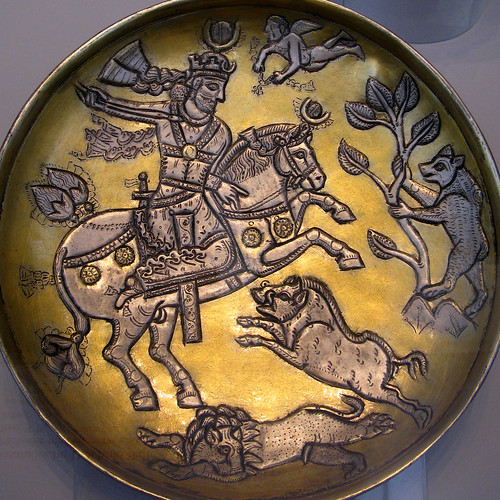
Ballista must eventually seek help from his former enemies headed by the son of the King of Kings himself.  But will the Persians see the advantage to an alliance with the notorious "demon of death" who slaughtered so many of their brethern in past battles?  Viewing Ballista from the Persian perspective was particularly interesting.

Sassanid-era Persian king hunting boar.  Museum of Islamic
Arts, Berlin, Germany. Image courtesy of  Frank Ravik.
All in all, I found "The Caspian Gates" well written and, as always, chock full of historical detail that really brought the story to life for me.  I always enjoy the little extra bits of history that Dr. Sidebottom injects into the narrative that always prompts me to research a particular topic more deeply.  In this book, one of Ballista's household, a Greek pirate turned secretary named Hippothous, was a serious adherent to physiognomy.  Each time a new character is introduced, Hippothous would share his thoughts on the new arrival's worth based on his perceived physiognomy.

Physiognomy is the assessment of a person's character or personality based upon the contours of his outer appearance. Physiognomic theory first appear in 5th century BCE Athens, with the works of Zopyrus , who was said to be an expert in the art. By the 4th century BCE, Aristotle makes frequent reference to physiognomic in his works including his Prior Analytics:

It is possible to infer character from features, if it is granted that the body and the soul are changed together by the natural affections: I say "natural", for though perhaps by learning music a man has made some change in his soul, this is not one of those affections natural to us; rather I refer to passions and desires when I speak of natural emotions. If then this were granted and also that for each change there is a corresponding sign, and we could state the affection and sign proper to each kind of animal, we shall be able to infer character from features.—Prior Analytics 2.27 (Trans. A. J. Jenkinson)

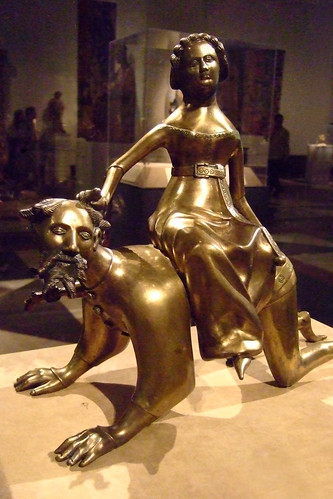
A 14th century CE  aquamanile (water dispenser) 
depicting Aristotle's girlfriend Phyllis riding the
philosopher around the garden after he gave advice
about women to Alexander the Great.  Photographed
at the Metropolitan Museum of Art in New York by
Mary Harrsch. 
The first systematic physiognomic treatise to survive to the present day is a slim volume, Physiognomonica ascribed to Aristotle (but probably of his "school" rather than created by the philosopher himself). The volume is divided into two parts, conjectured to have been originally two separate works. The first section discusses arguments drawn from nature or other races, and concentrates on the concept of human behavior. The second section focuses on animal behavior, dividing the animal kingdom into male and female types. From these are deduced correspondences between human form and character. - Wikipedia

By Ballista's time, physiognomists could also study the writings of Polemo of Laodicea, de Physiognomonia.

Like the science of astrology, though, modern academics have rejected physiognomy as not having much worth.

"Although we may now bracket physiognomy with Mesmerism as discredited or even laughable belief, many eighteenth-century writers referred to it in all seriousness as a useful science with a long history(...) Although many modern historians belittle physiognomy as a pseudoscience, at the end of the eighteenth century it was not merely a popular fad but also the subject of intense academic debate about the promises it held for future progress." - The Cambridge History of Science: Eighteenth-century science.

Anyway, it was funny to read what Hippothous deduced about someone based on how they looked to him.

I did find The Caspian Gates less compelling storywise, however, than Ballista's exploits in earlier novels.  I think this was a result of Ballista no longer being in a command position throughout much of this novel. Previous novels have firmly established Ballista with the innate ability to galvanize men to achieve victory, whatever the endeavor.  But, without a leadership role in this book, Ballista is left to languish seemingly waiting for someone else to make the first move.  I also simply could not imagine this quintessential man of action lounging around the quarters of a nomadic princess for days on end either.

Hopefully, he'll assume a command position again in the next installment "Wolves of the North".

Here's a clip of Dr. Sidebottom discussing "The Caspian Gates" up on YouTube:


If you enjoyed this post, never miss out on future posts by following me by email!


Tuesday, December 6, 2011

Review: Lion of the Sun by Harry Sidebottom


Dr. Harry Sidebottom's "Lion of the Sun" continues the story of Marcus Claudius Ballista, a courageous "Warrior of Rome" born to the Angles but raised as a hostage in the Roman imperial court .

When we left Ballista at the end of "King of Kings" he, along with his emperor Valerian, had fallen victim to a treacherous plot by the emperor's treasurer, T. Fulvius Macrianus, known as Macrianus the Lame, who had betrayed the emperor and his field army  to Sassanid King of Kings, Shapur I.

Sassanid Persian King Shapur I with the captive Roman
Emperor Valerian at Naqsh-e Rustam. Image courtesy of

Fortunately, although Ballista's prospects looked pretty grim, especially considering his past victories against the Persians and his practice of cremating the Persian dead despite the knowledge that it was viewed as a desecretion of holy fire by the enemy Zoroastrians, Ballista's famillia including his devoted Hibernian body guard Maximus, his lovingly irrascible Caledonian guardian Calgacus and his poetic Greek secretary Demetrius had escaped. So I wondered how they would rescue him from what looked like certain death.  Having met the revolting Macriani in "King of Kings" I also hoped Ballista could avenge himself and his emperor as the tale unfolded.

But it was not Ballista's famillia that came to his rescue.  It was the frail old emperor who finally remembered who he had always been able to trust.

Historically, Valerian apparently had a high regard for Ballista, as illustrated by the following communication from Valerian to a prefect of Illyricum quoted in the Historia Augusta:

 "From Valerian to Ragonius Clarus, prefect of Illyricum and the provinces of Gaul. If you are a man of good judgement, my kinsman Clarus, as I know that you are, you will carry out the arrangements of Ballista. Model your government on them.  Do you see how he refrains from burdening the provincials, how he keeps the horses in places where there is fodder and exacts the rations for his soldiers in places where there is grain, how he never compels the provincials or the land-holders to furnish grain where they have no supply, or horses where they have no pasture?  There is no arrangement better than to exact in each place what is there produced, so that the commonwealth may not be burdened by transport or other expenses.  Galatia is rich in grain, Thrace is well stocked, and Illyricum is filled with it; so let the foot-soldiers be quartered in these regions, although in Thrace cavalry, too, can winter without damage to the provincials, since plenty of hay can be had from the fields.  As for wine and bacon and other forms of food, let them be handed out in those places in which they abound in plenty.  All this is the policy of Ballista, who gave orders that any province should furnish only one form of food, namely that in which it abounded, and that from it the soldiers should be kept away. " - The Historia Augusta, The Lives of the Thirty Pretenders, Volume III:18, p113.     

But the old emperor had been seduced by Macrianus into believing his seemingly loyal courtier acted upon reliable intelligence about the whereabouts of Persian forces and ignored Ballista's repeated warnings about the army's precarious position.  Now that it appeared all was lost, Valerian realized the ambitious Macriani had inadvertently left him an instrument of redemption.
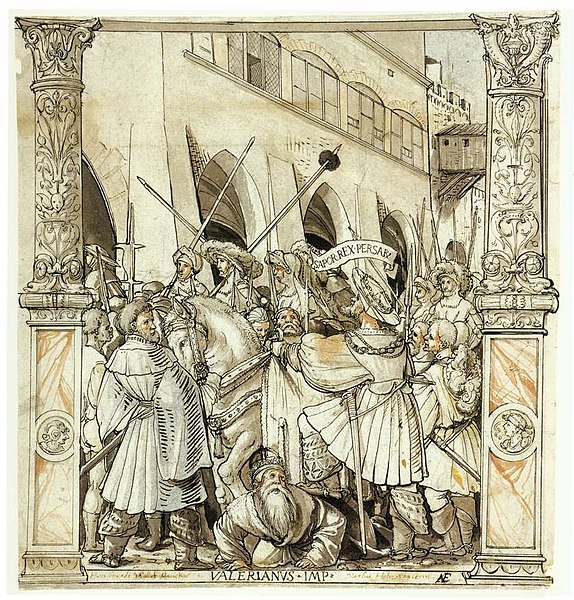
The anachronistic "Humiliation of Valerian" by Hans Holbein the
Younger, 1521 CE.  Courtesy of Wikimedia Commons.


Without a hint to Shapur that Valerian had finally realized the ambitious author of the treachery, the old Roman asked Shapur to send Ballista to Macrianus' headquarters to negotiate a ransom, knowing full well that Macrianus would refuse any suggestion of ransom.  But Valerian's  best general would then be free to first, drive out the Persians, then deal with the imperial traitors.

But is Ballista being snatched from the frying pan only to be delivered to the fire?


Much of the ensuing story is based on the few fragments of history that survived Rome's brutal Third Century.

"The plague throughout these years was still rampant over the empire.  Zosimus sets it alongside the invasions as if in doubt which was the worse.  Inflation was raging.  The normal course of bourgeois economic life was dislocated.  Famine was endemic around the theatres of war, though the wheat fleets of Egypt and Africa still fed the Roman populace.  The Christians had as much to fear from the imperial officials as from the Germans or the Persians.  The social tension between the old senatorial class, tenacious in its grasp on its traditional preserves of office, and the new aspiring officer class, mainly Illyrian in origin, called for resolution.  Loyalty in high places was far to see; provincial governorships and provincial high commands were potential focuses of usurpation; the soldiers tended to be sullen and mutinous.  To some minds the complete dissolution of society might have seemed to be imminent." 
"Spiritually and culturally too things were at an impasse.  The old traditional forms of religion had long since lost their credibility outside the peasantry.  There were the mystery religion, Greek and oriental.  There were for the educated and intellectual the various schools of philosophy, the Stoic in decline, the neo-Platonist in the ascendant. Those in authority sought desperately, and sought in vain, for some cohesive belief or principle capable of welding the various classes of peoples of the empire into a spiritual unity and inspiring a common purpose and a common devotion." - Gallienus: A study in reformist and sexual politics by John Bray.

The few ancient sources we have to decipher the events of this tumultuous period is the much maligned and historically suspect Historia Augusta.


The Historia Augusta says Maeonius Astyanax claimed Ballista openly supported the usurpation of the Macriani saying:

"As for myself, my age and my calling and my desires are all far removed from the imperial office, and so, as I cannot deny, I am searching for a worthy prince.  But who, pray, is there who can fill the place of Valerian except such a man as yourself, brave, steadfast, honourable, well proved in public affairs, and — what is of the highest importance for holding the imperial office — possessed of great wealth?  Therefore, take this post which your merits deserve. My services as prefect shall be yours as long as you wish."  - The Historia Augusta, The Lives of the Thirty Pretenders, Volume III:12, p97.

What? His age precludes him from seeking the purple himself? Ballista was only in his thirties!  Although his military calling and personal ambitions may not have included the purple, he was hardly too old.  In fact, he was probably not that much older than the sons of Macrianus.
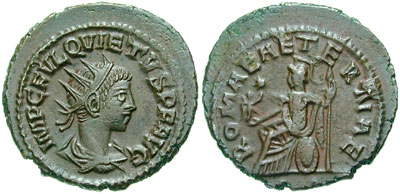
Quietus the usurper, son of Macrianus the Lame.
Courtesy of The Classical Numismatic Group, Inc.
via Wikimedia
Sidebottom's novel, instead, has Ballista publicly accept the office of Prefect only after a henchmen of the Macriani makes veiled threats about Ballista's family in Antioch that was essentially at the mercy of the Macriani  if Ballista refused to support the regime.  I think this is a far more believable scenario as there is nothing in the histories to suggest Ballista was ever one to personally exploit a political situation.

But, either way, Ballista once more ends up in command of much of the Roman army in Syria and he once more inflicts serious losses on the invading Persians.  Sidebottom's gritty descriptions of 3rd century warfare leave you breathless and his excellent characterizations makes you worry about not only Ballista (who captivated me in the very first novel of the series) but loyal (and virile!) Maximus, cranky old Calgacus and even gentle Demetrius.  Ballista's wife, Julia, gets her moment to shine too as she confronts Persian warriors in a surprise attack on the city of Antioch.

The Persians, though, are not the ultimate enemy.  To restore the imperium, Ballista must kill the Macriani pretenders but not until he can find a way to safeguard his wife and two sons.
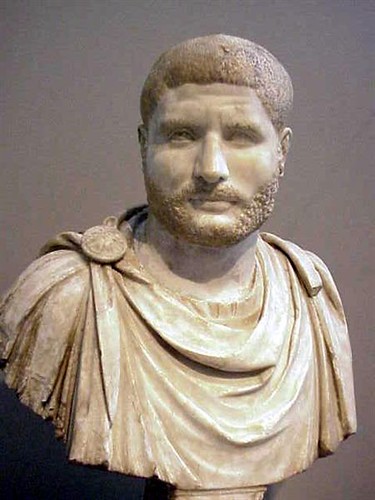
Bust thought to resemble the emperor Gallienus. 
Photographed at the Walters Art Museum 
by Mary Harrsch.

When Macrianus the Lame and his namesake, Macrianus the Younger, leave for Europe to challenge Valerian's son Gallienus for the throne of the entire Roman Empire, Ballista is ordered to remain with Quietus.  Now, at least, the odds for Ballista's opportunity to exact retribution improve.

However, when Quietus receives word that his father and brother have been defeated and killed in Thrace, he becomes paranoid and imprisons Ballista and his family.  Now Ballista must place his trust in an old acquaintance from Book 1, "Fire in the East" and "The Lion of the Sun", Odaenathus, King of Palmyra, to save all that Ballista holds dear.

"...while Valerian was growing old in Persia, Odaenathus the Palmyrene gathered together an army and restored the Roman power almost to its pristine condition.  He captured the king's treasures and he captured, too, what the Parthian monarchs hold dearer than treasures, namely his concubines.  For this reason Sapor [Shapur I] was now in greater dread of the Roman generals, and out of fear of Ballista and Odaenathus he withdrew more speedily to his kingdom." - The Historia Augusta, The Two Valerians, Volume III:4 

The Historia Augusta only includes a couple of brief paragraphs about Quietus but those few lines reveal why historians often find themselves so exasperated when trying to piece together the events of the period using the Historia Augusta as a source.

We read that Ballista was killed along with Quietus when Odaenathus captured the city of Emesa.  But in the very next section of the Augusta Historia about Odaenathus himself, the Historia Augusta says while Odenathus was defeating Quietus at Emesa, Ballista claimed the purple for himself to avoid being slain.

Then under section 18 of Volume III describing Ballista, the author of that portion (if it is not the same as the rest of the work) details yet another fate of Ballista but admits that he really doesn't know what happened to Ballista since most ancient sources only refer to his prefecture not any reign as usurper.

"This man [Ballista], then, while resting in his tent was slain, it is said, by a certain common soldier, in order to gain the favour of Odaenathus and Gallienus.  I, however, have not been able to find out sufficiently the truth concerning him, because the writers of his time have related much about his prefecture but little about his rule." -The Historia Augusta, The Lives of the Thirty Pretenders, Volume III:18, p113


 Fortunately, Sidebottom sorts this out in a much more satisfying conclusion that sets us up for the next novel in the series, "The Caspian Gates".

Note: This review is based on the unabridged audio version of this book produced by Blackstone Audio with an outstanding performance by Stefan Rudnicki.

Enhanced by Zemanta
If you enjoyed this post, never miss out on future posts by following me by email!