Showing posts with label Mary Harrsch. Show all posts

Saturday, August 18, 2018

Dr. J LED mini-projector provides economical solution to history presentations

This is a cross post from my blog "Technology Times and Trials." A technology resource article by Mary Harrsch © 2018

If some of you, like me, are asked to present information periodically that includes images and video and no longer have access to institutional multimedia equipment, you might be interested in this 3 pound Dr. J micro-projector measuring just 7.8 x 2.7 x 6 inches that is capable of producing projected output of 170 inches (diagonally). 

In September, I will be attending my 50-year class reunion and offered to produce some music videos of my classmates working and having fun over the past 50 years as well as a salute to our class veterans.  But the Historical Museum where we will be gathering owned no projection equipment. Since I'm retired, I also no longer have access to a university projector. It was a bit of a dilemma until I saw this unit advertised as an Amazon Lightning deal for only $60. (It is regularly priced at $98.99 - still a bargain!) It was very positively reviewed, although for the price, I quite honestly, wasn't expecting a lot. When the projector arrived, though, I was very pleasantly surprised.

The unit is solidly built and comes with a remote as well as having adjustment controls on the projector itself. I had copied my videos to a flash drive and inserted it into the USB port then turned on the projector and selected USB as my video source using the setup menu. Then I navigated through the flash drive folders to the folder containing my videos and selected the one I wished to play. Pressing the source button again opened the video in full screen mode and played all videos in the selected folder.  I was quite pleased with the color reproduction and thought the sharpness was also quite good as well.

The unit has built-in speakers, a big plus for such a compact unit, and they put out a decent amount of sound.  If you need more volume for a larger room, you can use the included RCA cable to connect external speakers.  Quite honestly, I was totally amazed at the quality of the output for such a small price. When I was an education technologist before I retired ten years ago I had to spend over a thousand dollars to get the results this LED micro-projector produces.

In short, this little gem offers great portability, is easy to set up and adjust, and has very good sharpness and color reproduction for a terrific price!  (No, I don't work for this company or receive any commissions for publicizing it.)  I just might go forth and produce more presentations on the Roman Empire for local groups now that I have a way to share them.  After all, if the SAT advisory board follows through with the proposal to eliminate teaching history before the mid-1400s in U.S. AP courses, someone needs to do it!! The legal and social constructs of the classical world were used to form the foundation on which our republic was built!

Note: The projector shipped with an HDMI cable which is great for those with a newer laptop or other HDMI-compatible devices.  However, if you are using an older laptop as your content source you will need your own VGA cable and audio patch cable to connect your laptop's VGA port and headphone jack to the projector's VGA port and AV jack as they are not provided. Unless your files require software on your laptop or you are demonstrating software, though, I recommend copying your images or videos to a USB flash drive and eliminate the hassle of connecting all the cables for laptop projection. 

This unit is optimized for video output and is not recommended for text-heavy Powerpoint presentations.  However, I could still read projected text with the unit properly focused. Instead, I use a slideshow program called ProShow Gold by Photodex to combine my images with a soundtrack, add transitions, and output a video file in my desired file format.
If you enjoyed this post, never miss out on future posts by following me by email!


Monday, August 6, 2018

Review: The Middle Ages in 50 Objects by Gertsman and Rosenwein

A history resource article by Mary Harrsch © 2018

Normally, I review books focused on the ancient world but I received an email from Cambridge University Press asking if I would be interested in receiving a review copy of their new release "The Middle Ages in 50 objects." Even though the Middle Ages is not the period of my personal research, I still enjoy examining art and artifacts from the Middle Ages when I photograph the permanent collections of of the museums I visit, so I agreed to give it my attention.

As promised, the book was lavishly illustrated with full page color photos of the artifacts selected for inclusion.  I was surprised that all of the objects came from a single museum, the Cleveland Museum of Art, though.  Most world-class museums have galleries of medieval art so I was not expecting a single museum not devoted to that historical period, to have the breadth needed to encompass an entire age.

But Professor Elina Gertsman of Case Western Reserve University and her co-author, Professor Barbara Rosenwein of Loyola University Chicago, have certainly selected objects that are representative of their four focus areas, The Holy and the Faithful, The Sinful and the Spectral, Daily Life and Its Fictions, and Death and Its Aftermath.

Most objects are Christian-themed, but several artifacts from Islamic regions are also included.  I was particularly surprised to find a sculpture dated as early as 280-290 CE to be the first object discussed, though. I usually consider the Middle Ages a period from the fifth to fifteenth centuries CE, after the fall of the Western Roman Empire and lasting into the early Renaissance.  But, as a scholar of the ancient period, I was, of course, anxious to read what these distinguished art historians had to say about the piece.

Jonah Cast Up Roman 280-290 CE. Courtesy of the Cleveland Museum of Art.

The piece, entitled Jonah Cast Up, was a bit baffling to me. Most of us are quite familiar with the tale of Jonah being swallowed by a a huge fish (New International version, King James version) or dag gadol - great fish (Hebrew). But here, the "fish" has the head and forepaws of a wolf, typically symbolic of the Roman Empire. Furthermore, the male figure has the hair style and beard often seen in Roman art depicting Jupiter.

The authors, too, recognized the resemblance of the Jonah figure to Zeus (Jupiter in the Roman pantheon).

"A strong muscular man with an abundant beard and wild curly hair, Jonah dives out from the jaws of the beast, arms up, the movement of his torso echoing the direction of the sea creature's pricked up ears and scrunched snout. The broad-shouldered Jonah, with his copious curls and robust arms, is reminiscent of images of Zeus, the Greek god of Thunder and the ruler of Olympus."

But they say nothing about the symbolism of the wolf other than to observe that the great fish of the Jonah story has sometimes been interpreted as a sea monster (in later Greek translations of the scriptures).

I thought, perhaps, the archaeological context could provide additional insight.

The authors point to collateral finds as possible evidence of a patron with Christian leanings.
"This sculpture seems to have formed part of an ensemble.  It was supposedly found buried in a very large jar alongside six paired portrait busts, an image of Christ the Good Shepherd, and three other representations of Jonah in prayer, under the shade plant, and being swallowed by the sea monster. The patrons therefore appear to have had Christian leanings."

The dating appears to be tentative and the authors speculate whether it was produced a little later than the date given, perhaps during Diocletian's persecution of Christian believers in 302 CE.

Portrait head of Diocletian photographed at the
Art Institute of Chicago by Mary Harrsch © 2016
"Soldiers were ordered to sacrifice to the Roman gods or face discharge; Christian churches were destroyed; books of scripture were confiscated and burned; and Christians were stripped of their rank if they did not conform, making them liable to torture or execution. Whether carved before the Great Persecution or at some point during it, the marble image of the rebellious Jonah - not only saved from drowning but also finding himself cast safely ashore - must have been exceptionally reassuring."

I would offer a slightly different interpretation as another possibility. I think the sculpture could have been produced a little later still, during the reign of Constantius II.  Although seemingly an image representing the Jonah story, I think it could have been carved to represent the expulsion of paganism from the Roman Empire itself.  That would account for the human figure's resemblance to Zeus (Jupiter) and for the wolf's head on the sea monster's body - still probably reassuring to a Christian-leaning patron who may have suffered during the Great Persecution.

I definitely agree with the author's summary conclusion, however.

"Jonah Cast Up stands as a perfect witness to the cultural and religious complexity of the late third [and early fourth] century."

I also found a gilt-silver arm reliquary of the Apostles, circa 1190 CE, from lower Saxony interesting too. Although I view the veneration of bits of human corpses to be a macabre practice, I have admired beautiful reliquaries, strictly from an artistic perspective, at a number of museums I have visited.  As an ancient scholar, though, the thing I found really intriguing was the authors' observation that often reliquaries do not house the body part they represent, although this one did.  It seems deception has plagued religions for thousands of years as I have read that ancient Egyptian votive mummies depicting various animals rarely contain the animal they represent either.

I found the background information on a 14th century French ivory mirror case depicting a couple playing chess quite eye-opening. In fact, the authors' description of some of the symbolism represented by this particular mirror and chess as a metaphor for courtship made me blush!

"Such mirrors were popular in French and German wealthy households, surviving in large numbers. The subjects carved on their cases were almost always secular, some featuring the God of Love, others the Castle of Love Under attack still other scenes of courtship and narratives from romances.  The game of chess, very popular in medieval literature, was particularly favored for mirrors, which were given as gifts and often formed part of a trousseau."

I'll definitely have to keep my eye out for more of these little marvels in my museum travels!

I found the authors' background information and symbolic interpretation of the selected artifacts in "The Middle Ages in 50 Objects" quite fascinating and highly recommend this text.


If you enjoyed this post, never miss out on future posts by following me by email!


Sunday, July 29, 2018

Review: Onslaught by Anthony Riches

A historical resource article by Mary Harrsch © 2018


As I began listening to Anthony Riches' "Retribution" today, I realized I had not reviewed its prequel "Onslaught", the second in "The Centurions" series about the Batavian Revolt during the year of the Four Emperors, 69 CE. So, let's remedy that now.

Toward the end of The Centurions Book 1, "Betrayal", a sizable portion of the Batavian cohorts has been sent south from Germania Inferior to fight the forces of Marcus Salvius Otho, a young Roman aristocrat who has instigated the assassination of the short-lived emperor Servius Sulpicius Galba and now claims the purple for himself. The legions guarding the Rhine frontier, who initially marched south to fight Galba, are unwilling to accept Otho either, since they declared their own commander Aulus Vitellius emperor before hearing of Otho's coup. Now they plan to enforce their will regardless of which man the weak Roman senate ordains.

The forces clash violently at Cremona with Vitellius' forces victorious due in no small part to the ferocity of the Batavians.  As a reward, Vitellius orders the Batavians to return to their homeland.

But then word comes Titus Vespasianus, a general who has personally fought beside the Batavians in Britannia and even owes his life to them, has declared his intention to wrest control of the empire from Vitellius' tenuous grasp.  So, Vitellius changes his mind about sending the Batavians home to their prince.

This poses quite a dilemma for the Batavians as they have no real personal allegiance to Vitellius and they also know the Rhine legions he commands are determined to eliminate their prince Gaius Julius Civilis for his apparent collusion with Gaius Julius Vindex in an ill-fated revolt to support Galba a year earlier. Then, word leaks out that Vitellius plans to break up the Batavian cohorts and distribute them across his legions to blunt any threat they may present in the future.

Meanwhile, Civilis meets with envoys from Vespasianus including Pliny the Elder, and agrees to begin a rebellion to distract Vitellius and prevent him from ordering the remaining Rhine legions south to meet Vespasian's forces. Historically, this may have occurred, but is not specifically stated in any ancient sources.

Civilis knows it is a dangerous game he plays as Rome has always ruthlessly punished any tribal group who attempt to throw off the Roman yoke.  How far can he really trust Vespasian or even his own countrymen knowing he, himself, does not go unchallenged for leadership?  Much hinges on arrangements he has made with a long-time tribal opponent, Claudius Labeo. The plan is kept secret from even Civilis' closest kinsmen. Civilis wonders whether he can restrain his warriors from claiming Roman battle trophies and accept the defeat and plunder of Roman auxiliaries and fellow Germans instead.  Furthermore, for the plan to succeed, Civilis needs the rest of the Batavian cohorts now poised between returning to Batavia and continuing south with the forces of Vitellius.

His choice apparently made, Civilis sends a secret messenger to the Batavians in the south asking them to ignore Vitellius and continue their march north to join their countrymen and the game of thrones begins in earnest.

The grisly battle scenes, as is always the case with Riches' tales, keep you riveted to the action and guessing as to what Prince Civilis has up his sleeve. The characters are vibrantly drawn and  you can't help but feel empathy for them as they desperately battle their former comrades for the continued freedom of their tribe and even life itself.

I found myself still more partial to the Batavians than the defenders of the "Old Camp" and didn't really find a new Roman centurion called Aquilius particularly appealing either due to his brutal nature. But I know such characters really crank up the tension and realism of the narrative.

I am anxious to continue the Centurions' trilogy with "Retribution" and highly recommend this masterful series.


If you enjoyed this post, never miss out on future posts by following me by email!


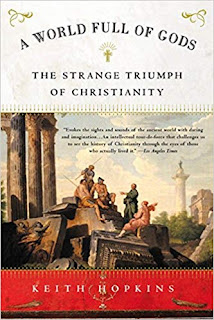
Review: A World Full of Gods: The Strange Triumph of Christianity by Keith Hopkins


A historical resource article by Mary Harrsch

When I was researching the Roman Empire's financial crisis of the late 3rd century and subsequent embrace of Christianity as part of the solution, I found a wealth of information in the late Keith Hopkins book "A World Full of Gods: The Strange Triumph of Christianity."  Before his death in 2004, I had often admired Hopkins insight shared in a number of television documentaries on the Roman Empire. 

Although Hopkins is mostly remembered as a professor of ancient history at Cambridge, he also served a lectureship at the London School of Economics. Since my research was going to cross over from history to economics, I was excited to find his book, originally published in 1999.

But the book, like the man, was quite unconventional. Instead of a purely historic treatise on the rise of Christianity, it began with a fictional tale of time travel to first, ancient Pompeii, and then to ancient Egypt, to give the reader a taste of other competing religions during the formative years of Christianity's development.  Although I was really more interested in facts than fantasy, I enjoy time travel tales so was not dissuaded from continuing to read on.

Then, I came upon a very long third chapter and it was literally stuffed with the background information and sociological interpretation I was truly looking for.  I marked each usable passage with purple sticky tabs and soon that portion of the text was fluttering with purple markers.
Hopkins, a sociologist, drew parallels between the ancient Christian "revolution" and the political upheaval resulting in the establishment of communist China.

"...in Rome as in China, the veneer of virtuous prescription disguised a multitude of sins; the church grew steadily richer, and more corrupt; Christian rigorists pursued mad ends with obsessional fervor; bishops borrowed the oppressive powers of the state to bully, exclude, and even execute doctrinal rivals. "

Hopkins goes on to point out Christians viewed themselves as the fervent elect, chosen by God, and linked together by their difference from and radical rejection of others. 

"...once in alliance with the state, Christian leaders exploited their newfound powers in order to impose single versions of correct belief, through votes by universal councils of bishops.  Almost inevitably, once its influence and power was buttressed by the state, the church also became in part a business, distributing charity, patronage, privilege, and immortality."

How I interpreted this information and dozens of other passages in relation to the financial crisis of the Roman empire and the "conversion" of the Roman Emperor Constantine can be read in my paper, "Did Financial Exigency Drive The Roman Empire to Embrace Christianity?"

Hopkins spends the rest of his text examining Christian literature, comparing different versions of the gospels, and evaluating Christianity's turbulent coexistence with Judaism and paganism.

If you are looking for an account of purely historical events, this book, with the exception of Chapter Three, may disappoint.  But, if you are open to exploring religious roots as a journey, you may find Hopkins unorthodox approach thought-provoking.

If you enjoyed this post, never miss out on future posts by following me by email!


Wednesday, April 13, 2016

Hannibal's Route Over The Alps or just Horse S***?

Hannibal embodying perseverance at the Mausoleum of Engelbert II
of Nassau and Cimburga van Baden in the Grote Kerk or
Onze-Lieve-Vrouwekerk (Church of Our Lady) in Breda, Netherlands.
Image courtesy of Wikimedia Commons user Vassil.
Digitally enhanced by Mary Harrsch.
A history resource article by Mary Harrsch © 2016

Earlier this month the news media was whipped into a frenzy by reports that Bill Mahaney, a geologist and professor emeritus at York University in Toronto, Canada, had "found" Hannibal's route over the Alps.

Unfortunately, many of the mainstream media outlets, eager to garner a bump in pageviews by armchair historians, published the findings and inferred a resolution without attempting to verify if the information provided was, in fact, definitive or could have had an alternative explanation. Some even used the word "pinpoint" even though the findings are based primarily on the inexact process of Carbon 14 dating.


One of the less sensationalized articles appeared in The Guardian, a UK online news magazine:

https://www.theguardian.com/science/2016/apr/03/where-muck-hannibals-elephants-alps-italy-bill-mahaney-york-university-toronto

Dr. Patrick Hunt, director of the Stanford University Alpine Archaeology Project, is another researcher who has been seeking Hannibal's route across the Alps since 1994. He is quoted towards the end of the above article but he, however, is more in favor of a northerly route.

"I have spent over 20 field seasons tracking Hannibal, not only in the Alps but also in Spain, France (Gaul) and of course Italy and elsewhere including Carthage and Western Turkey. Our Stanford teams have crossed at least 30 Alps passes and we’ve always used Polybius as a guide. Polybius gives some helpful clues but never names the pass. He [Polybius] suggests it was the highest pass known at the time, which doesn't necessarily mean the highest pass known today, an obvious logical fallacy," Hunt explains.

"The Clapier-Savine Coche route—an ancient Celtic pathway with a summit around 8,500 feet—best fits Polybius in my opinion and that is shared by many others. This verified route has been used for thousands of years and while there is erosion on the precipitous descent that has taken away most of the ancient pathway, the summit valley floor is fairly stable and has been for millennia. Mammal animal mire there has also built up over a long time because the Clapier-Savine Coche summit valley has been a grazing place since at least Celtic times. I always encourage Alps explorers to weigh multiple passes against each other rather than to merely examine one pass and conclude prematurely or only read about it, which is dangerously inadequate."

Hunt has serious reservations about Mahaney's proposed route, claiming the view described by Polybius of the Po Valley and Torino itself can best be glimpsed from the Clapier-Savine Coche saddle immediately a few hundred feet above the summit campground, especially because Polybius says they camped at the summit and from there Hannibal showed the view.”

"Hannibal made a concerted effort to raise the spirits of the army, leading his men to the dramatic precipice very close by at the edge of the summit camp possibly at the broad Clapier-Savine Coche saddle around 8,500 feet altitude with an immense vista when there are no clouds or fog to obscure the view. From this height, Italy opens up before the eyes of viewers, creating a spectacle of mountains dropping away in undulating waves to the plain of the Po Valley below, especially from the south side of the Savine-Coche Valley, where humans have crossed since the Neolithic Age even with perennial snow traces here." - Patrick Hunt, Hannibal

"The route in question is too often promoted by popularists who've never climbed competing Alpine routes, of which about 10 passes need to be totally eliminated before this study has any real credibility," Hunt observes, "The fact that so many today in the popular media are claiming this now solves Hannibal's route is both sadly superficial and premature. Although they could be hypothetically right, there's no real hard material evidence presented yet. Until they find actual material artifacts, it's moot. Datable remains of elephant dung would be much better, but possibly not enough because Hannibal's brother Hasdrubal followed him a decade later. I know several other Alps passes with at least as much corroborating evidence and one pass far better in terms of fitting Polybius, the best source."

Although famed naturalist Gavin de Beer first proposed the Col de Traversette as Hannibal's crossing point in his 1955 book Hannibal's March: Alps and Elephants, eminent Polybian scholar, F.W. Wallbank rejected de Beer's theories the following year in his 1956 article Some Reflections on Hannibal's Pass published in volume 46 of The Journal of Roman Studies.

Dr. Hunt's Stanford research team thinks the Clapier-Savine Coche is at least as good and actually closer to what Polybius describes as the Col de Traversette.

"The Clapier-Savine Coche has a huge campground right by the summit as Polybius describes," explains Hunt, "If the new mire-dung spot is the campground Mahaney et al. suggest, it is on the west side of the Col de Traversette about 1500 feet below the summit, not at the summit as described by Polybius. The Traversette summit is also a knife blade scarcely capable of holding 100 people, let alone an army. There is no way Hannibal could have addressed his army encouragingly from the Traversette summit."

Hannibal shows his army the valley of the Po from the summit of the Alps by Alfred Rethel, 1842.  Image courtesy of
Wikimedia Commons
"Also, Polybius states Hannibal's forces slipped through fresh snow to ice below from the previous winter on the initial descent, not frozen ground or firnpack as interpreted by the Traversette group," Hunt continues, "Such snow traces fitting Polybius are found each year on the summit of the Clapier-Savine Cloche around 8200-8500 feet but there is still ample grass for animal foraging and cattle graze there currently as well."

Furthermore, Hunt thinks a route leading to the Col de Traversette must be twisted somewhat to make it fit the description given by Polybius.  Polybius says after Hannibal's army marched north of the point where the Rhone and Iskaras Rivers meet for approximately 800 stades (about 91 miles) the army began their ascent of the most rugged part of the Alps and found their way blocked by a fierce mountain tribe known as the Allobroges (according to Livy the most famous and powerful tribe in Gaul).  The border of the Allobroges territory was defined historically by the "Iskaras" (Polybius) or "Arar" (Livy) River, which Hunt thinks corresponds to the modern Isère River.

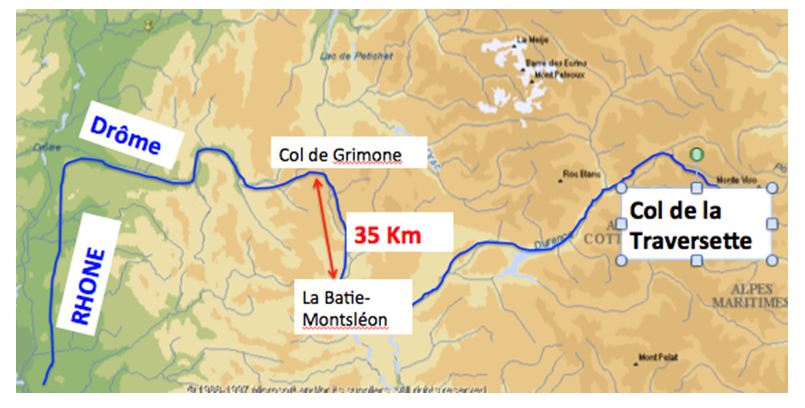
"Given that the Rhone delta and mouth were less extended southward in antiquity due to less alluviation buildup and that Hannibal crossed at least a day's march inland - both because there were more salt marshes (etangs) then around the Rhone mouth and in order to avoid Massilian Roman allies around Marseilles - the Rhone crossing should be around Avignon, an ancient fording place", Hunt observes. "The traditional Allobroges boundary - like that of so many tribes partly demarcated by a river confluence - would then be the Isere-Rhone junction beyond Valence, not the more southerly Drome-Rhone confluence, proposed by Mahaney's Traversette group."

Hannibal traverses the Rhône by Henri Motte, 1878, (Public Domain) 

"Mahaney's team proposes the first ambush occurred in the upper Valdrome (which was not Allobroges territory).  This would require Hannibal to make a double Alps crossing then drop down southeastward into the Durance River watershed," Hunt continues, "They then have Hannibal marching up the Durance but turning away from the perfectly accessible broad northeast Mont-Genevre route (which they claim could be blocked by hostile Celts, but isn't very likely) detouring into the narrow Guil far southward into the Queyras region and over the extremely  difficult Traversette, which takes them southward away from Torino and the Taurini tribe, the point where Hannibal eventually emerged according to Polybius."

This rather fanciful scene thought to depict Hannibal battling the Romans at Cannae adorns the shield of Henry II of France.
Today it can be viewed at the Metropolitan Museum of Art in Gallery 374.
Image courtesy of the Metropolitan Museum of Art.
"Sir Gavin de Beer originally proposed the Grimone pass for the ambush of an Allobrogian tribe," French scholar Dr. Geoffroy De Galbert, author of Hannibal et Cesar dans les Alpes, explains.

"Furthermore, de Beer claimed their oppidum (hill fort) was located at La Batie-Montsléon. Hannibal’s companions claimed that the Allobroges spent the nights in their oppidum and returned in the morning to guard this delicate passage.  But it is 35 km between the Col de Grimone and La Batie-Montsléon.  A 35 km journey twice a day would be practically impossible."


"Livy, in describing the crossing of the river added the word “Durancia”, de Galbert continues, "claiming that it referred to the Durance river. Livy wrote: “This river, which also takes its rise in the Alps, is of all the rivers of Gaul the most difficult to cross. Though carrying down a great volume of water, it does not lend itself to navigation, for it is not kept in by banks, but flows in many separate channels.” (Livy III, XXI, 31)

"The Durance river around Embrun cannot be the most difficult river to cross of all Gaul." de Galbert states, "On the contrary, this description perfectly matches crossing the Isere at Chateauneuf-sur-Isére near Valence. The Isère river was divided into several branches at Chateauneuf-sur-Isère before being contained. The Latin historian Orosius, living in the 5th century CE, also claimed that Livy had confused the Durance with the Isère."


 "Furthermore, de Galbert adds, "Livy wrote : Hannibal, leaving the Druentia, and advancing for the most part through a champaign country, reached the Alps without being molested by the Gauls who inhabited those regions. (Book 21, 32)."

"Between the crossing of the Durance near Embrun and the Alps, there are no plains. On the contrary, after crossing the Isere at Chateauneuf sur Isere, there is a large plain leading to the entrance of the Alps," de Galbert concludes.

"Mahaney's group also claims the Po River only starts near Traversette," Hunt observes, "but that's a geographic fallacy as there is no one source for a major river and the Dora Riparia is a primary Po watershed as well and runs directly eastward into the Po west of Torino. They also say only the insanely narrow Traversette has the view for Hannibal's speech but clearly must have only tried the modern Clapier footpath and not the adjacent Savine Coche broad ridge immediately west where the ancient path ran, which has a great view of Torino and the Po plain."

"If you assess the northern route toward the Clapier-Savine Cloche, you will find a satisfying first ambush place in the Isere near Voreppe, (clearly Allobroges territory)," Hunt points out.

The likelihood that a major confrontation could have taken place there was also suggested by the recent discovery of what appears to be the remains of a large Celtic oppidum (hill fort) near there.

Significant differences in the geophysical features between the two proposed passes is discussed in an article that appeared in this 2010 post in Earth Magazine:

http://www.earthmagazine.org/article/hannibals-trail-clues-are-geology

In this article Hunt also describes a two-tier rockfall at the Clapier-Savine Coche pass a short distance from the summit.

"Polybius actually describes more of a multi-tier precipice," Hunt says, "and the Clapier-Savine Coche descent has multi-tiered rockfalls that geological weathering dates to more than a few thousands years ago."

Hannibal crossing the Alps from The illustrated history of the world for the English people, 1881.

But perhaps one of the best analyses of all candidate passes as of 1959 was prepared by John Hoyte, a British engineer whose team actually took an elephant over the Alps in an effort to settle the question in July 1959.
Hoyte first distilled a list of conditions defined by Polybius in his Histories.

(a) be large enough to camp 30,000 men and about 5,000 horses (on its French side)

(b) command a panoramic view of the Po valley

(c) have a difficult descent

(d) be high enough to have large areas of snow, from two consecutive winters on its flanks

(e) have a place for pasturing the horses immediately after the difficult stretch of the descent

(f) give a distance of three days' march, from here to the plains.

(g) lead straight down to the land of the Turini.

(h) be a day's march from a probable site for the 'bare-rock' ambush (or a day and a night for the baggage and elephants).

(i) be positioned so that the most direct route to it from the Rhône passes by the 'Island' (where the river 'Skaras' meets the Rhône) seven days' march from the sea (three days from the sea to the crossing of the Rhône and four from the crossing to the Island).

He then scored each pass on a scale of 0-5 for each of these parameters with 5 awarded for a complete fit and less for more doubtful cases.


Hoyte's group launched their attempt from Montmelian, France and followed the valley of the Arc River with the goal of crossing the Col de Clapier, since that pass scored the highest in Hoyte's comparison study of Polybian parameters.  However, the pass had become narrowed and dangerous due to rockfall so the group retracted down into the valley and crossed the Petit Mon Cenis, which branches off the Clapier route at ~7150 ft a short distance before the final Clapier ascent, a route proposed by Napoleon.  After 10 days of travel, the expedition successfully reached Susa in Italy.
Details of the expedition and a wonderful series of photographs can be viewed on Hoyte's website (http://johnhoyte.com/alpine-elephant/).

Hoyte also published an account of the expedition in his book, Trunk Road for Hannibal - with an elephant over the Alps, in 1960.  It was republished in 1964 under the title Alpine Elephant - In Hannibal's Tracks.

Geoffroy de Galbert, also points out that later supply trains were unable to use the proposed route across the Traversette.

"During the 14th and 15th centuries, the Maurienne and Gresivaudan valleys of the Alps were swept by the Black Death," de Galbert points out, "These valleys had been the traditional routes used to ship salt from mines in the south of France to Italy's Po valley.  The Traversette pass lay within a region unaffected by the plague but was so narrow a heavily laden mule could not cross there. Mule convoys had to be unloaded at the foot of the pass and reloaded onto the backs of men who then carried the cargo across the pass.  Finally, in 1480, a tunnel 75 meters long and 1.5 meters in height was built under the Traversette pass to provide a navigable route for salt shipments."

"If the mules could not cross the Alps through the Traversette pass in the fifteenth century, they could not do it in Hannibal's time," de Galbert concludes.

"In fact, in pre-Roman antiquity, there was only one wide road from Spain to the Po Valley," de Galbert continues, "This road crossed the Alps by the Maurienne valley.  Hannibal with his huge army could not have used a simple mountain trail.  This is further supported by the fact that no neolithic or Iron Age remains have been found on the roads from Durance to the Traversette pass."

A map showing the locations of Iron Age remains found in the Maurienne region of the French Alps.  Dr. Geoffroy de Galbert points out that no neolithic or Iron Age remains have been found between the Durance and the Traversette pass.  Image courtesy of Geoffroy de Galbert.
But in the latest research, Mahaney tackles the question from a different perspective.  The new findings most recently reported are based primarily on the discovery of a layer of soil disturbance and the findings of "a mass animal deposition event" -  bacterial remains indicating the presence of a large number of equines in the vicinity.  Although the articles currently circulated by the media claim the Carbon 14 dates obtained for the material in the disturbed layer point to 218 BCE.

"The C14 dating of an object from 218 B.C. does not result in a date. It gives two time intervals: one comprised between 231 and 97 B.C. with 66 % probability; the other between 355 and 292 BC with a 30 % probability," explains de Galbert. "These results have been calculated by the Oxford Radiocarbon Unit’s software OXCAL and may be seen on the graph below:


Contamination is always a concern too and testing waste from ruminants can also be problematic as vegetation can have varying amounts of carbon that could impact test results as well.

"The new hypothesis places the boggy dung mass on the eastern side at 2580 meters," Hunt points out, "Given the warmer climate around Traversette, since it's further south, vegetation is more lush there, so Alpine tribes have grazed animals there for thousands of years."

Andrew Wilson of Oxford's Institute of Archaeology, apparently agrees.  In a recent New Yorker article he expressed doubt about Mahaney's claims pointing out that, due to the wide date range encompassed by the Carbon 14 analysis, the disturbed layer probably accumulated over a considerable period of time, perhaps from animals drinking at the mire rather than a single event during the passage of an army.

In fact, Hannibal's expedition through the Alps, although truly legendary in its scope and military context, was not the first mass migration across the mountain range that could have left sizable animal waste deposits.

When Hannibal harangues his troops about their fear of crossing the Alps, Livy says Hannibal himself describes earlier mass migrations.

"What on earth do you think the Alps are except a collection of high mountains? Perhaps you think they are even higher than the Pyrenees? So what?  Nothing on earth can ever reach the sky; no mountain is too high for man to conquer. People actually live in the Alps, for goodness’ sake! They till the ground; animals breed and grow fat there. If a small group of natives can cross them, so can an army.  Look at these delegates from the Boii – they didn’t grow wings and fly here over the top. Even their ancestors were not born here; they came here as immigrant peasants from Italy; they crossed these selfsame Alps in huge migrating hordes, with all their women and children – and lived to tell the tale." - Livy, Book 21, Chapter 30.6 - 30.8 


A reconstructed late La Tène Period (3rd-1st century BCE) Celtic settlement in Havranok,Slovakia.
Image courtesy of Wikimedia Commons

In fact, activities preceding the Gallic War of 225 BCE culminating in the Battle of Telamon had involved large scale movements of Gauls across the Alps.

"After their defeats by Rome in the 280s, the Gauls were quiescent for forty-five years; but eventually a younger generation took their place, 'full of unreflecting passion and without experience of suffering or peril' (Polybius' Histories 2.21.1-2).  They began to disturb the existing equilibrium with Rome, and invited Gauls from across the Alps to participate in a new war...The leaders of the Po Valley peoples held out to the leaders of the Gauls beyond the Alps the promise of the rich loot that awaited them in Italy, along with assurances that Gallic military power could easily overcome the Romans; after all, this had happened before, when Rome itself had been taken and held for seven months by Gallic warriors (Polyb. 2.22.4-5)." - Arthur M. Eckstein, Polybius, the Gallic Crisis, and the Ebro Treaty. 

Hannibal's crossing was also followed by more than twelve years of war-related traffic, again mentioned in Livy:

"He [Hannibal] had believed, indeed, that his brother [Hasdrubal] would come over into Italy that summer; but when he recalled what he had himself endured during five months, in crossing first the Rhone, and then the Alps, in conflicts with men and the nature of the country, he looked forward to a crossing by no means so easy and so soon accomplished. This accounted for his slowness in leaving winter quarters. But for Hasdrubal everything moved more quickly and more easily than had been expected by himself and others. For not only did the Arverni, and then in turn other Gallic and Alpine tribes, receive him, but they even followed him to war.  And not merely was he leading an army through country for the most part made passable by his brother's crossing, although previously trackless, but, thanks to the opening up of the Alps by twelve years of habitual use, they were also crossing through tribes now less savagely disposed.  For previously, being never seen by strange peoples and unaccustomed themselves to see a stranger in their own land, they were unfriendly to the human race in general. And at first, not knowing whither the Carthaginian was bound, they had believed that their own rocks and fastnesses and booty in cattle and men were the objects of attack.  Then reports of the Punic war, with which Italy had been aflame for eleven years, had made it quite plain to them that the Alps were merely a route; that two very powerful cities, separated from each other by a wide expanse of sea and land, were contending for empire and supremacy." - Livy, The History of Rome, Book 27.39


Replica of a Celtic warrior's garb
In the museum Kelten-Keller, Rodheim-Bieber, Germany
Image courtesy of Wikimedia Commons.
De Galbert explains, "At least five armies crossed the Alps between 231 and 97 BC. In 231 B.C., the Insubres and the Boii asked some Gallic tribes of the Alps and the Rhone Valley to come and help them fight the Romans. (Polybius, II, 22). Hannibal’s army crossed the Alps in 218 B.C. Hasdrubal, Hannibal’s brother, crossed the Alps in 207 B.C. with an army larger than Hannibal’s. The consul Fulvius Falcus crossed the Alps in 125 B.C. to help Marseilles when it was attacked by Salyens. Then the consul Marius crossed the Alps around 125 B.C."

These activities all occurred within the time encompassed by the Carbon 14 dating period of the Col de Traversette equine waste remains.

In fact, Hasdrubal's crossing of the Alps in 207 BCE, significantly complicates the search for Hannibal's crossing.  Although Livy makes it sound like Hasdrubal followed in the path of Hannibal, Polybius uses the word "shorter" in his fragmentary reference to Hasdrubal's easier crossing  in Polybius' Histories.  Much of the easier aspect can be attributed to Hasdrubal's much more friendly reception by native tribesmen who have, by then, decided to join the Carthaginian's war efforts.  But to have a reportedly shorter journey suggests a deviation from Hannibal's original route at some point.  Furthermore, Hasdrubal brought war elephants with him as well, so even finding pachyderm waste or remains may not definitely prove a route was Hannibal's and not Hasdrubal's.

"To a viewer in the Val di Susa, three passes (Mont-Genevre, Clapier-Savine Coche, and Mont-Cenis) all converge in the Dora Riparia river watershed en route to Torino. If an ancient observer had known Hannibal came through here via the higher middle route of the Clapier-Savine Coche and if also knowing Hasdrubal came through here via the shorter and lower Mont-Genevre, it would still appear they came through the same Val di Susa before it joins the Po Valley," Hunt observes.

Apparently,The London Times has expressed their skepticism about the latest claims, too, as have noted historian Tom Holland and others.

"We are unlikely to know definitively but the literature of ancient military campaigns has an allure regardless of strict accuracy. Caesar's Gallic War recounts a fantastical tale of how German tribesmen caught elks through a cunning plan reminiscent of Piglet's heffalump trap. Polybius and Livy tell of how Hannibal's elephants crossed the Rhone by walking along the riverbed and using their trunks as snorkels; evidently no one told these historians that elephants can swim. There is a pleasing symmetry that the latest scholarship of the ancient world is literally rather than metaphorically a pile of manure." - Elephantine Enigma: Scientists believe they have identified Hannibal's route over the Alps, Editorial, The Times (London), April 5, 2016

Tom Holland was a little more succinct, "The evidence is s***," he said.

"The amount of evidence needed is substantial indeed across multiple parameters; this new claim just does not have the kind of support required despite sounding so scientific," Hunt observes.

The bottom line as I see it is that, despite our wishful thinking, none of the current findings are truly definitive without the discovery of supporting archaeological remains.

Perhaps we should take the advice of Polybius, who once cautioned his readers about fully embracing statements by another Roman historian, Q. Fabius Pictor, "My own opinion is that one must not treat his authority as being of little weight, but at the same time one should not regard it as final."

A Numidian horseman by Hocine Ziani, an Algerian artist who is a founding member of the Central Army Museum in Algiers.  Other examples of his amazing work can be viewed on Pinterest.
I must admit I was intrigued with the possibility of finding ancient equine DNA from a breed originating in North Africa, though.  Hannibal's elite Numidian cavalry probably would have brought their own mounts with them so that does pose an opportunity for further study. However, finding the whereabouts of ancient equine DNA from North Africa for comparison, possibly locked away in some museum or research institution's dusty basement, may prove as challenging as trying to find a crated Ark of the Covenant in a government warehouse!

References:

Polybius, Histories

Ball, P. (2016, April 3). The truth about Hannibal’s route across the Alps. The Guardian. Retrieved April 8, 2016, from https://www.theguardian.com/science/2016/apr/03/where-muck-hannibals-elephants-alps-italy-bill-mahaney-york-university-toronto

Walbank, F. W.. (1956). Some Reflections on Hannibal's Pass. The Journal of Roman Studies, 46, 37–45. http://doi.org/10.2307/297963

Hoyte, J. (1960). Trunk road for Hannibal; with an elephant over the Alps. London: G. Bles.

Livy, The History of Rome

Eckstein, A. M.. (2012). Polybius, the Gallic Crisis, and the Ebro Treaty. Classical Philology, 107(3), 206–229. http://doi.org/10.1086/665622

Elephantine Enigma: Scientists believe they have identified Hannibal's route over the Alps. (2016, April 05). The Times (London). Retrieved April 12, 2016, from http://www.thetimes.co.uk/

A Kindle preview of related reading:


Other suggested reading:

If you enjoyed this post, never miss out on future posts by following me by email!


Tuesday, February 23, 2016

Review: AD 69: Emperors, Armies & Anarchy by Nic Fields (non-fiction)

A history resource article by  © 2015

"Historians generally like to encourage us to remember Rome as a glorious font of western civilization.  I find it difficult to agree with this proposal.  Rather than be dazzled by its so-called glory, Rome is better seen as 'that immense monument of human arrogance'.  So from here on abandon any notions about the glory that was Rome or the noble legacy it ostensibly left us." - Nic Fields, AD69: Emperors, Army and Anarchy

After reading the above paragraph along with others disparaging academia and claiming much of what is written about Rome has been composed by "dewey-eyed Western romantics" culpable of "Eurocentric cultural imperialism", I wondered why this former Royal Marine turned classicist even bothered to write the book.

I never thought of myself as a "dewey-eyed Western romantic", although I do feel there is much to admire in Roman civilization.  On the other hand I am well aware of the brutal nature of ancient warfare and some of the less savory aspects of life under Roman rule.  So I hope I examine Roman history through a relatively unbiased lens and it is from this viewpoint that I continued to read Fields' account of this tumultuous year.

Fields recounts the events of the Year of the Four Emperors as viewed by Tacitus, one of our most reliable ancient sources, but, unfortunately, couples his research with condescending asides about the Romans as a people.

A representation of Tacitus outside the Austrian Parliament
in Vienna, Austria.  Image courtesy of Wikimedia Commons.

"As a race they were passionately unpretentious, enormously addicted to pattern, with a faculty beyond all other people of ignoring their neighbours, their surroundings, or in the last resort, themselves.  Because the Romans were the worst kind of liberty takers, violence was acceptable, the unwilling cajoled and the openly hostile duly crushed, harshness and hatred for 'the Other' was actively encouraged, moderation and magnanimity was for the weak." - Nic Fields, AD69: Emperors, Army and Anarchy

Fortunately, I was already familiar with most of the main events of this period after reading Douglas Jackson's excellent novel "Sword of Rome."  I even got a glimpse of life in Rome itself during the Year of the Four Emperors in Kate Quinn's "Daughters of Rome".  But I have continued to be puzzled why Vespasian did not make his move to grasp the purple until Vitellius wrested the throne from the blood-stained hands of Otho.  Vespasian supported Galba as Nero's successor and, even though Otho ultimately ordered the assassination of Galba, Vespasian appeared to make no protest about that either.  So what was it about Vitellius that was so repugnant to Vespasian? I hoped Fields might share some light on this.

Fields points out that, according to Tacitus, there were rumors Galba intended to adopt Titus, Vespasian's oldest son.

"Titus Vespasian had been sent from Judaea by his father while Galba still lived, and alleged as a reason for his journey the homage due to the Emperor, and his age, which now qualified him to compete for office. But the vulgar, ever eager to invent, had spread the report that he was sent for to be adopted. The advanced years and childless condition of the Emperor furnished matter for such gossip, and the country never can refrain from naming many persons until one be chosen. The report gained the more credit from the genius of Titus himself, equal as it was to the most exalted fortune, from the mingled beauty and majesty of his countenance, from the prosperous fortunes of Vespasian, from the prophetic responses of oracles, and even from accidental occurrences which, in the general disposition to belief, were accepted as omens." - Tacitus, The Histories, Book II.1
Portrait bust of Titus Flavius Vespasianus at the Capitoline
Museum in Rome, Italy.  Photo by Mary Harrsch © 2005
But Tacitus tells us Titus only made it as far as Corinth where he received the news of Galba's assassination.

"At Corinth, the capital of Achaia, he received positive information of the death of Galba, and found men who spoke confidently of the revolt of Vitellius and of the fact of war. In the anxiety of his mind, he sent a few of his friends, and carefully surveyed his position from both points of view. He considered that if he should proceed to Rome, he should get no thanks for a civility intended for another, while his person would be a hostage in the hands either of Vitellius or of Otho..." - Tacitus, The Histories, Book II.1

Fields points out that that Titus decides to return to his father and stops off in Cyprus to visit the temple of Aphrodite at Paphos.  There Titus consults the oracle and the omens were pronounced as favorable.  Even the high priest, Sostratos, assured Titus of his great destiny in a private interview. So Fields thinks this was the beginning of Flavian aspirations for the throne.

However, if we examine Tacitus a little more closely, we find Tacitus describes Titus' ruminations about the consequences of failing to offer support to whomever would end up on top in Rome while he is still in Corinth and speculates about "father joining the party".  This would lead me to conclude that Vespasian was already considering entering the fray before Titus even left Judea and may not have felt any loyalty to Otho or Vitellius even though the eastern legions had sworn loyalty to Otho by the time Titus got back.

So, why Vespasian and not Caius Lucius Mucianus, legate governor of Syria, or Tiberius Julius Alexander, prefect of Egypt?

Portrait bust of the Roman emperor Vespasian
near the Forum Romanum in Rome, Italy
Photo by Mary Harrsch © 2005
Fields tells us  the childless senator  Mucianus despised Vespasian but was a close friend of Titus, finding the young man easy-going and congenial (much as Galba had).  Furthermore, although Mucianus had leadership gifts, he lacked the will to reach for the throne himself.  Apparently, Alexander didn't either as he quickly switched sides as well and hailed Vespasian emperor.  Whether this was from lack of will or lack of courage, Fields does not speculate (Alexander may have felt his Alexandrian Jewish origins would not be acceptable to the patrician class in Rome), but points out even Vespasian realized he was being offered an opportunity that may look like a compliment but was, in reality, a possible death sentence.  Still Vespasian agreed to undertake the task and the three conspired to starve Rome of grain while Mucianus marched towards Italy with components of many of his Syrian legions via Asia Minor and Thrace.  They even arranged for a mock revolt of the Batavi at the mouth of the Rhine.

As it turns out, though, Rome didn't get an opportunity to starve because, Fields tells us, Marcus, Antonius Primus, a gifted commander and tough fighting legate of the recently formed Legio VII Galbiana, took the initiative with the Danube legions, attacking and routing the Vitellians near Cremona, the original site of the victory of the Vitellians over the Othonians.

A 17th-century rendition of Marcus Antonius Primus at the
Musee des Augstins in Toulouse, France.  Image courtesy of
Wikimedia Commons.

This is the part of the book I found most fascinating as I was unaware of the exploits of Antonius Primus who ended up recapturing Rome for the Flavians yet was not rewarded with any prestigious position by Vespasian or any of the other Flavian emperors.

"In an impressive display of rapid marching, his [Antonius Primus] rush down Italy echoed the approach of his Olympian namesake, Marcus Antonius, by relying on speed and decisiveness to surprise the enemy.  Despite the dark depths of winter fast approaching, he took advantage of the flight of the Vitellians to cross the snows of the Apennines, for it was now the month of December." - Nic Fields, AD69: Emperors, Army and Anarchy

Rather than the Olympian namesake, I thought Antonius Primus' valiant dash sounded more like Julius Caesar!

But, despite the execution of Vitellius and many of his followers and the power vacuum that created, the patrician class would probably not accept someone with the obscure origins of Antonius Primus, a native of Tolosa (modern day Toulouse, France), in any permanent imperial position.

"Like Achilles, he was a man who fitted uneasily, if at all, into a chain of command.  The embodiment of ferocity, a fierce restless warrior, he could not, or would not, march in step.  There are many ways to lead an army.  Being a warrior is one way and not necessarily the best." - Nic Fields, AD69: Emperors, Army and Anarchy

Although Antonius Primus was granted the rank of consul by the Senate, when the high born Mucianus finally arrived, Antonius Primus left Rome forever and retired to his estates in Tolosa.

Fields goes on to critique the battle of second Cremona (Bedriacum) and the ultimate victor of the struggles of AD69, Vespasian, and provides black and white images of sculpture, coins, grave reliefs and the modern day countryside around Cremona.  He also adds eleven appendices covering everything from legionary weapons and food to the cult of Jupiter Dolichenus.  These provide interesting information although only obliquely related to the events recounted in the books' nine chapters.

Fields scholarship is solid.  I just found some of his opinions somewhat abrasive.  But then, maybe I'm just a closet romantic after all!

Check out a preview of the Kindle edition:


More suggested reading:

If you enjoyed this post, never miss out on future posts by following me by email!


Sunday, January 24, 2016

Review: The Last Roman: Vengeance by Jack Ludlow

A history resource article by  © 2015

Before Belisarius became the famous general that recaptured much of the western Roman Empire for the emperor Justinian, he was a youth on the cusp of manhood in Durostorum (now called Silistra in Bulgaria), an outpost of the Eastern Roman Empire on the southern shore of the Danube River.  There, according to the novel, he was trained in the arts of war and honor under the watchful eye of his father, Decimus, a senior centurion commanding the local imperial cohort, and his three older brothers.

Historical note - Although Belisarius was born and raised in this area, little is known of his parentage or family.  Some scholars claim Belisarius was born of peasant stock.  But in his 1829 biography, "The Life of Belisarius", Earl Philip Henry Stanhope disagrees:

"Some modern historians deny Belisarius the advantage of liberal studies, and place his birth amongst the peasants of his province.  Yet from two passages in Procopius, which have not hitherto been observed, it may be concluded that he was of noble blood, and inherited a patrimonial fortune.  He is mentioned as possessing an estate near Constantinople in the year before the African expedition, when, having but very lately been appointed to any high or lucrative station, he could hardly have derived from it the means of purchase.  Nor could he have acquired this property by marriage, since his wife's first husband had died poor.  Besides the Greek word used by Procopius is almost always applied exclusively to that property which descends by hereditary right." - Earl Philip Henry Stanhope, The Life of Belisarius

Stanhope further points out that Procopius quotes a letter between Pharas, a Herulian prince to King Gelimer of the Vandals and Alans saying "should you consider it disgraceful to be a subject of Justinian with Belisarius and myself?  Though we also, like you, are of noble birth, we glory in obeying so magnanimous a sovereign." - Procopius, Vandal. lib.ii.c.6

Late Roman helmet, called the Deurne helmet,
covered in expensive silver-gilt sheathing
and inscribed to a cavalryman of the equites
stablesiani.  Image courtesy of  Rob Koopman,
Wikimedia Commons.  cc by-sa 2.0
Although Belisarius was taught the importance of honor in his noble household, it was no longer an attribute deemed essential by a corrupt senator, Senuthius Vicinus, who controls most of the land around Durostorum and commands the local militia. When Decimus discovers the extent of the senator's crimes and requests a formal imperial investigation, the senator connives with the Huns to put an end to Belisarius' meddlings.  The resulting treachery wipes out all of the Belisarius men except for 15-year-old Flavius who must flee to escape a horrific death on the cross planned by the senator and his henchman, the local Monophysite bishop.

Followers of Monophysitism held that Jesus Christ had only a single nature which was either purely divine or a synthesis of divine and human. Chalcedonian followers, including the Belisarius family and many others in Thrace and Illyricum, believed that Christ had two distinct natures, one divine and one human.  Unfortunately for the Chalcedonians, the reigning emperor Anastasius I (who reigned from 491 - 518 CE), decreed formal support for the Monophysite position after riots of the populace in Constantinople in 512 CE.  Although this may seem like a minor issue of interpretation to us, it caused a major schism in the developing Christianity of the early 6th century and resulted in a rebellion led by Flavius Vitalianus, a native of Moesia of possibly mixed Roman and barbarian descent, who had become a senior commander in Thrace, probably comes foederatorum.

Flavius' father had kept his family's religious position to himself, under the circumstances, like many other senior officials of the empire, including his old comrade-in-arms, Justinus, who now served as the commander of the emperor's bodyguard at the palace in the capital city.  It is Justinus who had been communicating with Decimus about the criminal activities of Senuthius, so Flavius decides he must somehow make his way to Constantinople and convince Justinus to help him avenge his family.

After a hair-raising escape across the Danube and capture by the barbarian Sklaveni tribe, Flavius finally meets up with Vitalian's army marching on Constantinople.  Despite his age, Flavius' military skills bring him to the attention of his superior officers and he soon finds himself a decanus - the leader of a contubernium, a squad of eight legionaries living in the same tent.

A figure thought to be Belisarius from the mosaic in the
Church of  San Vitale in Ravenna, Italy.
Vitalian's army, numbering some 50,000-60,000 men, was composed of both untrained peasants and disaffected imperial troops from the provinces of Thrace, Moesia II and Scythia Minor who were outraged that Anastatius and his very unpopular magister militum per Thracias, Hypatius (Anastasius' nephew) had refused to supply the foederati with "annonae" - rations and provisions.

How 5th-6th century CE emperors got away with not provisioning their troops is a mystery to me but it happened frequently in the collapsing Western Empire and must have not been considered disastrous in the Eastern Empire at this time either.  I recently took an online course through FutureLearn entitled "Hadrian's Wall: Life on the Roman Frontier" and learned that often troops in Britain towards the end of the occupation there were not paid for months at a time.  (Augustus must have been churning in his grave!) Although troops were fed, I wondered what happened to their "unofficial" families that lived outside the fort if no money for support was forthcoming.  Anway, back to our story.

The formidable walls of Constantinople depicted in a 14th century CE mural in the Istanbul Archaeological Museum.
Image courtesy of Wikimedia Commons CC by-sa 3.0.
When the army arrives at Constantinople, the soldiers are dismayed by the city's formidable walls as Vitalian has no siege equipment.  But, Anastasius, fearful of a restive populace within the city, offers to negotiate.  Vitalian demands the restoration of the Chalcedonian orthodoxy and settlement of the Thracian army's grievances.  Anastasius offers to restore Chalcedonian bishops to their parishes and to settle the army's grievances. As proof of his sincerity the emperor provides lavish gifts to Vitalian's officers.

But all is not as it seems and young Belisarius soon becomes entangled in an imperial web of intrigue orchestrated by Justinus' shrewd and calculating nephew, Flavius Petrus Sabbatius, who would become known to history as Justinianus Augustus - Justinian I.

Ludlow has once more done a masterful job of bringing this tumultuous period of Roman history to life.  He crafts an honorable but conflicted hero in Belisarius, a respectable though illiterate commander in Justinus and a suitably conniving and ambitious future emperor in Petrus.  Although Vitalian is mostly in the background, Ludlow carefully structures his story around the real events of Vitalian's rebellion and provides enough background on the religious controversy to make the causes of the rebellion understandable without allowing theology to dominate the storyline, no mean accomplishment during this period of Byzantine politics.

I'm very much looking forward to continuing this trilogy with "The Last Roman: Honour".

A Kindle Preview:


 More suggested readings:
If you enjoyed this post, never miss out on future posts by following me by email!