Showing posts with label Commodus. Show all posts

Wednesday, March 17, 2021

The Wonders of the Horti Lamiani

 The Horti Lamiani (Lamian Gardens) was a luxurious complex of an ancient Roman villa with large gardens and outdoor rooms located on the Esquiline Hill in Rome, in the area around the present Piazza Vittorio Emanuele. They were created by the consul Lucius Aelius Lamia, a friend of Emperor Tiberius, and they soon became imperial property.  Along with other ancient Roman horti on the Quirinal, Viminal and Esquiline hills, they were discovered during the construction work for the expansion of Rome at the end of 1800s.

The villa and gardens were scenically divided into pavillions and terraces adapted to the landscape, on a model of Hellenistic tradition. They were eventually filled with exceptional works of art, from original ancient Greek sculptures to exquisite frescoes and marble floors. A museum of the nymphaeum excavations is planned to open in 2021.

The land for the horti Lamiani was originally a cemetery just outside the ancient Servian Wall but was purchased by Lucius Aelius Lamia, the Roman consul in 3 CE, who developed the property. He seems to have bequeathed the property to the emperor probably during the reign of Tiberius, and it became imperial state property. Emperor Caligula loved the place so much he established his residence there and further developed the property. In an evocative eyewitness account, the philosopher Philo visited the gardens in 40 CE and accompanied Caligula inspecting the elaborate residence ordering them to be made more sumptuous. After his assassination, Caligula was briefly buried at the site.

The Horti Lamiani adjoined the Gardens of Maecenas and the Gardens of Maiani. Under Claudius (41-54 CE) the Horti Lamiani and Maiani were united and administered by a special superintendent (procurator hortorum Lamianorum et Maianorum).

The property survived until at least the Severan dynasty (193-235 CE) when it became the emperor's private property as shown by a stamped lead water pipe. By the 4th c. the gardens were no longer in use as evidenced by the statuary found broken in pieces and used in the foundations of a number of spas.

Emperor Commodus as Hercules recovered from the Horti Lamiani at the Musei Capitolini in Rome courtesy of Wikimedia Commons contributor Ricardo André Frantz

Spectacular closeups of Emperor Commodus as Hercules at the Musei Capitolini in Rome courtesy of Wikimedia Commons contributor José Luiz Bernardes Ribeiro

Spectacular closeups of Emperor Commodus as Hercules at the Musei Capitolini in Rome courtesy of Wikimedia Commons contributor José Luiz Bernardes Ribeiro

Discobolus, 140 CE, recovered from the Horti Lamiani at the Palazzo Massimo Alle Terme in Rome courtesy of Wikimedia Commons contributor Livioandronico2013


My own closeups of Discobolus at the Palazzo Massimo in Rome

My own closeups of Discobolus at the Palazzo Massimo in Rome

My own closeups of Discobolus at the Palazzo Massimo in Rome

Genius of Emperor Domitianus, with the aegis and a cornucopia recovered from the area around the Horti Lamiani, at the Capitoline Museum courtesy of Wikimedia Commons contributor Marie-Lan Nguyen

Triton or sea centaur, part of a group representing Commodus' apotheosis as Hercules recovered from the Horti Lamiani, Luni marble, Roman artwork, 191-192 CE, at the Capitoline Museum courtesy of Wikimedia Commons contributor Marie-Lan Nguyen.

Sculpture of a woman in a chiton recovered from the Horti Lamiani, now in the Capitoline Museum in Rome, courtesy of Wikimedia Commons contributor Burkhard Mücke (white balance adjusted, digitally enhanced and recomposed)

Head of Dionysos recovered from the Horti Lamiani, now in the Capitoline Museum in Rome, courtesy of Wikimedia Commons contributor Marie-Lan Nguyen

Bottom of a statue of a Roman soldier, he wears a military tunic and caligae, the typical footwear worn by Roman soldiers, early Imperial period, from the Horti Lamiani, Musei Capitolini, Rome courtesy of Wikimedia Commons contributor Carole Raddato

Head of Priapus recovered from the Horti Lamiani, now in the Capitoline Museum in Rome, courtesy of Wikimedia Commons contributor Carole Raddato

Faun with grapes from the Horti Lamiani at the Capitoline Museum courtesy of Wikimedia Commons contributor Sailko.

Esquiline Venus, recovered from the Horti Lamiani, at the Capitoline Museum in Rome courtesy of Wikimedia Commons contributor Miguel Hermoso Cuesta.
If you enjoyed this post, never miss out on future posts by following me by email!


Sunday, October 8, 2017

Review: Altar of Blood Empire IX by Anthony Riches

A historical resource article by Mary Harrsch © 2017

In the ninth and final installment (at least for now) of Anthony Riches' Empire series dubbed "Altar of Blood", we find the young centurion Marcus Valerius Aquila accompanying Tribune Rutilius Scaurus and about three dozen hand-picked men from the Tungrian cohorts back to Germania where they have been charged with kidnapping the seer of the fiercesome Bructeri tribe. The sinister imperial chamberlain, Marcus Aurelius Cleander, has not revealed the reason for this clandestine action across the Renus (Rhine) into such dangerous territory but Scaurus and his men are not given any choice in the matter.

The Bructeri are one of the six tribes who attacked Publius Quintilius Varus and massacred the seventeenth, eighteenth and nineteenth legions at the battle of the Teutoburg Forest at the beginning of the first century. Six years after the famous disaster, Lucius Stertinius, a general serving under Germanicus, swept through the Bructeri territory between the Amisia and Luppia rivers, destroying everything in their path and recovering the eagle of Legio XIX.

The Bructeri next appear in history during the Batavi revolt of 69-70 CE. Their tribal seer during that period was named Veleda. It is said she foretold the Batavi success in that uprising and was considered the tribe's spiritual leader.

Germanic Warrior courtesy of military artist Johnny Shumate
Of course, that was all more than a century before our novel's time period but it made the existence of a revered tribal seer quite believable and certainly explained the bad blood between the Romans and the Bructeri.

To make an almost impossible situation worse, Germania Inferior is now governed by Tribune Scaurus' arch nemesis, Clodius Albinus. Albinus is actually a historical figure who served the emperor Commodus in both Gallia Belgica and, later, Britain.  But when a false rumor claimed Commodus was dead (before he actually was), Albinus denounced Commodus before his soldiers in Britain, calling Commodus a tyrant, and maintained that it would be useful to the Roman Empire to restore to the Senate its ancient dignity and power. Although this declaration pleased the Senate it understandably riled Commodus who sent Junius Severus to relieve Albinus of his command. But, the relief order was not received until Commodus and even his successor, Pertinax, were murdered in 193 CE, a year that was to become known as the Year of the Five Emperors.

In our story, though, Albinus is still just a duplicitous schemer who is trying to thwart Tribune Scaurus in his mission or at least claim the captive seer and credit for the mission's success. Tribune Scaurus is going to have to use every bit of cunning he possesses to escape a determined Bructeri war band and prevent his men from being sacrificed on an "Altar of Blood" - that of either the Bructeri's bloodthirsty war god Wodanaz or an unscrupulous Roman's ambition.

One of my favorite characters was captured by the Bructeri in this novel and I spent a good deal of time worrying about his ultimate fate. I certainly didn't want to visualize him spread-eagled on a bloody altar with a wild-eyed shaman hovering over him with a wickedly-sharpened knife! As you can tell, over the course of nine novels I have closely identified with such finely crafted characters and felt a member of their select group.  I will definitely miss them although I suspect Riches is not yet done with them all as the seer claims Rutilius Scaurus will play a key role in the Year of the Five Emperors!

Here's a short preview:


More suggested reading:


If you enjoyed this post, never miss out on future posts by following me by email!


Tuesday, September 12, 2017

Review: Thunder of the Gods - Empire VIII by Anthony Riches

Historical resource article by Mary Harrsch © 2017


When we left Marcus Valerius Aquila and the Tungrian auxiliaries in Book 7, they had returned to Rome to expose the corruption of Praetorian Prefect Sextus Tigidius Perennis. While there, Marcus also ferreted out the names of the Prefect's assassins responsible for the deaths of his family members and taken brutal revenge on all of them except the despicable emperor Commodus, himself.

Although glad to be rid of the "Emperor's Knives", the emperor's chamberlain Cleander considers Marcus to be a valuable but dangerous asset who might attempt to take ultimate revenge on the emperor as well. So, as Book 8 opens, Cleander has decreed that heretofore Tribune Rutilius Scaurus is promoted to Legatus and Marcus  is appointed his equestrian-level tribune. Together with any Tungrians who wished to accompany them, they have been ordered to Syria. There, Legatus Scaurus is ordered to take command of Legio III Gallica, root out the corruption that has flourished under the current governor, and relieve a Parthian siege of the important Roman stronghold of Nisibis (modern Nusaybin, Turkey).

One of my favorite historical novels, "Fire in the East", by Harry Sidebottom, takes place in Roman Syria so I was already familiar with many of the obstacles Marcus and his Legatus would face there including the lethal armored cataphracts and the deadly archers with their perfected "Parthian shot".

The action is driven by the historical events of an uprising of Parthian client kings against both Rome and their own ruler, Vologases IV. Although I could not find a particular reference to a siege of the contested stronghold of Nisibis during this time period, it could have very well occurred during attempts by Osroes II, King of Media, to overthrow his father, the King of Kings, Vologases IV, and prevent the succession of his brother Vologases V. Osroes II, as well as his ally, Narsai of Adiabene were both historical figures that appear in this installment.  The author does an outstanding job of bringing this struggle to life since the ancient sources are rather sketchy on the details of events that transpired during this period.

File:Coin of Vologases IV of Parthia.jpg
Silver coin of Vologases IV

The first major battle that occurs while the troops make their way to Nisibis, is nothing less than thrilling as Legatus Scaurus uses every tactic he has read about to thwart destruction of his forces - specially laminated shields, improved body armor, portable bolt throwers, lengthened thrusting spears and, of course, deadly caltrops. Scaurus has left nothing to chance, drilling his men for weeks before they finally set out on the march. As it turns out, the Tungrians must use every ounce of that training to drive back the Parthians and keep them at bay until they can finally reach the relative safety of the stolid Roman outpost.

But, how will Scaurus and Marcus lift the siege and return this part of the Roman frontier to a respectful stalemate? It will take another valiant defense against almost impossible odds as well as the blessings of Fortuna on a clandestine attempt by Marcus to negotiate a settlement with the King of Kings himself!

Highly recommended!

Check out the preview:


If you enjoyed this post, never miss out on future posts by following me by email!


Saturday, July 29, 2017

Review: The Emperor's Knives, Empire VII by Anthony Riches

A historical resource article by Mary Harrsch © 2017

In Book 7 of Anthony Riches' Empire series of novels, the hero, Marcus Tribulus Corvus, formerly Marcus Valerius Aquila, finally gets the opportunity to return to Rome and take revenge on Praetorian Prefect Tigidius Perennis and his cadre of assassins who slaughtered Marcus' family to confiscate their wealth. But, the four men, referred to as "The Emperor's Knives," present quite a challenge to Marcus and his officer comrades, who have sworn to help him. One is a serving Praetorian officer.  Another is the leader of one of Rome's most vicious street gangs. The third is a powerful senator with a taste for salacious entertainment and the last is none other than Rome's reigning gladiatorial champion.


Closeup of the left side of Myrmillo-style bronze gladiator
helmet with bas-relief depicting scenes from the Trojan War
 found in Herculaneum 1st Century CE. Photographed by
Mary Harrsch © 2015
A senator whose son served with Marcus in Dacia has hired an informant to assist Marcus and his friends. But, the duplicitous informant, a ruthless former imperial grain officer Marcus encountered in Britannia,  has several employers with different agendas.  Although he seems to be providing accurate information, Marcus is certain he will ultimately lead them to a disastrous outcome. So Marcus recruits some of the Tungrians to become street-savvy spies themselves to ensure Marcus, Tribune Scaurus and Marcus' assorted barbarian companions  won't end up at the wrong end of Emperor Commodus' sword before their mission is completed.

The emperor Commodus, dressed as Hercules, admired
gladiators and even competed in "arranged" matches himself.
Photographed by Mary Harrsch at the Capitoline Museum in
Rome, Italy. © 2005
In the other six novels, we have seen Marcus use his formidable swordsmanship to get out of almost impossible situations. Now we have a chance to see Marcus pit his skills against some of the best gladiators in the Flavian amphitheater in his final act of revenge.

Riches' vibrant descriptions of combat that even include details of which foot is used to pivot or launch an attack result in the reader feeling totally involved in the action. His descriptions of ancient Rome's back alleys and less than savory street life are also quite evocative.  As is the case in his other books, Riches maintains suspense with a well organized and fast-paced narrative while reserving a few surprises for the revealing conclusion.

I was surprised, though, that one loose thread was not addressed. Marcus had learned in a previous novel that his younger brother had been sold into slavery. However, he apparently makes no effort to locate his brother or ascertain if he still lives. Maybe this issue will be addressed in a future book.

Once again I highly recommend this entire series!

A Kindle preview:


Other suggested reading:


If you enjoyed this post, never miss out on future posts by following me by email!


Wednesday, March 29, 2017

Review: Fortress of Spears by Anthony Riches

A historical resource article by Mary Harrsch © 2017

As Anthony Riches' third novel in his "Empire" series begins, we find our protagonist Marcus, now known as Marcus Tribulus Corvus, preparing to attack the fortified encampment of the (fictional) rebel Selgovae chieftain, Calgus, and his warriors and allies, the fiercesome Venicones.  The Romans succeed in devastating the Selgovae at the encampment but with terrible losses including one of Marcus' own brother centurions. To make matters worse, Calgus is spirited away by the Venicones, although now he is their captive, no longer their war leader.  However, before his loss of power, Calgus dispatched a contingent of Selgovae to take over the Votadini capital, the daunting "Fortress of Spears" of this installment's title, and the Romans must now plan an even more dangerous assault to finally rid themselves of the last of the rebellious Selgovae and return the Votadini to their previous status as Roman allies.

Fortunately, the Votadini Prince, Martos, captured by the Romans in book 2, now shares their cause and harbors nothing but hatred for Calgus and the Selgovae who so ruthlessly betrayed him. Martos will prove invaluable in the ultimate attack on the "Fortress of Spears". But capturing the fortress is not the only obstacle to Roman victory. The Venicones king discovers the Romans have his treasured torc, found when the original encampment was seized, and vows to take it back or die gloriously in the attempt.
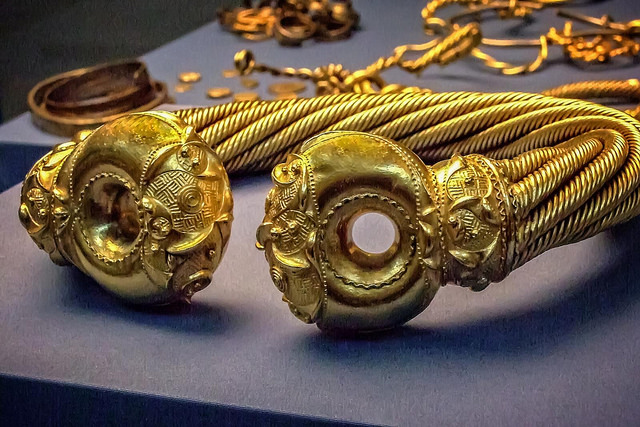

Celt Neck-Ring known as the Snettisham Great Torc Iron Age 150 BCE - 50 BCE Electrum photographed at the
British Museum by Mary Harrsch © 2008

Meanwhile, unbeknownst to Marcus, the corrupt Praetorian Prefect in Rome, Sextus Tigidius Perennis, has dispatched a Praetorian assassin and a "corn" officer to hunt down Marcus, the last surviving son of a proscribed senatorial family.  Perennis' son, the villain of book 1, betrayed Marcus' biological father's Sixth Legion to engineer a promotion and accolades from the vile emperor Commodus. The younger Perennis' treachery was, as is often the case with wealthy, powerful men, covered up by the military.  So, the elder Perennis mistakenly believes Marcus killed his son and is being protected by an auxiliary unit of Tungrians serving on Hadrian's Wall.

In the novel, the Praetorian assassin holds a rank equivalent to a centurion but I was confused about the presence of a "corn" officer. However, if you read up on the importance of those charged with supervision of the Roman grain supply, it becomes quickly apparent that such officers carried quite a bit of clout.

"In classical antiquity, the grain supply to the city of Rome could not be met entirely from the surrounding countryside, which was taken up by the villas and parks of the aristocracy and which produced mainly fruit, vegetables, and other perishable goods. The city, therefore, became increasingly reliant on grain supplies from other parts of Italy, notably Campania, and from elsewhere in the empire, particularly the provinces of Sicily, North Africa, and Egypt. These regions were capable of shipping adequate grain for the population of the capital amounting to 60 million modii (540 million litres / 540,000 cubic metres or 135 million gallons / 16.8 million bushels) annually, according to some sources. These provinces and the shipping lanes that connected them with Ostia and other important ports thus gained great strategic importance. Whoever controlled the grain supply had an important measure of control over the city of Rome." - Wikipedia, Cura Annonae

Neronian coin with the reverse depicting the goddesses Annona, the personification of the grain supply, and Ceres, whose temple was the site of the dole
Throughout most of the Republican era, the care of the grain supply (cura annonae) was part of the aedile's duties. The Annona was personified as a goddess, and the grain dole was distributed from the Temple of Ceres. As early as 440 BC, however, according to Livy, the Roman Senate appointed a special officer called the praefectus annonae with greatly extended powers. His staff apparently carried a paramilitary rank and could have theoretically been suborned for "special" duties.

Perennis' assassins harbor no qualms about slaughtering anyone who gets in their way and they leave a bloody trail in their pursuit of Marcus.

Once again, Riches develops intriguing characters and empathetically portrays the comradery that develops between men struggling to survive north of Hadrian's Wall.  The action scenes are superb and draw the reader right into the beating heart of Roman military life.  Riches artfully transitions between scenes in the multithreaded plot and successfully maintains a high level of suspense until the novel's climactic conclusion. I highly recommend this series and have already plunged ahead into subsequent installments.

A Kindle preview:


If you enjoyed this post, never miss out on future posts by following me by email!