Showing posts with label Dionysus. Show all posts

Monday, June 14, 2021

Spurned Women: The violent death of Orpheus

Orpheus is best known as a musician that could play so beautifully he charmed even the most violent animals.  As such he is portrayed in numerous mosaics, paintings, and on ceramics.  So I was surprised to see a red-figure calyx krater attributed to the Villa Giulia Painter and dated to 460-450 BCE depicting Orpheus being violently attacked by Thracian women, one with a spear and one with an axe. I realize taste in music is quite personal but this extreme response is so antithetical to all of those peaceful images I have seen of Orpheus surrounded by mesmerized animals that I had to research this event further.

According to a Late Antique summary of Aeschylus' lost play Bassarids, Orpheus, towards the end of his life, disdained the worship of all gods except the sun, whom he called Apollo. One early morning he went to the oracle of Dionysus at Mount Pangaion to salute his god at dawn, but, like Pentheus, was ripped to shreds by Thracian maenads for not honoring his previous patron (Dionysus). It has been speculated that the Orphic mystery cult regarded Orpheus as a parallel figure to or even an incarnation of Dionysus so his abandonment of Dionysus would have been viewed as the ultimate sacrilege. Pausanias writes that the river Helicon sank underground when the women that killed Orpheus tried to wash off their blood-stained hands in its waters. 

Other legends claim that Orpheus became a follower of Dionysus and spread his cult across the land and abstained from the love of women. In this version of the legend, it is said that Orpheus was torn to shreds by the women of Thrace for his inattention.

Ovid's account of the death of Orpheus in Metamorphoses Book X is quite similar:

"[Orpheus] had abstained from the love of women, either because things ended badly for him, or because he had sworn to do so. Yet, many felt a desire to be joined with the poet, and many grieved at rejection. Indeed, he was the first of the Thracian people to transfer his affection to young boys and enjoy their brief springtime, and early flowering this side of manhood."

Feeling spurned by Orpheus for taking only male lovers (eromenoi), the Ciconian women, followers of Dionysus, first threw sticks and stones at him as he played, but his music was so beautiful even the rocks and branches refused to hit him. Enraged, the women tore him to pieces during the frenzy of their Bacchic orgies.

His head and lyre, still singing mournful songs, floated down the River Hebrus into the sea, after which the winds and waves carried them to the island of Lesbos, at the city of Methymna. There, the inhabitants buried his head and a shrine was built in his honor near Antissa where his oracle prophesied, until it was silenced by Apollo. Orpheus' soul is said to have returned to the underworld, to the fields of the Blessed, where he was reunited at last with his beloved Eurydice.

As with many myths, scholars believe Orpheus may have actually existed. Only Aristotle, alone, thought he did not.  Most believed he lived several generations before Homer.  He is thought to have been a poet, augur, and astrologer who also earned a living as a musician and some say, a wizard.  Aristophanes, in his play "Frogs" refers to Orpheus as one of the oldest poets and characterizes him as a religious teacher.

When I read the part about Orpheus' eventual rejection of all gods except the sun which he called Apollo, I couldn't help but think about that old Star Trek episode "Bread and Circuses" where the Enterprise crew intercepts radio transmissions from a planet they are orbiting that refer to worship of the "sun".  As the episode progresses, the crew realizes some of the planet inhabitants are not worshipping the sun up in the sky but the Son. Perhaps this was the case with Orpheus - why else would he give the entity the name of an anthropomorphic deity? 

Attic Red-figure calyx krater attributed to the Villa Giulia Painter and dated to 460-450 BCE depicting Orpheus being violently attacked by Thracian women now in the collections of the Getty Villa, image courtesy of the museum.

Detail of Attic Red-figure calyx krater attributed to the Villa Giulia Painter and dated to 460-450 BCE depicting Orpheus being violently attacked by Thracian women now in the collections of the Getty Villa, image courtesy of Wikimedia Commons contributors Dave and Margie Hill/Kleerup.

Attic Red-figure calyx krater attributed to the Villa Giulia Painter and dated to 460-450 BCE depicting Orpheus being violently attacked by Thracian women now in the collections of the Getty Villa, image courtesy of Wikimedia Commons contributors Dave and Margie Hill/Kleerup.

The Death of Orpheus, detail from a silver kantharos, 420-410 BCE, part of the Vassil Bojkov collection, Sofia, Bulgaria, courtesy of Wikimedia Commons contributor Gorgonchica.

Attic red figure stamnos with lid depicting Thracian women killing Orpheus by the Dokimasia Painter, 480-470 BCE, at the Antikenmuseum Basel und Sammlung Ludwig in Basel, Switzerlandm courtesy of Wikimedia Commons contributor ArchaiOptix.

Hydria fragment with the death of Orpheus, c. 460 BCE at the Martin von Wagner Museum in Würzburg, Germany courtesy of Wikimedia Commons contributor Daderot.

Thracian Girl Carrying the Head of Orpheus on His Lyre (1865) by Gustave Moreau, now in the Musée d'Orsay, Paris, France, courtesy of Wikimedia Commons.

Nymphs Finding the Head of Orpheus (1900) by John William Waterhouse (PD), now in a private collection, courtesy of Wikimedia Commons.


If you enjoyed this post, never miss out on future posts by following me by email!


Saturday, June 5, 2021

Mystery religions as a response to concepts of a bleak afterlife

Yesterday I posted about incense and the types of incense required for each Olympian god or hero as specified in the Orphic hymns.  

"Faced with the thought of a bleak existence in the Underworld, some individuals in the ancient Mediterranean sought to improve their lot while they were alive. Virtuous behavior might not be sufficient, and one way to obtain a happier afterlife was thought to be through initiation into mystery cults associated with Orpheus and Dionysos. Self-styled preachers offered followers transformative experiences that mainstream practice could not provide. Their rites were shrouded in secrecy and remain little understood today" - J. Paul Getty Museum

Initiates were sometimes buried with thin sheets of gold, termed Orphic tablets by modern scholars, inscribed with guidance for their journey into the Underworld much like the Book of the Dead for ancient Egyptians, although much shorter. The text might reference landmarks along the journey, such as a spring, a cypress tree, or the Lake of Memory.

Average Greeks did not view the afterlife as an eternal paradise, except for a select few, heroes related to the Olympian gods, but rather a bleak existence characterized primarily by the absence of life's pleasures.  The idea of moral judgment and an expectation of the good rewarded and evil punished did not arise until the early 5th century BCE.  

"Drawing on abstract speculation as much as popular belief, Plato (about 428–347 BCE) described separate destinations for the good and the bad, as well as cycles of penance and reincarnation. But for determining what the majority of ancient Greeks thought about the afterlife, his most revealing assertion may be that individuals dismiss the stories told about what goes on in Hades—until they face death themselves." - J. Paul Getty Museum

The comic playwright Aristophanes provided more color, describing wrongdoers lying in mud and dung, while initiates dance in myrtle groves (Frogs, 405 BCE).

The mystery cults, however, offered practices designed to achieve a more favorable sojourn after death. 

"In contrast to public festivals and sacrifices, which were typically organized at a communal or civic level, the rituals of mystery cults were performed privately for individuals or small groups. Self-styled priests offered followers transformative experiences that mainstream practice could not provide and that marked the initiate as special." 

"Armed with this privileged information as to where to go in the Underworld and what to say, the deceased could feel secure in the face of death. Although the tablets like this have been found across a wide area—in Sicily and southern Italy, northern Greece, the Peloponnese, and Crete—they are exceedingly rare. Their owners were a select few, who subscribed to beliefs that would have appeared esoteric and eclectic to their contemporaries." - J. Paul Getty Museum

I find it interesting that, although the Romans adopted much of Greek mythology and philosophy, their view of the afterlife was significantly different. They believed in the immortality of the soul but believed that when one died, one was met by Mercury, the messenger god and son of Jupiter and taken to the river Styx, that flowed nine times around the underworld. There they paid the ferryman, Charon, a fee to cross the river where they were met and judged by Minos, Aenaeus, and Rhadymanthas.

"However, the ancient Romans did not believe in eternal damnation. Therefore, after one was judged he was sent either to the Fields of Elysium, if one was a warrior or other type of hero, or to the Plain of Asphodel, if one was an ordinary citizen. However, if one was judged to have committed a crime against society, one would have been sent to Tartarus to be tortured by the Furies until such time as one's debt to society was deemed to have been paid in full. At that time, one was released. " - All About History: https://www.allabouthistory.org/ancient-romans-faq.htm

This example of an Orphic tablet, now in the collections of the Getty Villa, takes the form of a dialogue between the dead initiate and a spring in the Underworld:
(Initiate): I am parched with thirst and perishing!
(Spring): Then come drink of me, the Ever-Flowing Spring. On the right there is a bright cypress. Who are you? Where are you from?
(Initiate): I am the son of Earth and Starry Heaven. But my race is heavenly.
(Translation by Roy Kotansky (2017)). Image courtesy of the J. Paul Getty Museum.

Mixing Vessel with Odysseus Summoning the Shades from the Underworld (detail), South Italian, made in Lucania, 390–380 BC; found in Pisticci, Italy, terracotta. Red-figure calyx krater attributed to the Dolon Painter. Bibliothèque nationale de France, Paris, 422. Image courtesy of the J. Paul Getty Museum.

Closeup of Mixing Vessel with Odysseus Summoning the Shades from the Underworld (detail), South Italian, made in Lucania, 390–380 BC; found in Pisticci, Italy, terracotta. Red-figure calyx krater attributed to the Dolon Painter. Bibliothèque nationale de France, Paris, 422. Image courtesy of the J. Paul Getty Museum.

Storage Jar with Athena, Herakles, and Kerberos (detail), Greek, made in Athens, 530–510 BC; found in Vulci, Italy, terracotta. Bilingual amphora attributed to the Andokides Painter. Musée du Louvre, Départment des Antiquités grecques, étrusques et romaines, Paris, F204. Image © RMN-Grand Palais / Art Resource, NY. Photo: Hervé Lewandowski. Image courtesy of the J. Paul Getty Museum.

Fragment of a Funerary Relief with Underworld Figures, Greek, made in South Italy (Taras), 325–300 BC, limestone. State Collections of Antiquities and Glyptothek Munich, GL 494. Photograph by Renate Kühling. Image courtesy of the J. Paul Getty Museum.

Seated Musician thought to represent Orpheus, Greek, made in South Italy (Taras), 330–300 BCE, terracotta with traces of pigment, that I photographed at the Getty Villa in Pacific Palisades, California.


If you enjoyed this post, never miss out on future posts by following me by email!


Saturday, May 15, 2021

The Late Antique Roman Villa of Noheda

In 1897, Spanish geographer Francisco Coello reported the existence of Roman ruins, with tesserae, in the district of Noheda. But the 291 square meter  figural mosaics in the triclinium of the Late Period Roman Villa were not formally  documented until  1984 when a local peasant plowing a field belonging to José Luis Lledó Sandoval stumbled over the stones. Even then, archaeological excavations did not begin until the end of 2005.  The villa, which lies about 17 km north of Cuenca near the ruins of the ancient cities of Segóbriga , Ercávica and Valeria, was finally opened to the public in 2019. The interpretation center has been established in Villar de Domingo Garcia.

The obviously wealthy owner may have profited from the mining of lapis specularis, a variety of translucent gypsum much appreciated at the time for the manufacture of window glass.  Pliny the Elder mentions this material was mined in "100,000 places around Segóbriga" and Pliny assures us that "the most translucent of this stone is obtained near the city of Segóbriga and extracted from deep wells".

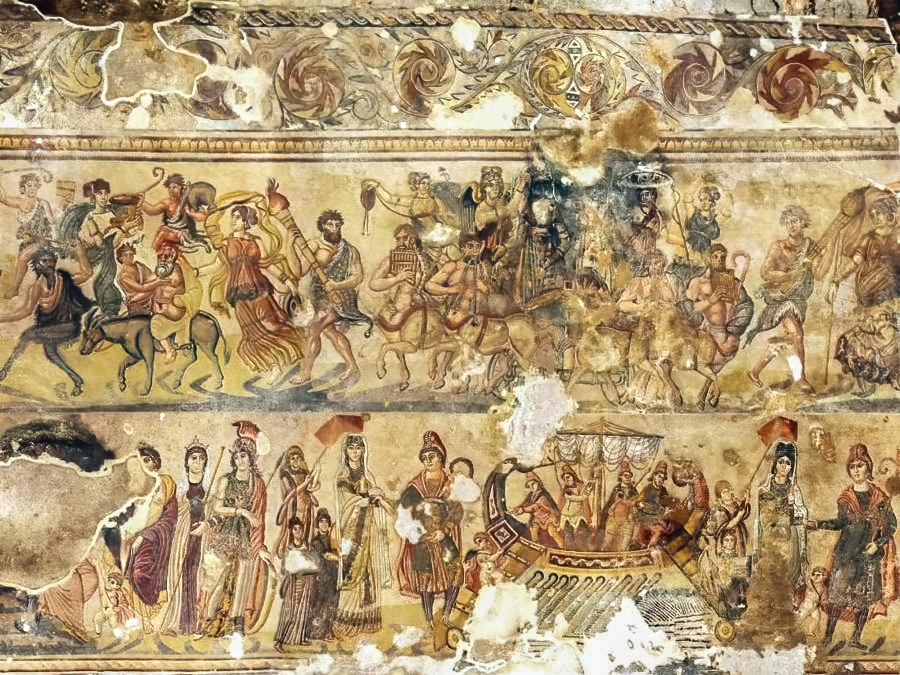
The mosaic of the  triclinium  consists of six panels with mythological and allegorical scenes: the myth of Oenomaus, Pelops and Hypodamia, two pantomimes, the judgment of Paris and the abduction of Helena, the Dionysian courtship and a marine Thiasos (procession of Dionysus). It is presently considered the largest surviving mosaic from the Roman Empire. On average 1243 tesserae were used in each 25X25 square centimeters  of the work. 

Later excavations revealed the site included a complex of private thermal baths as well. Researchers have identified more than 30 types of marble used in its construction.

Images: I have tried to select the best images I could find although the site needs to be photographed by someone like Carole Raddato or Marie-Lan Nguyen. (I'm afraid my overseas travel days are pretty much at an end).  My university has also not registered their Shibboleth license with Cambridge Core so I couldn't access the main article that originally appeared in the Journal of Roman Archaeology in 2013. As indicated, here in the US, images of ancient 2-dimensional artwork are considered "slavish copies" so therefore in the public domain.

Mosaic depicting the myth of Oenomaus and the chariot race with Pelops in the triclinium of the Roman Villa at Noheda (PD in US)

Mosaic depicting the myth of Oenomaus and the chariot race with Pelops in the triclinium of the Roman Villa at Noheda (PD in US)

Severed heads depicted in the mosaic of the Roman Villa at Noheda (Spain) (PD in US)

Boxers in the triclinium mosaic of the Roman Villa at Noheda (Spain) (PD in US)

Three panels of the triclinium mosaic in the Roman villa at Noheda (Spain) - bottom panel: the life of Paris and abduction of Helen, the middle panel: Dionysian procession (PD in US)

Detail of Dionysian courtship panel of the mosaic in the triclinium of the Roman vill at Noheda (Spain) (PD in US)

Mosaic depicting the myth of Oenomaus and the chariot race with Pelops in the triclinium of the Roman Villa at Noheda (PD in US)

Detail of a pantomime scene in the mosaic of the Roman Villa at Noheda (Spain) (PD in US)

Closeup of panel depicting the life of Paris in the mosaic of the Roman Villa at Noheda (Spain)

Mosaic depicting the myth of Oenomaus and the chariot race with Pelops in the triclinium of the Roman Villa at Noheda (PD in US)

Panel depicting the life of Paris and abduction of Helen in the mosaic of the triclinium of the Roman Villa at Noheda (PD in US)

Marine Thiasos in the triclinium of the Roman Villa in Noheda (PD in US)

Detail of a pantomime scene in the mosaic of the Roman Villa at Noheda (Spain) (PD in US)


If you enjoyed this post, never miss out on future posts by following me by email!


Wednesday, March 17, 2021

The Wonders of the Horti Lamiani

 The Horti Lamiani (Lamian Gardens) was a luxurious complex of an ancient Roman villa with large gardens and outdoor rooms located on the Esquiline Hill in Rome, in the area around the present Piazza Vittorio Emanuele. They were created by the consul Lucius Aelius Lamia, a friend of Emperor Tiberius, and they soon became imperial property.  Along with other ancient Roman horti on the Quirinal, Viminal and Esquiline hills, they were discovered during the construction work for the expansion of Rome at the end of 1800s.

The villa and gardens were scenically divided into pavillions and terraces adapted to the landscape, on a model of Hellenistic tradition. They were eventually filled with exceptional works of art, from original ancient Greek sculptures to exquisite frescoes and marble floors. A museum of the nymphaeum excavations is planned to open in 2021.

The land for the horti Lamiani was originally a cemetery just outside the ancient Servian Wall but was purchased by Lucius Aelius Lamia, the Roman consul in 3 CE, who developed the property. He seems to have bequeathed the property to the emperor probably during the reign of Tiberius, and it became imperial state property. Emperor Caligula loved the place so much he established his residence there and further developed the property. In an evocative eyewitness account, the philosopher Philo visited the gardens in 40 CE and accompanied Caligula inspecting the elaborate residence ordering them to be made more sumptuous. After his assassination, Caligula was briefly buried at the site.

The Horti Lamiani adjoined the Gardens of Maecenas and the Gardens of Maiani. Under Claudius (41-54 CE) the Horti Lamiani and Maiani were united and administered by a special superintendent (procurator hortorum Lamianorum et Maianorum).

The property survived until at least the Severan dynasty (193-235 CE) when it became the emperor's private property as shown by a stamped lead water pipe. By the 4th c. the gardens were no longer in use as evidenced by the statuary found broken in pieces and used in the foundations of a number of spas.

Emperor Commodus as Hercules recovered from the Horti Lamiani at the Musei Capitolini in Rome courtesy of Wikimedia Commons contributor Ricardo André Frantz

Spectacular closeups of Emperor Commodus as Hercules at the Musei Capitolini in Rome courtesy of Wikimedia Commons contributor José Luiz Bernardes Ribeiro

Spectacular closeups of Emperor Commodus as Hercules at the Musei Capitolini in Rome courtesy of Wikimedia Commons contributor José Luiz Bernardes Ribeiro

Discobolus, 140 CE, recovered from the Horti Lamiani at the Palazzo Massimo Alle Terme in Rome courtesy of Wikimedia Commons contributor Livioandronico2013


My own closeups of Discobolus at the Palazzo Massimo in Rome

My own closeups of Discobolus at the Palazzo Massimo in Rome

My own closeups of Discobolus at the Palazzo Massimo in Rome

Genius of Emperor Domitianus, with the aegis and a cornucopia recovered from the area around the Horti Lamiani, at the Capitoline Museum courtesy of Wikimedia Commons contributor Marie-Lan Nguyen

Triton or sea centaur, part of a group representing Commodus' apotheosis as Hercules recovered from the Horti Lamiani, Luni marble, Roman artwork, 191-192 CE, at the Capitoline Museum courtesy of Wikimedia Commons contributor Marie-Lan Nguyen.

Sculpture of a woman in a chiton recovered from the Horti Lamiani, now in the Capitoline Museum in Rome, courtesy of Wikimedia Commons contributor Burkhard Mücke (white balance adjusted, digitally enhanced and recomposed)

Head of Dionysos recovered from the Horti Lamiani, now in the Capitoline Museum in Rome, courtesy of Wikimedia Commons contributor Marie-Lan Nguyen

Bottom of a statue of a Roman soldier, he wears a military tunic and caligae, the typical footwear worn by Roman soldiers, early Imperial period, from the Horti Lamiani, Musei Capitolini, Rome courtesy of Wikimedia Commons contributor Carole Raddato

Head of Priapus recovered from the Horti Lamiani, now in the Capitoline Museum in Rome, courtesy of Wikimedia Commons contributor Carole Raddato

Faun with grapes from the Horti Lamiani at the Capitoline Museum courtesy of Wikimedia Commons contributor Sailko.

Esquiline Venus, recovered from the Horti Lamiani, at the Capitoline Museum in Rome courtesy of Wikimedia Commons contributor Miguel Hermoso Cuesta.
If you enjoyed this post, never miss out on future posts by following me by email!


Sunday, February 14, 2021

A Christianized Roman mosaic of the 3rd - 4th century CE

The central panel of this extraordinary mosaic depicts a scene from Classical mythology, the moment when Dionysos, the Greek god of wine, first sees his future wife, the Cretan princess Ariadne. It seems to have been a popular subject for floor mosaics in Syria during the third and fourth centuries C.E. One of the most compelling aspects of this mosaic is its apparent transformation from a purely pagan image to one with Christian overtones. At some point in the mosaic's later history, a bloody wound that recalls the right ribcage injury sustained by Christ at the hands of the Roman soldiers who crucified him was added to Dionysos's left side. Apparently at the same time the red wound was added to Dionysos's side, a flat, vessel-like object was placed in his right hand. The identification of the object is uncertain, but it may represent either a shallow bowl for wine, previously the province of Dionysos but which in Christian iconography represented the blood of Christ, or a dish on which was served the bread that symbolized his body, both of which were consumed by Christ's followers in communion with their god. - Miho Museum, Kyoto, Japan


Image: Roman Mosaic Depicting Dionysos' Discovery of Ariadne on Naxos, 3rd-4th century  C.E., courtesy of the Miho Museum in Kyoto, Japan.


If you enjoyed this post, never miss out on future posts by following me by email!


Thursday, January 28, 2021

Anthesteria: a precursor to Roman Saturnalia?

The three-day festival of the Anthesteria was celebrated around the time of the full moon in January or February.  It celebrated the beginning of spring, particularly the maturing of the wine stored at the previous vintage, whose pithoi were now ceremoniously opened. During the feast, small gifts were exchanged and social order was interrupted or inverted, much like Roman Saturnalia, with the household slaves allowed to participate. The Anthesteria also had aspects of a festival of the dead.  Both the Keres, female spirits who bewailed violent death on the battlefield, or the Carians were ritually entertained and thought to roam the city until they were expelled at the conclusion of the festival.  A Greek proverb, said of those who pestered for continued favors,  "Out of doors, Keres! It is no longer Anthesteria!"

On day one of the festival, known as Pithoigia, the jars of wine from the previous year were opened, libations offered to Dionysus, and the entire household (including the slaves) joining in the festivities. Spring flowers were used to decorate the rooms of the house, the home's drinking vessels, and any children over three years of age.

On day two of the festival, known as Choes, merrymaking continued: people dressed themselves gaily, some in the figures of Dionysus's entourage, and paid a round of visits to their acquaintances. Drinking clubs held contests to see who could drain their cups the most rapidly. Others poured libations on the tombs of deceased relatives. The day also marked a state occasion: a peculiarly solemn and secret ceremony in the sanctuary of Dionysus 'in the marshes' which was closed throughout the rest of the year. Despite the name, there were no actual marshes in the immediate surroundings of Athens and the sanctuary was located in the Bouleuterion in the Athenian Agora. Athens' ritual queen, the basilinna, underwent a ceremony of marriage to the god. Precisely what this entailed, and how physical was the public union, remain matters of discussion, but it may have involved intercourse. She was assisted by the gerarai, 14 Athenian matrons chosen by her husband the archon basileus, who were sworn to secrecy. Burkert regarded the ceremony as a recreation of the yielding of Ariadne to Dionysus by Theseus during their escape from Minoan Crete.

On day three, the Chytroi, considered a festival of the dead, fruit or cooked pulse was offered to Hermes in his capacity as Hermes Chthonios, an underworld figure, and to the souls of the dead, who were then bidden to depart. None of the Olympians were included and no one tasted the pottage, which was food of the dead. Celebration continued and games were held. Although no performances were allowed at the theater, a sort of rehearsal took place, at which the players for the ensuing dramatic festival were selected.

Terracotta oinochoe: chous (jug), Greek, attributed to the Meidias Painter, 420-410 BCE.  The scene depicts two women in festive dress perfuming garments. A stool suspended by chords is piled with folded clothing. On the ground below, there is a pile of wood shavings and twigs from which smoke rises. One woman carefully empties an oinochoe onto the fire. The other woman surveys the "swing" and stands beside a stately chair with a footstool over which more clothes are slung. At the far left is a wreathed boy wearing a himation (cloak). The shape of the vase associates it with the Anthesteria.  Courtesy of the Metropolitan Museum of Art in New York.

This small "chous," a vessel for wine, would have been given as a gift to a young boy during the Athenian festival known as the Anthesteria, celebrating the new wine. Such vessels depict children at play, often imitating adults. Here, a chubby Eros runs, pulling a child's toy cart behind him. He wears a wreath, a spiked headdress, and a string of amulets across his chest.  Courtesy of the Walters Art Museum in Baltimore, Maryland.

A red-figured chous depicting Dionysus and a satyr recalling drunken festivities of the first two days of the Anthesteria, 430-420 BCE, courtesy of the Ancient History Encyclopedia.

Oinochoe with Anthesteria scene, Athens, 460-450 BCE in the Martin von Wagner Museum - Würzburg, Germany. Courtesy of Wikimedia Commons contributor Daderot.


If you enjoyed this post, never miss out on future posts by following me by email!


Thursday, December 10, 2020

Roman stucco

 Traditional stucco was made of lime, sand, and water. Animal or plant fibers were often added for additional strength. Stucco was easily molded or modeled into relief decoration for walls, ceilings, and floors and was traditionally used as both an interior and exterior finish applied in one or two thin layers directly over a solid masonry, brick, or stone surface. The finish coat often contained an integral color and was typically textured for appearance.

Stucco relief was used in the architectural decoration schemes of many ancient cultures. Examples of Egyptian, Minoan, and Etruscan stucco reliefs remain extant. In the art of Mesopotamia and ancient Persian art there was a widespread tradition of figurative and ornamental internal stucco reliefs.

In Roman art of the late Republic and early Empire, stucco was used extensively for the decoration of vaults. Though marble was the preferred sculptural medium in most regards, stucco was better for use in vaults because it was lighter and better suited to adapt to the curvature of the ceiling.  Stuccowork grew in popularity in late Republican and early imperial Rome as a result of the construction boom associated with brick and cement construction. 

"Artists working in Roman Italy created expansive stucco schemes in private homes, tombs, and public buildings, particularly in baths. On walls, architectural members such as balustrades, column capitals, pilasters, columns, cornices, and frieze borders were fashioned in stucco and integrated into painted schemes. The stucco elements enhanced the two-dimensional decorative surfaces with projecting architectural members, adding a play of light and shadow to the interior spaces. The pieces in high relief were secured to the walls with metal rods or nails. Some forms were molded before they were attached to the walls, but other shapes and designs, such as cornices or frieze borders, were stamped into semi-dry plaster after application to the wall or ceiling. The stamped patterns imitated the egg-and-dart and vegetal borders carved on monumental architecture, a fashion that is also seen in contemporary Roman wall paintings, particularly those painted in the Second Style." - Metropolitan Museum of Art.

Read more about it at:

https://www.metmuseum.org/toah/hd/stuc/hd_stuc.htm

To see many of the stuccos in the tepidarium of the Forum Baths in Pompeii:

https://commons.wikimedia.org/wiki/Category:Forum_Thermae_(Pompeii)_-_Stuccos_in_Tepidarium

1st century CE stucco relief of a woman with deer from a Roman villa that I photographed at the Art Institute of Chicago

Stucco reliefs that I photographed in the tepidarium of the Forum Baths in Pompeii in 2007

Stucco relief fragment with standing figure identified as the Emperor Antoninus Pius on the basis of his similarity to known portraits. Before him kneels a barbarian suppliant. 138–161 CE, Roman, The Metropolitan Museum of Art in New York

Stucco relief panel depicting nude female, 2nd half of 1st century CE, Roman, The Metropolitan Museum of Art in New York

Stucco relief panel depicting nude follower of Dionysus, 2nd half of 1st century CE, Roman, The Metropolitan Museum of Art in New York

Stucco relief panel depicting maenad with tympanum, 2nd half of 1st century CE, Roman, The Metropolitan Museum of Art in New York

Stucco relief panel depicting Eros, 2nd half of 1st century CE, Roman, The Metropolitan Museum of Art in New York

Stucco relief panel depicting a painther frequently associated with Dionysus, 2nd half of 1st century CE, Roman, The Metropolitan Museum of Art in New York


If you enjoyed this post, never miss out on future posts by following me by email!