Showing posts with label Romans. Show all posts

Sunday, May 27, 2012

Poison Honey and the Importance of the Classics


My husband brought home a beehive this week so he could learn to become a beekeeper (his latest hobby).  We have multitudes of rhododendrons blooming in the front yard right now and, remembering my Xenophon, when we went to Glory Bee Foods to get some beekeeping supplies, I asked the salesperson if we were supposed to keep the bees shut up during the rhododendron bloom?  She seemed totally clueless so I reminded her of the fate of Xenophon's men who became severely sickened from eating honey produced by bees feasting on rhododendron pollen. She said she had never heard anything about it.  I told her she should brush up on her ancient history.
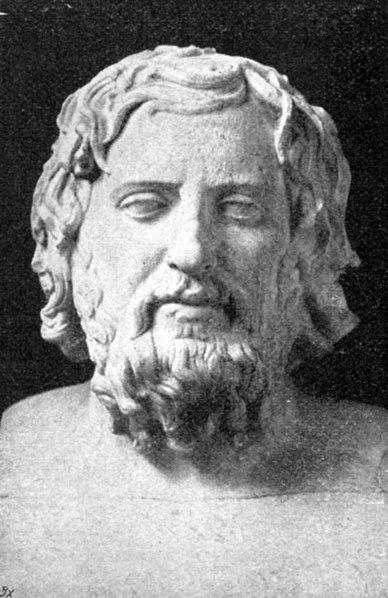
Xenophon, author of "Anabasis" that
relates the famous March of the Ten 
Thousand.  Image courtesy of 
Wikimedia Commons.
"The effect upon the soldiers who tasted the combs was, that they all went for the nonce quite off their heads, and suffered from vomiting and diarrhoea, with a total inability to stand steady on their legs. A small dose produced a condition not unlike violent drunkenness, a large one an attack very like a fit of madness, and some dropped down, apparently at death's door. So they lay, hundreds of them, as if there had been a great defeat, a prey to the cruellest despondency. But the next day, none had died; and almost at the same hour of the day at which they had eaten they recovered their senses, and on the third or fourth day got on their legs again like convalescents after a severe course of medical treatment." - Anabasis by Xenophon, Book IV Chapter VIII

I also pointed out that if she needed a more recent reference she should check out the campaigns of Pompey the Great as well since, he, too, failed to learn from history and suffered from the effects of rhododendron honey when he and his troops were campaigning in Turkey in the 1st century BCE.

"As king of Pontus and a scholar of toxicology, Mithridates was well aware of the deadly properties of the rhododendron honey of his kingdom.  He would have kept some in his royal laboratory of pharmaka and, as noted earlier, he may have included it in his mithridatium...Mithridates would also have known of Xenophon's misadventure with the poisonous honey..."
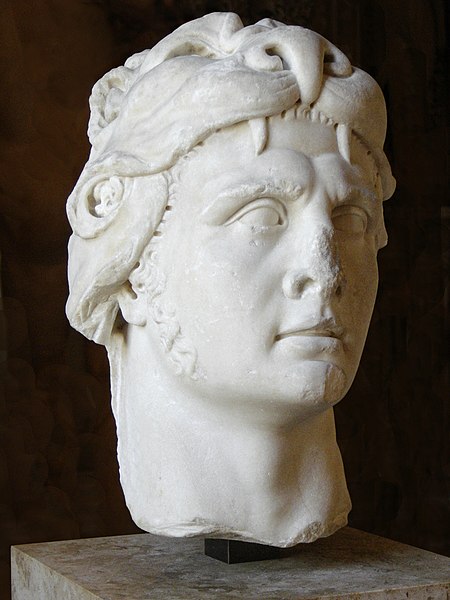
Mithridates VI of Pontus, The Poison King
Image courtesy of Wikimedia Commons

"In about 65 BCE, Pompey's army was approaching Colchis.  Mithridates' allies there, the Heptakometes, were described by Strabo as 'utterly savage' mountain barbarians, dwelling in tree forts and living on 'the flesh of wild animals and nuts.'  The tribe was feared for attacking wayfarers - suddenly leaping down on them like leopards from their tree houses.  The Heptakometes may have received specific orders from Mithridates on how to ambush the Roman army.  What we do know for a fact is that they gathered up great numbers of wild honeycombs dripping with toxic honey and placed them all along Pompey's route.  The Roman soldiers stopped to enjoy the sweets and immediately lost their senses.  Reeling and babbling, the men collapsed with vomiting and diarrhea and lay on the ground unable to move.  The Heptakometes easily wiped out about one thousand of Pompey's men." - Greek Fire, Poison Arrows, and Scorpion Bombs: Biological and Chemical Warfare in the Ancient World by Adrienne Mayor

I saw an article last week listing the ten most worthless disciplines to pursue in higher education and among them was archaeology and anthropology.  It looks to me like this is a prime example of information from the past that has direct modern implications and could be one of many examples that could refute such nonsense!


Enhanced by Zemanta
If you enjoyed this post, never miss out on future posts by following me by email!


Monday, January 16, 2012

Romano Britain website resurrected!


I just received word that the website Romano Britain (http://www.romanobritain.org) has been resurrected by Marsh Wise, aka Decimus Mercatius Varianus of LEGIO IX HISPANA on the east coast of the U.S.  Apparently the original webmaster developed serious medical issues some time ago and the original website disappeared .  Fortunately, Marsh had stored a copy of the website for reference purposes and decided to resurrect the site so the Roman history community would not lose it as a valuable online resource.

Kudos to Marsh!

Related articles
Enhanced by Zemanta
If you enjoyed this post, never miss out on future posts by following me by email!


Friday, February 15, 2008

Barbaians focus of new exhibit in Venice

"HISTORY has been unkind to the Barbarians. Some 1,600 years have passed since they began to redraw the boundaries of Europe, yet their names are best remembered for the anti-social and savage behaviour always associated with Vandals, Goths and Huns. Now an exhibition in Venice seeks to help rehabilitate them. The Vandals? They took Carthage when the locals were watching a circus. Huns? Attila was not always as bad as he is painted; he forbore, after all, to sack Rome. As for the Goths, they were not without their redeeming features, either.

This show is the latest sign of a growing interest—visible in fiction, film, television and even computer games—in the hordes that felled Rome. The chief curator is Jean-Jacques Aillagon, a French former culture minister, who dramatises the traditional view of the Barbarians by exhibiting a scattering of 19th-century paintings that depict them in the worst possible light. In one, two near-naked hooligans are destroying an elegant marble statue of a Roman nobleman. Mr Aillagon's historical method is to look for similarities between today's Europe and Europe during the decline and fall of the Roman empire.

“Europe at the start of the third millennium is living through a cultural revolution not unlike that of the first,” writes Mr Aillagon in the preface to the exhibition catalogue. Does this mean the Barbarians were entrepreneurial capitalists, economic migrants and asylum-seekers? Not quite. Attila the Hun (played in the BBC's latest biopic by Rory McCann, pictured above) is best known for his furious savagery. He behaved so cruelly in cities such as Aquileia and Verona that some survivors fled to islands in the nearby lagoon and laid the foundations of Venice.

The exhibition begins and ends with different varieties of triumphalism. It starts by proclaiming the shrewdness of a Roman empire that kept the Barbarians at bay for almost 300 years, after the shocking defeat by German tribes in the Teutoburg forest in 9AD until the final gasp of Rome's western stronghold in 476AD.

The first exhibits are sarcophagi decorated with mounted Roman soldiers trampling half-naked Barbarians. Since the Romans were fearful of this new enemy—named after the Greek barbaros, which mocked the babbling sounds of foreigners' languages—the efficient Roman propaganda machine commissioned public statues to reassure a nervous populace. There is a fine early example in the exhibition showing a kneeling, near-naked Barbarian with his hands tied behind his back.

The Romans decided that assimilation was the best form of defence, and many of the exhibits illuminate the lengths to which Roman bureaucrats and soldiers went to absorb foreigners into the machinery of empire. Barbarian religions were widely tolerated, and one of the most striking exhibits, which was found in Arras, is a stone image of a bald Freyr, the Norse god of fruitfulness, as a fertility god, clutching his penis to his body.

With the fall of the Roman empire, historical evidence becomes scarce. Unlike the Romans, the Barbarians did not build for posterity, and their story is told principally through displays of funerary jewellery and weaponry, with the odd cooking pot thrown in. These can grow monotonous and, since the explanatory cards are not much help and are translated only randomly, the audio-guide is a necessity.

The second triumphalist episode, in which the cross becomes a common object in Barbarian graves, is reflected in the exhibits in the final rooms. Rather as Romans aspired to Greek virtues, the new Barbarian aristocracy aspired to live like Romans. By the sixth century no Roman custom was more influential than Christianity. What happened was a rare case of the religion of the defeated spreading among the victors..."

If you enjoyed this post, never miss out on future posts by following me by email!