Monday, August 25, 2008

"Pompeii and the Roman Villa" exhibit opens October 18 in Washington D.C.

In the first century BC, the picturesque Bay of Naples became a
favorite retreat for vacationing emperors, senators, and other
prominent Romans. They built lavish seaside villas in the shadow of
Mount Vesuvius where they could indulge in absolute leisure, read and
write, exercise, enjoy their gardens and the views, and entertain
friends. The artists who flocked to the region to adorn the villas also
created paintings, sculptures, and decorative arts for the residents of
Pompeii and nearby towns. Pompeii and the Roman Villa
presents some 150 works of sculpture, painting, mosaic, and luxury
arts, including recent discoveries on view in the U.S. for the first
time and celebrated finds from earlier excavations. Exquisite objects
from the richly decorated villas reveal the breadth and richness of
cultural and artistic life, as well as the influence of classical
Greece on Roman art and culture in this region. The exhibition also
focuses on the impact that the 18th-century excavations and rediscovery
of Pompeii and Herculaneum had on the art and culture of the modern
world.


Organization

Pompeii and the Roman Villa: Art and Culture around the Bay of Naples is
organized by Museum of Art, with the cooperation of the
Direzione Regionale per i Beni Culturali e Paesaggistici della Campania
and the Soprintendenza Speciale per i Beni Archeologici di the National Gallery of Art, Washington, in association
with the Los Angeles County Napoli e
Pompei.

Schedule

National Gallery of Art, October 19, 2008–March 22, 2009;
Los Angeles County Museum of Art, May 3–October 4, 2009

For those of you that cannot attend either of the venues, a DVD about the exhibit will be released October 28, 2008 from MicrocinemaDVD with a list price of $19.95.

If you enjoyed this post, never miss out on future posts by following me by email!


Thursday, August 14, 2008

Antony and Cleopatra a Love/Hate Relationship?


I finished reading Colleen McCullough's latest addition to her "Masters of Rome" series of novels, "Antony and Cleopatra" and found her characterization of the relationship between Antony and Cleopatra as one of a combination of love and exasperation to be quite convincing.

This seems to be born out by a quote by Pliny the Elder that I stumbled across today on a very good website offering essays on the history and culture of Rome:

"Pliny (XXI.7.9) relates how Cleopatra played on Antony's fear of being poisoned. Refusing to take any food that had not been tasted [sic], she instead laid a garland of poisoned flowers on his head, suggesting, as the revelry grew wilder, that they all drink their chaplets. As Antony began to drink from the cup into which he had scattered his flowers, she stopped him. A prisoner was brought in and commanded to drink, dying on the spot."


This act, if indeed it ever happened, appears to be much less playful than Cleopatra ordering a diver to go underwater and tie a dried fish to Antony's fishing line.

Of course Pliny is also the source for the story of Cleopatra dissolving one of her almost priceless pearls in a cup of vinegar to impress Antony:

"There have been two pearls that were the largest in the whole of history; both were owned by Cleopatra, the last of the Queens of Egypt--they had come down to her through the hands of the Kings of the East....In accordance with previous instructions the servants placed in front of her only a single vessel containing vinegar, the strong rough quality of which can melt pearls. She was at the moment wearing in her ears that remarkable and truly unique work of nature. Antony was full of curiosity to see what in the world she was going to do. She took one earring off and dropped the pearl in the vinegar, and when it was melted swallowed it....With this goes the story that, when that queen who had won on this important issue was captured, the second of this pair of pearls was cut in two pieces, so that half a helping of the jewel might be in each of the ears of Venus in the Pantheon at Rome." - Pliny, Natural History (IX.59.119-121)


The value of the pearl that Cleopatra dropped in her cup was said by Pliny to be worth ten million sesterces (a hundred thousand gold aurei). It's as if Antony and Cleopatra were engaged in constant competition to see which one could outdo the other in startling behavior.

This page, peppered with interesting asides, also mentions Julius Caesar restricting the wearing of pearls to individuals with a certain status. It's an anecdote about him I had not read before:

"Suetonius relates that Caesar had attempted to restrict the wearing of pearls, a symbol of wealth and prestige, only "to those of a designated position and age" (XLIII).

Suetonius goes on to attribute Caesar's invasion of Britain to a desire for the fresh-water pearls found there and that, "in comparing their size he sometimes weighed them with his own hand" (XLVII)."

I also had to chuckle at Seneca's wit when criticizing the ostentatiousness of Roman women wearing pearls. "Seneca (On Benefits, VII.9) complains that the ears of women are trained to carry pearls in pairs, with another fastened above, and are not content unless the value of two or three estates hang from each lobe."
If you enjoyed this post, never miss out on future posts by following me by email!


Monday, August 4, 2008

Rome Reborn to be featured at SIGGRAPH 2008


"A view of the Circus Maximus seen from the Palatine in Rome Reborn 2.0. Model copyright Past Perfect Productions srl (Rome Italy) 2008. All rights reserved. Rendering courtesy Procedural (Zurich, Switzerland)."

"A significantly enhanced version of Rome Reborn will make its public debut at SIGGRAPH 2008 this August in Los Angeles. It is one of several cutting-edge New Tech Demos that exemplifies how the past invigorates the future of computer graphics and interactive techniques. Considered the largest virtual reconstruction, cultural heritage, and digital archaeology project to date, Rome Reborn is an international collaboration designed to create an interactive 3D digital model that illustrates the urban development of ancient Rome.

Rome Reborn showcases new approaches for exhibiting historical findings in museums, classrooms, and on the Internet. Approximately 7,000 buildings recapture Rome at the peak of its glory in 320 AD, at the time of Constantine the Great. The project opens new channels for education, collaboration between scholars, and communication of archaeology to the general public.

"Rome Reborn is re-inventing the way we explore, understand, and celebrate our past by bringing together technologies that invigorate and define the future of computer graphics and interactive techniques," said Cole Krumbholz, SIGGRAPH 2008 Associate Producer of Encounters. "This exhibit demonstrates the impact modern computer graphics is having on other fields, such as archeology and the humanities."
In real time, visitors to the exhibit will be able to explore the ancient city landscape and its numerous buildings and immerse themselves in the reconstructed 3D models of ancient Roman architecture, rendered interactively.

The exhibit will also feature a series of scheduled talks by representatives of the participating Rome Reborn partners, detailing how this unique and ambitious project was brought to life."
If you enjoyed this post, never miss out on future posts by following me by email!


Sunday, July 20, 2008

Capware Virtual Museums Try to Relieve Pressure on Pompeii and Other Sites In Crisis

Images of what the bath complex in Pompeii originally looked like.

With the cries of alarm going up from the archaeological superintendent of Pompeii and other ancient sites around Vesuvius, digital artists from Capware, an Italian computer graphics company, have stepped forward to create virtual museums of many of the endangered sites in Italy in an effort to relieve the pressure from too many on-site visitors.

At the real site of Pompeii, "chunks of frescoes depicting life in the Roman city are missing, carried away by visitors or eroded by the elements. Graffiti is gouged into walls. Tourists ignore signs forbidding flash photography as they take pictures of erotic designs inside the Lupanare, an ancient brothel."

"Frescoes which would have been a rich "Pompeii red" when excavated in the 1800s have turned pinkish grey or peeled off altogether.

Scaffolding and steal beams prop up crumbling columns and roofs infiltrated by water. Many of the 1,500 houses at the site are closed to the public, either for repair works or for lack of custodians -- guards who retired have not been replaced."

"At least 150 square meters (1,600 square feet) of frescoes and plaster are lost to lack of upkeep each year and 3,000 stones crumble away, Antonio Irlando, the Campania region's alderman for culture, told newspaper Corriere della Serra on July 3." - Bloomberg

But, in Capware's virtual Pompeii, Herculaneum, Boscoreale, Baiae, Capri, and Stabiae, the structures appear as they did to the ancient Romans themselves complete with vibrant frescoes, breathtaking sculpture and intricately adorned furnishings.

I particularly like some of the physicality effects of Capware's Musei E Mostre (click on the link in the lower left corner of the website then the Technologie tab in the center of the screen and watch the movie in the lower right corner. I love how they have combined graphics effects with motion sensors that enable a visitor to virtually swish their hand in the water of a mosaic pool! They must have combined their visuals with "Wii"-type controls.

As you explore their website be sure to check out the links on the colored bar just below each tabbed section as well. On the Pompeii tab, for instance, they have image collections for different sections of the city such as the House of the Faun, the brothel, the necropolis, and the House of the Tragic Poet. The site is in Italian but the breathtaking images speak for themselves!

If Capware's imagery was combined with the multi-directional treadmill (I mentioned in an earlier post) into a facility that permitted a kind of physical exploration of each site, some people's curiosity may be sufficiently gratified to the degree that they would be willing to forgo admission to the actual sites themselves. You would probably need one installation adjacent to Pompeii with only a small restricted portion of Pompeii available for foot traffic to satisfy the more adventurous travelers, then one touring facility that could not only provide an educational and cultural experience for milllions of others but serve as a focus of attention on the need to preserve our collective cultural heritage and encourage contributions to research and preservation efforts.

An restored interior view from the House of the Tragic Poet in Pompeii.


Images of Roman Aqueducts


Baiae

Stabiae


Capware's Villa dei Papiri in Herculaneum

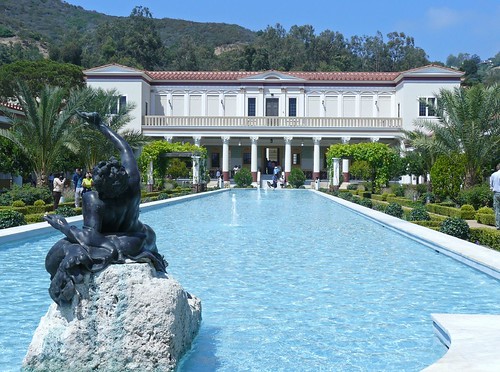
I had to marvel at the images of the Villa dei Papiri and was exhilarated to have confirmed the accuracy of its life-sized counterpart at the Getty Villa in Malibu, California that I visited again just a few weeks ago:


If you enjoyed this post, never miss out on future posts by following me by email!


Tuesday, July 15, 2008

Chariots to Race Once More at the Circus Maximus!!

Yahoo! The only frustrating thing is I'm not scheduled to go to Rome again until March 2009! Argghhh!

"The thunderous sounds of Ancient Rome's chariot races could once more echo around the Eternal City, with plans to stage an event in the Circus Maximus.
A scene from the  film Ben Hur
In Ancient Roman times, races were held using either two or four horses but sometimes skilled charioteers would use up to 10 to impress the Emperor

For hundreds of years, citizens of the Roman Empire watched chariots tear around the famous racetrack in what was the Formula One event of its time.

Now the historical society, Vadis Al Maximo (To the Maximum), is in talks with city officials to bring the event back – with perhaps slightly less blood and carnage as depicted in the film, Ben Hur.

Franco Calo, of Vadis Al Maximo, said: "The event would last three days, starting on October 17, at the same period when the race took place in Roman times.

"According to our calculations, the Circus Maximus area could hold up to 35,000 people. If possible, we hope to involve charioteers from all over the world."

In Ancient Roman times, races were held using either two or four horses but sometimes skilled charioteers would use up to 10 to impress the Emperor.

As in modern day Formula One there were various teams and winners would be given wreaths made from laurel leaves, as well as prize money.

Successful charioteers were hero worshiped and treated as celebrities but their life expectancy was not very high.

The most famous was Scorpus, who won over 2000 races before being killed in a collision at the meta, the column used as a turning point at one end of the track, aged just 27.

Horses, too, could become celebrities, but their life expectancy was even lower with many killed or maimed in spectacular crashes.

Mr. Calo said he hoped the plan would extend beyond the Circus Maximus, which is now being used as a park, with recreations of other pars of Ancient Rome around the city.

"All the main squares of the capital would be transformed into scenes from Ancient Rome, using props on loan from the Cinecitta film studios.

"Various screens would need to be installed at various points outside the course so that people could watch the races."

Restoring the Circus Maximus would include setting up platforms, security exits, a stage at the centre of the course, a ditch and outdoor stables."

If you enjoyed this post, never miss out on future posts by following me by email!