
English Heritage is cleaning it up and visitors can request to see it by calling the archaeology store at Helmsley after April 21, 2010.
[Image courtesy of English Heritage]


The Roman marble bust of the Emperor Caracalla depicts him turning sharply to his left, his face contorted in a characteristic forbidding frown, his creased forehead with curving eyebrows drawn together, the eyes deep-set with articulated pupils. The nose is broad with a short moustache above his downturned mouth, his strong chin cleft and covered with a short curling beard, his hair composed of tight curls with drilling, the thick sideburns joining his beard. He wears a paludamentum draped around his shoulders.
This bust is of the 'Sole-Ruler' type, dating to the period after he murdered his brother and co-emperor Geta. Other examples of this type are in the Museo Capitolino Montemartini, (inv. 2310), the Museo Archeologico Nazionale di Napoli, the Vatican Museum and the British Museum. A head in the Acropolis Museum, Athens has some of the closest stylistic similarities. - Culturekiosque Art and Archaeology News
Caracalla's, features reflect his mixed Punic/Berber and Syrian descent, being the son of Roman emperor, Septemius Severus who hailed from Leptis Magna in Libya. I think his face also reflects the savagery that marked his reign from 198 (co-ruling with his father) to 217 CE. In addition to assassinating his brother, Geta, the family of his former father-in-law Gaius Fulvius Plautianus, his wife Fulvia Plautilla and her brother, he slaughtered over 20,000 hapless citizens of Alexandria when rumors reached him that the people there had been mocking his claim that he killed his brother in self defense.
Caracalla was equally brutal and duplicitous in his foreign affairs. In 216 CE, he triggered a war with Parthia after accepting a marriage proposal then slaughtering the guests who arrived for the wedding celebration.
He made only two relatively positive contributions to the people of the Rome and the empire. In 212 CE, he issued the Constitutio Antoninian that granted citizenship to all free men in the Roman Empire. Before this time, only inhabitants of Italia or their descendants living in provinces along with a small number of nobles and client kings held full citizenship. Caracalla issued this edict to increase the number of people subject to more Roman taxes to replenish his imperial coffers. He may have also used the legal device to increase the number of men who could serve as legionaries rather than mere auxiliaries in the Roman Army. Scholars point to this event as one of the reasons the professional Roman military became barbarized. Also, With Roman citizenship no longer an enticement for enlistment, this edict may have inadvertently led to the recruiting difficulties of the Roman army by the end of the 3rd century CE.
Between 212 and 216 CE, Caracalla 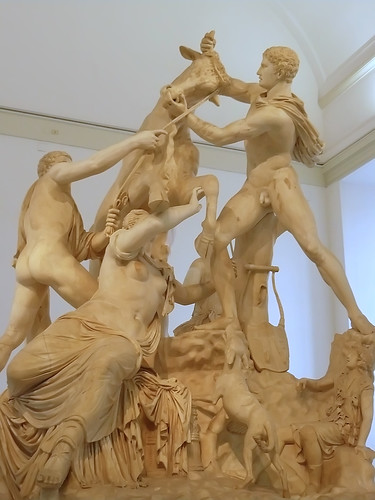
The massive structure not only included the requisite cold, warm and hot bathing facilities that accomodated up to 16,000 bathers, but libraries, gymnasia, shops, and colossal statues including a sculpture representing the myth of Dirce.
[Image: Farnese bull sculpture group depicts the legend of Dirce who was tied to a wild bull as punishment for abusing the mother of Amphion and Zethus. Photographed at the Museo Archaeologico di Napoli, Naples, Italy by Mary Harrsch]
Dirce was the wife of Lycus, king of Thebes. Dirce's niece, Antiope, was seduced by the ever amorous Zeus, king of the gods, and impregnated. Antiope's father was furious with her so she fled to King Epopeus of Sicyon who took her for his wife. Her father, killed himself in disgrace but before he died he asked his brother, King Lycus to avenge him by punishing King Epopeus and Antiope. King Lycus marched on Sicyon and slew King Epopeus then gave the hapless Antiope to his wife Dirce to serve as her maid. Dirce hated her niece, probably for her beauty, since that is often considered a normal female rationale in Greek mythology and usually the reason women attracted Zeus, and treated her cruelly. Dirce had given birth to twin boys, Amphion and Zethus, after King Lycus captured her, and, who, like many offspring of Greek deities, were exposed but found and raised by a kindly shepherd.
One day, Antiope escaped her cruel mistress and found her way to the cave where her sons lived. When she explained who she was and what had happened to her, Amphion and Zethus rose up and slew King Lycus and tied Dirce to the horns of a wild bull. After her gruesome death, Dirce was cast into a spring on Mount Cithaeron or, as some versions relate, she was transformed into a spring by the god Dionysos because of her devoted worship of him.
Unfortunately, this myth was supposedly recreated in the Roman arena during Christian persecutions, although Christian persecutions did not occur during Caracalla's reign, with the exception of limited activities in North Africa.
 The Dirce sculpture is now known as the Farnese Bull after it was excavated from the Baths of Caracalla in 1546 by a team funded by Pope Paul III who was looking for artwork to place in his new residence, the Farnese Palace. It eventually wound up in the Museo Archaeologico di Napoli in Naples where it can be seen today.
When I think of the Baths of Caracalla, I also envision the pleasant scene of beautiful Roman women lounging before the luxurious pools as depicted by one of my favorite artists, Sir Lawrence Alma-Tadema. Actually, the women's clothing is a little more Victorian than it should be and the scene depicts men bathing alongside women that was not accurate either but you get a definite sense of the size and sumptuousness of the halls and how much bathing was viewed as a shared social experience in the Roman world.
[Image: The Baths of Caracalla by Sir Lawrence Alma-Tadema, 1899, Oil on canvas, courtesy of The Art Renewal Center]

Cutting-edge imaging techniques are being used in the digital restoration of a 2000-year old Roman statue.
The delicately painted statue, which was discovered in the ancient ruins of Herculaneum in 2006 and believed to depict an Amazon Warrior, is now the subject of a joint restoration project by the University of Southampton, the University of Warwick, and the Herculaneum Conservation Project.
Highly sophisticated digital imaging is vital for the recording, subsequent analysis and restoration of cultural heritage material. Experts in archaeological computing led by Dr Graeme Earl of the Archaeological Computing Research Group in the School of Humanities, used a novel form of photography – Polynomial Texture Mapping (PTM), developed by HP Labs - to provide a detailed record of the texture and colour of the painted surfaces.
A specially-designed rig, camera structure, and associated custom software was developed in the School of Electronics and Computer Science by Dr Kirk Martinez and the team in the Mechanical Workshop to enable very fast acquisition of PTM data, with variable sample sizes. The rig uses a lightweight tripod running on battery power, making it adaptable enough to use on archaeological sites. The whole kit is highly portable and can be carried in a suitcase. 'It was fascinating to pull together various elements from my imaging research projects in order to solve all the issues for the new rig design,' said Kirk Martinez.
The head of the Amazon Warrior was discovered in 2006 in the ancient ruins of Herculaneum, a town close to Pompeii, which was buried in the AD79 eruption of Mount Vesuvius. The delicate painting of the statue’s features and its fine state of preservation meant that it was regarded as a landmark discovery by archaeologists, providing clues to the decoration of Roman statues that had previously been only guessed at. - More: University of South Hampton
The PTM viewer enables a virtual light source to be moved across the virtual scene. The viewer can also vary lighting intensity, add additional virtual lights, derive surface models and to carry out image processing tasks such as edge detection. Try it out for yourself!


favorite retreat for vacationing emperors, senators, and other
prominent Romans. They built lavish seaside villas in the shadow of
Mount Vesuvius where they could indulge in absolute leisure, read and
write, exercise, enjoy their gardens and the views, and entertain
friends. The artists who flocked to the region to adorn the villas also
created paintings, sculptures, and decorative arts for the residents of
Pompeii and nearby towns. Pompeii and the Roman Villa
presents some 150 works of sculpture, painting, mosaic, and luxury
arts, including recent discoveries on view in the U.S. for the first
time and celebrated finds from earlier excavations. Exquisite objects
from the richly decorated villas reveal the breadth and richness of
cultural and artistic life, as well as the influence of classical
Greece on Roman art and culture in this region. The exhibition also
focuses on the impact that the 18th-century excavations and rediscovery
of Pompeii and Herculaneum had on the art and culture of the modern
world.
Organization
Pompeii and the Roman Villa: Art and Culture around the Bay of Naples is
organized by
Direzione Regionale per i Beni Culturali e Paesaggistici della Campania
and the Soprintendenza Speciale per i Beni Archeologici di the National Gallery of Art, Washington, in association
with the Los Angeles County Napoli e
Pompei.
Schedule
National Gallery of Art, October 19, 2008–March 22, 2009;
Los Angeles County Museum of Art, May 3–October 4, 2009
For those of you that cannot attend either of the venues, a DVD about the exhibit will be released October 28, 2008 from MicrocinemaDVD with a list price of $19.95.
 |
| A polychromy restoration of the Roman emperor Augustus in his Prima Porta pose. Image courtesy of The Digital Sculpture Project. |
 |
| The head of the Roman emperor known as Caligula colored as it would have been in antiquity Image courtesy of The Digital Sculpture Project. |


