Discovered by a metal detectorist in Dumfries and Galloway, Scotland in 2014, the Galloway Hoard, buried around 900 CE, contains over 100 diverse objects, from silver, gold and jewelled treasures to rarely surviving textiles, including wool, linen and Scotland’s earliest examples of silk.
It is thought that the hoard was buried some time in the mid-ninth or tenth century, though it is not known why it was buried. The hoard consists of a variety of gold and silver objects including armbands, a silver pectoral cross, brooches, ingots, and what is possibly the largest silver Carolingian pot ever discovered. The pot was one of the older items in the hoard and may have been more than 100 years old by the time it was deposited. It is made of a silver alloy and was found wrapped in the remains of a cloth, with its lid still in place. It contained a collection of silver Anglo-Saxon disc brooches, an Irish silver brooch, Byzantine silk from the area around Constantinople, a gold ingot and gold and crystal objects wrapped in cloth.
Five of the silver armbands have runic inscriptions scratched on them. Although the hoard is considered to be a Viking hoard, the inscriptions are written in Anglo-Saxon runes, and they record Anglo-Saxon names, possibly some of the original owners of part of the hoard. The items among the treasure originated across a wide geographic area that includes Ireland, Scandinavia, and central Europe.
The hoard was buried in two discrete levels. The more valuable objects – the gold items and the Carolingian pot – were more deeply buried, while the upper level consisted of smaller and less valuable items which would have been the equivalent of "loose change" in the Viking bullion economy.
After the exhibition ends at the National Museum of Scotland, it will tour on to Kirkcudbright Galleries from 9 October to 2021 to 10 July 2022 then on to Aberdeen Museum and Art Gallery from 30 July to 23 October 2022.
 |
| Selection of objects from the Galloway Hoard, 9th - 10th century CE, courtesy of Wikimedia Commons and the National Museum of Scotland. |
 |
| Ornamented silver pectoral cross with wire chain. The cross is decorated with what appears to be gilding and niello, each arm ornamented with a motif and there appears to be an ornamentation missing from the centre. A chain of coiled silver wire is wrapped around the arms. The cross is from the Galloway Hoard, 9th - 10th century CE, courtesy of Wikimedia Commons and the National Museum of Scotland. |
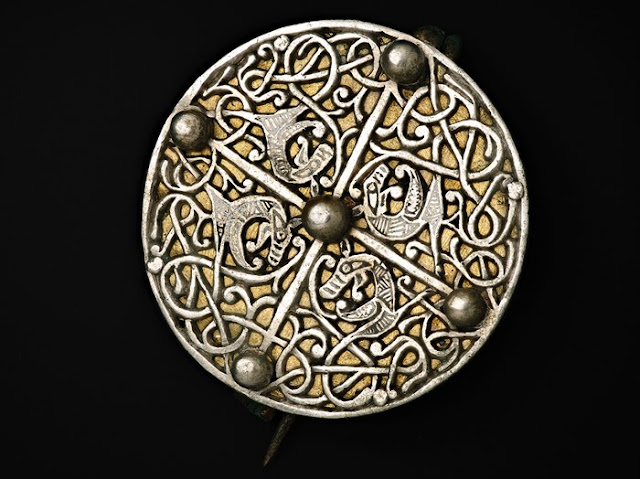 |
| An Anglo-Saxon disc brooch from the Galloway Hoard, , 9th - 10th century CE, courtesy of Wikimedia Commons and the National Museum of Scotland. |
 |
| A hinged mount with Anglo-Saxon Trewhiddle-style decoration from the Galloway Hoard, , 9th - 10th century CE, courtesy of Wikimedia Commons and the National Museum of Scotland. |
 |
| A gold bird pin thought to be unique from the Galloway Hoard, , 9th - 10th century CE, courtesy of Wikimedia Commons and the National Museum of Scotland. |
 |
| A selection of beads, including a large 'melon' style bead with ribbed edge, clear glass, slightly yellowed, from the Galloway Hoard, 9th - 10th century CE, courtesy of Wikimedia Commons and the National Museum of Scotland. |
 |
| Anglo-Saxon quatrefoil brooch from the Galloway Hoard, , 9th - 10th century CE, courtesy of Wikimedia Commons and the National Museum of Scotland. |
If you enjoyed this post, never miss out on future posts by following me by email!


