Showing posts with label cremation. Show all posts

Wednesday, February 17, 2021

Cremation or Inhumation?

During the Ptolemaic period a distinctive type of subterranean tomb for multiple burials proliferated in the cemeteries around the city of Alexandria. Underground chambers cut into the living rock radiated from a central courtyard open to the sky. Most chambers contained a number of loculi, long narrow niches cut into the walls, which served as burial slots. Some loculi were sealed with painted limestone slabs in the form of small shrines. - Metropolitan Museum of Art

Roman columbaria were often built partly or completely underground as well. Most columbaria were managed by funeral societies and used by the lower and middle-classes. Niches could be quite simple or elaborately decorated with inscriptions, paintings, and mosaics depending on each family's economic means.  

The Columbarium of Pomponius Hylas is a 1st-century CE Roman columbarium, situated near the Porta Latina on the Via Appia, Rome, Italy. It was discovered and excavated in 1831 by Pietro Campana. Though its name derives from Pomponius Hylas, who lived in the Flavian period (69-96 CE), the building itself has been dated to between 14 and 54 CE due to inscriptions on two of its niches (one dedicated to a freedman of Tiberius and the other to a freedman of Claudia Octavia, daughter of Claudius and Messalina). It was later bought by Pomponius Hylas for himself and his wife.

 Inhumation was practiced regularly in archaeic Rome although cremation was gaining acceptance and a practice known as os resectum ("cut-off bone") was developed to satisfy both economy and spiritual traditions. According to Plutarch, King Numa Pompilius (r. 715-673 BCE) had forbidden cremation so perhaps in at least partial obedience to this prohibition, and perhaps on the understanding that "a part implies the whole", a complete finger was sometimes cut from the corpse before cremation and buried separately, unburnt, to complete the household's purification, return the deceased to mother Earth and make the grave inviolable. 

But, cremation became the most common burial practice in the Mid- to Late Republic and the Empire into the 1st and 2nd centuries. Interestingly, this appears to correspond to the military expansion of Rome and the increasing lack of ability to return intact war dead from distant battlefields.

Patrician members of the gens Cornelia seem to have resisted this change, though, and continued inhumating their dead until the first century BCE. In 79 BCE, the dictator Sulla was the first patrician Cornelius to be cremated, perhaps because he feared his body would be defaced by his former enemies.

Eventually, however, cremation remained a feature of imperial deification funerals, and very few others.  Building columbariums was finally halted during Hadrian’s rule from 117 to 138 CE as inhumation once more preferred.

Painted limestone funerary slab with a man controlling a rearing horse, 2nd half of 3rd century B.C.E. at the Metropolitan Museum of Art in New York. Here, a lively depiction of a Thessalian man named Pelopides trying to bridle a horse, while a boy stands behind him, commemorates a man from Thessaly in Northern Greece, who must have been one of the many foreigners who congregated in the wealthy, cosmopolitan Ptolemaic capital.

Painted limestone funerary slab depicting a soldier and two girls from Alexandria, 2nd half of 3rd century BCE at the Metropolitan Museum of Art.

Painted limestone funerary slab with a soldier taking a kantharos from his attendant girls from Alexandria, 2nd half of 3rd century BCE at the Metropolitan Museum of Art.

Painted limestone funerary slab with a soldier standing at ease, 2nd half of 3rd century B.C.E. at the Metropolitan Museum of Art. A soldier wearing a long blue cloak stands alone, with a spear in his right hand and a tall ovoid shield at his left. Celtic groups from Europe migrated eastward in 279 B.C. and established independent kingdoms in Thrace and central Asia Minor. Known as Galatians, they were used extensively as mercenary soldiers. Inscriptions identifying at least three Galatian soldiers who must have served under the Ptolemies occur on loculus slabs in a rather simple tomb found in 1884.

Interior of the Columbarium of Pomponius Hylas (Rome, Italy) courtesy of Wikimedia Commons contributor Tyler Bell. 


If you enjoyed this post, never miss out on future posts by following me by email!


Wednesday, January 27, 2021

Phoenician mortuary practices of the Achaemenid Period

The Phoenicians as a politically, religiously, and perhaps even ethnically distinct entity on the Levantine coast emerged at the end of the Late Bronze Age about 1200 BCE, as one of the successor cultures to the Canaanites.  From their homeland on the coast of the Levant, the Phoenicians spread throughout the Mediterranean and its islands including Cyprus, Sicily and Malta. Some scholars have observed that Iron Age Phoenicia was not a nation, but rather a collection of cities built around natural harbors along the coast. While they shared a common culture, these small states remained independent, competing with each other in the international marketplace. 

"Depending on how evidence is weighed [based on Ugaritic texts and classical sources], Phoenician religion might be presented on the one hand as inclusive and diverse – a “conservatively” polytheistic society easily able to incorporate or syncretize new deities, customs and traditions or on the other hand as highly place-specific – a model in which Phoenicians were devoted to city-gods only, with little shared pantheon above the local or regional scale," Helen Dixon, University of Michigan, observes.

This variety in religious practices initially resulted in the use of both cremation and inhumation in mortuary practices and funerary art often expressed influences by non-Phoenician ruling administrations like New Kingdom Egyptians, Assyrians, and Achaemenid Persians.  By the Achaemenid period, however, adult cremation abruptly disappears from sites in the Phoenician cultural sphere.  This corresponds with the increasing importance of Zoroastrianism in the 5th century BCE. In Zoroastrianism, water (aban) and fire (atar) are agents of ritual purity, and the associated purification ceremonies are considered the basis of ritual life. A corpse is considered a host for decay. Consequently, scripture enjoins the safe disposal of the dead in a manner such that a corpse does not pollute the good creation.

For inhumation burials, the use of sarcophagi during the Achaemenid period along with epigraphic evidence points to a consistent and insistent emphasis on the integrity of the burial. Deities, including Astarate, are invoked to assist with the procurement of blessings and to enforce curses and righteousness is defined by political accomplishments or the building of religious shrines.  Although Egyptian iconography persisted, it was supplemented by Persian iconography. A paucity of grave goods was referenced in inscriptions as a deterrent to grave robbing and what few ceramic vessels have been found in Phoenician burials have been ceremonially broken. Wealthier burials, though, apparently included the use of expensive resins such as myrrh to anoint, perfume or preserve the body and the deceased were dressed in special garments with head ornaments, particularly royal women whose head ornament was described as a gold bridle. However, there apparently were no extensive preparations for a “next life,” no large quantities of food or drink on which to survive or any biographical depictions or texts to accompany the dead. With the exception of the occasional appearance of amulets or other possibly apotropaic items, there was no preparation for an encounter with an underworld deity or space or expectation of  a future meeting one's deceased ancestors.

Read more about it in Dixon's dissertation, "Phoenician Mortuary Practice in the Iron Age I – III (ca. 1200 – ca. 300 BCE) Levantine “Homeland”:

https://deepblue.lib.umich.edu/handle/2027.42/99972

Sarcophagus made from Greek marble. burial grounds of Antarados, northern Lebanon. 480-450 BCE courtesy of Wikimedia Commons contributor McLeod

Anthropoid sarcophagi, from Sidon, 5th century BCE, National Museum of Beirut, Lebanon courtesy of Carole Raddato.


Phoenician sarcophagus of the fifth century BCE, from the Carthaginian colonization of Sicily. Discovered in Palermo. Regional Archaeological Museum of Palermo, courtesy of Wikimedia Commons contributor Giovanni Dall'Orto.


Sarcophagus of Eshmunazar II, king of Sidon, Phoenicia, ca first quarter of the 5th century BC.E. at The Louvre courtesy of Wikimedia Commons contributor Fred Romero.

Marble anthropoid sarcophagus, last quarter of the 5th century B.C.E., Graeco-Phoenician found on Cyprus at the Metropolitan Museum of Art.


Phoenician sarcophagus of the fifth century BCE, from the Carthaginian colonization of Sicily. Discovered in Palermo. Regional Archaeological Museum of Palermo, courtesy of Wikimedia Commons contributor Giovanni Dall'Orto.


Marble anthropoid sarcophagus, last quarter of the 5th century B.C.E., Graeco-Phoenician found on Cyprus at the Metropolitan Museum of Art.

Phoenician marble sarcophagus found in Cádiz. Spain, 5th century BCE, courtesy of Wikimedia Commons contributor Professor Ángel M. Felicísimo, University of Mérida.

Phoenician marble sarcophagus found in Cádiz. Spain, 5th century BCE, courtesy of Wikimedia Commons contributor Professor Ángel M. Felicísimo, University of Mérida.


If you enjoyed this post, never miss out on future posts by following me by email!


Friday, February 26, 2010

Routine Child Sacrifice Not Practiced by Ancient Carthaginians After All

Although Hannibal was used as a "boogey man" to scare misbehaving Roman children, Carthaginians did not, contrary to popular myth, actually wantonly sacrifice their children according to a new report by researchers from the University of Pittsburg.

The scientists examined the remains of children found in Tophets, structures on the margins of Punic cemetaries where urns containing the remains of young children and animals were placed.  The contents of 348 urns were inspected for developmental markers that would reveal the children's age at death.

[Image: Medea Killing Her Sons by Delacroix, 1862.  Courtesy of Wikimedia Commons]

"Schwartz [Jeffrey H. Schwartz, a professor of anthropology and history and philosophy of science in Pitt's School of Arts and Sciences and president of the World Academy of Art and Science] and Houghton [Frank Houghton of the Veterans Research Foundation of Pittsburgh] recorded skull, hip, long bone, and tooth measurements that indicated most of the children died in their first year with a sizeable number aged only two to five months, and that at least 20 percent of the sample was prenatal."

"Schwartz and Houghton then selected teeth from 50 individuals they concluded had died before or shortly after birth and sent them to Macchiarelli and Bondioli, who examined the samples for a neonatal line. This opaque band forms in human teeth between the interruption of enamel production at birth and its resumption within two weeks of life. Identification of this line is commonly used to determine an infant's age at death. Macchiarelli and Bondioli found a neonatal line in the teeth of 24 individuals, meaning that the remaining 26 individuals died prenatally or within two weeks of birth, the researchers reported."

"The team's report also disputes the contention that Carthaginians specifically sacrificed first-born males. Schwartz and Houghton determined sex by measuring the sciatic notch&'a crevice at the rear of the pelvis that's wider in females&'of 70 hipbones. They discovered that 38 pelvises came from females and 26 from males. Two others were likely female, one likely male, and three undetermined." - More: Spero News

Carthage: A Journey Back in Time (Lost Treasures of the Ancient World)    History - Engineering An Empire: Carthage   The Punic Wars: Rome, Carthage, and the Struggle for the Mediterranean   Dying for the Gods: Human Sacrifice in Iron Age & Roman Europe   Some Inquiries Concerning Human Sacrifices Among the Romans
If you enjoyed this post, never miss out on future posts by following me by email!


Monday, September 28, 2009

Possible Victims of Trojan War unearthed in Turkey


A team from the University of Tubingen, led by Ernst Pernicka, have uncovered a pair of skeletons in the ancient city of Troy near ceramic fragments dated to the period of the Trojan War. It is discoveries like this that remind us how important literature like Homer's Iliad is to understanding our ancient past. It will really blow me away if they find a skeleton of an infant with its head crushed. We could then be looking at the only corporeal remnant of the famous Hector, trainer of horses!

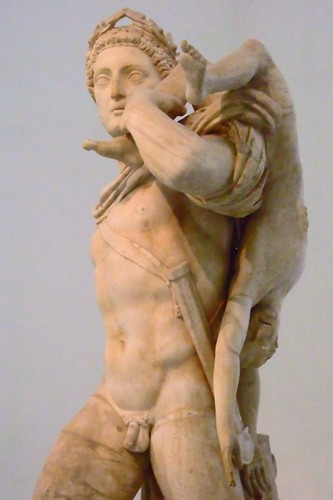
[Image - Warrior with captured child, Roman copy of 3rd century BCE Greek original. Photographed at the Museo Archaeologico di Napoli, Naples, Italy by Mary Harrsch.]

This discovery, though, also raises the question about disposal of "enemy" dead after a catastrophic sack. Both the Greeks and the Trojans at the time practiced cremation. If skeletons are found that could have been retrieved for burial, it makes a person wonder if the Greeks not only violated religious taboos by slaughtering people who had fled to the temples for sanctuary, but did not grant the defeated and enslaved survivors the courtesy of properly burying their dead either. Perhaps the violent deaths later visited upon the Mycenaean victors were just desserts after all.

"Pernicka said pottery found near the bodies, which had their lower parts missing, was confirmed to be from 1,200 BC, but added the couple could have been buried 400 years later in a burial site in what archaeologists call Troy VI or Troy VII, different layers of ruins at Troy. professor of archaeometry who is leading excavations on the site in northwestern Turkey, said the bodies were found near a defense line within the city built in the late Bronze age.

The discovery could add to evidence that Troy's lower area was bigger in the late Bronze Age than previously thought, changing scholars' perceptions about the city of the "Iliad."

"If the remains are confirmed to be from 1,200 B.C. it would coincide with the Trojan war period. These people were buried near a mote. We are conducting radiocarbon testing, but the finding is electrifying," Pernicka told Reuters in a telephone interview.

Pernicka said pottery found near the bodies, which had their lower parts missing, was confirmed to be from 1,200 BC, but added the couple could have been buried 400 years later in a burial site in what archaeologists call Troy VI or Troy VII, different layers of ruins at Troy.

If you enjoyed this post, never miss out on future posts by following me by email!


Wednesday, April 2, 2008

Household items most common Anglo-Saxon gravegoods in 5th century CE


"MUNDANE household objects were used by our distant ancestors to honour their dead according to an expert from Chester University.

Combs, tweezers and razors were among the distinctive artefacts used by the Anglo-Saxons.

According to new research conducted by an international expert at the University of Chester, the popular perception that the early Anglo-Saxons would mark death with grandiose gestures is untrue.

Senior Lecturer in Archaeology Dr Howard Williams has conducted research suggesting that it was more modest items which were particularly important to those in the fifth and sixth centuries. Dr Williams, who has an international reputation as an expert in mortuary archaeology, presented his findings at the British Museum to representatives of the museum, University College London, and other professional archaeologists.

He said: “The latest discoveries from cemeteries show that portable and quite modest artefacts, such as carefully wrought combs made of deer antler, and small tweezers, shears and razors made of iron or bronze, were of clear importance in the commemoration of the dead.

“Some of the objects were miniatures especially made for the funeral, and many were deliberately broken, with only a portion interred in the cinerary urns, with the rest perhaps kept as mementoes for the living.

“Combs, tweezers, shears and razors were objects intimately connected with the presentation of the body in life, and so placing them with the dead was a way for pagan Anglo-Saxons to create continued bonds with their ancestors following the spectacle of open-air cremation.”

“It reveals a belief that the dead in pagan Anglo-Saxon society retained a physical presence even after being reduced to ashes.”

If you enjoyed this post, never miss out on future posts by following me by email!