Showing posts with label Antony. Show all posts

Thursday, August 14, 2008

Antony and Cleopatra a Love/Hate Relationship?


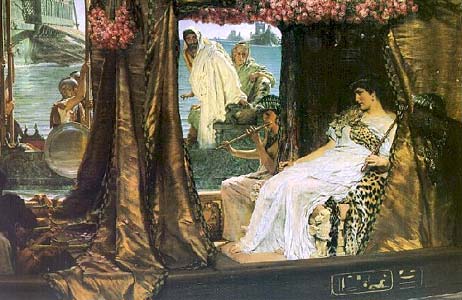
I finished reading Colleen McCullough's latest addition to her "Masters of Rome" series of novels, "Antony and Cleopatra" and found her characterization of the relationship between Antony and Cleopatra as one of a combination of love and exasperation to be quite convincing.

This seems to be born out by a quote by Pliny the Elder that I stumbled across today on a very good website offering essays on the history and culture of Rome:

"Pliny (XXI.7.9) relates how Cleopatra played on Antony's fear of being poisoned. Refusing to take any food that had not been tasted [sic], she instead laid a garland of poisoned flowers on his head, suggesting, as the revelry grew wilder, that they all drink their chaplets. As Antony began to drink from the cup into which he had scattered his flowers, she stopped him. A prisoner was brought in and commanded to drink, dying on the spot."


This act, if indeed it ever happened, appears to be much less playful than Cleopatra ordering a diver to go underwater and tie a dried fish to Antony's fishing line.

Of course Pliny is also the source for the story of Cleopatra dissolving one of her almost priceless pearls in a cup of vinegar to impress Antony:

"There have been two pearls that were the largest in the whole of history; both were owned by Cleopatra, the last of the Queens of Egypt--they had come down to her through the hands of the Kings of the East....In accordance with previous instructions the servants placed in front of her only a single vessel containing vinegar, the strong rough quality of which can melt pearls. She was at the moment wearing in her ears that remarkable and truly unique work of nature. Antony was full of curiosity to see what in the world she was going to do. She took one earring off and dropped the pearl in the vinegar, and when it was melted swallowed it....With this goes the story that, when that queen who had won on this important issue was captured, the second of this pair of pearls was cut in two pieces, so that half a helping of the jewel might be in each of the ears of Venus in the Pantheon at Rome." - Pliny, Natural History (IX.59.119-121)


The value of the pearl that Cleopatra dropped in her cup was said by Pliny to be worth ten million sesterces (a hundred thousand gold aurei). It's as if Antony and Cleopatra were engaged in constant competition to see which one could outdo the other in startling behavior.

This page, peppered with interesting asides, also mentions Julius Caesar restricting the wearing of pearls to individuals with a certain status. It's an anecdote about him I had not read before:

"Suetonius relates that Caesar had attempted to restrict the wearing of pearls, a symbol of wealth and prestige, only "to those of a designated position and age" (XLIII).

Suetonius goes on to attribute Caesar's invasion of Britain to a desire for the fresh-water pearls found there and that, "in comparing their size he sometimes weighed them with his own hand" (XLVII)."

I also had to chuckle at Seneca's wit when criticizing the ostentatiousness of Roman women wearing pearls. "Seneca (On Benefits, VII.9) complains that the ears of women are trained to carry pearls in pairs, with another fastened above, and are not content unless the value of two or three estates hang from each lobe."
If you enjoyed this post, never miss out on future posts by following me by email!


Wednesday, May 14, 2008

Caesar's Assassins Financial "Rape" of the East

Right now I am listening to Colleen McCullough's latest Roman novel, "Antony and Cleopatra". Colleen paints a much more intellectual Antony than many ancient sources did. In the novel, Antony's meeting with Cleopatra in Tarsus was not at all the seduction experience depicted by so many others. It was more of a contest of wills with Antony trying to "bring Cleopatra to heel" and Cleopatra, of course, having none of it. This is in contrast to the effect Cleopatra had on Antony according to Plutarch:

" Antony was so captivated by her, that while Fulvia his wife maintained his quarrels in Rome against Caesar by actual force of arms, and the Parthian troops...were assembled in Mesopotamia, and ready to enter Syria, he could yet suffer himself to be carried away by her to Alexandria, there to keep holiday, like a boy, in play and diversion, squandering and fooling away in enjoyment that most costly, as Antiphon says, of all valuables, time." - Plutarch


The novel also emphasizes the financial "rape" of the east by Cassius during the civil war following Caesar's assassination. The sheer lack of resources in the traditional centers of the East is portrayed as the reason Antony turned to Cleopatra in the first place to fund his Parthian campaign.


Antony initially, at the urging of one of his advisors, charges Cleopatra with providing aid to the conspirators when she sent four legions from Alexandria to the governor of Syria who subsequently diverted them to Cassius. Cleopatra points out that Egypt was suffering from plague and famine at the time so she was only too glad to comply with the request of Sextus, the legitimate Roman governor of Syria to remove the burden of feeding the legions from Egypt's dwindling grain supply. According to Cassius Dio, Sextus was actually a relative of Caesar so Cleopatra would not have viewed granting a request by him as accommodating Caesar's assassins.

"The governor of Syria was Sextus; for since he was not only quaestor but also a relative of Caesar's, Caesar had placed in his charge all the Roman interests in that quarter, having done this on the occasion of his march from Egypt against Pharnaces." - Cassius Dio

Cleopatra in turn pointed out that it was also not her fault that the fleet she sent in support of Antony and Octavian was destroyed in a storm at sea.

I find these complex exchanges during and following the civil war with the conspirators most interesting. If you read book 47 of Cassius Dio's history of the period, you discover that there were various Romans from both sides of the controversy running around in the east claiming to be provincial governors and engaging in battles to assert their claims and issuing edicts to squeeze money from eastern populations.

"...learning that Caesar [Octavian] was growing stronger, they [Brutus and Cassius] neglected Crete and Bithynia, whither they were being sent, since they saw no prospect of any noteworthy aid in those countries; but they turned to Syria and to Macedonia, although these provinces did not belong to them at all, because they excelled as strategical positions and in point of money and troops. 2 Cassius went to Syria, because its people were acquainted with him and friendly as a result of his campaign with Crassus, while Brutus proceeded to unite Greece and Macedonia. For the inhabitants of those districts were inclined to give heed to him in any case because of the glory of his deeds and in the expectation of similar service to their country, and particularly because he had acquired numerous soldiers, some of them survivors of the battle of Pharsalus, who were even then still wandering about in that region..."

"...He [Brutus] reached Macedonia at the moment when Gaius Antonius had just arrived and Quintus Hortensius, who was his predecessor in the governorship, was about to retire; however, he experienced no trouble. For Hortensius embraced his cause at once, and Antonius was weak, being hindered during Caesar's supremacy in Rome from performing half of the duties belonging to his office. Vatinius, who was governor of Illyricum near by, came from there to Dyrrachium, seized it before Brutus could prevent it, and acted as an enemy in the present strife, but could not injure him at all; for his soldiers, who disliked him and furthermore despised him by reason of a disease, went over to the other side. So Brutus, taking over these troops, led an expedition against Antonius, who was in Apollonia; and when Antonius came out to meet him, Brutus won over his soldiers, shut him up within the walls when he fled thither before him, and captured him alive through betrayal, but did him no harm. After this success, Brutus next acquired all Macedonia and Epirus, and then despatched a letter to the senate, stating what he had accomplished and placing at its disposal himself as well as the provinces and the soldiers. The senators, who, as it chanced, already felt suspicious of Caesar [Octavian], praised him[Brutus] highly and bade him be governor of all that region..."

If you enjoyed this post, never miss out on future posts by following me by email!