Showing posts with label Caesar. Show all posts

Saturday, July 9, 2011

Hail Caesar: The evolution of family name to imperial title

"The princes who by their birth or their adoption belonged to the family of the Caesars, took the name of Caesar.    After the death of Nero, this name designated the Imperial dignity itself, and afterwards the appointed successor. - Footnote, Gibbon's Decline and Fall of the Roman Empire

However, scholars in Gibbon's time were unsure of the exact point in the Roman succession that the name transitioned to an imperial title.

Augustus as Pontifex Maximus
photographed at the Palazzo
Massimo in Rome by Mary
Harrsch.
"The time at which it was employed in the latter sense, cannot be fixed with certainty. Bach (Hist. Jurisprud. Rom. 304) affirms from Tacitus, H. i. 15, and Suetonius, Galba, 17, that Galba conferred on Piso Lucinianus the title of Caesar, and from that time the term had this meaning: but these two historians simply say that he appointed Piso his successor, and do not mention the word Caesar.  [Actually, Galba himself assumed the title "Servius Galba Imperator Caesar" then passed it on by adoption to his successor.]

Aurelius Victor (in Traj. 348, ed. Artzen) says that Hadrian first received this title on his adoption; but as the adoption of Hadrian is still doubtful, and besides this, as Trajan, on his death-bed, was not likely to have created a new title for his successor, it is more probable that Aelius Verus was the first who was called Caesar when adopted by Hadrian. Spart. in Aelio Vero, 102.- W."   - Footnote, Gibbon's Decline and Fall of the Roman Empire

Adoption certainly accounts for Augustus, who was adopted by Julius Caesar, and Tiberius, who was subsequently adopted by Augustus.  Claudius assumed the name of Caesar upon accession without previous adoption but he was a direct descendant of Caesar's bloodline.  Claudius later adopted Lucius Domitius Ahenobarbus (Nero) thus transmitting the name Caesar to him. So Gibbon's initial observations are correct.  However,  Gibbon seems to become a bit confused with the successions occurring in the Year of the Four Emperors.

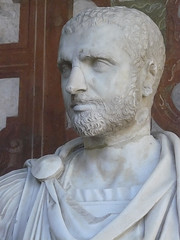
Roman emperor Otho in 69 CE.  
Photographed at The Louvre in Paris
by Mary Harrsch.
"Galba's reign did not last long and he was soon deposed by Marcus Otho. Otho did not use the title "Caesar", but occasionally used the title "Nero" as emperor. Otho was then defeated by Aulus Vitellius who acceded with the name "Aulus Vitellius Germanicus Imperator Augustus." Vitellius did not at first adopt the cognomen "Caesar" as part of his name, and may have intended to replace it with "Germanicus" (he bestowed the name "Germanicus" upon his own son that year).

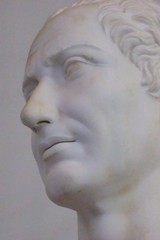
Publis Septimus Geta 3rd century CE.
Photographed at the Palazzo Altemps
in Rome by Mary Harrsch.
Nevertheless, Caesar had become such an integral part of the imperial dignity that its place was immediately restored by Titus Flavius Vespasianus ("Vespasian"), whose defeat of Vitellius in 69 [CE] put an end to the period of instability and began the Flavian dynasty. Vespasian's son, Titus Flavius Vespasianus became "Titus Caesar Vespasianus". - Wikipedia

Following the Flavians, the emperor Nerva assumed the title as well then passed it on through adoption to his heir  Caesar Nerva Traianus who, supposedly, adopted his heir Hadrian, passing the title to him.  At this point our path once more converges with Gibbon.


I thought it was also interesting to read that to further distinguish the use of the name to designate the imperial heir, the title Nobilissimus (meaning "most noble") was added in the 3rd century CE beginning with  Publius Septimius Geta.


If you enjoyed this post, never miss out on future posts by following me by email!


Thursday, July 23, 2009

Caesar's Fables and the Price of Fame


I was working on my "virtual" Julius Caesar today, a natural language conversational agent depicting a resurrected Julius Caesar, when I happened upon this fascinating excerpt from Maria Wyke's book, "Caesar: A Life in Western Culture" about all of the fables that have grown up around the man and the myth that was Julius Caesar. I had been specifically searching for references to his unique horse "Toes".

Wyke observes:

Every conqueror needs a distinguished horse which only he can ride. A number of classical sources note that Julius Caesar possessed such a horse, born on his own lands, whose front hooves resembled feet since they were divided in such a way that they looked like toes. This unusual condition was interpreted by a soothsayer as an omen that the master of such a horse would one day rule the world. Naturally, the horse would endure no other rider save Caesar. This observation in Caesar’s ancient biography seems to recall the characteristics of Bucephalus, the wild horse tamed by Alexander, which provided that hero too with an oracle predicting world empire. In medieval romance, Alexander’s horse becomes a horned creature so wild that it eats men. In a later medieval epic on Julius Caesar, in addition to unmistakable feet, his horse gains a fabulous horn on its head with which it can topple other riders and their mounts. A number of depictions survive in which this mythic horse (rather than its owner) is in sharp focus. A colourful earthenware dish of the early sixteenth century, which captures a moment in the triumph of Julius Caesar, appears to jettison the medieval horn in favour of a more rational spike attached to a harness, but all four of the horse’s human feet remain clearly visible as it is ridden on parade by a youth, who carries a globetipped branch to signify that their master is ruler of the whole world . - Caesar: A Life in Western Culture

I found her discussion of Caesar as one of the medieval "Nine Worthies" quite interesting as well:

The mature Caesar was also included in the medieval canon of the Western world’s greatest military heroes. This collection of champions, or Nine Worthies (‘neuf preux’), was first identified, categorized, and made popular in the early fourteenth century in a poem composed by a French jongleur or itinerant ministrel. Joining a neatly composed arrangement of three Christians, three Hebrews and two other pagans (Hector and Alexander the Great), Julius Caesar along with the rest was made to embody chivalric goodness, wisdom, prowess and valour. Perfect warriors, the Nine Worthies conferred glory on their nations and provided patterns of both military virtue and moral conduct for imitation. They frequently appeared on frescoes, tapestries, enamelled cups and playing cards owned by medieval princes and noblemen. In a similar way to a collection of saints, their role was to exhort a supposedly degenerate present to live up to medieval ideals projected back into the past. In this line-up, Julius Caesar was conventionally distinguished by his imperial crown and the crest of a two-headed eagle emblazoned on his medieval armour. In a fourteenth-century tapestry of the Nine Worthies commissioned by the Duke of Berry (and now surviving only in parts), a majestic and heavily bearded Caesar sits enthroned within a fantastic Gothic niche. He grasps a broad, unsheathed sword and is surrounded by his courtiers (mainly musicians, but also a soldier and, directly above him, his lady). His heraldic symbol of the double-headed imperial eagle is woven in sable on gold." Caesar: A Life in Western Culture

The idea of a heavily-bearded Caesar seemed pretty far-fetched since Caesar was so meticulous about his appearance he frequently had his body plucked to remove any unsightly hair (except on the top of his head) and all ancient sculptures of him show him clean shaven like most military men of the late Republican era.

[Image: Imperial Statue from the Antonine Period with modern head of Julius Caesar, Museo Archaeologico di Napoli. Photo by Mary Harrsch]

Wyke also said medieval chroniclers further elaborated on the evil portents preceding Caesar's assassination. In addition to the ancient references to horses Caesar had dedicated to the gods that would no longer graze but wept abundantly; a bull Caesar was sacrificing turning out to have no heart and a ‘king’ bird torn to pieces by other birds in Rome’s senate-hall, a 15th century poem related:

"... on that dark night, at the sixth hour, when the betrayal was arranged, terrible voices were heard clamouring in the sky, the earth quaked as if it were releasing a great sigh, fires with bloody tails circled through the air in battle, a lamb cried out ‘Slaughter! Slaughter!’, oxen pointed out to their ploughmen the pointlessness of carrying on …"

These strange manifestations of fame that Caesar openly sought seem to point to the fulfillment of an eerie prophecy by Cicero during his own on-again, off-again relationship with Caesar.

"Posterity will be staggered to hear and read of the military commands you have held and the provinces you have ruled … battles without number, fabulous victories, monuments and shows and Triumphs. And yet unless you now restore this city of ours to stability by measures of reorganization and lawgiving, your renown, however far and wide it may roam, will never be able to find a settled dwelling-place or firm abode. For among men still unborn, as among ourselves, there will rage sharp disagreements. Some will glorify your exploits to the skies. But others, I suggest, may find something lacking, and something vital at that. (Cicero, pro Marcello 28รป9. Trans. M. Grant, 1969)"

[Image: Marcus Tullius Cicero. 1st century BCE. Capitoline Museum, Rome, Italy. Photograph by Mary Harrsch]

Yet, the two-edged nature of such fame, however, has served men's purposes through the centuries.

"Caesar has been deployed to legitimate or undermine the authority of kings, to justify or denounce the coups of generals, to launch or obstruct revolutions, to demonstrate incisive literary style and perfect grammar, to teach military strategy and tactics or the workings of fortune and destiny, to display luxury, to play out sexual excess, to stimulate expenditure and consumption. Moreover, the history of Caesar’s reception is not only a matter of re-presenting him in ways that speak to the present (in paintings, plays, novels, operas, films and computer games, as well as in political speeches and historical treatises); it is also often a matter of adopting aspects of his life in someone else’s, or replicating his murder for political reasons—a matter of becoming or removing a new Caesar. - Caesar: A Life in Western Culture

Like Achilles who accepted death to obtain enduring fame, I think Caesar would have found it a worthy trade off.
If you enjoyed this post, never miss out on future posts by following me by email!


Friday, May 16, 2008

French divers discover bust of Caesar in the Rhone


"French archaeology divers have discovered a marble bust of an ageing Caesar in the Rhone river that could be the oldest known of the Roman emperor.

The life-sized bust showing Caesar with wrinkles is tentatively dated to 46BC.

A statement issued by French culture minister Christine Albanel called the find "exceptional" and said that the Caesar bust was "the oldest representation known today" of Caesar.

Divers have uncovered the bust and a collection of other finds in the Rhone near the town of Arles, which was founded by Caesar.

Among other items in the treasure trove of ancient objects is a 5.9 foot marble statue of Neptune, dated to the first decade of the third century after Christ.

Two smaller statues, both in bronze and measuring 27.5 inches each also were found, one of them, a satyr with his hands tied behind his back, "doubtless" originated in Hellenic Greece, the ministry said."

I see classicist Mary Beard doesn't think so though:

"This sculpture is, I should say, a very nice piece of work – and looks remarkably good for something that has been at the bottom of the Rhone for a couple of thousand years. There is, I suppose, a remote possibility that it does represent Julius Caesar, but no particular reason at all to think that it does – still less to think that it was done from life. (How do you compare something less than a centimetre with a bust of the better part of a metre?)

The game of art-historical snap is a risky business, and honestly you could find hundreds of Romans who, with the eye of faith, look pretty much like this. Besides – despite all you get told about the style of the portrait pinning it down to a few years – this style of portraiture lasted for centuries at Rome. There is nothing at all to suggest that it came from 49-46 BC.

The desperate archaeologist in this case has, of course, found a nice reason for imagining how a made-from-life portrait of Julius Caesar might have ended up at the bottom of the Rhone. It was chucked there after Caesar had been assassinated and so had fallen from favour.

Has he forgotten that that was the very moment when Caesar was turned into a god?"

She makes her point by including a picture of a coin featuring Caesar's image.

If you enjoyed this post, never miss out on future posts by following me by email!


Wednesday, May 14, 2008

Caesar's Assassins Financial "Rape" of the East

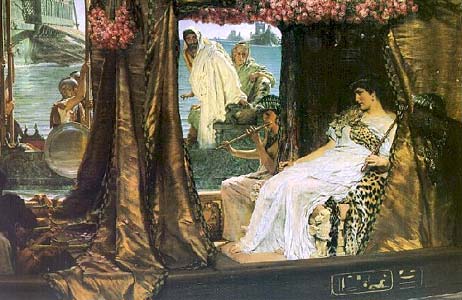
Right now I am listening to Colleen McCullough's latest Roman novel, "Antony and Cleopatra". Colleen paints a much more intellectual Antony than many ancient sources did. In the novel, Antony's meeting with Cleopatra in Tarsus was not at all the seduction experience depicted by so many others. It was more of a contest of wills with Antony trying to "bring Cleopatra to heel" and Cleopatra, of course, having none of it. This is in contrast to the effect Cleopatra had on Antony according to Plutarch:

" Antony was so captivated by her, that while Fulvia his wife maintained his quarrels in Rome against Caesar by actual force of arms, and the Parthian troops...were assembled in Mesopotamia, and ready to enter Syria, he could yet suffer himself to be carried away by her to Alexandria, there to keep holiday, like a boy, in play and diversion, squandering and fooling away in enjoyment that most costly, as Antiphon says, of all valuables, time." - Plutarch


The novel also emphasizes the financial "rape" of the east by Cassius during the civil war following Caesar's assassination. The sheer lack of resources in the traditional centers of the East is portrayed as the reason Antony turned to Cleopatra in the first place to fund his Parthian campaign.


Antony initially, at the urging of one of his advisors, charges Cleopatra with providing aid to the conspirators when she sent four legions from Alexandria to the governor of Syria who subsequently diverted them to Cassius. Cleopatra points out that Egypt was suffering from plague and famine at the time so she was only too glad to comply with the request of Sextus, the legitimate Roman governor of Syria to remove the burden of feeding the legions from Egypt's dwindling grain supply. According to Cassius Dio, Sextus was actually a relative of Caesar so Cleopatra would not have viewed granting a request by him as accommodating Caesar's assassins.

"The governor of Syria was Sextus; for since he was not only quaestor but also a relative of Caesar's, Caesar had placed in his charge all the Roman interests in that quarter, having done this on the occasion of his march from Egypt against Pharnaces." - Cassius Dio

Cleopatra in turn pointed out that it was also not her fault that the fleet she sent in support of Antony and Octavian was destroyed in a storm at sea.

I find these complex exchanges during and following the civil war with the conspirators most interesting. If you read book 47 of Cassius Dio's history of the period, you discover that there were various Romans from both sides of the controversy running around in the east claiming to be provincial governors and engaging in battles to assert their claims and issuing edicts to squeeze money from eastern populations.

"...learning that Caesar [Octavian] was growing stronger, they [Brutus and Cassius] neglected Crete and Bithynia, whither they were being sent, since they saw no prospect of any noteworthy aid in those countries; but they turned to Syria and to Macedonia, although these provinces did not belong to them at all, because they excelled as strategical positions and in point of money and troops. 2 Cassius went to Syria, because its people were acquainted with him and friendly as a result of his campaign with Crassus, while Brutus proceeded to unite Greece and Macedonia. For the inhabitants of those districts were inclined to give heed to him in any case because of the glory of his deeds and in the expectation of similar service to their country, and particularly because he had acquired numerous soldiers, some of them survivors of the battle of Pharsalus, who were even then still wandering about in that region..."

"...He [Brutus] reached Macedonia at the moment when Gaius Antonius had just arrived and Quintus Hortensius, who was his predecessor in the governorship, was about to retire; however, he experienced no trouble. For Hortensius embraced his cause at once, and Antonius was weak, being hindered during Caesar's supremacy in Rome from performing half of the duties belonging to his office. Vatinius, who was governor of Illyricum near by, came from there to Dyrrachium, seized it before Brutus could prevent it, and acted as an enemy in the present strife, but could not injure him at all; for his soldiers, who disliked him and furthermore despised him by reason of a disease, went over to the other side. So Brutus, taking over these troops, led an expedition against Antonius, who was in Apollonia; and when Antonius came out to meet him, Brutus won over his soldiers, shut him up within the walls when he fled thither before him, and captured him alive through betrayal, but did him no harm. After this success, Brutus next acquired all Macedonia and Epirus, and then despatched a letter to the senate, stating what he had accomplished and placing at its disposal himself as well as the provinces and the soldiers. The senators, who, as it chanced, already felt suspicious of Caesar [Octavian], praised him[Brutus] highly and bade him be governor of all that region..."

If you enjoyed this post, never miss out on future posts by following me by email!