Showing posts with label Egypt. Show all posts

Saturday, August 14, 2021

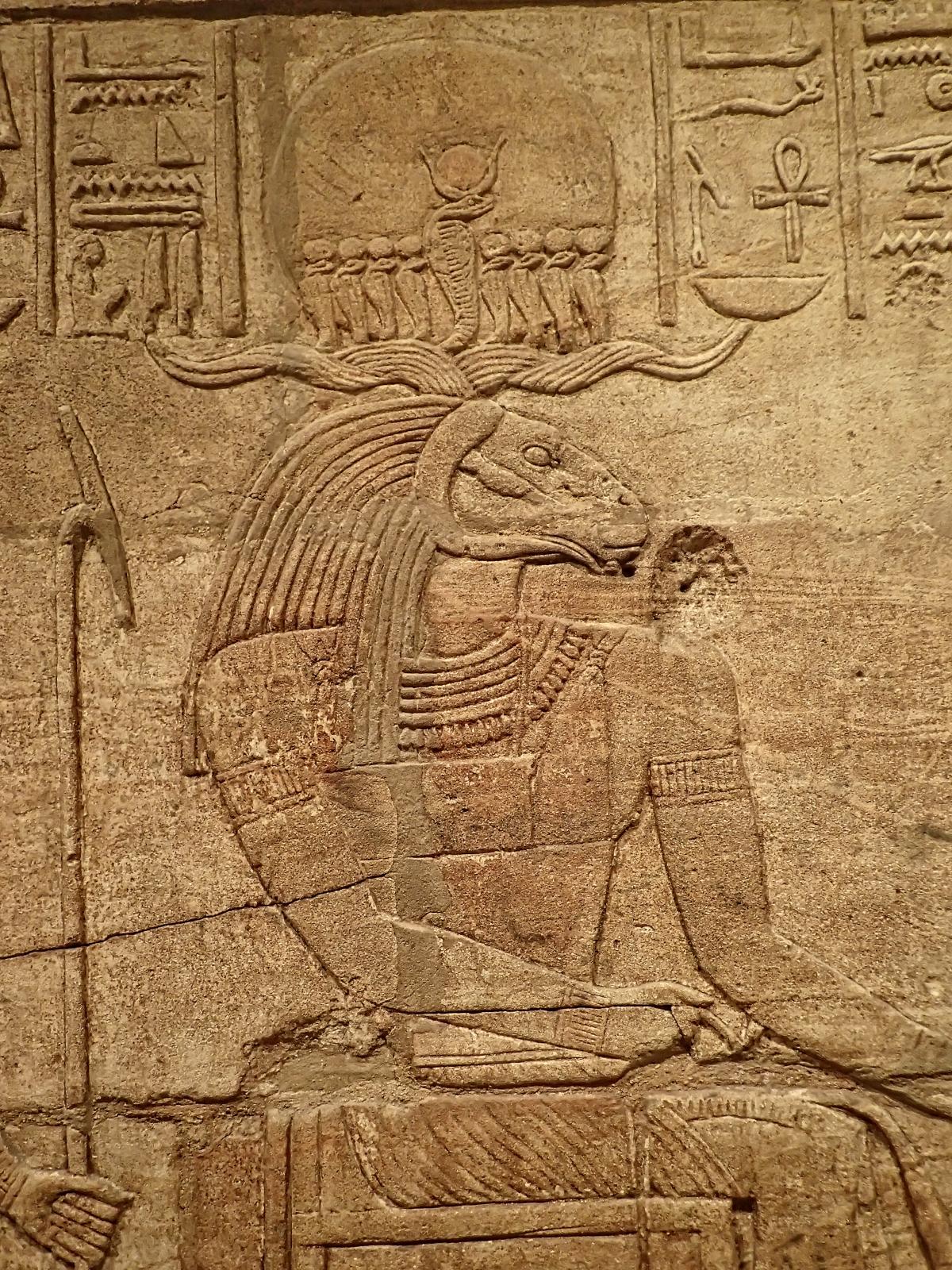
The Syncretization of Zeus Ammon and the Oracle of Siwa

Zeus was identified with the Roman god Jupiter and associated in the syncretic classical imagination with various other deities, such as the Etruscan Tinia and the Egyptian Amun (Ammon). He, along with Dionysus, absorbed the role of the chief Phrygian god Sabazios as well in the syncretic deity known in Rome as Sabazius.

Ammon was origiinally a Libyan deity.  His oracle, situated in the Siwa oasis, 500 kilometers west of Memphis became known by the Egyptians as "Amun of Siwa, lord of good counsel." Siwa is believed to have been occupied as early as Paleolithic and Neolithic times, and some believe at one time it was the capital of an ancient kingdom that may have included Qara, Arashieh and Bahrein. 

According to one myth the temple at Siwa was founded by the Greek god Dionysus. While lost in the Western Desert, Dionysus was perishing of thirst when a man appeared and guided him to the spring at Aghurmi. In gratitude, Dionysus erected the temple. In other myths, the Oracle of Siwa is reputed to have cursed Andromeda who was then tied to a rock to be devoured by a sea-serpent. Perseus is said to have stopped off to visit the Oracle prior to beheading Medusa, and Hercules is though to have visited it before he fought Bursiris.

"Siwa was too far away and too isolated to be a real part of the Egyptian kingdom, but there may have been indirect control. We are certain that during the Nineteenth Dynasty, there was a fort north of Siwa, at Umm el-Rakham on the coast. This proves that the pharaohs were interested in the far west. After the fall of the New Kingdom, Siwa was certainly independent, and it is no strange idea that the Libyan kings of the Twenty-Second and Twenty-Third Dynasties were somehow related to the rulers of Siwa."

"Siwa finally became a fully integrated part of Egypt after the domestication of the dromedary had made desert travel easier, for example to Egypt in the east, the Cyrenaica in the northwest and the Nasamones in the west. Among the oasis' exports was salt." - Livius.org

When the Libyan tribes assisted in the ascension of the pharaoh Amasis (r. 570-526 BCE), the pharoah built a shrine at site.  The Lydian king Croesus, an ally of Amasis, is said to have offered sacrifices to the god Ammon. Documented by Herodotus, it is assumed that the cult had spread beyond Egypt by then (560-546 BCE). A second temple at the oasis was built by Nectanebo II ( (r. 359/358-342/341 BCE). 

The first Greeks to visit the shrine were people from Cyrenaica, who knew the site through caravan trade. They called the god Zeus Ammon and the poet Pindar (522-445 BCE) was the first Greek to dedicate an ode to the god and one of the first Greeks to erect a statue to the god at Thebes and at Sparta. 

“and one day Apollo, in his gold-filled house,
will admonish him by oracle,
when at length he enters the Pythian shrine,
to lead a host of men in ships
to the rich precinct of Zeus Ammon by the Nile.”

Pindar, Pythian 4

Later visitors included the Persian king Cambyses, the Athenian commander Cimon, the athlete Eubotas, the Spartan general Lysander, the Macedonian king Alexander the Great, and the Carthaginian commander Hannibal.

Cambyses was said to have wanted to destroy the Oracle but lost his army in a raging sandstorm in the Western Desert instead. Pliny tells us that this was because the sacred stone at the temple was touched by a sacrilegious hand.

In 449 BCE Cimon, the Athenian general, waiting at Cyprus, sent emissaries to the Oracle to ask if he should attack Egypt.  Upon reaching the temple, his emissaries were told "Cimon is already with me!". When they returned to Cyprus they learned that Cimon had died at the same moment as they were speaking with the Oracle.

About 409 BCE, Eubotas, the famous Cyrene athlete sought advice from the Oracle and Lysander, the Spartan general, made two treks to consult with the Oracle. 

In his "History of Alexander," Quintus Curtius writes:

What is worshipped as the god does not have the same form that artificers have commonly given to the deities; its appearance is very like that of a navel fastened in a mass of emeralds and other gems. When an oracle is sought, the priests carry this in a golden boat with many silver cups hanging from both sides of the boat; matrons and maidens follow, singing in the native manner a kind of rude song, by which they believe Jupiter is propitiated and led to give a trustworthy response. (4. 23-25)

Then, after sacrifice had been offered, gifts were given both to the priests and to the god, and the king’s friends also were allowed to consult Jupiter. They asked nothing more than whether the god authorized them to pay divine honours to their king. The prophets replied that this also would be acceptable to Jupiter. (4. 28-29)

Such was the oracle's reputation among the Classical Greeks that Alexander the Great, declared "the son of Amun" by the oracle at Siwa, thereafter considered himself divine.

As for Hannibal, I only found a reference that he visited the Oracle. I wish we knew what he asked and what response he received.

Under Roman administration, the Oracle began to decline in importance.  Not before Cato (the Younger?), though, attempted to consult the Oracle about the freedom of Rome. One source claims the Oracle refused to answer.  Another source claims it was Cato who refused to speak in his effort to challenge and disparage the Oracle. Inscriptions dating to as late as the reign of Trajan have been found there, though.


Fragment of a clay slab depicting Jupiter Ammon, 1st century CE, polychrome terracotta at the Museo Barracco in Rome, courtesy of Wikimedia Commons contributor Archeologo


Bronze bust of god Sabazios, 2nd-century CE, in the collections of the Musei Vaticani courtesy of Wikimedia Commons contributor Jebulon.

Tinia, highest god in Etruscan mythology, equivalent to the Roman Jupiter and the Greek Zeus. Terracotta, 300-250 B.C.E. now in the collections of the Staatliche Antikensammlungen in Munich, Germany, courtesy of Wikimedia Commons contributor Dan Mihai Pitea.

Head of a colossal statue of ram-horned Zeus Ammon, Roman Tunisia (?), 150-180 CE, courtesy of Wikimedia Commons contributor Carole Raddato.

Zeus Ammon. Roman copy of a Greek original from the late 5th century BCE. The Greeks of the lower Nile Delta and Cyrenaica combined features of supreme god Zeus with features of the Egyptian god Amun-Ra, now in the collections of the Staatliche Antikensammlungen in Munich, courtesy of Wikimedia Commons contributor Dan Mihai Pitea.

Ancient Roman statue of Zeus Ammon found in Pergamon, now in the collections of the Istanbul Archaeological Museum, courtesy of Wikimedia Commons contributor Giovanni Dall'Orto

Aequipondium (steelyard counterweight) in the shape of a Jupiter Ammon, 190-210 CE, courtesy of Wikimedia Commons contributor Sailko

Head of Zeus Ammon, 1st-2nd centuries CE, Roman copy of a Greek original now in the collections of the Hermitage Museum in St. Petersburg, Russia.

Diorite head of a Ptolemaic king (Ptolemy I?) as Zeus Ammon, from Egypt, now in the collections of the Istanbul Archaeological Museum

A Marble Head of Zeus Ammon, Roman Imperial, 120-160 CE recently sold for $3,554,500. by Sotheby's.

Coin from Cyrene, showing Zeus-Ammon now in the collections of the Kunsthistorisches Museum, Vienna (Austria)

Entrance to the oracle courtesy of (https://www.livius.org/pictures/egypt/siwa/siwa-oracle/)

View of the sanctuary courtesy of (https://www.livius.org/pictures/egypt/siwa/siwa-oracle-1/) Note: with sky replacement - hey, plain blue sky is boring!!
If you enjoyed this post, never miss out on future posts by following me by email!


Thursday, August 12, 2021

Ptolemaic dynastic portraits using a combination of marble and stucco: Economy, Practicality, or Distinctive Style?

 "Beginning with Ptolemy I Soter, the Ptolemaic dynasty reigned from 305 BCE to 30 BCE, when the last Ptolemaic ruler, Kleopatra VII, committed suicide, and Octavian made Egypt a province of Rome. In their capital at Alexandria and in historically prominent Egyptian cities and sanctuaries, the Ptolemies continued the practices of their pharaonic predecessors in an attempt to integrate themselves into Egyptian society and their images into Egypt’s visual culture," explains Yale University's Susan B. Matheson. "They employed architecture and sculpture to help establish their rightful place as rulers and to present themselves as a dynasty like those that came before. This impressive display of public art featured primarily Egyptian iconography and style. Egyptian dress and traditional royal and divine attributes were typical, and inscriptions were generally in the native hieroglyphic script."

Matheson points out that Ptolemaic dynastic portraits ranged from those appearing  as purely Greek, to those styled as purely Egyptian with some portraits rendered as a blend of both elements.

"It is likely that the sculptors commissioned to carve them determined the material, iconography, and style based on the wishes of their clients and the ultimate function of the portrait, Matheson notes, "Although there may have been official portrait types that emanated from Alexandria, as was later true of imperial portrait types disseminated from Rome, the king would find it expedient to have his image correspond to the preferences of local priests and officials."

Way back in 1925, classical archaeologist A. W. Lawrence in his article "Greek Sculpture in Ptolemaic Egypt" observes "It has been said that an Alexandrian School existed with ideals markedly different from those of the rest of the Hellenistic world."  Unfortunately, he does not really seem to recognize a blending of styles of the Egyptian with the Greek. He describes the works produced in Egypt as a poorly executed impressionist technique in which less than able local sculptors "neglect detail in their modelling and trust to the soft finish to conceal the fact that they had put no more work than they could help into the different parts of the face but merely made it up of various blank planes."

Egyptian sculptures from the Ptolemaic period often featured details added separately in stucco. Sometimes the entire head was imported from Greece or Asia Minor with the hair or hair extensions, beards, diadems, veils, etc. added in stucco once the work arrived in Egypt.  Some scholars point to this practice as common then because marble had to be imported and was therefore quite expensive.

Lawrence dismisses this observation as well.  

"This habit of finishing things in stucco has been put down to a desire to economize in marble, which is not found in Lower Egypt and so was naturally expensive there.  But in most cases, the quantity saved is infinitesimal, and the practice was employed in other countries where marble was abundant," Lawrence says. "It seems therefore to have been a device to save labour rather than material."

I doubt to some extent the conservation of materials as a reason for the use of stucco as well.  But, although some portrait heads seemed to have been prepared for stucco additions only on the top part of the head, others, like the portrait of Ptolemy I Soter appear to have used marble only for the face while the entire back of the head is assumed to have been completed in stucco.  This would appear to support the economy of materials theory. 

Classicist Flavia Vanni at the University of Birmingham, in her research for her PhD thesis, "Byzantine Stucco Decoration: Cultural and Economic Implications Across the Mediterranean World, 850-1453," points out that, from a shipping perspective, big bulky pieces of marble were not divisible cargo either, so incurred more cost because of the amount of space they consumed in a cargo hold.

I also can't fully embrace the labor saving aspect of the practice either, as Lawrence proposes, at least in respect to the original production. The labor expended in crafting an ornate hair style or diadem even in stucco surely would have been roughly equivalent to carving the remainder of the marble head. Lawrence's criticisms of style and workmanship seem to cast aspersions on the skill and dedication of Egyptian sculptors in the Ptolemaic Period. Due to the date of the article (1925) I can't help but suspect that Lawrence may have allowed his British colonial perceptions of Egyptians at the tiime to bias his observations, even if he was the brother of T.E. Lawrence (of Arabia).

So if the stucco additions were not the result of economy, either of materials or labor, why was this practice employed for a number of Ptolemaic dynastic portraits? Thinking of the turbulent history of this family and the frequent fratricides and changes in succession, I wondered if stucco was used on the top or back of the head and beards so changes in dynastic succession could be more easily depicted without recarving much of an expensive marble portrait.

I've seen a number of Roman portraits where one emperor's portrait was recarved into a subsequent emperor. Recarving a portrait of Nero is always a challenge because sculptors often cannot disguise telltale remnants of his sideburns and longer than normal hairstyle.  If the hair and sideburns had been rendered in stucco, a hairstyle alteration could have been relatively easy to remove and replace. The Ptolemies, following traditional Egyptian style, also attempted to have their portraits resemble, to some extent, their predecessors as a visual reference to the enduring nature of their dynasty, so recarving would be relatively minimal if a change in succession occurred. 

However, I don't know of many monarchs modest enough that would commission artwork of themselves with thoughts as to its subsequent recarving by their successors.

Of course the use of stucco could have been a further attempt to blend Egyptian and Greek traditions. The use of lime and gypsum plasters in Egypt date back to the 3rd millenium BCE. The famous bust of Nefertiti dating to 1345 BCE is an exquisite example of stucco's extensive use in the production of  sculpture "in the round" in ancient Egypt.

Lawrence does mention portraits outside of Egypt using a combination of marble and stucco in areas with abundant sources of marble. I found one on Christies auction site. It is tentatively identified as the Seleucid King Demetrios III Eucaerus (well-timed), on the basis of comparison to his coin portraits. 

"Both portraits share the prominent hooked nose and a beard. Many late Seleucid portraits are indebted in style to contemporary Ptolemaic imagery, since they were able to maintain their hold over their territories only through Ptolemaic support. Demetrios III was the son of Antiochos VIII Grypos (Hook-nose). He was able to recover part of his father's territories in 95 B.C. with the help of Ptolemy IX Lathyrus. He was eventually defeated by the Parthian king Mithridates II, who kept him in confinement until his death in 88 B.C.E." - Christies

Such emulation of Ptolemaic dynastic sculpture may point to recognition of the use of stucco as a distinctive artistic style.

What do you think?


Portrait head of a late Ptolemaic ruler possibly Ptolemy IX, Hellenistic Period, Late 2nd - early 1st century BCE, marble from Paros with stucco added in Egypt, now in the collections of the Museum of Fine Arts Boston, image courtesy of the museum. "With its large eyes, long face and aquiline nose, this is a powerful and unforgettable image of a semi-divine king. It continues, while altering and exaggerating, the tradition of late third century Ptolemaic portraiture. The head was converted from a slightly earlier, beardless image. It was cut down at the sides of the neck, and a beard and new hairline were created with stucco. Egyptian sculptures from the Ptolemaic period often featured details added separately in stucco. Sometimes the entire head was imported from Greece or Asia Minor with the hair or hair extensions, beards, diadems, veils, etc. added in stucco once the work arrived in Egypt. Some scholars point to this practice as common then because marble had to be imported and was therefore not readily available.
"The three times life-sized head, found at Memphis in what appears to have been a temple or shrine of the Hellenistic and Roman periods, was carved in Greek marble, with hair, the tip of the nose, and beard finished in stucco. Reddish ground color remains in the pupils of the eyes and on the lips. There are traces of stucco on the neck and possible touches of gold on the stucco in the hair. The marble surface below the beard was smoothed and polished, then scarred by diagonal incisions to hold the stucco, suggesting the portrait did not originally have a beard. The complete statue must have been about twelve feet high if seated, and well over fifteen feet if standing. The head comprises only a marble mask and neck, the area behind being hollowed out."
Most scholars agree that the head bears closest resemblance to Ptolemy IX (reigned 116–107 and 88–80)." - Museum of Fine Arts Boston. 


Extensively restored marble portrait head of Ptolemy I Soter, 4th - 3rd century BCE, only face is original, probably the entire skull was completed in stucco, courtesy of The Louvre.

Arsinoe III portrait with missing stucco hair at the Yale University Art Gallery. By all accounts, Arsinoe III Philopater (ca. 245–204 BCE) was a remarkable woman. A highly educated member of the Ptolemaic dynasty, she reigned as Queen of Egypt after marrying her brother, Ptolemy IV, in 221/220 BCE, until she was murdered in 204 BCE in response to her role as regent for her 6-year-old son, Ptolemy V. The Greek historian Polybius reports that Arsinoe accompanied her husband into battle at Raphia in 217, an event also recorded in the ancient text, 3 Maccabees. According to the poet and mathematician Eratosthenes, the queen condemned her husband’s infamous worldly excesses, providing a counterweight to the stereotypical decadence of the Ptolemies.

Ptolemy III Evergeta or Ptolemy IV Philopator or Ptolemy VI Philometor marble portrait head that would have had additional above the hair and across the back of the skull, 4th - 3rd century BCE, courtesy of The Louvre

Marble portrait head of Ptolemy XII Aulete with traces of stucco on the back of the skull, 2nd half of 1st century BCE to 1st century CE, courtesy of The Louvre

Head of Arsinoe II at The Louvre in Paris, 250-200 BCE, missing hair and possibly headdress that would have been finished in stucco.

Marble head, portrait of the queen Arsinoe II as Aphrodite. The hair is incomplete because it was made in stucco following the Alexandrian custom, due to the rarity of Greek marble in the capital of Hellenistic Egypt. Ptolemaic period. Arsinoe II was deified in the guise of Aphrodite after her death in 270 BCE, courtesy of Ekinium Gallery

Marble head, portrait of the queen Arsinoe II as Aphrodite. The hair is incomplete because it was made in stucco following the Alexandrian custom, due to the rarity of Greek marble in the capital of Hellenistic Egypt. Ptolemaic period. Arsinoe II was deified in the guise of Aphrodite after her death in 270 BCE, courtesy of Ekinium Gallery

Portrait head of a Ptolemic queen with missing stucco headdress, 270-250 BCE, now in the collections of the Metropolitan Museum of Art in New York. "This monumental head gives an impression of sovereign calm and power, even though the veil that once covered the top and back of the head is now missing. Although the features are cast in a thoroughly classical style typical of the late fourth century B.C., the face is stamped with enough individuality to identify it as a portrait. In all probability, it represents a member of the Ptolemaic dynasty, that succession of Macedonian Greeks who ruled Egypt from the death of Alexander the Great in 323 B.C. until the annexation of Egypt by Rome and the suicide of Cleopatra VII in 30 B.C. Most recently, the head has been identified as Arsinoe II, who ruled together with her brother, Ptolemy II, from 278 B.C. until her death in 270 B.C. Not only was the queen part of a dynastic ruler cult during her life, she was also transformed into an independent deity by her brother after her death. She was worshiped as an Egyptian goddess in association with Isis and also separately as a Greek goddess, with her own sanctuaries and festivals. This strongly idealized head, which resembles classical images of Hera and Demeter, was probably associated with the latter cult."

Ptolemy VIII Euergetes II with unfinished head, mid to late 2nd century BCE at the Yale University Art Gallery

Marble sculpture of Ptolemy of Mauretania from Aquae Calidae, 10-5 BCE according to Landwehr, 5-15 CE according to Fittschen - no stucco additions, courtesy of The Louvre. The use of stucco additions seems to disappear with the arrival of the Romans.

A GREEK MARBLE PORTRAIT OF A MAN LATE HELLENISTIC PERIOD, CIRCA 1ST CENTURY B.C.E. Turned slightly to his right, the short hair coarsely fashioned and completed in stucco, some stucco locks preserved above the forehead, his slender face with bulging, knitted brows and deep-set unarticulated eyes preserving extensive original pigment, including the brows and lashes, the distinctive hooked nose with a humped bridge and a drooping tip, the thin lips pressed together below the trimmed mustache, the beard shaped and roughly picked to be completed in stucco, courtesy of Christies
If you enjoyed this post, never miss out on future posts by following me by email!


Thursday, August 5, 2021

The Transformation of Pharaonic deities to household gods in Roman Egypt

The iconography and style of depictions of Horus and other traditional Egyptian deities were influenced by Hellenistic and, later, Roman traditions of representation, often combining trappings of power in ways that are striking to modern observers.

"Roman period depictions of  the falcon-headed Horus have been  found  in  a  variety  of   materials  throughout  the  empire,  from  Egypt  to  Oxfordshire.  Usually  dressed  in  Roman  military costume, falcon-headed Horus is sometimes depicted on horseback, but more often standing, while seated figures are rare. Although smaller figures may have been dedicatory, larger stone and metal sculptures were probably objects of  public or private devotion." - Polychromy in Roman Egypt: A study of a limestone sculpture of the Egyptian god Horus by Joanne Dyer, Elisabeth R. O"Connell, and Antony Simpson.

Sir Harold Bell observes, "...a new religion, whether introduced by a conquering people or established as the result of a religious reform, never quite obliterates the beliefs and customs existing before its appearance.  Some of these beliefs and customs linger on underground, and so far from disappearing entirely with the passage of time they may even acquire new vitality as the first impulse of the new creed dies away." 

Opposing the traditional “decline of paganism/triumph of Christianity” model most often used to describe the Roman period in Egypt, David Frankfurter, in his text, "Religion in Roman Egypt: Assimilation and Resistance",  argues that the religion of Pharaonic Egypt did not die out as early as has been supposed but was instead relegated from political centers to village and home, where it continued a vigorous existence for centuries.

Even though the Roman emperor Augustus introduced restrictions on Egyptian temples that lead to their economic decline, the worship of traditional Egyptian deities continued in the domestic sphere including the consultation of oracles during the first three centuries of Roman occupation.

Frankfurter points to the continuing role of priests in Egyptian society despite the decline of religious institutions and the use of hieroglyphs for religious and administrative record keeping. Their charismatic leadership, their ritual expertise, and their knowledge of healing and guidance was still valued by the people since the day to day needs of the people - fertility, safety, and health of both individuals and their livestock - did not change.  Only their collective identity as it related to their religious systems evolved. This was accomplished with new divine names and the introduction of Roman iconography. Although divination under Roman administration could be accomplished by any literate individual who could read the sacred texts, no longer encoded in hieroglyphs but written in Coptic Egyptian or Greek, the fact remained that the most literate individuals were still the priests. Religious authority simply shifted from places and buildings to texts and persons in the form of independent "holy men." This resulted in the domestic worship of traditional deities up to the 5th century CE. 

Early Egyptian Christianity was eventually able to capitalize on this existing religious infrastructure. Frankfurter observed that Biblical texts and Christian lore were used not for their ideological content but for oracles and grimoires (magical texts) so what is described in the Coptic texts as the demonization and defeat of local spirits are not victories of one ideology over another but, rather, merely ritual innovations. 

Archaeologist point to the dozens of figurines found in Roman Period burials as evidence of this evolution in Egyptian worship. I find the figurines of Horus depicted in Roman armor to be among the most interesting. I think the ancient Egyptians would have identified the parallel between Horus, the son of Osiris, with Augustus and his descendants as sons of the deified Julius and hence the blending of iconography, especially with the introduction of the Roman emperor cult empire-wide during the reign of Augustus.  I also think it interesting that spectroscopy studies of the terracotta sculpture of Horus in Roman attire at the British Museum revealed the figure's chiton was painted green, the color of rebirth in the ancient Egyptian tradition.  However, the pigment was composed of celadonite, a common green pigment found in Roman art, but virtually unknown in dynastic Egypt. 

For those of you interested in examining this topic further, I would suggest exploring the posts and databases of "The Coptic Magical Papyri: Vernacular Religion in Late Roman and Early Islamic Egypt" project.  This ongoing scholarly effort is a five-year research project (2018-2023) under the direction of the Chair of Egyptology at  Julius Maximilian University Würzburg.  A team  consisting of Korshi Dosoo (research group leader), Edward O. D. Love, and Markéta Preininger are studying the corpus of Coptic  “magical texts” – manuscripts written on papyrus, as well as parchment, paper, ostraca and other materials, and attesting to private religious practices designed to cope with the crises of daily life in Egypt. There are about five hundred of these texts which survive, dating to between the third and twelfth centuries of the common era. Their website points out these documents address " the realities rather than the ideal of religious practices and beliefs as they were experienced and carried out in daily life. They provide rich information about the experiences of people from the periods they document – the transitions from traditional Egyptian religion to Christianity and Islam, the diffusion and interaction of different forms of Christianity (“gnostic” and orthodox, Miaphysiste and Dyophysite, cults of saints and angels), and conceptions of the human and divine worlds – how human experiences such as happiness and success, suffering and sickness, love and conflict were understood and negotiated."

Their English-version website is available here: https://www.coptic-magic.phil.uni-wuerzburg.de/

If you wish to read the full research paper Polychromy in Roman Egypt: A study of a limestone sculpture of the Egyptian god Horus, it is  available from: 

https://www.researchgate.net/publication/303482369_Polychromy_in_Roman_Egypt_A_study_of_a_limestone_sculpture_of_the_Egyptian_god_Horus 

Limestone seated figure of the Egyptian falcon god Horus wearing Roman military dress, from Egypt, Roman period, Roman Empire: Power & People, Leeds City Museum, UK courtesy of Carole Raddato

Limestone seated figure of the Egyptian falcon god Horus wearing Roman military dress, from Egypt, Roman period, courtesy of the British Museum.

Reconstruction of the pigments detected on the Limestone seated figure of the Egyptian falcon god Horus wearing Roman military dress, from Egypt, Roman period, now in the collections of the British Museum.

Roman period copper-alloy figure of the Egyptian god Horus, standing and wearing a nemes headdress and military costume now in the collections of the British Museum, courtesy of the museum.

Bronze figurine of Horus attired as Roman emperor with radiate crown suggestive of Sol Invictus, 2nd century CE, now in the collections of The Louvre in Paris. Image courtesy of the museum and Wikimedia Commons.

Shallow dish with high relief figures of Isis and falcon-headed Horus in Roman attire, possibly 2nd century CE, Egypt now in the collections of the Metropolitan Museum of Art. The curator there points out the feathered neck of the Horus figure suggests disintegration of pharaonic conventions for combining animal and human figures.

Egyptian relief of the God Horus in Roman style armor fighting the evil God Seth in crocodile form, 4th century CE, now in the collections of The Louvre in Paris, image courtesy of the museum.

Bronze figurine of Horus in Roman armor wearing the crowns of upper and lower Egypt at the Museum of Fine Arts Boston courtesy of the museum.


If you enjoyed this post, never miss out on future posts by following me by email!


Friday, July 9, 2021

The transformative shrew in Greco-Roman-Egyptian mythology

When I saw this carefully detailed bronze sculpture of a common shrew from Egypt's Greco-Roman Period, I wondered why the ancients thought this creature worthy of such expense. Although this sculpture is part of the collections of the Cleveland Museum of Art, the Metropolitan Museum of Art also has a similar, though less detailed example from the same period as does the Museum of Fine Arts in Budapest.  

According to The Met, the ancient Egyptians named the shrew, "the voracious", because of its feeding habits. In ancient Egyptian mythology, the shrew represented the blind aspect of the solar deity, “the one with no eyes in his face” (Mechenti-n-irti in old Egyptian) that was complemented by the ichneumon, “the one whose eyes (the Sun and the Moon) are in his face” (Mechenti-irti in old Egyptian), a creature with very keen eyesight. This god with the dual nature was revered in Letopolis as one of the aspects of Horus, who, as myth has it, was blind at birth. 

According to Egyptians, this Horus of Letopolis assists the Sun god during his nocturnal journey on the solar bark which lasted until the sixth hour of the night.

"The shrew assumed the form of the god Horus to enter the afterlife and descended into the darkness of the afterlife to revive the deceased/Osiris. In this phase of the journey, he helped to navigate the solar bark through the dark, while his reforming power accelerated the regeneration of the deceased. The more combative functions in the ascending phase of the Sun god’s journey, after the sixth hour of the night, were given to the companion animal: the ichneumon (mongoose)." - The Museum of Fine Arts, Budapest, Hungary.

The process of transformation from the blind shrew into a seeing being  and from a being of the afterlife/inactive being into a perfectly reborn being able to act dynamically in the light of daytime was therefore viewed as having the ability to grant life in the afterlife. In fact, the hieroglyphic inscription on the front and right side of the plinth on which the shrew sculpture in Budapest stands, asks this temporarily blind aspect of Horus of Letopolis to grant such life to an individual named Imhotep.

As for the shrew's complementary creature, although I am familiar with a mongoose I had never heard it called an ichneumon so did a little research and discovered it was a name used not only for a mongoose but a creature called the pharaoh's rat. Sometimes the name was also used for an otter. It's name in Greek means "tracker" and it was said to be the enemy of the dragon.

According to Pliny the Elder (Natural History, Book 8, 88), "The ichneumon is known for its willingness to fight to the death with the snake. To do this, it first covers itself with several coats of mud, drying each coat in the sun to form a kind of armor. When ready it attacks, turning away from the blows it receives until it sees an opportunity, then with its head held sideways it goes for its enemy's throat. The ichneumon also attacks the crocodile in a similar manner."  

I was aware of the snake-killing reputation of the mongoose but wondered how such a relatively small creature could kill a Nile crocodile.  However, the 1st century CE geographer, Strabo backs up the claim by Pliny saying "The ichneumon [is] most destructive both to crocodiles and asps. The ichneumons destroy not only the eggs of the latter, but the animals themselves. The ichneumons are protected by a covering of mud, in which they roll, and then dry themselves in the sun. They then seize the asps by the head or tail, and dragging them into the river, so kill them. They lie in wait for the crocodiles, when the latter are basking in the sun with their mouths open. They then drop into their jaws, and eating through their intestines and belly, issue out of the dead body."

As late as the 3rd century CE, Marcus Aurelius Olympius Nemesianus, a poet at the court of the Roman emperor Carus, refers to hunting the Ichneumon on river banks among the rushes in his poem Cynegetica. Sadly, the poem is fragmentary and any longer passage describing such a hunt has been lost. If the creature could take on a crocodile, it would seem to me that hunting the beast would be a very dangerous endeavor!

Read more about the cult of the shrew: https://www.mfab.hu/shrew-a-sacred-glutton/


Image: Solid cast bronze sculpture of a shrew, Egypt, Greco-Roman Period, 305-30 BCE, now in the collections of the Cleveland Museum of Art, image courtesy of the museum. 

If you enjoyed this post, never miss out on future posts by following me by email!


Saturday, July 3, 2021

The Napatan Period and Rome's clash with Kush

Napata was founded by Thutmose III in the 15th century BCE after his conquest of Kush. Napata’s location as the southernmost point in the empire led it to become an important religious center and settlement. In 750 BCE, during the political instability of the Third Intermediate Period, the Kushite ruler, Kashta, attacked Upper Egypt. His policy was pursued by his successors Piye, and Shabaka (721–707 BCE), who eventually brought the whole Nile Valley under Kushite control and ruled Egypt as the Twenty-fifth Dynasty. Religion, the arts, and architecture were restored to their Old, Middle, and New Kingdom forms under such pharaohs as Taharqa who built or restored temples and monuments throughout the Nile, including at Memphis, Karnak, Kawa, Jebel Barkal, and elsewhere.

However the dynasty was relatively brief. Taharqa and his successor cousin, Tantamani were constantly in conflict with the Neo-Assyrian Empire. Neo-Assyrian emperor Esarhaddon conquered Lower Egypt about 670 BCE then enlisted the conquered to assist him against the Kushite rulers of Upper Egypt. Necho, who became the ruler of Sais in 672 BCE and subsequently Esarhaddon's vassal, was given new territories possibly including the city of Memphis, 

Taharqa convinced some rulers of Lower Egypt, including Necho, to break with the Assyrians. However, Assurbanipal, who had succeeded Esarhaddon in the meantime, overpowered the coalition and deported the Egyptian conspirators to his capital at Nineveh, killing part of the population of the cities they governed. But, Necho was pardoned and reinstated at Sais with even more new territories.  Some scholars think Ashurbanipal hoped to rely on the loyalty of an Egyptian ally in the event of another offensive led by the 25th Dynasty pharaohs, and perhaps to inspire and strengthen a rivalry between the Kushites and the Saites. 

However, Necho I as slain in 664 BCE near Memphis while defending his realms from a new Kushite offensive led by Taharqa's successor Tantamani while Necho's son, Psamtik, fled to Nineveh under Ashurbanipal's aegis. This Nubian invasion into the Egyptian Delta was subsequently (664-663 BCE) repelled by the Assyrians who proceeded to advance south into Upper Egypt and performed the infamous sack of Thebes. Tantamani eventually abandoned his attempt to conquer Lower Egypt and retreated to Napata. However, his authority over Upper Egypt was acknowledged until the 8th regnal year of his reign at Thebes (or 656 BCE), when Psamtik I dispatched a naval fleet to Upper Egypt and succeeded in placing all of Egypt under his control.

The Napatan dynasty continued to rule the Kushite state, though, which flourished in Napata and Meroë until at least the second century CE. Napatan architecture, paintings, writing script, and other artistic and cultural forms were Kushite in style, but Egyptian burial customs continued, the building of pyramids resumed, and Kushites worshipped several Egyptian deities including Amun and Mut.

Napata began to lose its economic influence after an Achaemenid Persian raid in 591 BCE. The importance of iron propelled Meroe into prominence and it replaced Napata as the capital of Kush. 

In 23 BCE, the Governor of Roman Egypt, Gaius Petronius, invaded Kush with 10,000 men after an initial attack by the queen of Meroë, Kandake, razing Napata to the ground, according to the  Res Gestae Divi Augusti.  In retaliation, the Nubians crossed the lower border of Egypt and looted many statues (among other things) from the Egyptian towns near the first cataract of the Nile at Aswan. 

The destruction of Napata was not a crippling blow to the Kushites, though, and did not frighten Kandake enough to prevent her from again engaging in combat with the Roman military. Indeed, it seems that Petronius's attack might have had a revitalizing influence on the kingdom. In 22 BCE, a large Kushite force moved northward with intention of attacking Qasr Ibrim. Alerted to the advance, Petronius again marched south and managed to reach Qasr Ibrim and bolster its defenses before the invading Kushites arrived. Although the ancient sources give no description of the ensuing battle, we know that at some point the Kushites sent ambassadors to negotiate a peace settlement with Petronius and possibly accept a status like "Client State" of Rome. 

Napata was restored by King Natakamani, who renovated the temple of Amun and constructed a palace. But eventually the site was abandoned and its buildings plundered and destroyed. This may have been the result of a change in religious practices.  The first archaeologist to excavate the site, George Reisner, discovered two caches of statues, thought to have once adorned the Temple of Amun, comingled with ash indicating they had been purposefully destroyed.

Amethyst lion's head pendant, Napatan, Egypt, Dynasty 25, now in the collections of the Cleveland Art Museum, image courtesy of the museum. This pendant consists of two parts: a superbly carved lion’s head in amethyst that has been set into a D-shaped gold base consisting of a platform surrounded by eight seated baboons. The lion’s head is an heirloom from the New Kingdom, most likely a gaming piece that had been adapted in the Napatan period to serve as an pendant amulet.

Sandstone Omphalos depicting Nubian shrine, Meroitic Period, 100-200 CE, from Gebel Barkal Temple B 500, now in the collections of the Museum of Fine Arts Boston, image courtesy of the museum. Once thought to be a shrine imitating the form of a traditional African shelter, this hollow dome-like object of sandstone can now be identified as a model of Gebel Barkal, the "Pure Mountain" of Napata, which was the chief sanctuary and coronation center of Kush and the site of the oracle of Amun, said to select each new king following the death of his predecessor. The form of the object imitates the unique Napatan hieroglyphic symbol for Gebel Barkal, which appears several times in the stele of Nastasen (cat. 265). As a hieroglyph, the mountain is shown as a dome with a uraeus or cobra diadem rising from one side.
From the Egyptian New Kingdom onwards, Gebel Barkal was believed to be the residence of the southern (and primeval) form of the Theban god Amun, who was known as "Amun of Napata, dweller in the Pure Mountain." Because of the 75-meter high pinnacle on the southern corner of Gebel Barkal, which in silhouette looks like a rearing uraeus, the mountain was not only identified as the dwelling place of Amun, but was also identified by the Kushites as the true source of kingship in the Nile Valley, from which derived the legitimacy of the Twenty-fifth Dynasty.

Shrine of the 25th dynasty pharaoh and Kushite King Taharqa Egypt 7th century BCE that I photographed at the Ashmolean Museum in Oxford.

Shrine of the 25th dynasty pharaoh and Kushite King Taharqa Egypt 7th century BCE that I photographed at the Ashmolean Museum in Oxford.


Closeup of Shrine of the 25th dynasty pharaoh and Kushite King Taharqa Egypt 7th century BCE that I photographed at the Ashmolean Museum in Oxford.

Closeup of Shrine of the 25th dynasty pharaoh and Kushite King Taharqa Egypt 7th century BCE that I photographed at the Ashmolean Museum in Oxford.

Closeup of Shrine of the 25th dynasty pharaoh and Kushite King Taharqa Egypt 7th century BCE that I photographed at the Ashmolean Museum in Oxford.

Closeup of Shrine of the 25th dynasty pharaoh and Kushite King Taharqa Egypt 7th century BCE that I photographed at the Ashmolean Museum in Oxford.

Closeup of Shrine of the 25th dynasty pharaoh and Kushite King Taharqa Egypt 7th century BCE that I photographed at the Ashmolean Museum in Oxford.

Closeup of Shrine of the 25th dynasty pharaoh and Kushite King Taharqa Egypt 7th century BCE that I photographed at the Ashmolean Museum in Oxford.

Shrine of the 25th dynasty pharaoh and Kushite King Taharqa Egypt 7th century BCE that I photographed at the Ashmolean Museum in Oxford.

Closeup of Shrine of the 25th dynasty pharaoh and Kushite King Taharqa Egypt 7th century BCE that I photographed at the Ashmolean Museum in Oxford.

Closeup of Shrine of the 25th dynasty pharaoh and Kushite King Taharqa Egypt 7th century BCE that I photographed at the Ashmolean Museum in Oxford.

Closeup of Shrine of the 25th dynasty pharaoh and Kushite King Taharqa Egypt 7th century BCE that I photographed at the Ashmolean Museum in Oxford.

Closeup of Shrine of the 25th dynasty pharaoh and Kushite King Taharqa Egypt 7th century BCE that I photographed at the Ashmolean Museum in Oxford.

Closeup of Shrine of the 25th dynasty pharaoh and Kushite King Taharqa Egypt 7th century BCE that I photographed at the Ashmolean Museum in Oxford.

Closeup of Shrine of the 25th dynasty pharaoh and Kushite King Taharqa Egypt 7th century BCE that I photographed at the Ashmolean Museum in Oxford.

Statuette of a Kushite ruler, probably Taharqa, Dynasty 25, 690-664 BCE, Bronze, now in the collections of the Museum of Fine Arts Boston, image courtesy of the museum

Amulet of Pataikos, Napatan Period, reign of Shebitka or Taharqa, 712-664 BCE, Meroe now in the collections of the Museum of Fine Arts Boston, image courtesy of the museum. This faience figure of Pataikos has a faded glaze. He has a scarab on head, hawks on his shoulders and crocodiles under his feet. Winged Sekhmet is at the back, and there is an incised eye on the base.

Statuette of King Taharqa, Napatan Period, Gebel Barkal, 690-664 BCE, Bronze, now in the collections of the Museum of Fine Arts Boston, image courtesy of the museum

Cowroid of blue-green glazed steatite; back carries an incised border of line decoration. Base inscribed with throne name of Third Intermediate Period ruler Taharqa (Khuinefertemre), now in the collections of the Museum of Fine Arts Boston, image courtesy of the museum.


If you enjoyed this post, never miss out on future posts by following me by email!