Showing posts with label Aulus Cornelius Celsus. Show all posts

Sunday, July 30, 2017

Review: A Cabinet of Ancient Medical Curiosities: Strange Tales and Surprising Facts from the Healing Arts of Greece and Rome by J.C. McKeown

A history resource article by Mary Harrsch © 2017

Galen, one of the ancient world's most revered physicians, once said, "The only difference between doctors in Rome and highwaymen is that the doctors do their work in the city, not in the mountains."

What a cynical viewpoint from one of the best of his profession! Obviously, attitudes toward health care were as controversial in the ancient world as they are now, judging from all of the anguish expressed lately by members of the U.S. Congress. It is with these controversies in mind that J.C. McKeown, Professor of Classics at the University of Wisconsin-Madison collected quotes from the ancient sources to produce A Cabinet of Ancient Medical Curiosities: Strange Tales and Surprising Facts from the Healing Arts of Greece and Rome.

McKeown groups his quotes by category, including medicine, religion and magic, the doctor in society, attitudes towards doctors (that included the quote above), anatomy, sex matters, women and children, preventative medicine, treatment and diagnosis, and cures (many dubious if not outrageous.)
Much of the "wisdom" of the ancients he includes in his text leaves you scratching your head or, in some cases, outright appalled. Individuals whose teachings have been the foundation of medical ethics for centuries have expressed sentiments towards the healing arts that I certainly did not expect.

For example, Hippocrates himself once said "I shall begin with a definition of what I consider medicine to be, it consists of freeing patients from their disease, dulling the intensity of diseases, and not taking on hopeless cases, since medicine can do nothing for them."

He goes on to explain, "Some people criticize the medical art because of doctors who refuse to take on hopeless cases. They claim that those they do take on would recover by themselves, while they do not touch those who do need help. If medicine really is an art, they assert, it should cure all alike...But, whenever someone suffers from a disease that is too strong for the resources available to medicine, there should be no expectation that such an affliction can be overcome through medicine."

Hippocrates, the so-called "father of medicine" sounds like an ancient insurance company executive!

Two icons of health in the ancient world, Asclepius god
of medicine and healing and his daughter Hygeia
personification of health depicted as household gods. Roman
100-150 CE Bronze.Photographed at The Getty Villa,
Pacific Palisades, CA 
by Mary Harrsch © 2006
Other quotes, though, elicited a smile.  Pliny the Elder in his Naturalis Historia opines, "It is better to have sexual intercourse infrequently, though it revitalizes sluggish athletes, restores a husky voice, and cures back pain, dull vision, mental problems, and depression."

Some even cloaked a hint of truth within their admonitions. In his On Medicine, Aulus Cornelius Celsus warns, "People with weak constitutions  —most city dwellers and practically everyone who is keen on literature belong in this category — need to monitor their health more carefully than other people, so that by taking precautions they may compensate for the deficiencies in their physical well-being or in their environment or in their activities."

Apparently, Celsus believed anyone who read much must obviously be the Roman version of a couch potato!

One reviewer pointed out that McKeown's little book is best consumed in small bites and I would tend to agree. It is not written as a page turner and McKeown has not made any effort to interpret the remarks or even provide some degree of context to them. But, it certainly raised my awareness of such issues as eugenics in the classical world (see my resulting blog post, Ancient Eugenics: Much More Than Just Selective Infanticide), the ancient practice of talk therapy (I thought it was a modern construct), and that the ancients, though famous for their culinary binges, even dealt with anorexia.  In other words, it made me think! 

A preview:


More suggested reading:


If you enjoyed this post, never miss out on future posts by following me by email!


Thursday, February 3, 2011

Remains of Radish, Cabbage and Hibiscus found in 2000 year-old Roman pharmaceuticals

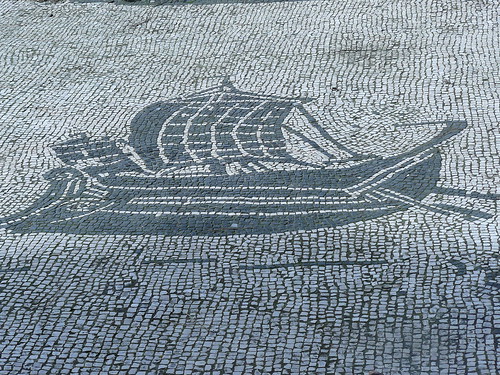
A Roman mosaic depicting a merchant ship in the
Piazzale delle Corporazioni in Ostia Antica near Lazio, Italy.
Photographed by Mary Harrsch.
Medical supplies retrieved from an ancient Roman merchant ship dating back to 130 BCE discovered back in 1980s have finally been analyzed by the Smithsonian Centre for Conservation and Evolutionary Genetics.
Alain Touwaide, historian of sciences in the department of botany at the Smithsonian's National Museum of Natural History obtained the tablets from the Italian Department of Antiquities in 2004.

In the 1980s, divers retrieved several tin containers, 136 vials made of boxwood, a locker and medical tools. The large number of vials suggests the medicines were being shipped rather than being used by the ship's doctor.  The tablets, preserved in small tin boxes, are the first remains of ancient pharmaceuticals to be found and successfully analysed with advanced DNA techniques. - Adrian Higgins, Sydney Morning Herald

Samples from two tablets revealed a dried concoction of medicinal herbs, including celery, alfalfa and wild onion, bound together with clay and zinc.

"The tablets might have been used to treat skin conditions or dissolved in water or wine for intestinal ailments such as dysentery," Touwaide observed.
Illumination of a 14th century Bolognese copy ...Image via Wikipedia
Strange illumination in a medieval copy
of Hippocrates' Aphorismi.

Other ingredients found included radish and cabbage, wild carrot or a relative, yarrow, jack bean, a hibiscus species, willow, aster, the common bean and nasturtium.

Use of some of these herbs in ancient times has come down to us in fragments of an ancient Greek medical text called The Hippocratic Corpus.

Andreas VesaliusImage via Wikipedia
Andreas Vesalius
"The Hippocratic Corpus is a library, or rather, the remains of a library. Although the 34 books included in the Collection were originally attributed to Hippocrates himself, scholars now know that they were more likely composed between the sixth and fourth centuries BCE. Between the career of Hippocrates and the pre-Socratic philosophers, a special kind of prose for medical writings developed in Greece. Although Cos, the island home of Hippocrates, is located within what was a Doric-speaking region, the medical writers of Cos (believed to have written the Hippocratic treatises) appropriated the more refined Ionic dialect of philosophy. Later, during the Renaissance, scientists like Andreas Vesalius would similarly shun using the vernacular, instead penning their medical treatises in Latin." -Alvin V. & Nancy Baird, Joan Echtenkamp Klein, University of Virginia


The benefits of radishes and onions have been known since the time of pyrmaid construction in ancient Egypt.

"The Egyptians made sure that the laborers were fed a diet rich in radish, garlic and onion, which modern researchers have found to be extremely rich in Raphanin, Allicin and Allistatin. These powerful natural antibiotics would certainly help to prevent outbreaks of disease in the often-crowded conditions of the workcamps." - Shuttleworth, Martyn (2010). Ancient Medicine - History of Medicine. Retrieved 03 Feb 2011 from Experiment Resources: http://www.experiment-resources.com/ancient-medicine.html
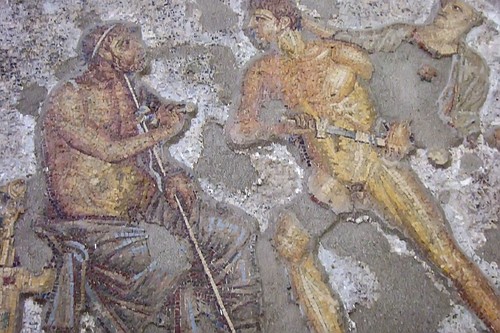
Mosaic depicting Achilles confronting Agamemnon from the House
of Apollo in Pompeii Roman 1st century BCE-1st century CE.
Photographed at the Museo Archaeologico Nazionale di Napoli in Naples,
Italy by Mary Harrsch.
In ancient mythology, Achilles was said to have used yarrow to treat the wounds of his comrades.  Modern researchers admit that yarrow does, in fact, possess blood-clotting qualities and is an effective anti-inflammatory.

The jackbean, a natural source of L-dopa, is currently being studied for its effectiveness against neurological disorders like Parkinson's disease. 

I found it interesting that modern scholars think the Romans used hibiscus to treat skin conditions and when I searched for ancient uses for hibiscus, I found a website on medicinal herbs, Ancient Wisdom Herbs that included a comment that hibiscus is recommended for the treatment of weeping eczema, a skin disease. Willow, another ingredient found in the Roman tablets, was used in ancient Egypt to treat toothache.

Nasturtium, a plant containing a natural antibiotic, benzyl mustard oil, was used in ancient times to treat inflamed wounds, kidney and urinary tract infections and as a blood-cleansing salad.  It is said that Hippocrates located his hospital by a stream with an abundance of nasturtium growing nearby so he could take advantage of a ready supply of the healing herb.  

Portrait of Young Marcus Aurelius, future empe...Image by mharrsch via Flickr
Bust of a young Marcus Aurelius
2nd century CE. Photographed  at
the Palazzo Massimo, Rome, Italy.
Aulus Cornelius Celsus (ca 25 BCE—ca 50 CE), Roman physician and author of  De Medicina, reports using celery for pain relief. In fact, in 1992, pharmacological researchers found that celery contains a chemical called 3-n-butyl phthalide, which relaxes the smooth-muscle lining of blood vessels, making them wider and thereby lowering blood pressure.  This same expansion of the blood vessels would also provide relief for certain types of headaches.

Obviously the Romans had acquired a wealth of knowledge about medically effective herbs long before the celebrated physician Galen began treating gladiators and the emperor Marcus Aurelius in the second century CE.


Roman Medicine (Revealing History)   Ancient Medicine (Sciences of Antiquity Series)   Celsus: On Medicine, Vol. 1, Books 1-4 (De Medicina, Vol. 1) (Loeb Classical Library, No. 292)   Hippocrates (Medicine and Culture)   The Healing Hand: Man and Wound in the Ancient World (Commonwealth Fund Publications)   Ancient Egypt: Modern Medicine
Enhanced by Zemanta
If you enjoyed this post, never miss out on future posts by following me by email!