Showing posts with label ancient Rome. Show all posts

Monday, August 27, 2012

Review: The Sword of Revenge by Jack Ludlow


The Sword of Revenge is the second book in Jack Ludlow's "Republic " trilogy.  One of the main protagonists in this novel is the young outcast, Aquila, the son of the wife of the famous Aulus Cornelius Macedonicus and a Celtic warlord named Brennos who captured her in a Celtic raid in Iberia (ancient Spain).  Aquila has grown up on the small farm of an old ex-legionary who discovered the infant abandoned in the woods with no indication of his parentage except a gold talisman depicting an eagle in flight wound around his foot.

Clodius raises the child as his own but Clodius is a better soldier than a farmer so the struggling family must rely on hunting and fishing just to put food on the table.  One day, Clodius, having drunk a little too much wine, is tricked into accepting the offer of a wealthy neighbor, Piscius Dabo, who says he will provide for Clodius' family if Clodius would serve in the legions as  the wealthy neighbor's surrogate.  In truth, Dabo has previously served in the legions but has found it much more profitable to stay home and buy up all the surrounding farms from other neighbors who have gone off to serve the Republic.
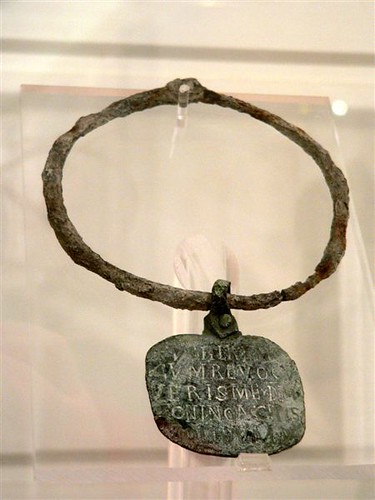
Roman Slave Medallion photographed at the
Terme di Dioclezione in Rome, Italy by
Mary Harrsch


With his adoptive father gone, Aquila spends his days in the surrounding hills hunting until one day he comes upon what appears to be an old shepherd.  However, Aquila discovers the man is really a one-eyed Celtic warrior named Gadoric who was captured by the Romans and masquerades as a feeble cripple to avoid being sent to Sicily to work on the large latifundias (farms owned by wealthy Roman senators) there.  The Celt is mystified by Aquila's tall, blonde appearance and feeling a kinship with the boy, teaches him to use a spear and a bow despite the fact that if the warrior, now a slave, should be found with weapons he could be crucified.

The Celt becomes a surrogate father to the youth and the two become inseparable.  But one day Aquila finds the Celt has been discovered and watches tearfully as his friend is led away in shackels towards Sicily.  More misfortune follows when his adoptive mother dies and he must go to live with the despised Piscius Dabo.

The other protagonist whose story runs parallel to Aquila's is Marcellus Falerius, son of Lucius Falerius, one of the two main characters from Book 1 who has, as yet, escaped the fate prophesied by the Sybil when Lucius and his boyhood friend Aulus clandestinely sought out the Sybil as children.
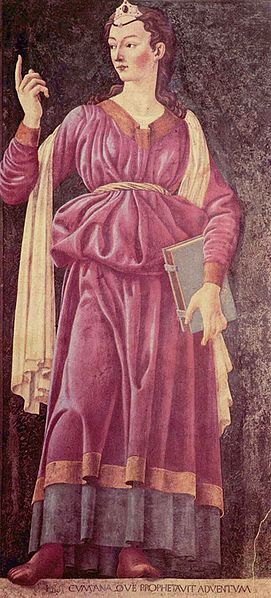
Cumaen Sybil by 
Andrea del Castagno 


One will tame a mighty foe, the other strike to save Rome's fame.
Neither will achieve their aim.
Look aloft if you dare, though what you fear cannot fly.
Both will see it before you die.

The old crone had scratched a drawing of an eagle in flight on a scrap of papyrus and tossed it to the two boys but as Lucius caught it, the image burst into flame, but not before searing the image into each boy's mind.

Before the climactic battle of Thralaxas at the conclusion of Book 1, Clodius, serving as a legionary under the great Macedonicus, had scratched his adopted son's eagle talisman in the dirt where Aulus stumbled across it before his bloody death at the Thermopylae-like defeat.  But Lucius is unaware that the first half of the prophecy has come to pass as he visits the tomb of his old friend at the beginning of Book 2.

Lucius Falerius grew up to become an ambitious politican and was the man who had ordered the murder of the tribune of the plebs (a character based on Tiberius Gracchus) because the man supported legislation to redistribute land to the poor.

A monument to the Gracchi by Eugene Guillame, French, 1853.
Photographed at the Musee d'Orsay by Mary Harrsch.


Falerius viewed this legislation as a move that would destroy the Rome he knew, directed by the wealthy elite known as the Optimates.  Although his ruthless act had caused quite a stir at the time, Falerius, claiming innocence, expertly manipulated the strings of power to overcome the opposition and become the first man in Rome.  Now aging, he works desperately to pass on his knowledge of the political machine to his son, Marcellus.  But Marcellus, actually the son of one of Falerius' barbarian slaves and Falerius' wife, unlike his "father", harbors an innate athletic ability that makes the martial arts come naturally to him.  Although he learns the political lessons his father drills into him, he, as yet, is not the ruthless singleminded individual his father has become.  And, he is beginning to chafe under his father's constant surveillance although he remains obedient to his father's commands.

This information is provided in the lengthy prologue as well as artfully woven throughout the fabric of the narrative as needed to make the novel stand on its own for readers who have not yet read Book 1, "The Pillars of Rome".

Then, "The Sword of Revenge" formally begins.

Flaccus, an old centurion who served with Aquila's adoptive father, shows up at the Nabo farm with a band of ex-gladiators on their way to take over the management of one of the large farms on Sicily.  Flaccus tells the boy of his adoptive father's death.  So, Aquila, without any further reason to stay, decides to throw in with Flaccus and his toughs and heads for Sicily hoping to find his old friend Gadoric.

Flaccus has made a bargain with the wealthy Cassius Barbinus, Aquila's vicious neighbor who owned Gadoric, to go to Barbinus' other farm on Sicily and "crack the whip" so to speak to improve the land's yield in return for a large percentage of the excess profit.

On the way to Sicily, some of Flaccus' ruffians sneak out at night to murder and pillage the surrounding countryside to enable them to buy wine and women.  I thought this was an excellent way Ludlow has chosen to introduce his readers to the dangerous environment of this period in Rome's history.  Such activities during this time were clearly described by Roman historian, Diodorus Siculus in his narrative about The First Servile War.

"With such licence given to men who had the physical strength to accomplish their every resolve, who had scope and leisure to seize the opportunity, and who for want of food were constrained to embark on perilous enterprises, there was soon an increase in lawlessness. They began by murdering men who were travelling singly or in pairs, in the most conspicuous areas. Then they took to assaulting in a body, by night, the homesteads of the less well protected, which they destroyed, seizing the property and killing all who resisted." - Diodorus Siculus
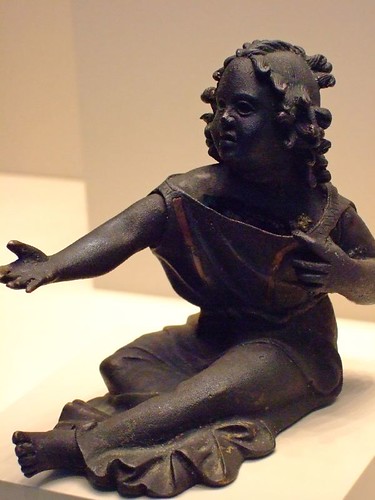
A bronze Roman coin bank depicting a beggar girl 25-50 CE.
Photographed at the Getty Villa by Mary Harrsch.


Once on Sicily, Flaccus,  implements a harsh regime, working not only the men but the women and children as he pushes hard to improve the farm's output.

"...they treated them with a heavy hand in their service, and granted them the most meagre care, the bare minimum for food and clothing. As a result most of them made their livelihood by brigandage, and there was bloodshed everywhere, since the brigands were like scattered bands of soldiers." - Diodorus Siculus

Soon a problem develops with runaway slaves who are banding together in the foothills and raiding the Roman estates.  This led to the revolt referred to as The First Servile War that lasted from 136 - 132 BCE.
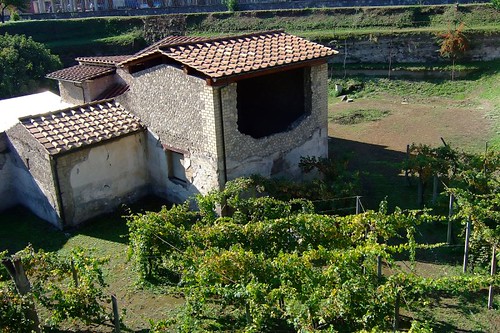
A Roman villa rustica excavated at Boscoreale near Naples, Italy.  Photo by
Mary Harrsch
The governor of Sicily calls for a meeting of the farming overseers to try to come up with a plan to avert the looming slave revolt.  Now a trusted bodyguard for Flaccus, Aquila goes with Flaccus to the meeting.  But on the way there he discovers his old Celtic friend, Gadoric, bound to a stake along the roadside in preparation for his impending crucifixion.

Aquila slips away from the meeting and when night falls, he overpowers the guards near the crucifixion site and frees his friend and a Palmyran Greek slave staked nearby named Hippolytas.

The rest of the novel focuses on the slave revolt eventually led by Aquila's friend and the mysterious Hippolytas who convinces the slaves on the island that he has oracular powers and demonstrates his ability to commune with the gods by spewing flames from his mouth.  This character is obviously based on the slave leader Eunus who led the slave revolt on Sicily in 136 BCE.

"There was a certain Syrian slave, belonging to Antigenes of Enna; he was an Apamean by birth and had an aptitude for magic and the working of wonders. He claimed to foretell the future, by divine command, through dreams, and because of his talent along these lines deceived many. Going on from there he not only gave oracles by means of dreams, but even made a pretence of having waking visions of the gods and of hearing the future from their own lips. 
Of his many improvisations some by chance turned out true, and since those which failed to do so were left unchallenged, while those that were fulfilled attracted attention, his reputation advanced apace. Finally, through some device, while in a state of divine possession, he would produce fire and flame from his mouth, and thus rave oracularly about things to come. 
For he would place fire, and fuel to maintain it, in a nut -- or something similar -- that was pierced on both sides; then, placing it in his mouth and blowing on it, he kindled now sparks, and now a flame. Prior to the revolt he used to say that the Syrian goddess appeared to him, saying that he should be king, and he repeated this, not only to others, but even to his own master." - Diodorus Siculus

Ludlow even has one of his characters confront Hippolytas about the use of the fuel-containing nut in his mouth to produce the illusion he throws flames from his mouth during his mystical prophesies.

Like Eunus, Hippolytas grows increasingly pompous as his superstitious followers become more insistent he assume the role of king of the slave army.  But Aquila, appalled by the brutality of the rebels and Hippolytas' growing greed, withdraws to the hills.

Meanwhile, back in Rome, an attempt is made on the life of Lucius Falerius.  To recover from his wounds, the old fox decides to seek solace in the south of Italy where he can direct the activities of Titus Cornelius, son of his late friend Aulus and now a military legate, and his own son, Marcellus, who are preparing a Roman military response to the slave revolt on Sicily.

Historically, the slaves take over the south central town of Enna and are eventually defeated there through siege and betrayal.

"Cities were captured with all their inhabitants, and many armies were cut to pieces by the rebels, until Rupilius, the Roman commander, recovered Tauromenium for the Romans by placing it under strict siege and confining the rebels under conditions of unspeakable duress and famine: conditions such that, beginning by eating the children, they progressed to the women, and did not altogether abstain even from eating one another. It was on this occasion that Rupilius captured Comanus, the brother of Cleon, as he was attempting to escape from the beleaguered city. 
Finally, after Sarapion, a Syrian, had betrayed the citadel, the general laid hands on all the runaway slaves in the city, whom, after torture, he threw over a cliff. From there he advanced to Enna, which he put under siege in much the same manner, bringing the rebels into extreme straits and frustrating their hopes. Cleon came forth from the city with a few men, but after an heroic struggle, covered with wounds, he was displayed dead, and Rupilius captured this city also by betrayal, since its strength was impregnable to force of arms." - Diodorus Siculus
Eunus is captured alive and thrown into prison where he sucuumbs to disease and dies at Morgantina.

"Eunus, taking with him his bodyguards, a thousand strong, fled in unmanly fashion to a certain precipitous region. The men with him, however, aware that their dreaded fate was inevitable, inasmuch as the general, Rupilius, was already marching against them, killed one another with the sword, by beheading. Eunus, the wonder-worker and king, who through cowardice had sought refuge in certain caves, was dragged out with four others, a cook, a baker, the man who massaged him at his bath, and a fourth, whose duty it had been to amuse him at drinking parties. 
Remanded to prison, where his flesh disintegrated into a mass of lice, he met such an end as befitted his knavery, and died at Morgantina." - Diodorus Siculus

Ludow, however, moves the action to the southern coastal city of Agrigentum where he treats us to an exciting naval battle between a rebel-converted merchant galley and a Roman trireme.

The revolt also ends quite a bit differently than in the history books as Aquila takes his revenge upon the Greek charlatan leaving blood-spattered images of his eagle talisman in his wake.  The sketches are dutifully copied and transmitted to none other than Lucius Falerius, thereby fulfilling the fateful prophecy.

Meanwhile, Marcellus visits the nearby cave of the Sybil and receives a prophecy of his own that sounds relatively benign.  The prophetess tells the young man he will inherit his father's fortune.  But, although Marcellus is unconcerned, it sent a shiver down my spine remembering that his real barbarian father was betrayed by Lucius Falerius and set upon by assassins who wounded him so severely that when he sought escape by jumping into the Tiber he could not withstand the strong current and drowned.

So, I'm looking forward to Book 3 of Ludlow's Republic trilogy, "The Gods of War" to learn how Aquila fulfills his destiny and if Marcellus escapes his fate.

Enhanced by Zemanta
If you enjoyed this post, never miss out on future posts by following me by email!


Thursday, August 16, 2012

Getty to feature modern depictions of Pompeii catastrophe


Unlike many other 
exhibitions of archaeological material from Pompeii, The Getty Villa's new presentation,  The Last Days of Pompeii: Decadence, Apocalypse, Resurrection, scheduled to open September 12, 2012 and running until January 7, 2013, begins with modern representations of perceived Pompeian decadence.  

The prevailing idea that the cataclysmic eruption that destroyed the Vesuvian cities in A.D. 79 was a justly deserved punishment for sins has pervaded popular consciousness through art and literature up to the present day. This notion has inspired artists and provided a vehicle to present sensual scenes or subversive themes in an acceptable setting.  A highlight of this section is Francesco Netti’s most famous work, Gladiator Fight during a Meal at Pompeii (1880, Naples, Museo di Capodimonte), which depicts the aftermath of a mortal combat held at a Pompeian banquet for the entertainment of dissolute, drunken Romans, while ladies swoon after the victor.

Gladiator Fight at a Meal in Pompeii by Francesco Netti (1880)

But despite its seeming accuracy, achieved through the precise depiction of archaeological artifacts, this scene has little basis in ancient practice. Roman gladiators generally performed in public arenas and rarely fought to the death.  The painting, rather, can be viewed as a contemporary critique of mid-nineteenth-century Italian aristocrats. 
Also on display are photographs by Wilhelm von Gloeden and Gugliemo Plüschow, some from Sir Lawrence Alma-Tadema’s personal archive, which record some of the best-known monuments at Pompeii populated by local youths staged in various states of undress. These photographs perpetuate a long-standing notion that Pompeii was a place of desire and erotic indulgence.

The second section examines the well-known apocalyptic event. Pompeii’s catastrophic demise has become the archetype for all subsequent disasters, whether natural or man-made. While eighteenth- and nineteenth-century artists often celebrated the terrifying yet beautiful power of nature, more recent artists have used the event to explore such issues as the aftermath of World War II and the angst of the Atomic Age.
 Image courtesy of the Art Institute of Chicago
Flight From Pompeii by Giovanni
Maria Benzoni, Italian,  1873.
Image courtesy of the Art Institute of Chicago.
Sebastian William Thomas Pether’s Eruption of Vesuvius with Destruction of a Roman City (1824, Boston, Museum of Fine Arts) dramatically shows the volcano spewing lava onto the ancient city, but his depiction of Roman architecture and figures in early-nineteenth century dress cross temporal boundaries. Also, embedded in the gilt frame are pieces of what appears to be lava, but is actually trimmed wood burl. Thus, what was intended to add authenticity to the imaginary scene is itself false. Alternatively, Andy Warhol’s Mount Vesuvius (1985, Pittsburg, Warhol Museum), with its vibrant palette and cartoonish effects, demonstrates that serial reproductions and kitsch are not just hallmarks of Pop Art, but also relate to the proliferation of images of the famous volcano. 
The exhibition also explores the famous body casts of Vesuvius’s victims. Since the invention of the plaster casting technique in 1863, body casts of victims have captured the imagination of the public through photographs of such artists as Giorgio Sommer, whose image on view of the famous cast of a dog found in the House of Vesonius Primus at Pompeii has served as an iconic representation of the suffering of the victims.
Cast of an unfortunate animal victim of
the 79 CE Vesuvius eruption.  
Photographed at Boscoreale, Italy by
Mary Harrsch.

Widely reproduced, it has been featured in numerous modern and contemporary works of art including Robert Rauschenberg’s Small Rebus (1956, Los Angeles, Museum of Contemporary Art) and Allan McCollum’s sculpture The Dog from Pompeii (1991, New York, Artist/Friedrich Petzel Gallery), which appear in the exhibition. The body casts on display in the exhibition are modern works, made from the now lost voids of disappeared bodies. Although we react to them emotionally, they are far removed from Vesuvius’s ancient victims. 
Another myth about Pompeii is its state of preservation. Few people realize that during World War II, the archaeological site was badly damaged by bombing carried out by American and British fighters seeking to disrupt German resupply routes nearby. After the war, many of the damaged structures were quickly rebuilt. Included in the exhibition are items from the Getty Research Institute’s special collections, which record the destruction caused by the bombing and detail the locations of the strikes. 
The exhibition concludes with an examination of archaeological fantasy and the attempts of artists to resurrect the ancient city. For over three hundred years, buildings and artifacts excavated at Vesuvian sites have advanced scientific reconstructions of daily life in the classical world. 
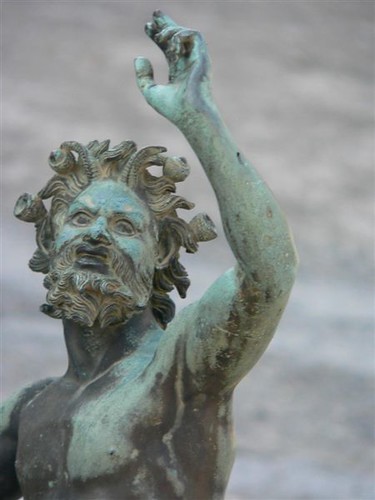
Reproduction of a bronze Faun found in the
House of the Faun in Pompeii.  Photographed
by Mary Harrsch at the Pompeii Archaeological
Park near Naples, Italy.

Simultaneously, they have underpinned more fanciful reincarnations, as artists have superimposed their contemporary values and ideas on antiquity with a variety of motivations, from the light-hearted to the serious. 
Inspired by a famous ancient figure of a dancing faun found in Pompeii, Hippolyte Alexandre Julien Moulin’s large bronze, A Lucky Find at Pompeii (1863, Paris, Musée d’Orsay), playfully depicts a nude Neapolitan youth rejoicing in the discovery of a fragmentary statuette of the hero Hercules, which he holds up in his right hand. The boy’s pleasure at his Pompeian find embodies the nineteenth-century European enthusiasm for both the artworks newly unearthed at Vesuvian sites and the process of their recovery, however idealized. The sculpture was much celebrated, winning a medal at the Paris Salon of 1864.
(Foreground) A Lucky Find in Pompeii by
Hippolyte Alexandre Julien Moulin, French
1863.  Photographed at the Mus
ée d'Orsay by Mary Harrsch.
 From the Vatican Museums comes an extraordinary loan of a cabinet containing objects excavated at Pompeii during the 1849 site visit by Pope Pius IX. There is much doubt about the extent to which these excavations were staged and whether artifacts were planted, since the objects found are strikingly diverse in type and material, including items of marble, glass, bronze, terracotta, local stone and lava, perhaps chosen in advance to emphasize the quality and variety of finds.
I sincerely hope I can make it down to the Getty Villa during this important exhibition.
Enhanced by Zemanta
If you enjoyed this post, never miss out on future posts by following me by email!


Tuesday, April 19, 2011

Aqueducts that enabled an empire

Aqueducts map courtesy of http://www.aqueducthunter.com
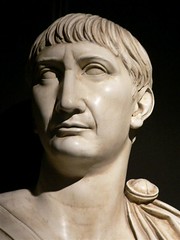
The second century Roman
Emperor Trajan.  Photo by
Mary Harrsch.
Although remnants of some of the first aqueducts dating to the early Iron Age have been found in the Middle East, the Romans brought aqueduct engineering to an art form beginning with the  Aqua Appia, built in 312 BCE.  At the height of the Roman Empire, the city of Rome, with inhabitants numbering an estimated one million people, was served by over 500 miles of aqueducts.  But, by the time of Trajan, the so-called "Optimus Princeps", the Romans' complex system of water delivery was falling into disrepair. 


 "... the existing aqueducts at that time came from the east of Rome, the sources were from rivers or springs providing water that carried dissolved salts that were deposited inside and eventually blocked the pipes and ducts, and also sometimes carried very large amounts of silt that blocked the ducts and reduced the water flow." - AqueductHunter.com


So Trajan commissioned his magistrate of public works, Sextus Julius Frontinus, to construct a new aqueduct sourced by  fresh water springs distributed in the mountains around the volcanic lake known as the Lacus Sabatinus, known today as Lake Bracciano. 


 The Aqua Traiana was inaugurated in 109 CE and is thought to have supplied water to Trajan's new bath 
The southwestern exedra of the Baths of Trajan...Remains of the Baths of Trajan.  Image via Wikipediacomplex, a naumachia (entertainment complex where mock naval battles were reenacted)  in the area that would become later known as the Vatican and grain mills high on the Janiculum Hill.  


The Aqueduct arrives in Rome at the top of the Janiculum Hill at a high level above the city. In order to reach Trajan's Baths on the top of the Colle Oppio and the storage cisterns known as the Sette Sale, the aqueduct probably crossed the river Tiber on a large stone bridge or just possibly under the river in a syphon made with lead pipes. 
The archaeologist Prof. Rabun Taylor from the University of Texas proposes that the aqueduct crossed the tiber on a high stone structure close to the Children's Hospice building at the Porto di Ripa Grande, and curved around the Aventine Hill before turning north towards the Colle Oppio, the hill adjacent to the Colosseum, and the site of Trajan’s baths. Some evidence of the structural arches can be seen on the 1551 map of Leonardo Buffalini. - AqueductHunter.com
The system would serve Rome, despite sporadic damage from various barbarian incursions, until the 9th or 10th centuries.  Later, it would be restored in 1612 by Pope Paulo V (Borgese) and renamed the Aqua Paola.  
 "Various Cardinals were sent to the Lake Bracciano area to investigate the strength and value of the local water sources throughout the sixteenth century, and the result was the deed of purchase by Pope Paul V of most of the sources which had comprised the Aqua Traiana." 
"However some veins of the aqueduct were specifically excluded from the purchase because by then they were supplying water for other purposes. Specifically the Aqua della Fiora was being used to supply the Bracciano grain mill which the local Duke, Paolo Giordano Orsini had caused to be constructed at Vigna Grande in 1578...The result was an aqueduct with a significantly lower yield than in Trajan’s day."
 "...in its first incarnation [the Aqua Paola] was not nearly as copious as in Trajan's time, and by 1673, it was supplemented instead by dirty lake water. 
For this reason, in modern Roman slang, something or someone of dubious worth is sometimes referred to as 'as good as the Acqua Paola'. " - AqueductHunter.com


At some point a small church was built over one of the primary sources of water for the Aqua Traiana near Lake Bracciano and obscured the Roman constructions beneath it.  But it was shown on a map from the year 1718 and it was this map found in the state archives, that peaked the interest of modern day aqueduct hunters, UK filmmakers Ted and Mike O'Neill, Lorenzo Quilici, Professor of Topography at the University of Bologna,  professor and historical map scholar Allan Ceen, archaeologist Raybun Taylor and Katherine W. Rinne, adjunct professor of architecture at the California College of the Arts. The group then decided to collaborate on a project to explore and film the second century Roman remains.


They have published much of their findings and images of their discoveries on their website AqueductHunter.com.  It's a fascinating read and I encourage you to explore the site fully.  The team is not sponsored by any particular institution so if you wish to become involved in their work, they welcome contributions or corporate or academic sponsorship.  


Their initial explorations are also documented in the film clip below.


The Emperor's Sacred Spring - 7 minute HD trailer from MEON HDTV PRODUCTIONS on Vimeo.


Roman Aqueducts and Water Supply (Duckworth Archaeology)   History -- Modern Marvels Aqueducts: Man Made Rivers of   Guide to the Aqueducts of Ancient Rome   Trajan: Optimus Princeps (Roman Imperial Biographies)


Enhanced by Zemanta
If you enjoyed this post, never miss out on future posts by following me by email!


Thursday, February 3, 2011

Remains of Radish, Cabbage and Hibiscus found in 2000 year-old Roman pharmaceuticals

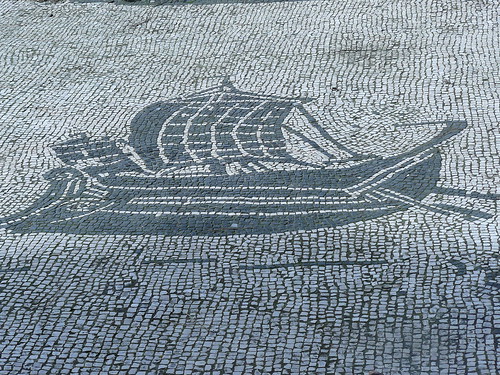
A Roman mosaic depicting a merchant ship in the
Piazzale delle Corporazioni in Ostia Antica near Lazio, Italy.
Photographed by Mary Harrsch.
Medical supplies retrieved from an ancient Roman merchant ship dating back to 130 BCE discovered back in 1980s have finally been analyzed by the Smithsonian Centre for Conservation and Evolutionary Genetics.
Alain Touwaide, historian of sciences in the department of botany at the Smithsonian's National Museum of Natural History obtained the tablets from the Italian Department of Antiquities in 2004.

In the 1980s, divers retrieved several tin containers, 136 vials made of boxwood, a locker and medical tools. The large number of vials suggests the medicines were being shipped rather than being used by the ship's doctor.  The tablets, preserved in small tin boxes, are the first remains of ancient pharmaceuticals to be found and successfully analysed with advanced DNA techniques. - Adrian Higgins, Sydney Morning Herald

Samples from two tablets revealed a dried concoction of medicinal herbs, including celery, alfalfa and wild onion, bound together with clay and zinc.

"The tablets might have been used to treat skin conditions or dissolved in water or wine for intestinal ailments such as dysentery," Touwaide observed.
Illumination of a 14th century Bolognese copy ...Image via Wikipedia
Strange illumination in a medieval copy
of Hippocrates' Aphorismi.

Other ingredients found included radish and cabbage, wild carrot or a relative, yarrow, jack bean, a hibiscus species, willow, aster, the common bean and nasturtium.

Use of some of these herbs in ancient times has come down to us in fragments of an ancient Greek medical text called The Hippocratic Corpus.

Andreas VesaliusImage via Wikipedia
Andreas Vesalius
"The Hippocratic Corpus is a library, or rather, the remains of a library. Although the 34 books included in the Collection were originally attributed to Hippocrates himself, scholars now know that they were more likely composed between the sixth and fourth centuries BCE. Between the career of Hippocrates and the pre-Socratic philosophers, a special kind of prose for medical writings developed in Greece. Although Cos, the island home of Hippocrates, is located within what was a Doric-speaking region, the medical writers of Cos (believed to have written the Hippocratic treatises) appropriated the more refined Ionic dialect of philosophy. Later, during the Renaissance, scientists like Andreas Vesalius would similarly shun using the vernacular, instead penning their medical treatises in Latin." -Alvin V. & Nancy Baird, Joan Echtenkamp Klein, University of Virginia


The benefits of radishes and onions have been known since the time of pyrmaid construction in ancient Egypt.

"The Egyptians made sure that the laborers were fed a diet rich in radish, garlic and onion, which modern researchers have found to be extremely rich in Raphanin, Allicin and Allistatin. These powerful natural antibiotics would certainly help to prevent outbreaks of disease in the often-crowded conditions of the workcamps." - Shuttleworth, Martyn (2010). Ancient Medicine - History of Medicine. Retrieved 03 Feb 2011 from Experiment Resources: http://www.experiment-resources.com/ancient-medicine.html
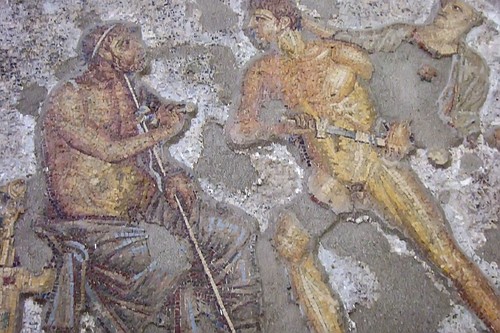
Mosaic depicting Achilles confronting Agamemnon from the House
of Apollo in Pompeii Roman 1st century BCE-1st century CE.
Photographed at the Museo Archaeologico Nazionale di Napoli in Naples,
Italy by Mary Harrsch.
In ancient mythology, Achilles was said to have used yarrow to treat the wounds of his comrades.  Modern researchers admit that yarrow does, in fact, possess blood-clotting qualities and is an effective anti-inflammatory.

The jackbean, a natural source of L-dopa, is currently being studied for its effectiveness against neurological disorders like Parkinson's disease. 

I found it interesting that modern scholars think the Romans used hibiscus to treat skin conditions and when I searched for ancient uses for hibiscus, I found a website on medicinal herbs, Ancient Wisdom Herbs,  that included a comment that hibiscus is recommended for the treatment of weeping eczema, a skin disease. Willow, another ingredient found in the Roman tablets, was used in ancient Egypt to treat toothache.

Nasturtium, a plant containing a natural antibiotic, benzyl mustard oil, was used in ancient times to treat inflamed wounds, kidney and urinary tract infections and as a blood-cleansing salad.  It is said that Hippocrates located his hospital by a stream with an abundance of nasturtium growing nearby so he could take advantage of a ready supply of the healing herb.  

Portrait of Young Marcus Aurelius, future empe...Image by mharrsch via Flickr
Bust of a young Marcus Aurelius
2nd century CE. Photographed  at
the Palazzo Massimo, Rome, Italy.
Aulus Cornelius Celsus (ca 25 BCE—ca 50 CE), Roman physician and author of  De Medicina, reports using celery for pain relief. In fact, in 1992, pharmacological researchers found that celery contains a chemical called 3-n-butyl phthalide, which relaxes the smooth-muscle lining of blood vessels, making them wider and thereby lowering blood pressure.  This same expansion of the blood vessels would also provide relief for certain types of headaches.

Obviously the Romans had acquired a wealth of knowledge about medically effective herbs long before the celebrated physician Galen began treating gladiators and the emperor Marcus Aurelius in the second century CE.


Roman Medicine (Revealing History)   Ancient Medicine (Sciences of Antiquity Series)   Celsus: On Medicine, Vol. 1, Books 1-4 (De Medicina, Vol. 1) (Loeb Classical Library, No. 292)   Hippocrates (Medicine and Culture)   The Healing Hand: Man and Wound in the Ancient World (Commonwealth Fund Publications)   Ancient Egypt: Modern Medicine
Enhanced by Zemanta
If you enjoyed this post, never miss out on future posts by following me by email!