Showing posts with label ancient world. Show all posts

Sunday, July 30, 2017

Review: A Cabinet of Ancient Medical Curiosities: Strange Tales and Surprising Facts from the Healing Arts of Greece and Rome by J.C. McKeown

A history resource article by Mary Harrsch © 2017

Galen, one of the ancient world's most revered physicians, once said, "The only difference between doctors in Rome and highwaymen is that the doctors do their work in the city, not in the mountains."

What a cynical viewpoint from one of the best of his profession! Obviously, attitudes toward health care were as controversial in the ancient world as they are now, judging from all of the anguish expressed lately by members of the U.S. Congress. It is with these controversies in mind that J.C. McKeown, Professor of Classics at the University of Wisconsin-Madison collected quotes from the ancient sources to produce A Cabinet of Ancient Medical Curiosities: Strange Tales and Surprising Facts from the Healing Arts of Greece and Rome.

McKeown groups his quotes by category, including medicine, religion and magic, the doctor in society, attitudes towards doctors (that included the quote above), anatomy, sex matters, women and children, preventative medicine, treatment and diagnosis, and cures (many dubious if not outrageous.)
Much of the "wisdom" of the ancients he includes in his text leaves you scratching your head or, in some cases, outright appalled. Individuals whose teachings have been the foundation of medical ethics for centuries have expressed sentiments towards the healing arts that I certainly did not expect.

For example, Hippocrates himself once said "I shall begin with a definition of what I consider medicine to be, it consists of freeing patients from their disease, dulling the intensity of diseases, and not taking on hopeless cases, since medicine can do nothing for them."

He goes on to explain, "Some people criticize the medical art because of doctors who refuse to take on hopeless cases. They claim that those they do take on would recover by themselves, while they do not touch those who do need help. If medicine really is an art, they assert, it should cure all alike...But, whenever someone suffers from a disease that is too strong for the resources available to medicine, there should be no expectation that such an affliction can be overcome through medicine."

Hippocrates, the so-called "father of medicine" sounds like an ancient insurance company executive!

Two icons of health in the ancient world, Asclepius god
of medicine and healing and his daughter Hygeia
personification of health depicted as household gods. Roman
100-150 CE Bronze.Photographed at The Getty Villa,
Pacific Palisades, CA 
by Mary Harrsch © 2006
Other quotes, though, elicited a smile.  Pliny the Elder in his Naturalis Historia opines, "It is better to have sexual intercourse infrequently, though it revitalizes sluggish athletes, restores a husky voice, and cures back pain, dull vision, mental problems, and depression."

Some even cloaked a hint of truth within their admonitions. In his On Medicine, Aulus Cornelius Celsus warns, "People with weak constitutions  —most city dwellers and practically everyone who is keen on literature belong in this category — need to monitor their health more carefully than other people, so that by taking precautions they may compensate for the deficiencies in their physical well-being or in their environment or in their activities."

Apparently, Celsus believed anyone who read much must obviously be the Roman version of a couch potato!

One reviewer pointed out that McKeown's little book is best consumed in small bites and I would tend to agree. It is not written as a page turner and McKeown has not made any effort to interpret the remarks or even provide some degree of context to them. But, it certainly raised my awareness of such issues as eugenics in the classical world (see my resulting blog post, Ancient Eugenics: Much More Than Just Selective Infanticide), the ancient practice of talk therapy (I thought it was a modern construct), and that the ancients, though famous for their culinary binges, even dealt with anorexia.  In other words, it made me think! 

A preview:


More suggested reading:


If you enjoyed this post, never miss out on future posts by following me by email!


Tuesday, March 5, 2013

Review: The Joy of Sexus by Vicki León


Vicki León has been out collecting ancient trivia again and this time her subject is sex.  In her latest collection of the obscure, she has assembled anecdotes about ancient aphrodisiacs, wandering wombs, practitioners of erotic mysteries and victims of doomed love.

By reading her book I learned about Callipygia worship - a fixation on a person's derriere - and divine gender-bending that affected such ancient prophets as Teiresias the Seer.  I think my favorite passage from the book, though, was a retelling of the story of Pherenike of Rhodes.

I have not studied ancient Greece as extensively as I have studied Republican Rome so, although I knew that the ancient Greek Olympics were conducted in the nude and that women were not allowed to attend, I had never read any background material to explain why.  León provided me with all the information I could have hoped for in her passage about Pherenike of Rhodes.

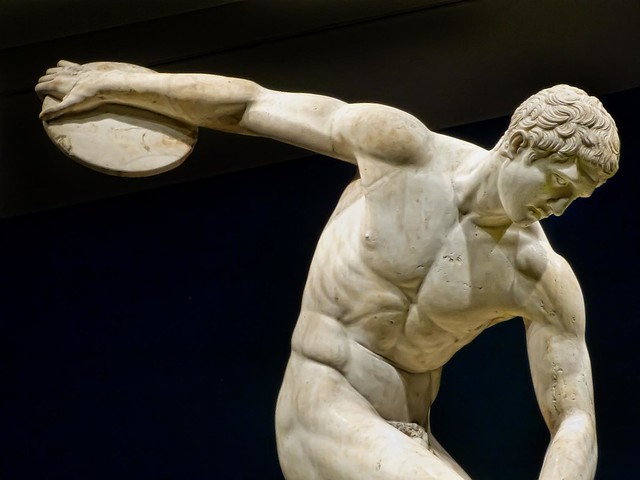
Diskobolos (discus thrower) 2nd century CE Roman copy of  450-440 BCE 
Greek bronze by Myron recovered from Emperor Hadrian's Villa in Tivoli, 
Italy.  Photographed by Mary Harrsch at the Body Beautiful exhibit at the 
Portland Art Museum, Portland, OR.
It seems that Pherenike was a young woman born into a family of Olympic victors.  Her father was a champion boxer at the Olympic Games in 464 BCE.

"Her big burly brothers continued the winning streak.  In boxing and the ferocious boxing-wrestling event called the pancratium, Pherenike's brothers swept six different Olympic Games." - Vicki León, The Joy of Sexus

León goes on to surprise me by observing that Pherenike probably watched her athletic family compete in the games when she was a young girl and later before her marriage.  Apparently, young virgins were allowed to watch the games - just not married matrons!

Then León continues saying Pherenike also married a famous athlete named Callianax and bore two sons who also trained for the Olympics.  Pherenike's older son, Eucles, won his boxing event but, because Pherenike was now married, she was not able to witness his victory.

A few years later, Pherenike's younger son Pisodorus entered his name as a contender for the boys boxing competition but before he could complete his ten months of training, Pherenike's husband died.  So, secretly Pherenike took up the mantle and resumed training her son dressed in the male garb of an official trainer.  When his time came to report for the 388 BCE Olympics, his mother went with him disguised in the full length robe of a trainer and carrying the traditional wooden staff.

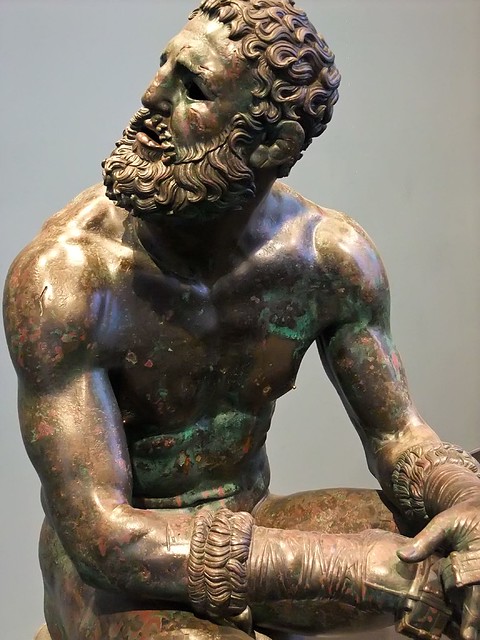
Boxer Resting 1st century BCE Roman copy of 3rd century 
Greek original by Apollonius.  Photographed at the Palazzo
Massimo in Rome, Italy by Mary Harrsch.

When her son was ultimately victorious, Pherenike, forgetting her precarious situation since a woman attending the forbidden event faced the death penalty of being thrown from the Typaeum cliffs, let out a high-pitched whoop and jumped over the fence to run and kiss her son.

"Either the high-pitched sound of her voice, or perhaps what her jump over the fence revealed, blew her disguise." - Vicki León, The Joy of Sexus

Fortunately for Pherenike, the ten Olympic judges decided not to punish her because of her illustrious family's contributions to the games, but forever after both trainers and athletes were decreed to appear in the nude.

So now I know why athletes are always depicted in the nude on all of those red and black-figure vases!

I also learned about Koan silk, a sheer see-through fabric.  I guess I hadn't kept up on all the latest discoveries and still thought silk worms were a closely guarded secret until much later in history than ancient Greece.  León reveals that some silk worms were purloined by the ancient Persians and made their way to the Greek islands of Amorgos and Kos.  Unlike the Chinese, who killed the worm to harvest the silk from their cocoons, the Greeks let the worm emerge naturally, breaking the threads as it went.  Then, using the same method they used with flax known as hackling, the women produced a gossamer silk that commanded a premium price.  The silk was so popular that Aristophanes referred to it in his play Lysistrata where women go on a sex strike to keep their men from going to war and sexually tease their husbands by prancing around "naked in their Amorgian chitons."

Apparently, in a surviving letter from Plato, the famous philosopher (and León questions "cheapskate?") orders three tunics for the daughters of a host but says "not those expensive Amorgian ones!" (I always love little tidbits that reveal what kind of person  a famous ancient was!)

The fashion eventually reached Rome and León found a quote from Pliny who called Koan silk "the vestments that cover a woman while at the same time revealing her naked charms."

These wonderful little glimpses about the truly personal lives of the ancients is what makes León's book so enjoyable.

There were only a couple of missteps that made me say "What?"  In her chapter about Alexander and Hephaestion, León explains that the Macedonians defeated the Persians at the battle of Issus. Then in the next sentence she says Persian King Darius was killed and his queen Statira captured. (p. 69 - 70) She may have been simply trying to condense the chapter but it makes it sound like Darius was killed at the battle of Issus and, of course, he wasn't.  Darius was killed some time after he fled the battle of Gaugamela and was assassinated by his own officers, who hoped to impress Alexander.  Alexander was not impressed with their treachery and ordered their execution.

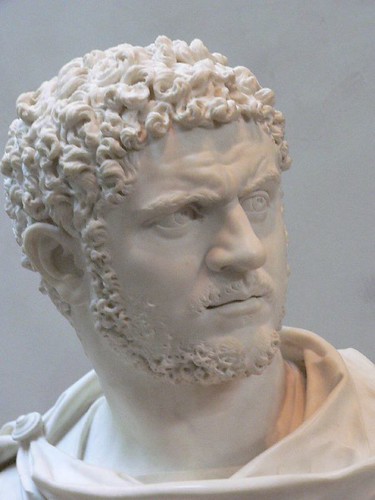
Roman emperor Caracalla by Italian sculptor
Cavaceppi 1750 CE after ancient original.
Photographed by Mary Harrsch at the
J. Paul Getty Museum in Los Angeles, CA

León made another confusing statement about the Roman emperor Caracalla.  She alluded to his death being the result of too many mistresses and a gladiator.  Although Caracalla may have dallied with too many mistresses and maybe a gladiator, too, this sounded much more like Commodus.  Caracalla was killed by a member of his own body guard when he stopped to relieve himself while marching with his army near Carrhae during a war with Parthia.  Historian Cassius Dio said the assassin, Martialis, was disgruntled for not being promoted to the rank of centurion.

But, I salute Vicki for such a revealing and fascinating look at lust, love and longing in the ancient world!

If you enjoyed this post, never miss out on future posts by following me by email!