Showing posts with label Boscoreale. Show all posts

Saturday, July 11, 2020

Memento Mori in the Boscoreale Treasure

One of the subjects touched on in the Great Courses lecture series, "The Black Death," was the rise of what was termed Memento Mori in art during and after the great mortality with paintings filled with skeletons.  But the somber reminder to remember we are mortal has been practiced throughout classical antiquity.  The Greek pre-Socratic philosopher Democritus born around 460 BCE, is said to have practiced the frequenting of tombs to remind himself of mankind's mortality.  The later Stoics, including Seneca, discussed the topic of death frequently.  The Stoic Epictetus admonished his students that when kissing their child, brother, or friend, they should remind themselves that they are mortal, curbing their pleasure, as do "those who stand behind men in their triumphs and remind them that they are mortal."

Ironically, such artwork was found in a villa in Boscoreale after it was destroyed by Vesuvius in 79 CE.  This skyphos or silver drinking cup is part of the celebrated Bosocoreale treasure, a large collection of exquisite silver and gold Roman objects discovered in the ruins of the ancient Villa della Pisanella at Boscoreale, near Pompeii.  This villa rustica covered 1000 square metres with a clearly defined residential sector and farm buildings. The villa was discovered in 1876, but it was only until April 13, 1895 that the remains of a vaulted box containing the treasure was discovered in the wine-pressing room of the villa. A number of the items discovered in the box were inscribed with the name Maxima, thought to be the daughter of L. Caecilius lucundus, a banker from Pompeii, who inherited the wealth of the Julio-Claudian dynasty in Campania.  The majority of the treasure is now in the collections of The Louvre.


Images: Memento Mori represented in the Boscoreale Treasure: Under garlands of roses: four scenes accompanied by epicurean maxims. The skeletons represent the remains of renowned authors: Euripedes, Sophocles, Menander, Moschino, and philosophers: Zénon, Epicurus, Monime of Athens, Demetrius of Phalere accompanied by explicit sentences, end of 1st century BCE- 1st century CE, gilt silver, in the collection of The Louvre. Image courtesy of The Louvre and photographer Hervé Lewandowski.
If you enjoyed this post, never miss out on future posts by following me by email!


Tuesday, June 23, 2020

The value of finding Roman seal stamps in an archaeological site

Yesterday when I was translating the excavations records for the House of Sallust, I read about one of the finds there, a stamp with ring on the back.  The stamp found had a vase inscribed on the bevel portion of the ring and the words A • COSS•LBAN probably the last owner of the house or one of the guests staying at the hospitium (the House of Sallust was converted into a hospitium (a Roman hotel) during the last decades before the eruption of Vesuvius).

This morning while I was searching the collections of the Metropolitan Museum of Art, I found just such a stamp from the Villa at Boscoreale. Its ring is inscribed with a winged caduceus, the staff of Mercury, god of commerce.  Its letter inscription, L*HER*FLO, signifies Lucius Herennius Florus, the name of the owner of the villa at Boscoreale from which the Museum's Second Style frescoes come.  Of course, this is a little confusing since the frescoes are labeled as coming from the Villa of P. Fannius Synistor.  The stamp was presumably the owner's property and likely served as the official seal of the household used to mark provisions. The museum curator tells us that many such bronze seals have been found in the excavations of Pompeii and Herculaneum, although stamps with intaglio on both ring and plate are less common.

Roman seal stamp from Boscoreale 1st century CE


As for the actual ownership of the Boscoreale villa where the beautiful frescoes in the museum's collections were discovered, a set of bronze tablets was also found there inscribed with Lucius Herennius Florus as well. 

In my research, I've noticed how names given to excavated structures sometimes have little to do with the last actual owners of the property.  One of the first villas excavated in Pompeii was given the name "House of Diomedes" because early excavators found a tomb nearby inscribed with the name "Diomedes."  The suburban villa was discovered along the main road between Pompeii and Herculaneum and it was customary for wealthier Romans to build tombs along main roads leading into cities to publicize the family's wealth.  So, whether the individual buried nearby had anything to do with the excavated villa is questionable.  Finding one of these household seals in situ is far more convincing.
If you enjoyed this post, never miss out on future posts by following me by email!


Sunday, April 12, 2020

A treasure from Vesuvius: Cleopatra Selene rises from the ashes of the Villa della Pisanella

The Villa della Pisanella was excavated by landowners beginning in 1876.  In 1894 excavations brought to light a villa rustica covering 1000 sqm with clearly defined residential sector and farm buildings with baths, warehouses for the manufacture and storage of wine and oil. Everything was still in place and arrangement of the objects were exactly as they would normally have been: furnishings, bronze bathtubs decorated with masks in the shape of lion heads seemed to be ready for use. In a large chest there were fifty keys and silver tableware; in the kitchen the skeleton of a dog on a chain; in the stable the bones of several tethered horses, one of which had managed to wriggle out and escape. In the pressing-room (torcularium) the first three human skeletons came to light, including that of a woman, probably the mistress of the house, who wore splendid gold earrings with topaz jewels.  In 1895 on the floor of the wine cellar a dead man was found in the midst of the so-called Boscoreale Treasure consisting of 102 of wonderful exquisite items: silver tableware, bracelets, earrings, rings, a double gold chain. The last owner of the silver was probably a woman named Maxima, a name written on many of the vessels. A thousand gold coins were still in the remains of a leather bag. The treasure had been found in the torcularium which at the time of the eruption was probably one of the safest rooms in the villa and probably the owner gave the order to a trusted man to hide it for better times.
"Conspicuously mounted on the cornucopia is a gilded crescent moon set on a pine cone. Around it are piled pomegranates and bunches of grapes. Engraved on the horn are images of Helios (the sun), in the form of a youth dressed in a short cloak, with the hairstyle of Alexander the Great, the head surrounded by rays ... The symbols on the cornucopia can indeed be read as references to the Ptolemaic royal house and specifically to Cleopatra Selene, represented in the crescent moon, and to her twin brother, Alexander Helios, whose eventual fate after the conquest of Egypt is unknown. The viper seems to be linked with the pantheress and the intervening symbols of fecunditity rather than the suicide of Cleopatra VII. The elephant scalp could refer to Cleopatra Selene's status as ruler , with Juba II, of Mauretania.The visual correspondence with the veiled head from Cherchel encourages this identification, and many of the symbols used on the dish also appear on the coinage of Juba II. " - Walker, Susan; Higgs, Peter (2001). Cleopatra of Egypt: From History to Myth . Princeton, NJ: Princeton University Press. ISBN 9780691088358 , pp 312-313;


Image: Cleopatra Selene on a silver cup with gilded crescent moon from the Villa de la Pisanella in Boscoreale now in The Louvre, Paris, France, courtesy of Wikimedia Commons contributor Jean-Pierre Dalbéra.
If you enjoyed this post, never miss out on future posts by following me by email!


Saturday, April 11, 2020

Villa of P. Fannius Synistor at Boscoreale: Frescoes to rival the Villa of the Mysteries!


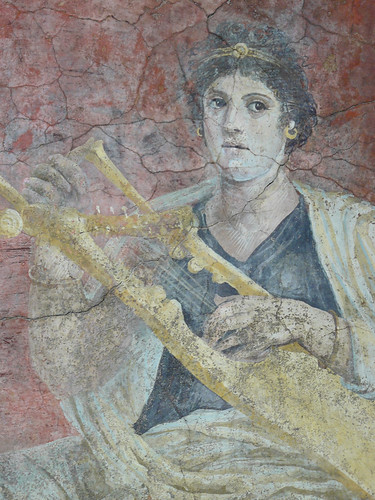
The fresco of a seated woman playing a kithara from either a triclinium or oecus of the Villa of P. Fannius Synistor at Boscoreale (50-40 BCE) now at the Metropolitan Museum of Art in New York is one of my favorite Roman frescoes in the world. I hadn't realized that the Met had collaborated on the creation of a virtual tour of the villa. 
Boscoreale, about a kilometer north of Pompeii was notable in antiquity for having numerous aristocratic country villas and was preserved as a hunting park - hence its name, meaning "Royal Grove" - by the kings of Naples. Like Pompeii and Herculaneum, it was consumed by volcanic debris following the eruption of Mount Vesuvius in 79 CE. The villa of P. Fannius Synistor (not thought to be the original owner) was among the sumptuous residences, originally built in the middle of the 1st century BCE, buried at that time. It was dated partially by the discovery of a graffito indicating the villa was auctioned in 12 CE. It was also determined that the villa had at least two owners during the 1st century CE based on the discovery of an inscription on a bronze vessel found in Room 24 (Publius Fannius Synistor) and a bronze stamp inscribed with Lucius Herennius Florus.
The villa was rediscovered in 1900 and its Second Style frescoed walls hacked out, framed and sold to art dealers in France, Belgium, and The Netherlands with some panels retained by the National Archaeological Museum in Naples. When the villa of Oplontis was excavated in 1964, archaeologists recognized the similarity of the frescoes there with those removed from Synistor's villa in Boscoreale. Both villas share the scheme in which red Corinthian columns with floral vines winding around them support a narrow entablature decorated with shields emblazoned with the so-called Macedonian starburst. In fact the similarities were so striking that scholars have speculated the two sites may have been painted by the same workshop.
The rooms of the complex were arranged around a central peristyle garden like many other villas of the period. One of the bedrooms recreated in the Metropolitan Museum of Art was located in the northwest of the home and preceded by a small vestibule. But the fresco of the woman with the kithara was from the east wall of room H, the villa's largest, thought to have been either a great dining hall or even a room reserved for the celebration of a cult, perhaps Aphrodite, although the presence of seemingly unrelated figures seem to contradict that theory.
"In this fresco, the kithara player is depicted as a plump young woman clothed in a purple chiton and white himation. She is adorned with a bracelet, earrings, and headband with a central medallion, all of gold. A small figure of Atlas supports the arm of her elaborately carved chair that originally was lacquered a deep lustrous red. The instrument she plays is not a simple lyre, but a gilded kithara, a large concert instrument played by Apollo and professional musicians. Behind the seated woman stands a small girl wearing a sleeveless purple chiton. She, too, is adorned with a gold headband, bracelet, and loop earrings. Like portrait figures, the woman and the girl gaze directly at the spectator."
"Most recently it has been suggested that the pair may represent a Macedonian queen, or princess, and her daughter or younger sister. The gilded kithara and richly adorned, throne-like chair, as well as the carefully rendered gold jewelry and headbands, give the impression of royal personage. Whatever the exact subject, this painting and others in the villa were admired as excellent copies of Hellenistic art that emphasized the erudition and worldliness of the villa's owner." - The Metropolitan Museum of Art.


Here is also a very good Italian website about the villa (it appears to have been mechanically translated without proofreading, though, so there are a few hiccups here and there)

http://www.deprisco.it/pages/english.htm
If you enjoyed this post, never miss out on future posts by following me by email!


Monday, June 11, 2007

Boscoreale Wall Paintings Featured in Renovated Greco-Roman Galleries at the Met

I am heading home today from my first visit to New York City and the Metropolitan Museum of Art. To say I almost suffered an art meltdown is an understatement! I spent two full days at the Metropolitan Museum of Art (and still only saw a fraction of the art there!) and was thrilled to discover they have a number of wall frescoes from villas in Boscoreale. They're quite stunning and I notice the women in them were painted with the wide eyes seen in many Greco-Roman mummy portraits from Egypt. They made me even more excited about seeing Boscoreale in person in October!

"Boscoreale, an area about a mile north of Pompeii, was notable in antiquity for having numerous aristocratic country villas. This tradition endured into the time of the Bourbon kings, as is attested by the region's name, the "Royal Forest," which implies that Boscoreale was a hunting preserve. Some of the most important wall paintings surviving from antiquity come from a Roman villa at Boscoreale built shortly after the middle of the first century B.C. The villa, which was buried by the eruption of Vesuvius in 79 A.D., is referred to as the Villa of P. Fannius Synistor, one of its owners during the first half part of the first century A.D. Excavated in the early 1900s, the villa's frescoes are among the most important to be found anywhere in the Roman world.

The villa at Boscoreale is a variant of the so-called villa rustica, a country house of which only a small part functioned as a farmhouse (pars rustica). The majority of the villa served as a residence for the owner, a member of that class of wealthy Roman citizens who owned more properties of this kind and used them as country houses. The painted decoration of the villa at Boscoreale, which was executed sometime around 40–30 B.C., attests to the original owner as a rich man with exquisite taste. The fact that the mid-first-century B.C. decoration was not replaced by another, more contemporary, decoration in the first century A.D. is a clear indication that there was already an awareness of the quality of the frescoes in antiquity.

The surviving paintings are extremely fine examples of the late Second Style, the most renowned style in Roman wall painting. Throughout the frescoes from the villa at Boscoreale there are visual ambiguities to tease the eye, including architectural details painted to resemble real ones, such as rusticated masonry, pillars, and columns that cast shadows into the viewer's space, and more conventional trompe l'oeil devices, such as three-dimensional meanders. Objects of daily life were depicted in such a way as to seem real, with metal and glass vases on shelves and tables appearing to project out from the wall. Cumulatively, these trompe l'oeil devices reveal the Republican owner's evident pleasure in impressing guests at his comfortable summer retreat." - The Metropolitan Museum of Art

If you enjoyed this post, never miss out on future posts by following me by email!