Showing posts with label excavation. Show all posts

Sunday, April 11, 2021

The Visigoths: ECCESVINTHUS REX OFFERET

The Visigoths were an early Germanic people who, along with the Ostrogoths, constituted the two major political entities of the Goths within the Roman Empire in Late Antiquity, or what is known as the Migration Period. The Visigoths emerged from earlier Gothic groups, including a large group of Thervingi, who had moved into the Roman Empire beginning in 376 CE and had played a major role in defeating the Romans at the Battle of Adrianople in 378 CE. Relations between the Romans and the Visigoths were variable, alternately warring with one another and making treaties when convenient. Under their first leader, Alaric I, they invaded Italy and sacked Rome in August 410 CE. Afterwards, they began settling down, first in southern Gaul and eventually in Hispania, where they founded the Visigothic Kingdom and maintained a presence from the 5th to the 8th centuries CE.

The Visigoths were never called Visigoths, only Goths, until Cassiodorus used the term, when referring to their loss against Clovis I in 507. Cassiodorus apparently invented the term based on the model of the "Ostrogoths", but using the older name of the Vesi, one of the tribal names which the 5th century poet Sidonius Apollinaris had already used when referring to the Visigoths.

The Visigoths first settled in southern Gaul as foederati to the Romans, a relationship that was established in 418. However, they soon fell out with their Roman hosts (for reasons that are now obscure) and established their own kingdom with its capital at Toulouse. They next extended their authority into Hispania at the expense of the Suebi and Vandals. In 507, however, their rule in Gaul was ended by the Franks under Clovis I, who defeated them in the Battle of Vouillé.

In the March/April issue of Archaeology Magazine is an interesting article, "The Visigoth's Imperial Ambitions".  In it author Jason Urbanus describes excavations of the former Visigoth stronghold at Reccopolis. I was actually disturbed by the fact that the city contained none of the typically Roman civic features of a forum, bath complex, theater, circus, or arena for public entertainment even though Hispania had been a Roman province for centuries and the Visigoths were previously Roman foederati. Instead the heart of the city was an enormous palatial compound  containing structures for administration, religious activities, and luxurious dwellings for the aristocracy.  Urbanus says scholars think this layout centered primarily around the rich was an effort by the local elite to emulate portions of Constantinople. 

The surrounding urban structures underscored the city's role as a major fiscal center (they had their own mint) and industrial complex (much of it focused on importing or crafting luxury items for the wealthy) but I was dismayed by the lack of public facilities for bathing with their libraries and gymnasia, or entertainment venues.  Even Constantinople had the hippodrome and public baths! At least Reccopolis was the only city constructed by the Visigoths with an aqueduct which brought water from a few miles away.  In fact, at the time there were only five remaining functional Roman aqueducts in Iberia so the aqueduct at Reccopolis was viewed as an important symbol of power and, so the author thinks, civic pride. 

To me, though, it seemed that what I view as devolution to a feudal model focused on selfish elite with little or no sense of civic duty and their control of government and use of religion to extract wealth from the populace had already taken shape.


Image: Visigothic votive crown that was part of the so-called Guarrazar treasure.  The "treasure" consisted of several crowns (more than twenty), crosses, chalices and other objects of gold and gems in a chest.  Image courtesy of Ángel M. Felicísimo from Mérida, Spain.


If you enjoyed this post, never miss out on future posts by following me by email!


Wednesday, January 13, 2021

Remnants of Caligula's Horti Lamiani now on display

During the four years that Caligula occupied the Roman throne, his favorite hideaway was an imperial pleasure garden called Horti Lamiani. The vast residential compound spread out on the Esquiline Hill, one of the seven hills on which the city was originally built, in the area around the current Piazza Vittorio Emanuele II.

There, just on the edge of the city, villas, shrines and banquet halls were set in carefully constructed “natural” landscapes. An early version of a wildlife park, the Horti Lamiani featured orchards, fountains, terraces, a bath house adorned with precious colored marble from all over the Mediterranean, and exotic animals, some of which were used, as in the Colosseum, for private circus games. 

Now, relics from the Horti Lamiani have been recovered and put on display by archaeologists. The objects and structural remnants on display in the museum paint a vivid picture of wealth, power and opulence including elaborate mosaics and frescoes, a marble staircase, capitals of colored marble and limestone, and an imperial guard’s bronze brooch inset with gold and mother-of-pearl.

Read more about it here:  

https://www.nytimes.com/2021/01/12/science/caligula-archaeology-rome-horti-lamiani.html


Image:  A theatrical mask in marble dust, recovered from the Horti Lamiani, the pleasure garden of the Roman emperor Caligula courtesy of the New York Times.

If you enjoyed this post, never miss out on future posts by following me by email!


Friday, June 26, 2020

Early Excavations of Herculaneum and Pompeii

Last year after attending the "Buried by Vesuvius" exhibit at the Getty Villa and meeting a group from the Herculaneum Society, I joined the organization. This morning in their newsletter, they included this interesting image of Herculaneum's main street, the Decumano in the 1st century CE alongside a modern photograph of the street today:


For years I was under the misconception that Herculaneum was the working port and Pompeii was the resort town but then learned that, in fact, it was just the opposite. Although Herculaneum was discovered first, it was covered by almost 100 feet of volcanic debris so only the "young and nimble" as it was described in an early report I read, were able to descend the deep tunnels to root out the beautiful sculptures and artifacts in demand from the royalty of Europe for their private collections. Pompeii, on the other hand, was only covered by about 11 feet of debris making it much more accessible to excavators in the 18th and 19th centuries than Herculaneum. I've been translating the Pompeianarum Antiquitatum Historia which is the diary of early 19th century excavators working in Pompeii and they complain that flocks of the local sheep wander through the ruins with impunity. After excavators exposed several structures, the tourists started to visit, guided by what were known as cicerones, local tour guides who could even arrange for a wealthier tourist to make their own "discovery."


If you enjoyed this post, never miss out on future posts by following me by email!


Tuesday, June 23, 2020

The value of finding Roman seal stamps in an archaeological site

Yesterday when I was translating the excavations records for the House of Sallust, I read about one of the finds there, a stamp with ring on the back.  The stamp found had a vase inscribed on the bevel portion of the ring and the words A • COSS•LBAN probably the last owner of the house or one of the guests staying at the hospitium (the House of Sallust was converted into a hospitium (a Roman hotel) during the last decades before the eruption of Vesuvius).

This morning while I was searching the collections of the Metropolitan Museum of Art, I found just such a stamp from the Villa at Boscoreale. Its ring is inscribed with a winged caduceus, the staff of Mercury, god of commerce.  Its letter inscription, L*HER*FLO, signifies Lucius Herennius Florus, the name of the owner of the villa at Boscoreale from which the Museum's Second Style frescoes come.  Of course, this is a little confusing since the frescoes are labeled as coming from the Villa of P. Fannius Synistor.  The stamp was presumably the owner's property and likely served as the official seal of the household used to mark provisions. The museum curator tells us that many such bronze seals have been found in the excavations of Pompeii and Herculaneum, although stamps with intaglio on both ring and plate are less common.

Roman seal stamp from Boscoreale 1st century CE


As for the actual ownership of the Boscoreale villa where the beautiful frescoes in the museum's collections were discovered, a set of bronze tablets was also found there inscribed with Lucius Herennius Florus as well. 

In my research, I've noticed how names given to excavated structures sometimes have little to do with the last actual owners of the property.  One of the first villas excavated in Pompeii was given the name "House of Diomedes" because early excavators found a tomb nearby inscribed with the name "Diomedes."  The suburban villa was discovered along the main road between Pompeii and Herculaneum and it was customary for wealthier Romans to build tombs along main roads leading into cities to publicize the family's wealth.  So, whether the individual buried nearby had anything to do with the excavated villa is questionable.  Finding one of these household seals in situ is far more convincing.
If you enjoyed this post, never miss out on future posts by following me by email!


Monday, September 13, 2010

Pompeii focus of new lectures series from The Teaching Company

When I received the latest catalog of courses from The Teaching Company I saw that they are now offering the 24-lecture series "Pompeii: Daily Life in an Ancient Roman City".  Pompeii has intrigued me since I was a young girl back in the 50s.  I don't even remember when I first learned about it since classical history was not covered in the school curriculum of my small hometown.  Besides being mesmerized by images of the beautiful frescoes, mosaics and sculptures that had been recovered from the site, I was admittedly rather morbidly drawn to the images I had seen of the plaster casts made of the hapless residents who met tortuous deaths that fateful day in 79 CE.  

For some time I thought Pompeii was a recent archaeological discovery, not realizing that it was actually rediscovered clear back in 1599 CE. I could hardly believe that despite the more enlightened thinking of the Renaissance period, architect Domenico Fontana, appointed to resume excavations in Pompeii, after working on St. Peter's under Pope Sextus V and erecting the massive Egyptian obelisk in front of the cathedral, actually chose to cover the find near Naples back over because of the "shocking" nature of the sexually explicit images and artifacts that he found there.  Wholesale plundering of the site began in 1748 under the auspices of  the King of Naples, Charles of Bourbon.

It was not until Giuseppe Fiorelli took charge of the excavations  in 1860, though, that techniques were developed to create those casts of the victims of Pompeii by pouring plaster into voids in the ash layer that were found to contain human bones.  

This bronze sculpture of Eros is contorted
by the heat from the volcanic blast of
Vesuvius.  Photographed at Boscoreale
by Mary Harrsch.
I had never seen any of the casts myself until only recently when I attended the "Pompeii: Stories From An Eruption" exhibit at the Smithsonian in Washington D.C. It included a number of casts, the most poignant being that of a child killed when a staircase collapsed in the House of the Golden Bracelet. 

When I finally got a chance to visit Italy for the first time in 2005, my friends and I rented a car and drove down to Pompeii for a day of exploration.  We entered through the main gate and began exploring the necropolis before we got to the remains of the villas.  Most of the artwork I had read about had been removed for conservation and display, much of it in the Museo Archaeologico di Napoli in downtown Naples so it was a bit of a treasure hunt searching for any small frescoes or particularly interesting mosaics that had been left behind.  

The bronze sculptures of a wild boar surrounded by hunting hounds that you see in the courtyard of the House of the Citharist as well as the bronze faun that you see in situ at the House of the Faun are actually reproductions but they help you envision the respective villas in their original state.


The infamous fresco of the well-endowed Priapus is still there though (or it was at least as late as 2005). It was smaller than I thought since most television programs that feature it normally zoom in for a startling closeup. Apparently, it was plastered over at one point by excavators for modesty's sake and was not rediscovered until 1998 when it was revealed by a heavy rain.  As for human casts, I saw only two victims on display in the site itself at the time.


When I returned to Naples in 2007, I entered Pompeii through a side entrance and quickly found myself exploring one of the public baths.  Somehow I had missed it on my first visit.  I also had a chance to visit Boscoreale, a neighborhood about a kilometer north of Pompeii where aristocrats lived in luxurious villas and a villa rustica is being currently excavated.  The museum at Boscoreale is small but quite interesting.  There I saw casts of a poor watch dog and a boar caught by Vesuvius' blast as well as a round loaf of Roman bread burnt to charcoal. 


In 2009, I was thrilled to attend the exhibit "Pompeii and the Roman Villa: Art and Culture Around The Bay of Naples" at the Los Angeles County Museum of Art.  I learned about the resurgence of archaism in Roman art that was discovered in Pompeii and the other villas surrounding Vesuvius and wrote an article about it for Heritage Key.  If that exhibit is still making the rounds I would highly recommend visiting it if it should make an appearance in a museum near you.


I am sure the new lecture series will point out even more details that I've probably overlooked and give me background information on the structures I admired there.  The lectures are presented by Dr. Steven Tuck, Associate Professor of the Classics and Art History at Miami University.


"After earning his B.A. in History and Classics at Indiana University, he received his Ph.D. in Classical Art and Archaeology from the University of Michigan. He held the postdoctoral Arthur and Joyce Gordon Fellowship in Latin Epigraphy at The Ohio State University.

An esteemed teacher, Professor Tuck was named a University Distinguished Scholar in 2005 and an Outstanding Professor in 2007, 2008, and 2009 at Miami University. He has served as a national lecturer for the Archaeological Institute of America and was a regular lecturer for the Continuing Education program at the University of Evansville, presenting lectures on topics including ancient social and political history, and archaeology.

Professor Tuck is the author of many articles featured in international journals on topics such as the spectacle schedule at Pompeii, the decorative program of the amphitheater at Capua, and triumphal imagery across the ancient Roman world. He is the author of Latin Inscriptions in the Kelsey Museum: The Dennison and De Criscio Collections." - The Teaching Company

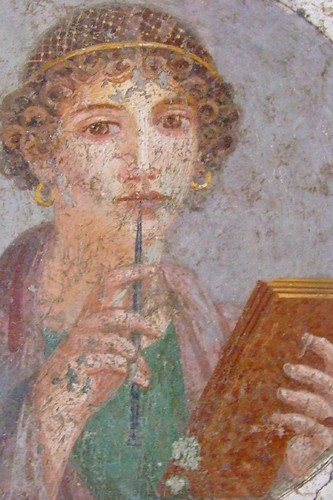
The lectures cover the history of the area clear back to its early settlement by the Etruscans, as well as the region's geology and commercial development including Pompeii's thriving wool industry and viticulture.  Dr. Tuck explores the upper class homes including the Villa of the Papiri as well as the House of the Vettii and the House of the Tragic Poet.  He also spends one lecture on the Praedia of Julia Felix, a collection of gardens, baths and shops that served as sort of a Roman country club of the period.  These remains are some of the most complete that I saw in Pompeii and some of the gardens have now been replanted by site restorationists.  When I saw the fresco of a thoughtful Roman woman (above) from the Villa di Guilia Felice in Pompeii at the Museo Archaeologico di Napoli, I wondered if it was a portrait of Julia herself thinking about all the money she was making with her various enterprises!

A slideshow of my images from Pompeii and the art recovered from Vesuvian ash:


Learn more about Pompeii!

The Complete Pompeii   Pompeii: The History, Life and Art of the Buried City   Pompeii (The Roman World)   Ancient Mysteries - Pompeii: Buried Alive   The Fires of Vesuvius: Pompeii Lost and Found    Pompeii: The Living City  Bodies From the Ash: Life and Death in Ancient Pompeii   Pompeii: Public and Private Life (Revealing Antiquity)   Pompeii: The Life of a Roman Town   Pompeii - The Last Day/Colosseum - A Gladiator's Story
If you enjoyed this post, never miss out on future posts by following me by email!


Thursday, May 6, 2010

80,000 Roman Artifacts final talley for Carlisle Castle Dig

After excavating for over 10 years, researchers have concluded the official dig at Carlisle Castle in the UK.


"Senior executive officer for Oxford Archaeology North, Rachel Newman, said: "The area was very damp 2,000 years ago, and therefore rare evidence survived for how the Romans and their medieval successors lived, in the form of the foundations for their timber buildings, as well as parts of Roman tents and saddles, their shoes, and wooden and leather possessions."

"Many thousands of objects were excavated, including less fragile material, such as pottery, metalwork, both jewellery and everyday utensils, coins, and stone objects."- BBC News

The Roman fort beneath the castle grew from a tent encampment to a town with a self-governing council - the only Roman settlement with "civitas" status in northern England, researchers say.  The Romans also apparently adapted to local culinary tastes as scientists found ample remains of cattle bones that appear to have been salted or smoked for preservation.

At home, Romans seldom ate beef, preferring pork (often in the form of sausage), game animals, fowl or seafood.

For the majority of persons dining in Ancient Rome, meals were centered around corn (grain), oil and wine, and, for the wealthy, different types of exotic foods.   Cereals were the staple food, originally in the form of husked wheat (far) being made into porridge (puls), but later naked wheat (frumentum) was made into bread.  Bread was the single most often eaten food in Ancient Rome, and was sometimes sweetened with honey or cheese and eaten along with sausage, domestic fowl, game, eggs, cheese, fish, or shellfish.
 Fish and oysters were especially popular; meat, particularly pork, was in high demand as well.  Elsewhere in Rome, delicacies, such as snails or dormice, were specially bred.  A variety of cakes, pastries, and tarts was baked commercially and at home, often sweetened with honey.  Vegetables, such as cabbage, parsnips, lettuce, asparagus, onion, garlic, marrows, radishes, lentils, beans, and beats was imported.  Fruits and nuts were also available to the consumer, as was a variety of strongly flavored sauces, spices, and herbs, which became very popular in Roman cuisine. - SPQR Online

 
Particularly exciting was the discovery of this remnant of articulated armor. I'm afraid I'm not an expert on Roman armor but judging from the image, the strips appear to be smaller than the classic lorica segmentata often seen in Hollywood movies.  Perhaps this is a fragment of a set of lorica squamata, a kind of scale armor worn by Roman cavalry.  The heaviest of Roman armor designs, lorica squamata was developed during the late Roman Republic and was usually backed with fabric so it could be pulled on like a shirt.  It's hard to tell from the image, though, if the armor plates were attached to fabric.  The fabric may have deteriorated centuries ago. 

[Image courtesy of BBC News]

To see other examples of Roman armor fragments check out Romanlegions.info

Around the Roman Table: Food and Feasting in Ancient RomeRoman Military Equipment: From The Punic Wars To The Fall Of Rome   The History of Warfare: The Roman Invasions of Britain   An Imperial Possession: Britain in the Roman Empire, 54 BC - AD 409 (Penguin History of Britain)  
If you enjoyed this post, never miss out on future posts by following me by email!


Friday, March 12, 2010

Wallace-Hadrill to present Herculaneum: Living with Catastrophe in Lexington, VA

I see that Dr. Andrew Wallace-Hadrill will present Herculaneum: Living with Catastrophe at Washington and Lee University, Lexington, Virginia on Tuesday, March 23, at 7 p.m. in the Stackhouse Theater.  Oh how I wish I could attend that lecture.  I love living on the west coast but up here in the Pacific Northwest we seldom get the opportunity to hear such world class presentations from classical scholars like Dr. Wallace-Hadrill.

[Image of  Dr. Wallace-Hadrill courtesy of  The Alleghany Journal]

Roman Mosaic found in the ruins of Herculaneum 1st century CE (1)I always enjoy his insight that he has shared in numerous History Channel programs.  Even after all of the years he has spent studying ancient Rome, he still talks about it with such marvelous enthusiasm.  I had hoped to catch a glimpse of him when I visited Herculaneum in October 2007, but no such luck. I did watch some of his researchers working on this beautiful mosaic in a bath complex:

[Image: 1st century CE Roman mosaic found in the ruins of Herculaneum.  Photographed by Mary Harrsch]


Herculaneum is a rather small excavation compared to Pompeii so I was able to explore it in about half a day.  There is much more of the site as yet unexplored but it has been covered by the modern city of Naples so it is doubtful any more of the ancient complex will be unearthed (except perhaps, sadly, by tunneling looters). Much of the artwork originally found in Herculaneum has been removed and placed in the Museo Archaeologico di Napoli but there are still a few pieces in situ.

The day I was there, the Villa di Papiri was closed because of ongoing excavations there.  I would have loved to have seen it, too, so I could compare the layout to the Getty Villa in Malibu that is based upon it.

Herculaneum: Italy's Buried Treasure   Secrets of the Dead - Herculaneum Uncovered   The Library of the Villa dei Papiri at Herculaneum   Vesuvius, A.D. 79: The Destruction of Pompeii and Herculaneum   Antiquity Recovered: The Legacy of Pompeii and Herculaneum (J. Paul Getty Museum)   Houses and Society in Pompeii and Herculaneum   An Introduction to Wall Inscriptions from Pompeii and Herculaneum (From Pompeii and Herculaneum)
If you enjoyed this post, never miss out on future posts by following me by email!