Showing posts with label villa. Show all posts

Sunday, July 11, 2021

Domus del Chirurgo (House of the Surgeon) in Rimini, Italy

 I noticed the link to this archaeological site in an article with a suggested "tour" of the Roman Empire. This 2nd century CE Roman site does have an English version website and a few images of mosaics and structures a visitor would find there. I checked Wikipedia and was surprised to find the site barely mentioned on Rimini's page although it appears to be an extensively excavated site. 

The nearby museum houses the 150 surgical instruments found there. Eutyches, the Greek physician who owned the house is thought to have been an accomplished military surgeon as his instruments were designed for bone injuries and wound repairs, including a Diocles' spoon for extracting arrows. No gynecology-related instruments were found though so he probably worked in an all-male environment.  

Eutyches was also an admirer of the Epicurean philosopher Hermarchus as fragments of his statue were found In the garden. Hermarchus was a disciple and successor of Epicurus as head of the Epicurean school. Although none of his writings survives it is known from other sources that he wrote works directed against Plato, Aristotle, and Empedocles. A fragment from his Against Empedocles, preserved by Porphyry, discusses the need for law in society.

The villa suffered a catastrophic fire and was abandoned about 260 CE based on the dates of 80 coins discovered in the ruins.

The official website:  https://www.domusrimini.com/eng/the-surgeon-house/ 

Mosaic pavements in the 2nd century CE Domus del Chirurgo (House of the Surgeon) in Rimini, Italy

If you enjoyed this post, never miss out on future posts by following me by email!


Friday, June 11, 2021

The Painters of Pompeii: Roman Frescoes from the National Archaeological Museum, Naples

The Painters of Pompeii: Roman Frescoes from the National Archaeological Museum, Naples will open June 26, 2021 at the Oklahoma City Museum of Art.  It will be on display until October 17, 2021. Tickets will be available on a timed entry basis with limited capacity to ensure adequate social distancing.  Although masks are encouraged, they are not required for fully vaccinated visitors.  Eighty artifacts and artworks from Pompeii and Herculaneum will be presented.

During the exhibition, the museum plans to host a series of lectures in the Noble Theater with several of the most renowned scholars in the field of Ancient Roman Art and History.  Topics include the rediscovery of Pompeii, Food & Wine in Pompeii, Roman Painting, and Powerful Elite Women in Imperial Rome.

The exhibit notice says its appearance at the Oklahoma City Museum of Art will be its only US presentation.


Image: Polyphemus hears of the arrival of Galatea (or Hercules and Omphale), ancient Roman fresco from a villa in Portici painted in the "Fourth Style" (45–79 CE) courtesy of the NAM Naples. 

If you enjoyed this post, never miss out on future posts by following me by email!


Monday, April 19, 2021

Gallo-Roman villa of Orbe-Boscéaz

Orbe-Boscéaz, also named Boscéay, is an archaeological site in Switzerland, located at the territory of the town of Orbe (Vaud). It includes a vast Roman villa measuring over 200 m long comprised of about 100 rooms, some heated by hypocaust, colonnaded porticoes, and ornamental ponds.  Nine of the rooms featured intricate mosaics depicting gods, trompe l’œil geometric shapes or figurative scenes of Greek mythology, such as the famous labyrinth of Theseus and the Minotaur.

Excavations have revealed the villa, constructed at the end of the 2nd century CE on the remains of a structure from the 1st century CE, was mostly abandoned during the crisis of the 3rd century CE.  Sadly, by the 5th century CE much of the structure became a quarry for building materials.

The first of its mosaics were discovered in 1841. The Triton and the Labyrinth mosaics were found in 1845 (the latter is reburied the same year, then rediscovered in 1930), the Divinities mosaic in 1862, the laurel leaves mosaic in 1863 (reburied and rediscovered several times up to 1925), and the Mosaic of Achilles on the island of Skyros, was discovered in 1993 and recently underwent restoration. The site is now open to the public.

The Triton mosaic at this villa depicts ichthyocentaurs, mermen with a horse's forelegs in place of arms.  The earliest known examples of this artistic variation of traditional Greek tritons date from the 2nd century BCE. The term "Ichthyocentaur" did not originate in ancient Greece, though, and only appeared in writing in the Byzantine period (12th century).  They were also known as "Centaur-Tritons".  Double-tailed tritons began to be depicted by the late 2nd century BCE, and can be seen on the Altar of Domitius Ahenobarbus at the Glyptothek in Munich.

Gallo-Roman Villa of Orbe-Boscéaz (Vaud, Switzerland) - The Deities Mosaic includes four medallions with a Triton and a Nereid. This photo shows the southwest medallion. The Deities Mosaic is preserved in its original location and the Gallo-Roman villa is a site open to the public and can be visited. Image courtesy of Wikimedia Commons contributor Sylvain Gailloud. (adjusted perspective, sharpened and enhanced)


Mosaic depicting Zeus in the form of an eagle and Ganymede at the Gallo-Roman Villa of Orbe-Boscéaz (Vaud, Switzerland) courtesy of Wikimedia Commons contributor Leemburg-CH.


Another medallion from the Triton mosaic at the Gallo-Roman Villa of Orbe-Boscéaz (Vaud, Switzerland) courtesy of Wikimedia Commons contributor Leemburg-CH.


Geometric mosaic with leaves at the Gallo-Roman Villa of Orbe-Boscéaz (Vaud, Switzerland) courtesy of Wikimedia Commons contributor Paulusburg


Closeup of the Deities Mosaic depicting Mars, the God of War at the Gallo-Roman Villa of Orbe-Boscéaz (Vaud, Switzerland), courtesy of Wikimedia Commons contributor Leemburg-CH


Mosaic of the deities at the Gallo-Roman Villa of Orbe-Boscéaz (Vaud, Switzerland) courtesy of Wikimedia Commons contributor Leemburg-CH


Mosaic of the Rustic Procession at the Gallo-Roman Villa of Orbe-Boscéaz (Vaud, Switzerland) courtesy of Wikimedia Commons contributor Leemburg-CH


Triton with two fish-tails. Altar of Domitius Ahenobarbus. Glyptothek Munich courtesy of Wikimeddia Commons contributor Miguel Hermoso Cuesta


If you enjoyed this post, never miss out on future posts by following me by email!


Tuesday, August 4, 2020

Brading Roman Villa to reopen on selected days beginning Friday, August 7, 2020

The museum on the site of Brading Roman Villa preserves the West Range of the structure, built around 300 CE, which is the last and grandest of three buildings on the site. The foundations of two earlier North and South Ranges are now outlined in chalk outside. The South Range was erected around 100 CE, not long after Claudius' Roman invasion of Britain in 43 CE and was followed by the completion of the grander North Range around 200 CE.

For those living here, this location was a perfect choice. It enabled the  freedom to communicate with and travel to local Island settlements, mainland Britain and cross the Channel to Gaul (France). Fertile arable lands around the Villa complex allowed good crops of grain to be grown. Sheep and cattle could fertilize the land between seasons and springs nearby gave a good water supply. 

By the early fourth century this high status house was completed. As a winged corridor villa, common in southern Britain, it provided separate private living accommodation for the owner and their family together with space for entertaining guests. Like modern homes today the West Range had many changes and adaptions to the living space. This included removing and moving internal walls and adding new mosaics.

The villa was rediscovered in 1879 by Captain John Thorpe and excavated from 1880-1883.  Over 100,000 artifacts were recovered including board games, jewelry, and farming implements.  The villa's mosaics are among the best preserved in Britain and depict mythological subjects including Orpheus, Bacchus, Ceres and other gods and goddesses framed with geometric patterns.


Image: The Orpheus Mosaic at Brading Roman Villa courtesy of their museum.
If you enjoyed this post, never miss out on future posts by following me by email!


Tuesday, July 6, 2010

Human skeleton unearthed in newly discovered Gloucestershire Roman villa

Remains of a bath complex at Lullingstone Villa.
Photo by Mary Harrsch
I noticed this news release today so I'm assuming this dig is centered on a newly discovered villa not the well known Chedworth site near Cheltenham.

A 2,000-year-old human skeleton has been discovered alongside Iron Age artefacts near Tewkesbury.  The experts do not know yet whether the skeleton is of a male or female but believe it is at least 2,000 years old.

Stuart Foreman of Oxford Archaeology said thousands of pieces of masonry, nails, tiles, pottery and clothing would be unearthed by the time the project is complete.


He said: "Fragments of stone peg-tiles from the roof and sections of painted wall plaster indicate a building of high quality and status. The footings survive to a height of nearly 1m cut into the hillside." - Sify News
 Actually, a number of villas have been discovered in Gloucestershire over the years.  I found this extensive list published by George Witts in an Archaeological Handbook in 1883.  Unfortunately I have not yet visited any of these sites but I have toured Lullingstone Villa, Veralamium and Fishbourne Roman Palace.  The remains of the bath complex at Lullingstone is probably quite similar to the remains of baths found in several of the Gloucestershire villas.

 Roman Britain: A New History   A History of Roman Britain   Roman Britain and Early England: 55 B.C.-A.D. 871 (Norton Library History of England)   The History of Warfare: The Roman Invasions of Britain   An Imperial Possession: Britain in the Roman Empire, 54 BC - AD 409 (Penguin History of Britain)
If you enjoyed this post, never miss out on future posts by following me by email!


Thursday, March 11, 2010

Ancient Vine Delights Visitors with Beautiful Recreations of Ancient Life

Today I received a news alert from Heritage Key about the impending illumination of Hadrian's Wall event and it included a marvelous video of a 3D recreation of Hadrian's Wall and Newcastle Fort by a system's analyst known as Decimus who manages a website called Ancient Vine.  The graphics in the video were absolutely stunning.


I actually thought Decimus had merged 3D computer graphics with live action because the soldiers in the video looked so lifelike.  When I visited his site I saw that they were creations of his talent as well:


Decimus has also created a virtual Roman domus as part of the exhibit "A Day in Pompeii" at Museum Victoria in Melbourne, Australia.

Above is Decimus' recreation of a Roman tablinum.  The museum created a wonderful video of a virtual visit to the domus complete with rain water falling in the atrium, music and background sound effects.

He is now working on a reconstruction of the ancient city of Alexandria.


He has already finished several iterations of the Pharos lighthouse and is presently working on a recreation of the famous library.

Decimus is also working on a game set in the fictional Roman town of Opacia that was built on the ruins of Oplontis.  It will be an adventure/role playing game and I'm sure the visuals alone would make it well worth the price of the final product!

He has a marvelous image gallery and even offers his graphics for free use with attribution.  His site also features a discussion forum with interesting discussions about both Roman History and 3D graphics tools.  So, please check out Ancient Vine and continue to encourage such an artistic enthusiast!

Roman Art in the Private Sphere: New Perspectives on the Architecture and Decor of the Domus, Villa, and Insula   Pompeii and the Roman Villa: Art and Culture Around the Bay of Naples   Pompeii and the Roman Villa   In Stabiano: Exploring Ancient Roman Villas
If you enjoyed this post, never miss out on future posts by following me by email!


Tuesday, May 5, 2009

'Pompeii And The Roman Villa' opens at LACMA


It looks like I need to plan another visit to the Los Angeles County Museum of Art. 'Pompeii And The Roman Villa' has opened there and will be on exhibit until October 4. At least I have most of the summer to find a decent airline ticket. This article doesn't mention anything about gladiator armor. When I was in Naples a couple of years ago I was very disappointed that gladiator armor found in Pompeii was not on exhibit at the Museo Archaeologico di Napoli. It was apparently on tour. I was hoping this traveling exhibit from the Naples museum was the one that contained it.

"An exhibition celebrating the art, culture and luxurious lifestyle of Ancient Rome's wealthy elite has reached Los Angeles. Entitled 'Pompeii And The Roman Villa', the event features over 120 items from ancient villas in the Bay of Naples, destroyed by the eruption of Vesuvius in AD 79.

The mosaics, sculptures, paintings and jewellery, some of which only uncovered in the last few years, are mostly on loan from the Naples Archaeological Museum.

Solid silver wine goblets, jewelled caskets that once contained exotic perfumes and the remains of gourmet delicacies, such as flamingo tongue and roast ostrich, are among the items uncovered.

In addition, the exhibition documents the fascination of Rome's nouveau riche with Greek culture, through books by Epicurius and Plato, garden sculptures of nude athletes and scantily clad statues of the Greek goddess of love, Aphrodite. - More: Ansa.it
If you enjoyed this post, never miss out on future posts by following me by email!


Thursday, March 20, 2008

Artifacts ripped from Trajan's Villa recovered from wealthy engineer


Roman mosaics are among my favorite art forms so this article made me shudder.

"Police seized some 1,000 ancient artifacts from a wealthy Italian man's country house outside Rome that were stolen from one of Emperor Trajan's villas, prosecutors said Wednesday.

Authorities contend the artifacts, which were being used to decorate the man's weekend residence, were ripped off the walls of what is believed to be Trajan's hunting retreat in Arcinazzo Romano, a town in the countryside outside Rome.

Some were stolen from boxes of fragments that archaeologists had excavated from the villa but had left at the site of the ongoing dig, prosecutors told a news conference.

Pieces of ancient Roman mosaics were inserted into the man's basement floor and his fireplace and bathroom were decorated with other pieces, authorities said.

Many of the artifacts were damaged by glue that he apparently used to stick them to transparent display supports, said Marina Sapelli Ragni, Lazio's superintendent for archaeology. Restorers would try to repair the damage, she said.

Among the loot are pieces of marble that once covered the sprawling villa in the upper Aniene River valley in Lazio. The villa has only been partially excavated."

If you enjoyed this post, never miss out on future posts by following me by email!


Sunday, March 9, 2008

Villa of Augustus on Palatine Hill Now Open To The Public

Exquisitely preserved frescoed rooms in the ruined house of Augustus, the first Emperor of Rome, were opened to the public today for the first time since they were unearthed nearly half a century ago.

Archaeologists say that the future emperor lived in the house on the Palatine Hill above the Forum in about 30BC, before he gained supreme power and built his imperial palace complex higher up the hill. The paintings have been restored at a cost of nearly €2 million (£1.5 million).

The wall and ceiling paintings in the house - discovered in the 1960s by the Italian archeologist, Gianfilippo Carrettoni - are in vivid red, blue and ochre. They include a small study, believed to have been Augustus's private retreat...

Some decorations on the walls and vaulted ceilings were found intact, while others have been pieced together from fragments. In one room, dubbed the Room of the Pines, the walls are painted to represent yellow columns.

In another, known as the Room of the Masks, a wall is painted like a stage, with narrow side doors standing ajar, comic masks peering through small windows and painted garden vistas beyond.

Visitors will enter the rooms in small groups to avoid damage to the delicate frescoes, restored after 20 years of excavation and conservation at the site by a team led by Irene Jacopi, the archaeologist in charge of the Palatine Hill.

Angelo Bottini, superintendent of archeology for Rome, said that a new combined ticket would provide access to the Roman Forum, the Colosseum, and the Palatine Hill, including the house of Augustus.

If you enjoyed this post, never miss out on future posts by following me by email!


Saturday, December 22, 2007

Roman villa excavations use technology to help visitors relive the past


What an excellent combination of technology and "hard" science!

"The restored ruins of two opulent Roman villas and private thermal baths will open to the public Saturday, along with a 3-D reconstruction that offers a virtual tour of the luxurious residences discovered in downtown Rome.

The 19,375-square-foot complex, dating from the second to fourth centuries, features well-preserved mosaic and marble floors, bathtubs and collapsed walls that archaeologists believe belonged to a domus — the richly decorated residences of Rome's wealthy and noble families.

"We found part of a residential high-class neighborhood, where probably senators and knights used to live," archaeologist Paola Valentini said.

Visitors will be able to walk on glass catwalks above the villas' underground remains, immersed in semidarkness just a few feet from the modern city. A 3-D virtual reconstruction recreates the elaborate decorations of the ancient residences through colored lights and projections.

The two villas were likely inhabited by a senator, his family and servants, and included libraries, halls, gardens, kitchens and stables, archaeologists said. One villa was abruptly abandoned during a fire in the fifth century, they said. Among the remains on display are parts of a basalt Roman road and a floor made of 500,000 multicolored mosaic tiles."

If you enjoyed this post, never miss out on future posts by following me by email!


Monday, December 17, 2007

Palace of the Emperor Augustus to Reopen


I'm so excited to see this note. My friend Richard White had previously toured the Palatine Hill and told me there wasn't much to see there. This will probably change his mind!

"Emperor Augustus' frescoed palace atop Rome's Palatine Hill, one of the city's famous seven hills, will partially reopen to the public March 2 after decades of restoration work, officials said Monday.

Since the palace was closed in the 1980s, experts have spent at least $17.6 million to restore the porticoed garden of Rome's first emperor and piece together precious frescoes that time had reduced to fragments. The palace was built in the first century B.C.

Groups of up to 10 people will be guided through the decorative marvels in Augustus' studio and in the hall where the emperor received guests, as well as rooms in the nearby palace built for his wife, Livia.

"We can finally enter into these places that have been preserved for some 2,000 years," said Rome Mayor Walter Veltroni.

Restoration of other parts of the residence will continue, officials said."

If you enjoyed this post, never miss out on future posts by following me by email!


Monday, June 11, 2007

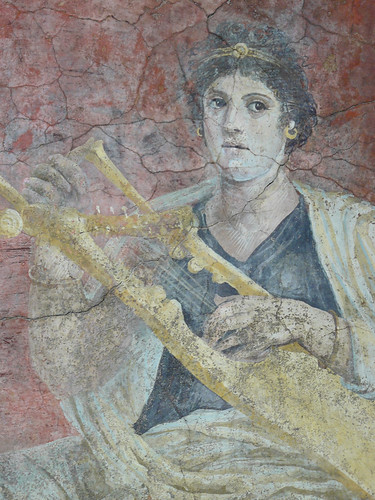
Boscoreale Wall Paintings Featured in Renovated Greco-Roman Galleries at the Met

I am heading home today from my first visit to New York City and the Metropolitan Museum of Art. To say I almost suffered an art meltdown is an understatement! I spent two full days at the Metropolitan Museum of Art (and still only saw a fraction of the art there!) and was thrilled to discover they have a number of wall frescoes from villas in Boscoreale. They're quite stunning and I notice the women in them were painted with the wide eyes seen in many Greco-Roman mummy portraits from Egypt. They made me even more excited about seeing Boscoreale in person in October!

"Boscoreale, an area about a mile north of Pompeii, was notable in antiquity for having numerous aristocratic country villas. This tradition endured into the time of the Bourbon kings, as is attested by the region's name, the "Royal Forest," which implies that Boscoreale was a hunting preserve. Some of the most important wall paintings surviving from antiquity come from a Roman villa at Boscoreale built shortly after the middle of the first century B.C. The villa, which was buried by the eruption of Vesuvius in 79 A.D., is referred to as the Villa of P. Fannius Synistor, one of its owners during the first half part of the first century A.D. Excavated in the early 1900s, the villa's frescoes are among the most important to be found anywhere in the Roman world.

The villa at Boscoreale is a variant of the so-called villa rustica, a country house of which only a small part functioned as a farmhouse (pars rustica). The majority of the villa served as a residence for the owner, a member of that class of wealthy Roman citizens who owned more properties of this kind and used them as country houses. The painted decoration of the villa at Boscoreale, which was executed sometime around 40–30 B.C., attests to the original owner as a rich man with exquisite taste. The fact that the mid-first-century B.C. decoration was not replaced by another, more contemporary, decoration in the first century A.D. is a clear indication that there was already an awareness of the quality of the frescoes in antiquity.

The surviving paintings are extremely fine examples of the late Second Style, the most renowned style in Roman wall painting. Throughout the frescoes from the villa at Boscoreale there are visual ambiguities to tease the eye, including architectural details painted to resemble real ones, such as rusticated masonry, pillars, and columns that cast shadows into the viewer's space, and more conventional trompe l'oeil devices, such as three-dimensional meanders. Objects of daily life were depicted in such a way as to seem real, with metal and glass vases on shelves and tables appearing to project out from the wall. Cumulatively, these trompe l'oeil devices reveal the Republican owner's evident pleasure in impressing guests at his comfortable summer retreat." - The Metropolitan Museum of Art

If you enjoyed this post, never miss out on future posts by following me by email!