It seems that scholars are never quite sure if they should embrace the reports of ancient historian Herodotus or not. Now a controversy has arisen over his statements that the "ugliest of customs", prostitution, actually took place as part of the sacred rituals inside the Temple of Ishtar.
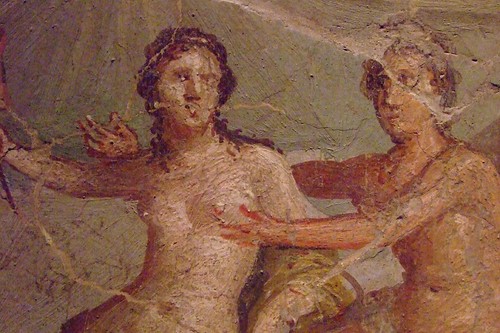
[Image: Ertoic fresco excavated from Pompeii displayed in the 'Secret Room' of the Naples Archaeological Museum. Photo by Mary Harrsch]
If you've ever visited the "Secret Room" inside the Museo Archaeologico di Napoli in Naples, you will have no doubt that the ancients definitely enjoyed their carnal pleasure. But did they go so far as to make the deflowering of virgins part of their worship of their respective goddesses of love?
The Greek geographer Strabo thought so claiming that Persians living along the shores of the Black Sea dedicated their "virgin daughters," hardly 12 years old, to cult prostitution.
But, a small group of female gender researchers led by American scholar Julia Assante claim it's all the product of overactive male imaginations. (After all, I saw a program this week on Good Morning America about the differences in the male and female brain where a doctor was discussing how the male brain is "marinated" in testoterone!)
More moderate scholars, however, think disavowing all sacred sexual practices goes a bit too far and have expressed their opinions that there were once:
* Temples that operated brothels on the side;
* Temples in which girls held the highest offices of the priesthood, even before their first menstruation;
* Professional harlots who donated their own money to cult sites, such as a site devoted to the goddess "Aphrodite Porne."
But with all those huge buildings dedicated to Ishtar, the goddess of love, there was not a single instance of ritual depravity?
Gernot Wilhelm, an Orientalist at Julis Maximilian University in Würzburg, Germany discovered a 3,300 year-old legal document that recounts how a man delivered his own daughter to the Temple of Ishtar to serve as a Harimtu.
According to the document, the man wanted a loan from the priests and was offering his daughter as collateral.
But what exactly did the pawned daughter do for her new employers? Wilhelm speculates that the young girl worked as a prostitute, "but outside the temple."
As evidence, the professor cites the "Book of Baruch" in the Old Testament. It describes prostitutes standing "along the paths" between the dusty houses of Babylon. They too were somehow associated with a sacred organization. - "Did Prostitution Really Exist in the Temples of Antiquity? by Matthius Schulz
Assante and her colleagues dispute this interpretation, however. She says a Harimtu was not a prostitute but just a single woman serving as a cult official.
Her reinterpretation of the word Harimtu doesn't make semantic sense, says economic historian Morris Silver. He insists that the Harimtu were clearly "professional prostitutes with cultic connections," who offered a "sexual service" on behalf of the temple. Priests acted as pimps and collected some of the profits. - "Did Prostitution Really Exist in the Temples of Antiquity? by Matthius Schulz
Other scholars point to the accounts of prostitution surrounding the Temple of Aphrodite in Corinth. Strabo reports the temple owned a stable of over 1,000 prostitutes (I thought he was supposed to be interested in geography?) Tanja Scheer, a professor of ancient history at the University of Oldenburg in northern Germany blames it all on an ode to Pindar.
"Pindar writes that a wealthy Olympic champion dedicated the temple to a "hundred-limbed" throng of prostitutes in 464 B.C.," Scheer points out, "It is unlikely that the prostitutes lounged directly at the altar. Instead the wealthy athlete probably offered the temple financial assistance in the form of female slaves."
Scheer bases her theory on the fact that the Athenian statesman Solon taxed prostitutes working in government houses of pleasure in Athens around 590 B.C.. The revenues were subsequently used to build a temple for worshipers of the goddess of love. Then somehow the construction of the temple became entangled with the source of the money used to build it in subsequent oral histories .
Besides, if you take Pindar literally, a "hundred-limbed" throng of prostitutes would have been only a mere 25 if you count all four limbs or 50 if you count just their arms - that seems a far cry from 1,000.
Strabo's sexual fantasies didn't end there, though, either. He went on to claim that loose women also inhabited the Temple of Amun in Thebes (Egypt) where they served as godly consorts.
Strabo writes, "a maiden of greatest beauty and most illustrious family prostitutes herself, and cohabits with whatever men she wishes until the natural cleansing of her body takes place" (menstruation).
Researchers do admit that a recently translated papyrus fragment does refer to young girls in service to the god.
According to the text, girls are permitted to work in the temple until their first menstruation. After that, however, "they are cast out from their duties." - "Did Prostitution Really Exist in the Temples of Antiquity? by Matthius Schulz
So, as they say on that tabloid TV show, "What side are you on?"


 If you enjoyed this post, never miss out on future posts by following me by email!