Showing posts with label ancient history. Show all posts

Sunday, July 21, 2019

Review: Army of the Roman Emperors: Archaeology and History by Thomas Fischer


History resource article by Mary Harrsch © 2019

Casemate Academic Publishing recently sent me a reference text to examine entitled "Army of the Roman Emperors: Archaeology and History" by Thomas Fischer.  This comprehensive  work is divided into six parts.

Part I, written by Dietrich Boschung,  examines "Iconographic sources for the Roman military" from the Republican period through Late Antiquity.  I found its in-depth descriptions of some famous Roman imagery very revealing.  Furthermore, some of the astonishing pieces I had not seen before either.  One such piece was the Gemma Augusta, a low-relief cameo cut from Arabian onyx attributed to Dioscurides or one of his disciples created in the second or third decade of the 1st century CE. It is currently housed in the Kunsthistorisches Museum in Vienna, Austria.  The text explains the significance of each major figure on the piece, something you rarely get with a museum identification card, and speculates on the purpose for which the piece was created.

1st century CE Roman cameo depicting Tiberius and Augustus with various deities and prisoners
courtesy of Wikimedia Commons contributor Carole Raddato
 It peaked my interest so much that I researched the cameo further and discovered there are also alternative explanations for some of the figures, particularly those in the lower register where captives are shown awaiting the erection of a tropaion.  It was interesting to read how various art historians use slight clues from hairstyles and attire in combination with a knowledge of political and military history of the period to determine who is actually represented and for what purpose.

Part II explores the changes that occurred over time in the armament and equipment of the Roman army, a result of the development of more advanced weapons and fluctuations in the procurement of raw materials.  It also discusses archaeological finds made in different contexts such as battlefield and siege finds, objects recovered from camps, forts and other military sites, those found in civilian settlements, and artifacts recovered from water deposits, hoards, and grave sites.

Part III examines all of the costumes, weapons, and equipment from original archaeological finds. This was my favorite section since I am a visually-oriented person and it was full of photographs, drawings, and reconstructions of objects actually recovered from the field.  I was particularly impressed with the condition of some of the artifacts, especially ornate pugio scabbards and cavalry helmets, many of them, I noticed, in private collections.  I was also surprised by the variety of different helmet designs and the degree of ornamentation on some accessories like a privately-owned collection of cheek pieces. I really appreciated the drawings showing the placement of some items of a legionary's kit and those used with horses, too.

Part IV explored the details of Roman army constructions and architecture from marching camps to vexillation fortresses and how defensive structures changed through the centuries.  There is even a discussion of the various military structures in Rome itself from the Castra Praetoria to the accommodation for the vigiles.

Part V wraps up the army portion with a chronological look at military conflicts and the armament and equipment used in each historical period beginning with the Republic.

Then Part VI discusses the development of the Roman navy from the arming and equipping of the marines to locations of naval installations including those along major rivers and tributaries.  A wealth of illustrations, informed by not only iconographic sources but the recovery of actual vessels, depict various ships and smaller craft as well as harbor installations.

I think this book would be an invaluable reference work for not only Roman history enthusiasts and re-enactors but aspiring novelists as well.  Its extensive bibliography serves as a stepping stone to more research sources and it offers a thorough index as well.
If you enjoyed this post, never miss out on future posts by following me by email!


Sunday, July 29, 2018

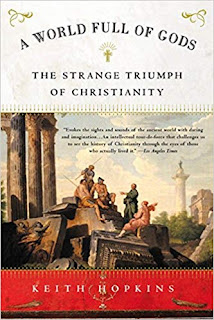
Review: A World Full of Gods: The Strange Triumph of Christianity by Keith Hopkins


A historical resource article by Mary Harrsch

When I was researching the Roman Empire's financial crisis of the late 3rd century and subsequent embrace of Christianity as part of the solution, I found a wealth of information in the late Keith Hopkins book "A World Full of Gods: The Strange Triumph of Christianity."  Before his death in 2004, I had often admired Hopkins insight shared in a number of television documentaries on the Roman Empire. 

Although Hopkins is mostly remembered as a professor of ancient history at Cambridge, he also served a lectureship at the London School of Economics. Since my research was going to cross over from history to economics, I was excited to find his book, originally published in 1999.

But the book, like the man, was quite unconventional. Instead of a purely historic treatise on the rise of Christianity, it began with a fictional tale of time travel to first, ancient Pompeii, and then to ancient Egypt, to give the reader a taste of other competing religions during the formative years of Christianity's development.  Although I was really more interested in facts than fantasy, I enjoy time travel tales so was not dissuaded from continuing to read on.

Then, I came upon a very long third chapter and it was literally stuffed with the background information and sociological interpretation I was truly looking for.  I marked each usable passage with purple sticky tabs and soon that portion of the text was fluttering with purple markers.
Hopkins, a sociologist, drew parallels between the ancient Christian "revolution" and the political upheaval resulting in the establishment of communist China.

"...in Rome as in China, the veneer of virtuous prescription disguised a multitude of sins; the church grew steadily richer, and more corrupt; Christian rigorists pursued mad ends with obsessional fervor; bishops borrowed the oppressive powers of the state to bully, exclude, and even execute doctrinal rivals. "

Hopkins goes on to point out Christians viewed themselves as the fervent elect, chosen by God, and linked together by their difference from and radical rejection of others. 

"...once in alliance with the state, Christian leaders exploited their newfound powers in order to impose single versions of correct belief, through votes by universal councils of bishops.  Almost inevitably, once its influence and power was buttressed by the state, the church also became in part a business, distributing charity, patronage, privilege, and immortality."

How I interpreted this information and dozens of other passages in relation to the financial crisis of the Roman empire and the "conversion" of the Roman Emperor Constantine can be read in my paper, "Did Financial Exigency Drive The Roman Empire to Embrace Christianity?"

Hopkins spends the rest of his text examining Christian literature, comparing different versions of the gospels, and evaluating Christianity's turbulent coexistence with Judaism and paganism.

If you are looking for an account of purely historical events, this book, with the exception of Chapter Three, may disappoint.  But, if you are open to exploring religious roots as a journey, you may find Hopkins unorthodox approach thought-provoking.

If you enjoyed this post, never miss out on future posts by following me by email!


Sunday, March 18, 2018

Review: Atlas of Empires by Peter Davidson

A historical resource article by Mary Harrsch © 2018


In the opening pages of this reference work, Peter Davidson tells us about his friend who defined an empire as "murder, incest, and the wearing of expensive jewelry!"

"There is the image here both of glorious conquest and of power held over far-flung lands, and indeed this captures something of what we have come to mean by the term 'empire,'" Davidson observes, "But how, then, does empire come about, what forms can it take, and does it have a defining characteristic?"

These are the questions he attempts to answer as he compiles information about most, if not all, empires that have arisen and collapsed throughout world history.

He begins by dividing up his work into nine main chapters, beginning with early civilizations formed when the social construct of empire was a new concept.  The first chapter, entitled "War and Peace", examines the contention between Sumer and Akkad, the rise of Egypt, how the attributes of a military society like Assyria could not achieve stability without advances in administration like those developed by the rulers of Babylonia, and how religion was used to forge unity between disparate peoples by the kings of Persia.

Chapter two focuses on empires of the classical world including Greece and Rome, as well as Alexander's conquests, the Parthians and Sasanians of Iran, the Mauryas and Guptas of India, and the Qin and Han of ancient China.

"The story of Rome is one of adaptation," Davidson points out. "The early growth of Roman power sprange from a zealous and rapacious republicanism that eventually threatened to destroy the republic itself. Unlike Athens, however, Rome restructured to resolve the tension between republic and empire. Subsequently, Rome began to resemble the Persia of Cyrus and Darius in the measures it took to cope with its increasing size and multiculturalism."

In chapter three Davidson leaves the ancient world behind and concentrates on what he terms "Empires of Faith", the Byzantine Empire, the Holy Roman Empire, and the Abbasid Caliphate.
"All the classical empires found ways to supplement control by force with a measure of consent delivered by shared beliefs," Davidson explains. "As the classical world crumbled and people looked for something to hold on to, however, religious ideas promising salvation exerted a stronger pull than political ideas such as citizenship."

Empires of the horse take up Chapter Four as Davidson examines the conquests and achievements of the Mongols, the later empires of the Chinese beginning with the Sui and ending with the Qing, Muslim India with the splendor of the Mughals, and the Ottoman Empire.

"The horse made light work of invading Eurasia's agricultural civilizations but building empires was another matter," Davidson points out. "The steppe riders faced the usual tribal problems of creating a larger community. They also faced the dilemma of what to do with the societies they conquered. If they destroyed they gained little. If they bent themselves to an alien way of life they stood to lose their identity."

Chapter Five looks at what Davidson terms "Empires of Isolation." Three empires are examined here including Mali, the Aztecs, and the Incas. Davidson observes that the empires arising in Eurasia  were ultimately linked by trade and religion but such was not the case in sub-Saharan Africa and in Central and South America. And yet, spectacular empires arose even without the use of iron and steel, draft animals or even the wheel, in some cases.

Chapter Six looks at the first global empires, Spain, Portugal, the Dutch, and both Britain and France in the Americas.

"Managing such far-flung empires was a new challenge," says Davidson. "It was partly a question of money. To squeeze profit from the silver mines of Peru or the nutmeg trees of the Est Indies, ships had to be built, voyages that could take two years had to be financed, and things had to keep going at home."

Chapter Seven examines the conquests of Napoleon, the development of Tsarist Russia and the rule of the Austrian Habsburgs.

"As much in opposition to French occupation as in sympathy with French ideals, national independence movements sprouted across the continent," Davidson observes. "The age of the nation-state had arrived, with first Greece, and later Italy, Germany, and others finding their modern form."
The imperialism of Britain and Japan are examined in Chapter Eight.

"By the 1870s, nationalism had become as much a force to serve imperial ambitions as to incite independence movements. A second industrial revolution now gave Continental powers the chance to compete with Brtain, and , as the 19th century drew to a close, a single global empire gave way to a feeding frenzy for colonial possessions ending in the First World War," Davidson states.

In the last chapter, entitled "Empires and Utopias" Davidson looks at the U.S., the Soviet Uniion, and the European Union.  In it, Davidson says each of these entities were ultimately searching for a better world but with the world defined differently to different people with widely disparate histories.

Like any good atlas, this one is full of maps I found extremely helpful in understanding the migration routes of various groups that conquered or influenced specific civilizations. There are other illustrations of cultural art and architecture. Davidson also includes an index and suggested readings.

Davidson does a good job of defining and describing key cultural characteristics of each empire and the inherent challenges their leaders faced.  He also astutely defines the strengths and weaknesses of each and how these either helped it to achieve greatness or resulted in its ultimate decline and destruction. You will not find descriptions of specific battles or a comprehensive discussion of each emperor's reign. Davidson limits even the most complex empire to about four to five pages including illustrations. But, I think this reference work does an excellent job of providing an overview of peoples and forces that have shaped our world.


If you enjoyed this post, never miss out on future posts by following me by email!


Tuesday, December 8, 2015

E-book Review: Inside the Egyptian Museum by Dr. Zahi Hawass

A history resource article by  © 2015

A couple of weeks ago I noticed Dr. Zahi Hawass had released an e-book version of "Inside the Egyptian Museum Pt 1".  The e-book is the first of four e-books that will be released highlighting the collections of the Egyptian Museum.  I thought it would make a perfect companion to take with me if I ever get a chance to finally visit Egypt so I downloaded both the iPad and iPhone versions from iTunes ($2.99 US).

Although I have never read the hard copy version of the book that was originally released in 2009, I have read "Valley of the Golden Mummies" by Dr. Hawass, so was sure his text would be fact-filled. Furthermore, I hoped the features  available on the iPad would enable me to study the images more closely than I would have been able to by simply browsing a physical book.

Dr. Hawass begins his journey through the museum as you physically would if you visited the galleries in person.  First, though, he describes some of his favorite objects.  These include, naturally, the golden mask of Tutankhamun, as well as a statue of a dwarf named Perniankhu.  As it turns out, Dr. Hawass was present when the dwarf statue was discovered and he describes the experience.  Dr. Hawass did the same thing in his book Valley of the Golden Mummies and I think these insights make the artifacts seem more personal than just a physical description of them.

As I had hoped, the retinal display of my iPad presented the high-resolution images in wonderful detail. If you hold your iPad in the horizontal position, the e-book is designed so each page has a panel of scrollable text on the right side and an image of the object Dr. Hawass is discussing on the left .  If there are multiple images of the artifact or the text describes more than one artifact, you will see little dots under each picture that you can select to view additional images.  Whenever I am photographing artifacts in a museum I try to take images from different angles and closeups as well as full length views. The photographer for this book, Sandro Vanini, has done the same thing, which I really appreciated.  You can also expand the images by spreading your fingers to really study specific details, something not possible with a physical book.

Each page also includes a little map to show you exactly where the object is in the actual museum. So, the iPhone version would work well as a gallery guide if you prefer not to travel with your iPad.
Dr. Hawass presents the artifacts in chronological order beginning with the early Pre-Dynastic Period. Each era in the book is preceded by beautiful full screen images of ancient remains as well as overhead views of the museum gallery pertaining to the period.

First up was a marvelous image of the Narmer Palette.  I had read about the Narmer Palette when I took the Great Courses lecture series "History of Ancient Egypt" presented by Dr. Bob Brier some years ago.  But it was wonderful to be able to examine it in such detail.  I also had a chance to examine the Libyan Palette, too, which I had never seen before.

The Narmer Palette from the Pre-Dynastic Period 3000 BCE Egypt


There were also images of Naqada II pottery.  I had first photographed Naqada pottery at the Metropolitan Museum of Art back in 2007 but knew very little about it.  Dr. Hawass carefully describes the imagery on them and I'm glad he did as I wouldn't have realized what some of the objects portrayed were.

Naqada II pottery at
the Metropolitan Museum of Art
Photo by Mary Harrsch  © 2006
Leaving the Pre-Dynastic Period you see an amazing image of the Step Pyramid of Djoser at Saqqara.  What made this image particularly interesting to me was the viewpoint of the pyramid with its chapels in the foreground.  Most documentaries I had seen always show the Step Pyramid from a distance and I don't recall ever seeing the mortuary chapels before.

The Old Kingdom, known as the Pyramid Age, begins with the 3rd dynasty and ends with the 6th dynasty.  One of my favorite pieces from this period was a wooden statue of the Lector Priest Ka-aper.  He looks almost kindly with the hint of a smile on his plump face and his lifelike eyes outlined in copper and crafted of quartz with black paste for pupils make him appear to be looking right at you.  I also found images of inlaid bracelets and a sedan chair particularly interesting.

Moving on we come to the Middle Kingdom.  There is an image of a statue of Queen Nofret, wife of the Pharaoh Senwosret II that caught my eye.  Just a few months ago I saw a similar statue on display at the Walters Art Museum in Baltimore and learned from Dr. Hawass that the distinctive wig worn by Queen Nofret and the statue I had seen in Baltimore is known as the Hathor wig.  I really appreciate these little details.

Egyptian Queen with Hathor wig 30th Dynasty.
Photographed at the Walters Art Museum, Baltimore,
Maryland by Mary Harrsch © 2015
I was also fascinated by a very lifelike statue of Senwosret III.  Many statues I have seen of Egyptian pharaohs are so stylized they sort of look alike to me, but this statue had a very distinctive, care-worn face.

"...his tired eyes, the bitter mouth, the forceful frowning, and the large ears. The tormented visage of the king reflects his new role and responsibility as administrator of Egypt, a result of the later 12th Dynasty kings' policies of expanding the Egyptian border further south, and of crushing the authority of the independent Nomarchs in order to create a more powerful centralized government." - Dr. Zahi Hawass, Inside the Egyptian Museum

Another more realistic sculpture depicted is a statue of Amenenhat III as a priest with a stern face and unusual haircut as well as a sphinx with the face of Amenenhat III and large tufted ears.  Dr. Hawass points out in the book that large ears are a distinctive feature of Middle Kingdom art, an interesting tidbit I will tuck away for future reference.

The book concludes with an extensive bibliography that provides sources for future study if you are so inclined.

I am really looking forward to the next three installments in this e-book series!

If you enjoyed this post, never miss out on future posts by following me by email!


Tuesday, August 13, 2013

Review: Pride of Carthage by David Anthony Durham


I began reading a hard copy of David Anthony Durham's "Pride of Carthage" several years ago and never seemed to get around to finishing it until an audio version was recently released on Audible.com.  I am one of the unfortunate individuals that becomes unbearably sleepy if I attempt to read a traditional book for more than about 45 minutes but I listen to books while I exercise each morning on my exercise bike, so if an audio version of a book becomes available, I'll usually finish it in due course as long as I don't have other activities interfering with my exercise routine.  Thankfully, this was the case with Durham's novel of Hannibal after switching to the audio version.

I have studied Hannibal to some extent and was quite familiar with his military conquests during the Second Punic War. But most history texts say little about his personal life and that was what I was most interested in.  I realize the ancient sources tell us little about the Barcas as a family so I knew much of Durham's characterizations would have to come from his own imagination.  But still, I wanted to have some images to cling to as I learn more about Hannibal in the future and this is the reason I chose to read this book.  So let's examine the cast of characters Durham has crafted for us.

Polybius tells us that a leader's true character is often obscured by actions he must take in response to circumstances created by his own undertaking.

"His [Hannibal's] circumstances were so extraordinary and shifting, his closest friends so widely different, that it is exceedingly difficult to estimate his character from his proceedings in Italy." - Polybius, The Histories, Book IX, Chapters 22-26

So, Durham takes the relatively safe route and introduces us to a quintessential warrior - finely muscled, an astute judge of character, a family man who welcomes his infant son with tenderness and a bit vain.  In one of the opening scenes, Hannibal stands nude before his wife, Imilcea, demonstrating to her that he has maintained his flawless body despite the latest battle he has fought at Arbocala.  (That image soon fades, though, as Hannibal suffers first a devastating spear wound then loses the sight in one eye slogging through mosquito-infested marshes in Italy.)

Family to Hannibal, however, is first and foremost a responsibility to maintain the ancestral "dignitas", if I may use a Roman term to define it, of the Barcids who were legendary even in Hannibal's own time.  His father, the revered Hamilcar Barca, though now dead, is a shadowy presence that Hannibal, sometimes consciously and sometimes unconscieously, defers to in almost every decision Hannibal considers.

And, if friends are so influential, what forces do we see swirling about Hannibal in his council chambers that will propel him to the apex of victory or foreshadow his eventual defeat?

This is where Durham chooses to diverge a little from historical sources.  We meet Hannibal's brother Hasdrubal, a luxury-loving but fiercely loyal lieutenant to his older brother.  Since Durham has read Polybius, he is certainly aware that the Barcids were reputed to love wealth.

"Fond of money indeed he does seem to have been to a conspicuous degree, and to have had a friend of the same character---Mago, who commanded in Bruttium. That account I got from the Carthaginians themselves; for natives know best not only which way the wind lies, as the proverb has it, but the characters also of their fellow-countrymen. But I heard a still more detailed story from Massanissa, who maintained the charge of money-loving against all Carthaginians generally, but especially against Hannibal and Mago called the Samnite. Among other stories, he told me that these two men had arranged a most generous subdivision of operations between each other from their earliest youth; and though they had each taken a very large number of cities in Iberia and Italy by force or fraud, they had never taken part in the same operation together; but had always schemed against each other, more than against the enemy, in order to prevent the one being with the other at the taking of a city: that they might neither quarrel in consequence of a thing of this sort nor have to divide the profit on the ground of their equality of rank." -Polybius, The Histories, Book IX, Chapters 22-26

However, greed is not an endearing trait to modern readers so I can understand Durham redirecting a love of wealth to Hannibal's brother rather than the commander himself to maintain reader empathy with his protagonist.  We must also consider the possibility that Massanissa, though initially loyal to the Barcas, was eventually forsaken by the Carthaginians in favor of Syphax, another Numidian chieftain.  So, Massinissa's criticism must be viewed skeptically.  I thought Durham's choice to introduce this aspect to the Barca family without sacrificing respect for Hannibal was reasonable.

Durham's decision to make Hasdrubal a composite figure of Hasdrubal Barca and Hasdrubal Son of Gisco is likewise understandable.  Having two Hasdrubals running around could get really messy and an author could risk losing readers partway through the narrative.

The death of Sophonisba by Giambattista Pittoni 18th century CE.
Courtesy of Wikimedia Commons
The reason I am sure Hasdrubal is a composite figure is based on a plot development later in the novel. Hasdrubal (Barca) agrees to give his youngest sister, Sophonisba, in marriage to the dastardly Syphax of Numidia in return for Syphax' Carthaginian support.  This famous tragedy (Sophonisba had been previously promised to Massinissa) was initiated historically by Hasdrubal Son of Gisco, not Hasdrubal Barca.  Sophonisba was known to be a Carthaginian noblewoman but not a Barca, although Hamilcar is thought to have had three daughters.  However, by making Sophonisba the youngest of Hannibal's sisters, Durham strengthens the reason for Scipio's insistence that after Massinissa's defeat of Syphax, his wife march in Scipio's victory triumph in Rome.

Then we meet Hannibal's brother Mago, who is portrayed as level headed and strategically skilled - a strong right arm who has a knack for thinking outside the box.  This personality appears consistent with the historical Mago who courageously stood by his brother's side in the crucial center of the Carthaginian line at Cannae and who traveled back to Carthage with the gold rings of the defeated Roman aristocracy to plead for support for Hannibal's continued success.

Closeup of the shield of King Henry II of France that depicts Hannibal at the
battle of Cannae. Image courtesy of Wikimedia Commons.


The next choice Durham makes, however, is much more of a leap.  He introduces us to a third brother, Hanno.  In all of my research, I found only a casual reference to the possibility that there was a fourth Barcid lion in Hamilcar's brood.  Hanno is portrayed as skilled but sourly envious of Hannibal's success and favored position as eldest in the family.  Hanno's sexual appetites are directed at other men.  These attentions were viewed as beneath his exalted position as a Barca and an element that promoted his anxiety toward Hannibal and his other brothers.

I could not find any specific references to the Phoenician view of homosexuality although the home country that spawned Carthage was under the influence of the Persians for centuries and Persia had a long history of antihomosexual tradition.  Rome at this point in history, although condoning homosexual relations with participants of lesser social status (slaves, captives, freedmen, etc.) prosecuted homosexuals in the military sphere, considering it damaging to the soldier's image as the supreme example of masculinity.  If the Roman viewpoint was shared by other military organizations around the Mediterranean, then Hanno's low self-esteem as portrayed by Durham would have been a probable outcome.

I must admit, though, I found it hard to accept the name of Hanno as a Barca.  Although Hanno is one of the few noble Carthaginian names, it is associated in history with the Barca family's strident opposition in the Carthaginian senate so I would have hesitated to use it for a Barca sibling.

However, once again, Durham creates this character as a composite of an historical Hanno who was, in fact, an officer (not brother) under Hannibal.  Durham probably chose to create this composite figure to reduce the confusion created by Livy in his history.  Livy identifies a Hanno who was a cavalry commander at Capua, another in command at Metapontum in 207 BC who was sent to Bruttium to raise fresh troops by Hannibal, and yet another Hanno who was sent to Spain in 206 BC by the Carthaginian senate, where he was defeated and captured by the Romans under Marcus Silanus in 207 BCE.  Durham's Hanno is defeated and captured in Spain then transported to Italy as a prisoner.  There he is sereptitiously freed and reappears fighting in Africa as indicated later by Livy in 203 BCE.

Actually, I found Durham's composite device quite effective in keeping the story line relatively continuous.  It also served as a counterbalance to the heroic aspects of the other Barcas.

Durham introduces another particularly dark character that kept cropping up throughout the book with a blood lust that Hannibal found difficult to check.  Monomachus, (historically named Hannibal Monomachus - those Carthaginians used only a handful of names for their noble families that makes reading Punic history really confusing!) is a warrior who worships the blood-thirsty god, Moloch, and is constantly urging Hannibal to unleash absolute horror upon the Romans.  Polybius gives us a specific example of this man's approach to total war:

"At the time that Hannibal was meditating the march from Iberia to Italy with his army, he was confronted with the extreme difficulty of providing food and securing provisions, both because the journey was thought to be of insuperable length, and because the barbarians that lived in the intervening country were numerous and savage. It appears that at that time the difficulty frequently came on for discussion at the council; and that one of his friends, called Hannibal Monomachus, gave it as his opinion that there was one and only one way by which it was possible to get as far as Italy. Upon Hannibal bidding him speak out, he said that they must teach the army to eat human flesh, and make them accustomed to it. Hannibal could say nothing against the boldness and effectiveness of the idea, but was unable to persuade himself or his friends to entertain it. It is this man's acts in Italy that they say were attributed to Hannibal, to maintain the accusation of cruelty, as well as such as were the result of circumstances."Polybius, The Histories, Book IX, Chapters 22-26

Durham's Hannibal resists the level of cruelty Monomachus suggests most of the time but later in the Italian campaign, when Hannibal struggles to maintain the loyalty of cities that waiver in their support of the Carthaginian cause, Durham's Hannibal allows Monomachus to perpetrate a number of atrocities.  This may or may not have occured in antiquity although Polybius points out some Roman cities suffered "treacherous violence" at this point in the campaign.

"...as soon as Capua fell into the hands of the Romans, the other cities naturally became restless, and began to look round for opportunities and pretexts for revolting back again to Rome. It was then that Hannibal seems to have been at his lowest point of distress and despair. For neither was he able to keep a watch upon all the cities so widely removed from each other---while he remained entrenched at one spot, and the enemy were maneuvering against him with several armies---nor could he divide his force into many parts; for he would have put an easy victory into the hands of the enemy by becoming inferior to them in numbers, and finding it impossible to be personally present at all points. Wherefore he was obliged to completely abandon some of the cities, and withdraw his garrisons from others: being afraid lest, in the course of the revolutions which might occur, he should lose his own soldiers as well. Some cities again he made up his mind to treat with treacherous violence, removing their inhabitants to other cities, and giving their property up to plunder; in consequence of which many were enraged with him, and accused him of impiety or cruelty. For the fact was that these movements were accompanied by robberies of money, murders, and violence, on various pretexts at the hands of the outgoing or incoming soldiers in the cities, because they always supposed that the inhabitants that were left behind were on the verge of turning over to the enemy." Polybius, The Histories, Book IX, Chapters 22-26

A depiction of a child sacrifice to the gold Moloch (sometimes referred to
as Molech).
Whether children were singled out for sacrifice is not specified.  Of course Roman propoganda is always a concern whenever you study Roman history.  But, we do know that Roman parents used to frighten their children with stories of Hannibal at the gates.  So, Durham makes the connection to these stories clear.  In the novel, during Monomachus' raids of villages and towns in the southern Italian peninsula, Monomachus seeks out Roman children to sacrifice to his god Moloch providing the reason those stories have persisted through the centuries.

In the opening chapters of the book we also meet one of Hannibal's sisters, Sapanibal.  Sapanibal is tall and athletic with a keen mind.  We are told she often served as a sounding board for Hannibal on matters of diplomacy and tribal relations.  She is the widow of Hasdrubal "The Handsome" or "The Fair",  the man who took over command of Iberia after the death of Hannibal's father, Hamilcar, until his own assassination.  Hasdrubal the Handsome is portrayed as an arrogant brute who apparently  resented his high-born wife and used every excuse to humiliate and psychologically wound her.  In the novel his womanizing is legendary much to her embarassment.

Of course ancient scholars seldom bothered themselves with the treatment of famous men's wives so we can assume Durham embellished this relationship for the purposes of drama.  We do know, though, that Hasdrubal the Handsome personally negotiated a treaty with Rome that established the Ebro river as the northern-most border of Carthaginian influence.

"The treaty had been concluded between the Romans and Hasdrubal, not Carthage. This is remarkable, because other Roman-Carthaginian treaties were concluded between the two states. This suggests that Hasdrubal was considering his position as if he were some sort of king. Several ancient sources even suggest that he wanted to become independent. This is probably incorrect, but his acts may have caused some raised eyebrows in Carthage." - Jona Lendering, Livius.org, 2004

So, it is not much of a stretch to associate a man "who would be king" with the personality Durham has created for him.  The resulting impact on Sapanibal was to make her unwilling to enter into close friendships and to make her skeptical of the motivations of those around her, both traits certainly understandable given the circumstances.

We also meet Hannibal's wife, Imilce, a beautiful Celtic princess who loves Hannibal passionately but seems somewhat mystified by the legacy of war and need for conquest and martial success that rules the Barca family.  Hannibal's marriage to her was arranged by Hasdrubal the Handsome to strengthen Carthaginian ties to the local populace.  But Hannibal seems to truly love and admire her for her intelligence and comprehension of tribal politics as well as her devoted care of their son, little Hamilcar nicknamed Hammer.

So the stage is set for the epic drama that is to come as Hannibal sets his sight on the conquest of Rome. With Durham's vibrantly drawn characters, his subsequent retelling of the victories and later defeats of Hannibal's army have a more human quality to them than most dry textbook accounts I have read in the past.

To see a reenactment of the final battle for Carthage, check out this trailer for the upcoming game Rome: Total War II due for a September release:


But I was most touched by the story of Sophanisba and Massinissa.  Although Durham heightened the tale by making Sophanisba Hannibal's youngest sister (she was actually the daughter of Hasdrubal Gisco as previously stated), Durham's details of the tragedy were taken straight from  the pages of Livy (and Polybius, Appian, Diodorus and Cassius Dio!).  I have to confess, though, that I had never read anything about Sophanisba before and I found the story of her doomed love for Massinissa as compelling as the famous romance of Antony and Cleopatra.

So all in all, I think David Anthony Durham created an engaging narrative, solidly based on factual accounts but with creative choices that made sense from both a dramatic perspective and to preserve a reader's overall understanding of events without tripping over too many characters with the same name.  My only regret is that Durham stopped with Hannibal's defeat at the battle of Zama and did not attempt to speculate on Hannibal's subsequent role in the resurrection of his nation, his political challenges and ultimate betrayal by the greedy Carthaginian opposition that lacked the vision to foresee the death of their own civilization.

Enhanced by Zemanta
If you enjoyed this post, never miss out on future posts by following me by email!


Sunday, February 27, 2011

Check out my latest reviews of books about the ancient world!

I have been busy trying to catch up on writing reviews about all of the books about the ancient world I have read lately and posted quite a few in relatively a short time span.  Check them out!

King of Kings: Warrior of Rome by Harry Sidebottom (3rd century CE - Roman/Persian Wars)
The Hittite by Ben Bova (12th century BCE - retelling of the Trojan War)
The Green Bronze Mirror by Lynne Ellison (Young adult time travel - 1st century CE)
The Genghis trilogy by Conn Iggulden (12 -13th century CE - not Roman but fascinating none the less!)
Roman Games by Bruce MacBain (late 1st century CE)

WARRIOR OF ROME II: KING OF KINGS (WARRIOR OF ROME 2)  The Hittite   The Green Bronze Mirror  Genghis: Birth of an Empire: A Novel  Roman Games: A Plinius Secundus Mystery
Enhanced by Zemanta
If you enjoyed this post, never miss out on future posts by following me by email!