Showing posts with label Marsyas. Show all posts

Saturday, May 22, 2021

The Aulos

An aulos or tibia (Latin) was an ancient Greek wind instrument, depicted often in art and also attested by archaeology. Though aulos is often translated as "flute" or "double flute", it was usually a double-reeded instrument like the modern oboe, but with a larger mouthpiece, and its sound—described as "penetrating, insisting and exciting"was more akin to that of the bagpipes. Although used for martial music, the aulos is more frequently depicted in other social settings. It was the standard accompaniment of the passionate elegiac poetry. It also accompanied physical activities such as wrestling matches, the broad jump, the discus throw and to mark the rowing cadence on triremes, as well as sacrifices and dramas. Plato also associates it with the ecstatic cults of Dionysus and the Korybantes.

Although aristocrats with sufficient leisure sometimes practiced aulos-playing as they did the lyre, after the later fifth century BCE the aulos became chiefly associated with professional musicians, often slaves. Nevertheless, such musicians could achieve fame. The Romano-Greek writer Lucian discusses aulos playing in his dialogue Harmonides, in which Alexander the Great's aulete Timotheus discusses fame with his pupil Harmonides. Timotheus advises him to impress the experts within his profession rather than seek popular approval in big public venues. If leading musicians admire him, popular approval will follow. However, Lucian reports that Harmonides died from excessive blowing during practicing.  

Some variants of the instrument were loud, shrill, and therefore very hard to blow. A leather strap, called a phorbeiĆ” in Greek or capistrum in Latin, was worn horizontally around the head with a hole for the mouth by the auletai to help support the lips and avoid excessive strain on the cheeks due to continuous blowing. Sometimes a second strap was used over the top of the head to prevent the phorbeiĆ” from slipping down. 

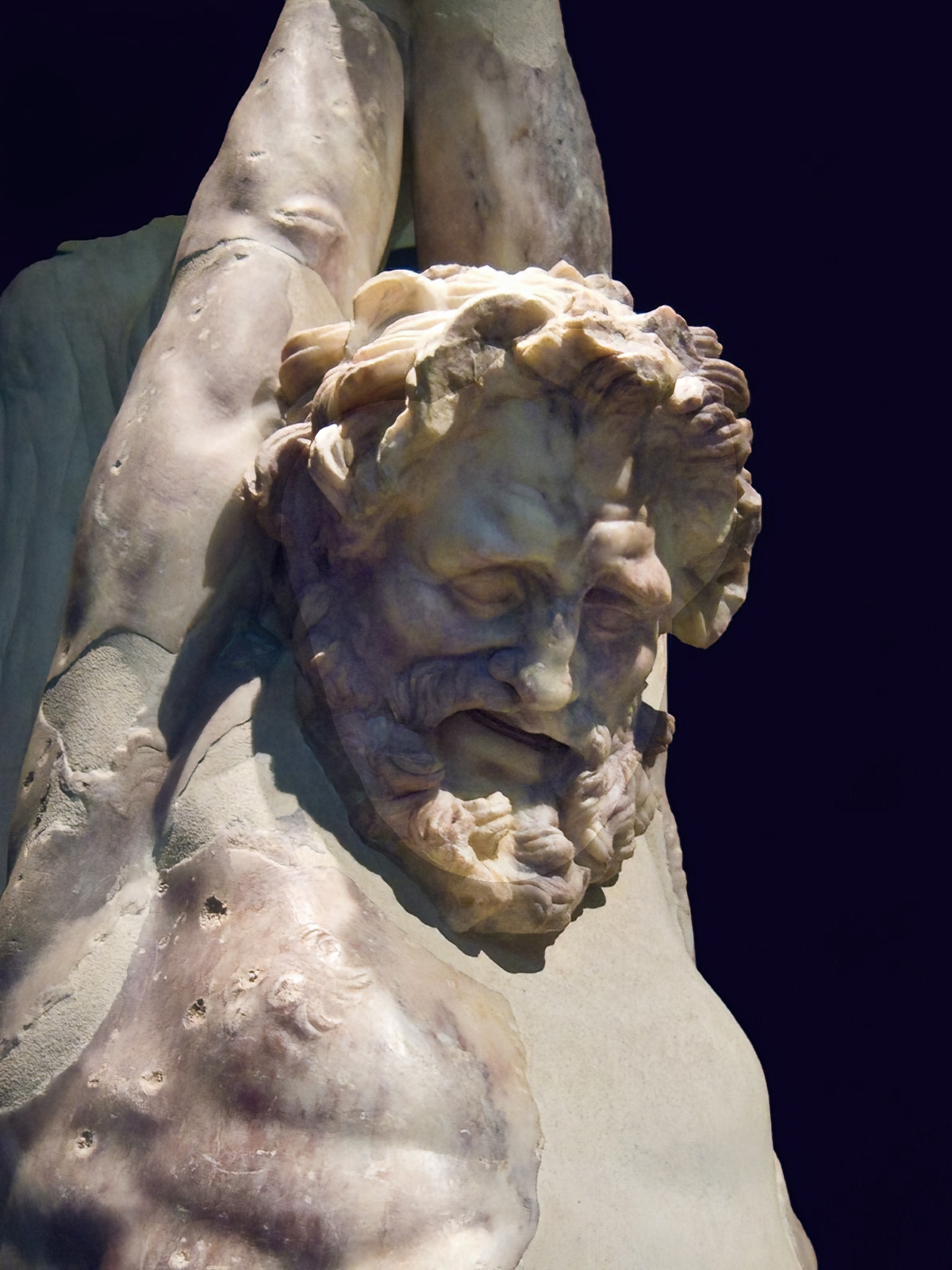
An aulos discarded by Athena then picked up by Marsyas the satyr was the instrument that resulted in Marsyas being flayed alive for his hubris after losing a musical contest with Apollo. A sculpture of the flayed Marsyas at the Capitoline Museum in Rome is one of the most poignant sculptures I have photographed in my travels.

Youth playing the aulos, detail of a banquet scene, tondo of an Attic red-figure cup, ca. 460 BC–450 BCE. Image courtesy of Wikimedia Commons contributor Marie-Lan Nguyen.

Coffin floorboard depicting Isis being served wine by the deceased, Egypt, Roman Period, 30 BCE-324 CE at the Royal Ontario Museum In Toronto, Canada courtesy of Wikimedia Commons contributor Daderot.

Competition between Apollo and Marsyas, panel of a sarcophagus, ca. 290–300 CE, found in 1853 on the Chiarone river banks (Tuscany, Italy), on the former Emilia-Aurelia road. Image courtesy of Wikimedia Commons contributor Marie-Lan Nguyen.

Statuette of a Young Satyr Playing the Double Aulos, silver with gilding, Roman 150-200 CE, courtesy of the J. Paul Getty Museum and photographer Bruce White. This rustic looking youth strides forward playing a double aulos or flute. The instrument is unusual in that it has one straight pipe and one with a flaring, upward-curving end. The youth is nude except for a gilded panther skin draped across his torso. The panther skin, impish facial features, and stiff, tousled hair characterize the young figure as a satyr, a semi-human follower of Dionysos, the Greek god of wine. Nevertheless, he lacks the expected animal ears of most satyr portrayals, and the place where a tail should be is covered by the panther skin. This confusion of traditional iconography, as well as his round face and bulging eyes, suggest that this statuette was made during the Antonine dynasty in the 100s CE. This time period also saw the production of many other solid-cast silver statuettes given by the wealthy as offerings to the gods either in a temple treasury or in a household shrine.

Choregos and actors including a musician playing the aulos, Roman mosaic from the House of the Tragic Poet (VI, 8, 3) in Pompeii courtesy of Wikimedia Commons contributor Marie-Lan Nguyen.

Roman mosaic depicting a comedy scene depicting a musician playing the aulos from the so-called Villa of Cicero in Pompeii 1st century CE that I photographed at the Museo Archaeologico Nazionale di Napoli in Naples, Italy.

Marsyas the satyr who was flayed alive for his hubris by Apollo for challenging him to a music contest Roman imperial period copy of 2nd century BCE Greek original that I photographed at the Capitoline Museum in Rome, Italy.

Closeup of the agony of Maryas the satyr who was flayed alive for his hubris by Apollo for challenging him to a music contest Roman imperial period copy of 2nd century BCE Greek original that I photographed at the Capitoline Museum in Rome, Italy.


If you enjoyed this post, never miss out on future posts by following me by email!


Friday, January 8, 2021

Marsyas: The Price of Hubris

One of the most moving sculptures I have ever photographed is a depiction of the satyr Marsyas who has been flayed alive by Apollo for his hubris of challenging Apollo, the god of music (among other things), to a music contest.  The large statue of Marsyas bound and hanging by his hands with his skin already partially removed at the Capitoline Museum in Rome is a Roman Imperial Period copy of a 2nd century BCE Greek original. 

In antiquity, literary sources often emphasize the hubris of Marsyas and the justice of his punishment. Hubris has been described as a personality quality of extreme or foolish pride or dangerous overconfidence, often in combination with (or synonymous with) arrogance. Hubris, arrogance and pretension are related to the need for victory (even if it doesn't always mean winning). Hubris is usually perceived as a characteristic of an individual rather than a group, although the group the offender belongs to may suffer collateral consequences from wrongful acts. Hubris was thought to indicate a loss of contact with reality and an overestimation of one's own competence, accomplishments or capabilities. In ancient Greece, hubris referred to “outrage” - actions that violated natural order, or which shamed and humiliated the victim, sometimes for the pleasure or gratification of the abuser.

Aristotle defined hubris as shaming the victim, not because of anything that happened to the committer or might happen to the committer, but merely for that committer's own gratification: 

"Hubris is not the requital of past injuries. This is revenge. As for the pleasure in hubris, its cause is this - naive men think that by ill-treating others they make their own superiority the greater."

As hubris was considered a transgression against the gods, it was rarely left unpunished in Greek mythology.  Marsyas was ordered flayed.  Arachne, a talented young weaver, was transformed into a spider when she said that her skills exceeded those of the goddess Athena. Niobe boasted of her fourteen children, seven male and seven female (the Niobids), to Leto who only had two children, the twin gods, Apollo and Artemis. Using arrows, Artemis killed Niobe's daughters and Apollo killed Niobe's sons.  So, the consequences of hubris were severe.

These events were not limited to myth, and certain figures in history were considered to have been punished for committing hubris through their arrogance. In Aeschylus' play, "The Persians," King Xerxes is said to have suffered his defeat at Salamis because he arrogantly lashed the waters of the Hellespont with chains after his fleet was destroyed by a storm.


Full length view of of Marsyas hanging on the tree as he is going to be flayed by Apollo. Marble, Roman copy of the 1st-2nd century after a Hellenistic original. Found in Rome, Italy, part of the Borghese Collection at The Louvre, courtesy of Wikimedia Commons contributor Carole Raddato.

Head of Maryas found in the Baths of Caracalla, Roman copy of Greek original from 150-100 BCE, now in the Antikensammlung inf Berlin courtesy of Wikimedia Commons contributor Sailko.

Roman fresco of the Myth of Marsyas in continuous narration, found in Pompeii in the House of Paccia (V, 2, 10, cubicle q), now on display in the National Archaeological Museum of Naples (inv. 120626). Marsyas observes from the top of a rock the continuation of his story: below Minerva, while playing the double flute, is reflected in the circular mirror held by a nymph who has emerged from the water. A little above the nymph is Marsyas who is fleeing with the double flute that the goddess had thrown away. Still further on, we see the satyr from behind playing the double flute and approaching the procession of Muses led by Apollo, whom he will soon challenge in a musical contest. Image courtesy of Wikimedia Commons contributor Sailko.

Ceiling panel depicting Marsyas in chains by Raphael, 1509-1511, at the Apostolic Palace, the official residence of the Pope, in Vatican City courtesy of Wikimedia Commons.

Closeup of inscription on bronze thymiaterion (incense burner) with Marsyas, late 4th century BCE, Etruscan, at the Metropolitan Museum of Art in New York City

Bronze thymiaterion (incense burner) with Marsyas, late 4th century BCE, Etruscan, at the Metropolitan Museum of Art in New York City

Roman mosaic depicting Apollo's sentence of Marsyas found near Cap d'Agde, France courtesy of Wikimedia Commons contributor inharecherche.

Apollo and Marsyas mosaic at the House of Aion, Paphos Archaeological Park, Cyprus courtesy of Wikimedia Commons contributor Jules Verne Times Two.

Right corner of a sarcophagus depicting the myth of the musical contest between the satyr Marsyas and the god Apollo Roman Severan 210-230 CE that I photographed at the Metropolitan Museum of Art in New York City.

The Satyr Marsyas Roman about 200 CE Marble that I photographed at the Getty Villa in Pacific Palisades, California.

Closeup of Marsyas hanging on the tree as he is going to be flayed by Apollo. Marble, Roman copy of the 1st-2nd century after a Hellenistic original. Found in Rome, Italy, part of the Borghese Collection at The Louvre, courtesy of Wikimedia Commons contributor Marie-Lan Nguyen.

This statuette fragment, now in the Louvre, represents the flaying of the satyr Marsyas. The original statue is known to us from many other replicas (see Ma 542 in the same room) and was part of a lost bronze statue group known mainly from a Roman bas-relief found in the theatre of Hierapolis (an ancient city of Asia Minor, in present-day Turkey). The god Apollo watched the scene while a Scythian slave whetted his knife (see the modern copy in the Michelangelo gallery). The air of pathos that hangs over the preparations for the ordeal suggest the original work should be dated to the late 3rd century BC and was linked to the Pergamum school. Courtesy of Wikimedia Commons contributor, Carole Raddato.

Marble statue of Marsyas from Tarsus, Roman copy of a 3rd BCE original. Istanbul Archaeological Museums courtesy of Wikimedia Commons contributor Sandstein (digitally enhanced)

Marsyas the satyr who was flayed alive by Apollo for challenging him to a music contest Roman imperial period copy of 2nd century BCE Greek original that I photographed at the Capitoline Museum in Rome.

Marsyas the satyr who was flayed alive by Apollo for challenging him to a music contest Roman imperial period copy of 2nd century BCE Greek original that I photographed at the Capitoline Museum in Rome.

Marsyas the satyr who was flayed alive by Apollo for challenging him to a music contest Roman imperial period copy of 2nd century BCE Greek original that I photographed at the Capitoline Museum in Rome.


If you enjoyed this post, never miss out on future posts by following me by email!


Sunday, August 16, 2020

Marsyas - Example of Hubris or Free Speech?

Although many of us are familiar with the story of Marsyas, a musically gifted satyr who found an aulos (a type of flute) discarded by Athena and challenged Apollo to a musical contest and lost, being flayed for his hubris, the Romans viewed Marsyas quite differently.  Among the Romans, Marsyas was cast as the inventor of augury and a proponent of free speech and "speaking truth to power". The earliest known representation of Marsyas at Rome stood for at least 300 years in the Roman Forum near or in the comitium, the space for political activity. Depicted as a silen carrying a wineskin on his left shoulder and raising his right arm, The statue was regarded as an indicium libertatis, a symbol of liberty, and was associated with demonstrations of the plebs, or common people. It often served as a sort of kiosk upon which invective verse was posted. 

Marsyas was sometimes considered a king and contemporary of Faunus, portrayed by Vergil as a native Italian ruler at the time of Aeneas.  The plebeian gens of the Marcii claimed that they were descended from Marsyas. In 213 BCE, two years after suffering one of the worst military defeats in its history at the Battle of Cannae, Rome was in the grip of a reactionary fear that led to excessive religiosity. The senate, alarmed that its authority was being undermined by "prophets and sacrificers" in the forum, began a program of suppression. Among the literature confiscated was an "authentic" prophecy calling for the institution of games in the Greek manner for Apollo, which the senate and elected officials would control. The prophecy was attributed to Gnaeus Marcius, reputed to be a descendant of Marsyas. The games were duly carried out, but the Romans failed to bring the continuing wars with the Carthaginians to a victorious conclusion until they heeded a second prophecy and imported the worship of the Phrygian Great Mother, whose song Marsyas was said to have composed that would protect them from invaders. 

The Romans considered the power relations between Marsyas and Apollo reflected the continuing Struggle of the Orders between the elite and the common people, expressed in political terms by optimates and populares. 

However, during the Principate, Marsyas became a subversive symbol in opposition to Augustus, whose propaganda systematically associated him with the silens’ torturer Apollo. Augustus's daughter Julia held nocturnal assemblies at the statue, and crowned it to defy her father.

Apollo and Marsyas ceiling fresco in the Apostolic Palace in Vatican City courtesy of Wikimedia Commons.

Marsyas the satyr who was flayed alive by Apollo for challenging him to a music contest Roman imperial period copy of 2nd century BCE Greek original that I photographed at the Capitoline Museum in Rome.


If you enjoyed this post, never miss out on future posts by following me by email!