Showing posts with label mosaic. Show all posts

Friday, July 30, 2021

The Romanization of northwest Iberia (modern Portugal)

During the last two centuries of the second millennium BCE a series of settlements were established along the coastal areas of northern Portugal. Their noble elite celebrated ritual banquets and participated in an extensive network of interchange of prestige items such as  cauldrons, knives, bronze vases, roasting spits, flesh-hooks, swords, axes and jewelry, from the Mediterranean up to the British Isles. But this network appears to collapse at the beginning of the first millennium and their open settlements were gradually replaced by fortified hill-forts constructed of earthen walls, battlements and ditches, which enclosed an inner habitable space. Trade dwindled to just the production of various axes and tools.

Then, beginning in the 6th century BCE, the "Castro" culture once again began to expand and widespread trade returned driven by Carthaginian merchants who brought imports of wine glass, pottery, and other goods.  The Carthaginians constructed emporia that sometimes even included temples and other civic structures. While the archaeological record of the Iron Age Castro suggests a very egalitarian society, a privileged class appears to have developed with better access to prestige items as evidenced by findings of large quantities of fibulae, pins, pincers for hair extraction, pendants, earrings, torcs, bracelets, and other personal objects used to enhance personal appearance.

Their hill-forts evolved as well, becoming semi-urban fortified towns we now know as oppida that in some cases housed several thousand inhabitants. These citadels included paved streets equipped with channels for stormwater runoff, reservoirs of potable water, and evidence of urban planning. Many of them also presented an inner and upper walled space, relatively large called acrópole by local scholars and the structures were surrounded by concentric ditches and stone walls sometimes reinforced with towers. Gates to these oppida become monumental and were decorated by sculptures of warriors.  Dwelling areas that have been excavated were frequently externally walled, with kitchens, sheds, granaries, workshops and living rooms ordered around an inner paved yard, sometimes equipped with fountains, drains and reservoirs.

People inhabiting the far northwestern corner of Iberia, now northern Portugal, became known as the Gallaeci. Those tribes living in what is now southern Portugal became known collectively as the Lusitani.

The people eventually encountered Rome when the Carthaginians hired them as mercenaries to fight the Romans during the Punic wars. During the Second Punic War between the years 218 and 201 BCE,  Silius Italicus reports a combined Celtic contingent of Lusitani and the Gallaeci led by a commander named Viriathus raided northern Italy whenever the terrain was too rough for Hannibal's famed Numidian cavalry. 

In retaliation, the Romans levied heavy taxes from the tribes. Between 209 and 169 BCE, the Roman army collected 4 tons of gold and 800 tons of silver from the locals and a number of their men were required to serve in the legions. The exploitation and extortion reached such an extreme degree that Rome had to create a special tribunal and laws, like the Lex Calpurnia which established the first permanent criminal court in Roman history, in order to deal with the growing number of crimes committed by Roman governors in the provinces.

In 150 BCE Praetor of Hispania Ulterior, Servius Sulpicius Galba joined forces with the Governor of Hispania Citerior, Lucius Licinius Lucullus and began to systematically depopulate Lusitania. Fearing a long siege and the destruction the Roman siege engines would cause in their towns, the Lusitanians sent an embassy to Galba to negotiate a peace treaty. Galba seemingly agreed but when the Lusitanians were gathered together to turn over their weapons, Galba's army surrounded them with a ditch, to prevent them from escaping. Then , Roman soldiers were sent in and began to massacre all the males of military age. Galba killed 9,000 Lusitanians and later sold 20,000 more as slaves in Gaul (modern France).  

Three years after the massacre, another Viriathus appeared with an understanding of Roman military tactics and proceeded to wreak havoc among the Romans until 139 BCE when he was betrayed and killed in his sleep by three of his companions who had been sent as emissaries to the Romans.  The warriors were bribed by Marcus Popillius Laenas to perform their treachery. However, when the three returned to receive their reward from the Romans, the Consul Quintus Servilius Caepio ordered their execution, declaring, "Rome does not pay traitors".

Viriathus stands as the most successful leader who ever opposed the Roman conquest in Iberia. During the course of his campaigns he was only defeated in battle against the Romans once, and from a military standpoint can be said to have been one of the most successful generals to have ever opposed Rome's expansion.

After the death of Viriatus, the Gallaecians and Lusitanians kept fighting and as a result the Roman general Decimus Junius Brutus Callaicus led a successful punishment expedition into the North in 137 BCE. The victory he celebrated in Rome granted him the title Callaicus (“Galician”). During the next century Gallaecia was still theatre of operation for Perpenna (73 BCE), Julius Caesar (61 BCE) and the generals of Augustus (29-19 BCE), but gradually the native people acquired Roman culture and language and eventually gained the status of "Citizens of Rome". Although most of their oppida were abandoned or converted to religious sanctuaries, some continued to be occupied up to the 5th century CE when the Germanic Suevi established themselves in the region.

Rebuilt hut in the oppidum of Santa Tegra, A Guarda, Galicia earth courtesy of Wikimedia Commons contributor Froaringus

Statue of a Gallaecian Warrior, Castro Culture, 1st Century CE, North Western Iberian Peninsula, courtesy of the National Museum of Archaeology (Portugal) and Wikimedia Commons.

Gold fibula, of long-footed form decorated with the figure of a naked warrior, wearing a Celtic helmet, with scabbard suspended from his waist and carrying a sword (scabbard and pommel are both of La Tene type), with another figure of a hunting dog jumping up to him. The eyes of both figures were originally inlaid with enamel. The arched bow has eight curls and the side panels are elaborated with running spirals and loops, also originally inlaid with blue enamel. Each end of the brooch is terminated by a dog's head. The hinge or spring and pin are now lost. The long foot of the fibula comprises two thick wires, twisted together and terminated with another dog's head, jaws agape and ears raised. The brooch was probably made by a Greek craftsman active on the Iberian Peninsular. Image courtesy of the British Museum and Wikimedia Commons.

Diadem from Moñes (Piloña, Asturias). Warriors with horned helmets parade carrying torcs and cauldrons, Castro Culture, 3rd - 1st century BCE, courtesy of Wikimedia Commons contributor Ángel M. Felicísimo

Lunula from Chão de Lamas, Coimbra (Portugal) courtesy of Wikimedia Commons contributor Luis Garcia. (removed glare spots) 

Boat-shaped earrings decorated with filigree and granules, Gallaecian, gold, from the "Bedoya Treasure", exhibited in the Museum of Pontevedra

Late Bronze Age golden helmet from Galicia courtesy of Wikimedia Commons contributor Carlos de Paz.

Iron Age Castro Culture Torcs from Asturias, Spain courtesy of Wikimedia Commons contributor Dageno.


Head of an stone Iron Age Galician warrior, wearing a torc. Now, in the Museo Provincial de Ourense, courtesy of Wikimedia Commons contributor Froaringus.

A Castro Culture severed head sculpture courtesy of Wikimedia Commons contributor Froaringus.

Nabia Fountain in Braga, Portugal. The deity probably had an association with water, the sky and the earth courtesy of Wikimedia Commons contributor Snitrom

Galician Celtic Stele for the deceased, called Apana, presumably an aristocrat of the tribe of Celtic Supertamáricos courtesy of Wikimedia Commons contributor Alexandre Gal.

Mosaic from the Casa dos Repuxos Roman villa in ancient Conimbriga, Portugal courtesy of Wikimedia Commons contributor Halley Oliveira

Roman mosaic with marine life in ancient Conimbriga, Portugal courtesy of Wikimedia Commons contributor Marta Magalhães 

Mosaics in the House of the Swastika in ancient Conimbriga, Portugal, courtesy of Wikimedia Commons contributor Carole Raddato.

Roman mosaic with man and dog in ancient Conimbriga, Portugal courtesy of Wikimedia Commons contributor GFreihalter (Adjusted perspective and cropped)

Mosaic in ancient Conimbriga, Portugal courtesy of Wikimedia Commons contributor Elisardojm. (Adjusted perspective and cropped)

Roman peristyle with mosaics in ancient Conimbriga, Portugal courtesy of Wikimedia Commons contributor Elisardojm

A Roman mosaic depicting Dionysus (?) in ancient Conimbriga, Portugal, courtesy of Wikimedia Commons contributor Elisardojm.

A Roman mosaic depicting a man walking a dog (?) in ancient Conimbriga, Portugal, courtesy of Wikimedia Commons contributor Elisardojm

More Roman mosaics in ancient Conimbriga, Portugal courtesy of Wikimedia Commons contributor Duca696.


Conimbriga is one of the best preserved Roman archaeological sites in Portugal.  You can see many more of its beautiful Roman mosaics here:  

https://commons.wikimedia.org/wiki/Category:Ancient_Roman_mosaics_in_Conimbriga


If you enjoyed this post, never miss out on future posts by following me by email!


Thursday, June 24, 2021

Tigers and Roman bestial entertainment

Unlike lions, leopards, and bears, tigers appear relatively rarely in Roman art, with the tigress seen more frequently than her male counterpart. - Cleveland Art Museum

Apparently, the emperor Titus was the first ruler to introduce tigers to the crowds in the Flavian Amphitheater (Colosseum), among the 9,000 beasts killed over the course of its 100 day inauguration. I found a reference to the book "Rome beyond the Empire" by Mortimer Wheeler published in 1954 that describes Roman trading posts around the coast of India and how a Greek merchant sailed as far as the Bay of Bengal about 60 CE. Perhaps he established some trading relationships that resulted in the acquisition of those tigers.

"The Scriptores Historiae Augustae explicitly praised the emperor Antonius Pius for his munificence in staging a games featuring ‘all the animals of the whole earth,’ and it seems such claims were scarcely an exaggeration: lions, rhinos, crocodiles, hippos, cheetahs, rhinoceroses, monkeys and elephants were all transported from Africa to the capital. Tigers, leopards, panthers, and cheetahs made the perilous journey from Asia, whilst bears were captured and taken to Rome from the highlands of Scotland..." - Lions and Tigers and Bears, Oh My! Wild animals in the Colosseum, througheternity.com 

Elephants were actually the first animal used for a public spectacle in Rome in 251 BCE when 142 elephants appeared in a victory celebration of the Roman legions over Carthaginians riding the beasts. Sadly, the animals were slaughtered afterwards.

"With the passage of the centuries things got a lot more sophisticated. In 186 B.C. the Roman consul and general Marcus Fulvius Nobilior staged the first known example of lions and panthers being hunted down in the arena for sport, and his innovation caused a sensation. Such venationes quickly became a staple of the Roman games, known as ludi circenses, and in 46 BC Julius Caesar built a dedicated wooden amphitheater where such spectacles could be staged."  - Lions and Tigers and Bears, Oh My! Wild animals in the Colosseum, througheternity.com

The result of all of this carnage? Hippos disappeared from the Nile and lions no longer roamed through Mesopotamia, whilst the north African elephant, aurochs, European wild horses, great Auks and Eurasian lynxes were all wiped out entirely. 

Read more about it: https://www.througheternity.com/en/blog/history/wild-animals-in-the-colosseum.html# 


Image: Roman mosaic of Tigress and cubs, 300s CE, estern Roman Empire, now in the collections of the Cleveland Art Museum, image courtesy of the museum. 

If you enjoyed this post, never miss out on future posts by following me by email!


Wednesday, June 2, 2021

Heracles (Hercules) and the Lernaean Hydra

The Lernaean Hydra or Hydra of Lerna more often known simply as the Hydra, is a serpentine water monster in Greek and Roman mythology. Its lair was the lake of Lerna in the Argolid. Lerna was reputed to be an entrance to the Underworld, and archaeology has established it as a sacred site older than Mycenaean Argos. In the canonical Hydra myth, the monster is killed by Heracles (Hercules) as the second of his Twelve Labors.

The oldest extant Hydra narrative appears in Hesiod's Theogony, while the oldest images of the monster are found on a pair of bronze fibulae dating to c. 700 BCE. In both these sources, the main motifs of the Hydra myth are already present: a multi-headed serpent that is slain by Heracles and Iolaus. While these fibulae portray a six-headed Hydra, its number of heads was first fixed in writing by Alcaeus (c. 600 BCE), who gave it nine heads. Simonides, writing a century later, increased the number to fifty, while Euripides, Virgil, and others did not give an exact figure.

Like the initial number of heads, the monster's capacity to regenerate lost heads varies with time and author. The first mention of this ability of the Hydra occurs with Euripides, where the monster grew back a pair of heads for each one severed by Heracles. In the Euthydemus of Plato, Socrates likens Euthydemus and his brother Dionysidorus to a Hydra of a sophistical nature who grows two arguments for every one refuted. Palaephatus, Ovid, and Diodorus Siculus concur with Euripides, while Servius has the Hydra grow back three heads each time. Depictions of the monster dating to c. 500 BCE show it with a double tail as well as multiple heads, suggesting the same regenerative ability at work, but no literary accounts include this feature.  The Hydra had many parallels in ancient Near Eastern religions. In particular, Sumerian, Babylonian, and Assyrian mythology celebrated the deeds of the war and hunting god Ninurta that included slaying a a seven-headed serpent.

Several versions of Heracles struggle with the hydra existed.  In one, Heracles, seeing the creature merely grew more heads when he decapitated it, asked his nephew Iolaus for help. His nephew then came upon the idea (possibly inspired by Athena) of using a firebrand to scorch the neck stumps after each decapitation.  In an alternate version, Heracles dipped his sword in the Hydra's blood and used its own venom to burn subsequent stumps and prevent their regrowth.

The victorious Heracles then dipped his arrows in the Hydra's poisonous blood and used them to kill the Stymphalian Birds, the giant Geryon, and, unfortunately, the centaur Nessus. Nessus' tainted blood was applied to the Tunic of Nessus, by which the centaur had his posthumous revenge against Heracles. Both Strabo and Pausanias report that the stench of the river Anigrus in Elis, making all the fish of the river inedible, was reputed to be due to the Hydra's poison, washed from the arrows Heracles used on the centaur.

Hercules slaying the Hydra, Roman copy of 4th century BCE original by Lysippos, restored by Algardi, that I photographed at the Capitoline Museum in Rome.

Relief of Hercules slaying the Hydra, end of 3rd century CE, from the Roman Villa of Chiragan, Musée des Antiques de Toulouse, courtesy of Carole Raddato. (CC BY)

Detail of Relief of Hercules slaying the Hydra, end of 3rd century CE, from the Roman Villa of Chiragan, Musée des Antiques de Toulouse, courtesy of Wikimedia Commons contributor Caroline Léna Becker.

Relief depicting Heracles battling the Hydra at the base of the facade of Colleoni Chapel, by Giovanni Antonio Amadeo courtesy of Wikimedia Commons contributor Sailko.

Sarcophagus Relief Depicting Labors of Hercules (Heracles), 3rd-4th century C.E., marble, Roman, Honolulu Academy of Arts, courtesy of Wikimedia Commons contributor Haa900.

Etruscan black-figure hydria depicting Herakles and Iolaos fighting the Lernean Hydra (c. 346 BCE) from Caere now on display at the Getty Villa courtesy of Wikimedia Commons contributor Wolfgang Sauber

Fragment of a red-figure vase depicting Heracles battling the Hydra with Athena offering support, 375-340 BCE, on exhibit at the Fitchburg Art Museum, Fitchburg, Massachusetts, courtesy of Wikimedia Commons contributor Daderot.

Archaic-styled Heracles, Iolaus and the Lernaean Hydra. Side A of an Attic black-figured amphora, 560–555 BCE, now in the collections of The Louvre, Paris, courtesy of Wikimedia Commons contributor Bibi Saint-Pol.

Corinthian Aryballos, Greek, 6th century BCE, from Corinth, Terracotta, now on view at the Getty Villa, Gallery 104, courtesy of the museum. On this intricately detailed Corinthian black-figure aryballos (oil-flask), Herakles battles the Lernean Hydra, a many-headed, serpent-like monster. Required to destroy the fierce creature as the second of the Twelve Labors assigned to him by King Eurystheus, the hero grasps one of the snaky heads while stabbing the monster with his sword. One of the Hydra’s heads is about to bite Herakles’ shoulder, and a crab, sent to help the Hydra, approaches the hero’s ankle from behind. The goddess Athena stands behind him, offering her support. Both Herakles and Athena are identified by inscriptions written in retrograde, or right to left, in the distinctive Doric alphabet of Corinth. Likewise, inscriptions on the other side of the vase identify Iolaos, Herakles’ nephew and faithful companion, and Iphikles (written as Wiphikledas), Herakles’ twin brother. One figure holds the Hydra, while the other (under the handle of the vase) is shown as a charioteer, head turned back to face the action while keeping the four-horse chariot ready to carry off the victorious hero. An unidentified female head facing left decorates the handle itself

1843 reproduction of Heracles and Iolaus battling the Hydra from a red-figure vase by Eduard Gerhard courtesy of Wikimedia Commons contributor Angyalfia.

Renaissance-era plaque depicting Heracles battling the Hydra, 16th century CE, courtesy of Wikimedia Commons contributor Sailko

Athena supports Heracles who is attacked by the crab and the Lenaean Hydra. White-ground Attic lekythos, ca. 500–475 BCE now in the collections of The Louvre, Paris courtesy of Wikimedia Commons contributor Bibi Saint-Pol.

Mosaic from Roman Spain, 26 CE, depicting Heracles battling the Hydra courtesy of Wikimedia Commons contributor Luis Garcia.

Hercules and the Hydra, 1785 etching by Raphael West, in the collection of the Royal Academy of Arts, London, courtesy of the museum.

Fragmented vase with applique depicting Hercules battling the Hydra, discovered at Saint-Colombe, 2nd - 3rd century CE, now in the collections of the Gallo-Roman Museum of Fourvière in Lyon, France courtesy of Wikimedia Commons contributor Eunostos


If you enjoyed this post, never miss out on future posts by following me by email!


Saturday, May 22, 2021

The Aulos

An aulos or tibia (Latin) was an ancient Greek wind instrument, depicted often in art and also attested by archaeology. Though aulos is often translated as "flute" or "double flute", it was usually a double-reeded instrument like the modern oboe, but with a larger mouthpiece, and its sound—described as "penetrating, insisting and exciting"was more akin to that of the bagpipes. Although used for martial music, the aulos is more frequently depicted in other social settings. It was the standard accompaniment of the passionate elegiac poetry. It also accompanied physical activities such as wrestling matches, the broad jump, the discus throw and to mark the rowing cadence on triremes, as well as sacrifices and dramas. Plato also associates it with the ecstatic cults of Dionysus and the Korybantes.

Although aristocrats with sufficient leisure sometimes practiced aulos-playing as they did the lyre, after the later fifth century BCE the aulos became chiefly associated with professional musicians, often slaves. Nevertheless, such musicians could achieve fame. The Romano-Greek writer Lucian discusses aulos playing in his dialogue Harmonides, in which Alexander the Great's aulete Timotheus discusses fame with his pupil Harmonides. Timotheus advises him to impress the experts within his profession rather than seek popular approval in big public venues. If leading musicians admire him, popular approval will follow. However, Lucian reports that Harmonides died from excessive blowing during practicing.  

Some variants of the instrument were loud, shrill, and therefore very hard to blow. A leather strap, called a phorbeiá in Greek or capistrum in Latin, was worn horizontally around the head with a hole for the mouth by the auletai to help support the lips and avoid excessive strain on the cheeks due to continuous blowing. Sometimes a second strap was used over the top of the head to prevent the phorbeiá from slipping down. 

An aulos discarded by Athena then picked up by Marsyas the satyr was the instrument that resulted in Marsyas being flayed alive for his hubris after losing a musical contest with Apollo. A sculpture of the flayed Marsyas at the Capitoline Museum in Rome is one of the most poignant sculptures I have photographed in my travels.

Youth playing the aulos, detail of a banquet scene, tondo of an Attic red-figure cup, ca. 460 BC–450 BCE. Image courtesy of Wikimedia Commons contributor Marie-Lan Nguyen.

Coffin floorboard depicting Isis being served wine by the deceased, Egypt, Roman Period, 30 BCE-324 CE at the Royal Ontario Museum In Toronto, Canada courtesy of Wikimedia Commons contributor Daderot.

Competition between Apollo and Marsyas, panel of a sarcophagus, ca. 290–300 CE, found in 1853 on the Chiarone river banks (Tuscany, Italy), on the former Emilia-Aurelia road. Image courtesy of Wikimedia Commons contributor Marie-Lan Nguyen.

Statuette of a Young Satyr Playing the Double Aulos, silver with gilding, Roman 150-200 CE, courtesy of the J. Paul Getty Museum and photographer Bruce White. This rustic looking youth strides forward playing a double aulos or flute. The instrument is unusual in that it has one straight pipe and one with a flaring, upward-curving end. The youth is nude except for a gilded panther skin draped across his torso. The panther skin, impish facial features, and stiff, tousled hair characterize the young figure as a satyr, a semi-human follower of Dionysos, the Greek god of wine. Nevertheless, he lacks the expected animal ears of most satyr portrayals, and the place where a tail should be is covered by the panther skin. This confusion of traditional iconography, as well as his round face and bulging eyes, suggest that this statuette was made during the Antonine dynasty in the 100s CE. This time period also saw the production of many other solid-cast silver statuettes given by the wealthy as offerings to the gods either in a temple treasury or in a household shrine.

Choregos and actors including a musician playing the aulos, Roman mosaic from the House of the Tragic Poet (VI, 8, 3) in Pompeii courtesy of Wikimedia Commons contributor Marie-Lan Nguyen.

Roman mosaic depicting a comedy scene depicting a musician playing the aulos from the so-called Villa of Cicero in Pompeii 1st century CE that I photographed at the Museo Archaeologico Nazionale di Napoli in Naples, Italy.

Marsyas the satyr who was flayed alive for his hubris by Apollo for challenging him to a music contest Roman imperial period copy of 2nd century BCE Greek original that I photographed at the Capitoline Museum in Rome, Italy.

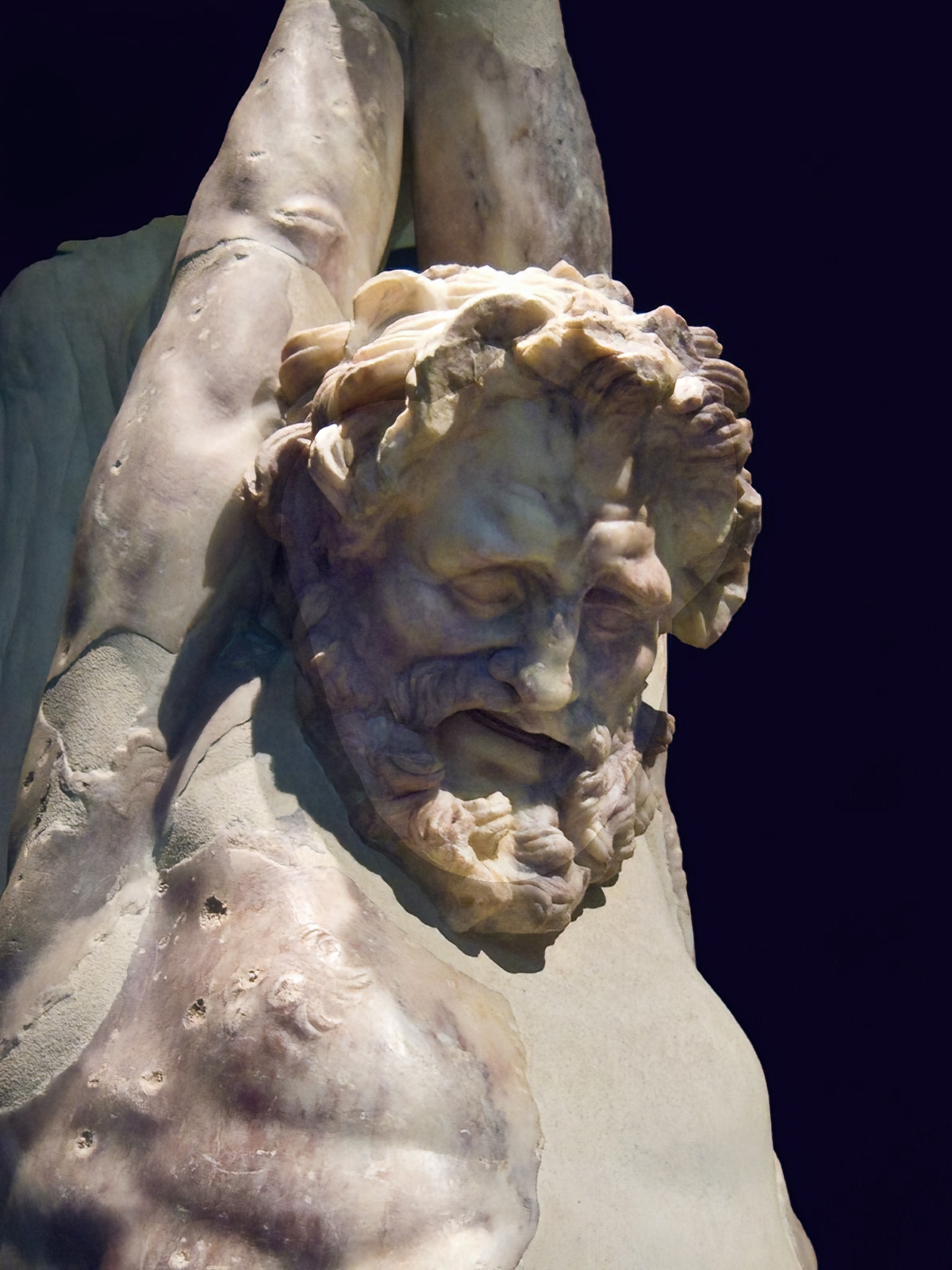
Closeup of the agony of Maryas the satyr who was flayed alive for his hubris by Apollo for challenging him to a music contest Roman imperial period copy of 2nd century BCE Greek original that I photographed at the Capitoline Museum in Rome, Italy.


If you enjoyed this post, never miss out on future posts by following me by email!


Friday, May 21, 2021

Dolphins in Greco-Roman Art

Dolphins have a rich background in Greek and Roman mythology. Not only are they frequently the companions of Venus serving as symbols of romance and reminders of the  myth that Venus was born from the sea, but in the Homeric Hymns, they play a key role when Dionysus (Roman Bacchus) was kidnapped by pirates. The god of wine turned himself into a lion to punish the kidnappers and, terrified, they jumped overboard whereupon Dionysus turned them into dolphins.  The also describe instances where the god Apollo transformed into a dolphin to guide a ship into harbor.  nother myth tells that Apollo’s son, Eikadios, was shipwrecked and carried to shore by a dolphin. This is one of many myths about dolphins rescuing drowming men, or bringing bodies back to shore for burial.

The Roman author Statius tells us in his 1st century CE work, "Achilleid" that the sea-nymph Thetis rode a chariot through the sea that was pulled by two dolphins. Philostratus’ ‘Imagines’ also describes a scene in which the one-eyed cyclops Polyphemus falls in love with the sea-nymph Galatea while she is riding four dolphins.

"Many dolphin stories can also be found in Greek and Roman folklore from small coastal towns, observes Emily Tilley, University of Leicester,  "In the first century A.D. Pliny the Elder recorded in his ‘Natural History’ the story of a young Roman boy who befriended a dolphin. Every day when the boy needed to cross the bay to get to school, he would call on his dolphin friend to carry him across the water. A second century A.D. story tells the tale of an elderly couple who rescued a young, injured dolphin and trained it to catch fish for them."

Statue of Venus (the Mazarin Venus), Roman, 2nd century CE, now on view at the Getty Villa in Gallery 106 Basilica. Image courtesy of the J. Paul Getty Museum

Early Imperial Portrait Roman 27 BCE-68 CE from the Farnese Collection in Naples that I photographed at "Pompeii: The Exhibit" at the Pacific Science Center in Seattle Washington.

Roman mosaic frieze depicting dolphins from Halicarnassus 4th century CE that I photographed at The British Museum.

Ovoid ceramic rhyton depicting a dolphin Pseira Crete Late Minoan 1B that I photographed at the University of Pennsylvania Museum of Archaeology and Anthropology

Frescoes of Marine Life including a dolphin found on a wall along the via La Portuense in the river port of San Paolo that I photographed at the Palazzo Massimo in Rome 125-150 CE

Mosaic pavement depicting a dolphin that I photographed in the Piazzale delle Corporazioni in Ostia Antica 1st century BCE-4th century CE.

Basilica of Neptune, Rome (Dolphin Frieze) Detail of Dolphins, a shell, and an upright trident from the frieze course of the entablature of the Basilica of Neptune, Rome, Hadrianic. (Hadrian r. 117-138 CE). The motif was popular for public buildings in Rome of the late first century (and the maritime theme is not necessarily associated with the function of the structure, such as a bath building). Image courtesy of Roger Ulrich (CC BY-NC-ND 2.0)

Detail of mosaic on the podium wall in the water sanctuary showing marine fauna, including a dolphin and urchins, Roman Ruins of Milreu, a luxurious rural villa transformed into a prosperous farm in the 3rd century, Portugal, courtesy of Carole Raddato.

Roman mosaic depicting the mask of Oceanus with lobster claws protruding from the head and dolphins and fish escaping from his beard, 2nd - 3rd century CE, found in 1959 at the Plaza de la Corredera, Salón de los Mosaicos (Hall of Mosaics) Alcazar of the Christian Monarchs, Cordoba, courtesy of Carole Raddato.

The Oceanus Mosaic from Bad Vilbel, it originally belonged to a Roman thermal bath facility, end of 2nd century AD, Hessisches Landesmuseum Darmstadt, Germany. The mosaic was found in 1849 during construction work of the Southern Railway Station in the remains of a Roman thermal spa. This bath complex was probably part of an estate (Villa rustica). Image courtesy of Carole Raddato.

Thalassa (spirit of the sea) with crab-claw horns, holding a ship's oar and a dolphin, late 5th century AD, found in the village of Yakto near Daphne, Hatay Archaeology Museum, Antakya, Turkey courtesy of Carole Raddato (perspective adjusted)


If you enjoyed this post, never miss out on future posts by following me by email!