Showing posts with label music. Show all posts

Monday, June 14, 2021

Spurned Women: The violent death of Orpheus

Orpheus is best known as a musician that could play so beautifully he charmed even the most violent animals.  As such he is portrayed in numerous mosaics, paintings, and on ceramics.  So I was surprised to see a red-figure calyx krater attributed to the Villa Giulia Painter and dated to 460-450 BCE depicting Orpheus being violently attacked by Thracian women, one with a spear and one with an axe. I realize taste in music is quite personal but this extreme response is so antithetical to all of those peaceful images I have seen of Orpheus surrounded by mesmerized animals that I had to research this event further.

According to a Late Antique summary of Aeschylus' lost play Bassarids, Orpheus, towards the end of his life, disdained the worship of all gods except the sun, whom he called Apollo. One early morning he went to the oracle of Dionysus at Mount Pangaion to salute his god at dawn, but, like Pentheus, was ripped to shreds by Thracian maenads for not honoring his previous patron (Dionysus). It has been speculated that the Orphic mystery cult regarded Orpheus as a parallel figure to or even an incarnation of Dionysus so his abandonment of Dionysus would have been viewed as the ultimate sacrilege. Pausanias writes that the river Helicon sank underground when the women that killed Orpheus tried to wash off their blood-stained hands in its waters. 

Other legends claim that Orpheus became a follower of Dionysus and spread his cult across the land and abstained from the love of women. In this version of the legend, it is said that Orpheus was torn to shreds by the women of Thrace for his inattention.

Ovid's account of the death of Orpheus in Metamorphoses Book X is quite similar:

"[Orpheus] had abstained from the love of women, either because things ended badly for him, or because he had sworn to do so. Yet, many felt a desire to be joined with the poet, and many grieved at rejection. Indeed, he was the first of the Thracian people to transfer his affection to young boys and enjoy their brief springtime, and early flowering this side of manhood."

Feeling spurned by Orpheus for taking only male lovers (eromenoi), the Ciconian women, followers of Dionysus, first threw sticks and stones at him as he played, but his music was so beautiful even the rocks and branches refused to hit him. Enraged, the women tore him to pieces during the frenzy of their Bacchic orgies.

His head and lyre, still singing mournful songs, floated down the River Hebrus into the sea, after which the winds and waves carried them to the island of Lesbos, at the city of Methymna. There, the inhabitants buried his head and a shrine was built in his honor near Antissa where his oracle prophesied, until it was silenced by Apollo. Orpheus' soul is said to have returned to the underworld, to the fields of the Blessed, where he was reunited at last with his beloved Eurydice.

As with many myths, scholars believe Orpheus may have actually existed. Only Aristotle, alone, thought he did not.  Most believed he lived several generations before Homer.  He is thought to have been a poet, augur, and astrologer who also earned a living as a musician and some say, a wizard.  Aristophanes, in his play "Frogs" refers to Orpheus as one of the oldest poets and characterizes him as a religious teacher.

When I read the part about Orpheus' eventual rejection of all gods except the sun which he called Apollo, I couldn't help but think about that old Star Trek episode "Bread and Circuses" where the Enterprise crew intercepts radio transmissions from a planet they are orbiting that refer to worship of the "sun".  As the episode progresses, the crew realizes some of the planet inhabitants are not worshipping the sun up in the sky but the Son. Perhaps this was the case with Orpheus - why else would he give the entity the name of an anthropomorphic deity? 

Attic Red-figure calyx krater attributed to the Villa Giulia Painter and dated to 460-450 BCE depicting Orpheus being violently attacked by Thracian women now in the collections of the Getty Villa, image courtesy of the museum.

Detail of Attic Red-figure calyx krater attributed to the Villa Giulia Painter and dated to 460-450 BCE depicting Orpheus being violently attacked by Thracian women now in the collections of the Getty Villa, image courtesy of Wikimedia Commons contributors Dave and Margie Hill/Kleerup.

Attic Red-figure calyx krater attributed to the Villa Giulia Painter and dated to 460-450 BCE depicting Orpheus being violently attacked by Thracian women now in the collections of the Getty Villa, image courtesy of Wikimedia Commons contributors Dave and Margie Hill/Kleerup.

The Death of Orpheus, detail from a silver kantharos, 420-410 BCE, part of the Vassil Bojkov collection, Sofia, Bulgaria, courtesy of Wikimedia Commons contributor Gorgonchica.

Attic red figure stamnos with lid depicting Thracian women killing Orpheus by the Dokimasia Painter, 480-470 BCE, at the Antikenmuseum Basel und Sammlung Ludwig in Basel, Switzerlandm courtesy of Wikimedia Commons contributor ArchaiOptix.

Hydria fragment with the death of Orpheus, c. 460 BCE at the Martin von Wagner Museum in Würzburg, Germany courtesy of Wikimedia Commons contributor Daderot.

Thracian Girl Carrying the Head of Orpheus on His Lyre (1865) by Gustave Moreau, now in the Musée d'Orsay, Paris, France, courtesy of Wikimedia Commons.

Nymphs Finding the Head of Orpheus (1900) by John William Waterhouse (PD), now in a private collection, courtesy of Wikimedia Commons.


If you enjoyed this post, never miss out on future posts by following me by email!


Tuesday, June 8, 2021

Triton and the fate of Misenus

This morning while browsing artifacts in the collections of the Getty Villa, I came across this exquisite gilded silver sculpture of a Triton forming the handle of an oinochoe.  As I described in a post a couple of years ago, the original sea god, Triton, was the son of Poseidon and Amphitrite according to Hesiod's Theogony. Triton is usually represented as a merman, with the upper body of a human and the tailed lower body of a fish. At some time during the Greek and Roman era, Tritons became a generic term for mermen in art and literature. A female version (tritoness) was eventually introduced as well.

Triton was said to dwell with his parents in  a golden palace claimed to be located at Aegae on the island of Euboea in a passage from book 5 of Homer's Iliad. It describes how  Poseidon "lashed his long-maned horses and drove to Aegae, where he had his famous palace" after having destroyed Odysseus' raft with a storm. Later in Book 13 of the Iliad, Poseidon "took three strides, and with the fourth he reached his goal—Aegae, where is his glittering golden palace, imperishable, in the depths of the sea."

Only in later times was Triton associated with possessing a conch shell, which he blew like a trumpet to calm or raise the waves. He was "trumpeter and bugler" to Oceanus and Poseidon. Its sound was so cacophonous that when loudly blown, it was said to put the giants to flight, who imagined it to be the roar of a dark wild beast.

in Virgil's epic poem the Aeneid, Misenus, a brother-in-arms of Hector and, after Hector's death, Aeneas' trumpeter, challenged the gods to a musical contest on a conch shell. He, like Marsyas, was punished for his hubris when he was drowned by Triton.  Aeneas was told by the Cumaean Sibyl at that time that Misenus's body had to be buried before he could enter the Underworld and detailed the necessary funeral rites required that were later adopted by the Romans. Cape Misenum, the headland that marks the northwestern limit of the Gulf of Naples as well as the Bay of Pozzuoli in southern Italy and supposedly named for Misenus,  was important to the Romans since it was a natural shelter for passage into the inner harbor of Portus Julius, the home port for the Roman western imperial fleet.


Image: Gilded silver oinochoe handle depicting Triton from Macedonia or Illyria, 100-1 BCE, at the Getty Villa in Gallery 111, Pacific Palisades, California. Now detached from the vessel of which it was once part, Triton’s scaly lower body serves as the functional part of the handle, and the acanthus leaves from which the torso rises would have hidden the join at the rim. Triton's torso would have projected as a decorative element above the mouth, and gilding elaborates much of its surface. The figure probably held a trident in its left hand, a frequent attribute of sea beings. Such an elaborate pouring vessel would have been part of an ornate set of serving and drinking vessels used at banquets or symposia.

If you enjoyed this post, never miss out on future posts by following me by email!


Saturday, May 22, 2021

The Aulos

An aulos or tibia (Latin) was an ancient Greek wind instrument, depicted often in art and also attested by archaeology. Though aulos is often translated as "flute" or "double flute", it was usually a double-reeded instrument like the modern oboe, but with a larger mouthpiece, and its sound—described as "penetrating, insisting and exciting"was more akin to that of the bagpipes. Although used for martial music, the aulos is more frequently depicted in other social settings. It was the standard accompaniment of the passionate elegiac poetry. It also accompanied physical activities such as wrestling matches, the broad jump, the discus throw and to mark the rowing cadence on triremes, as well as sacrifices and dramas. Plato also associates it with the ecstatic cults of Dionysus and the Korybantes.

Although aristocrats with sufficient leisure sometimes practiced aulos-playing as they did the lyre, after the later fifth century BCE the aulos became chiefly associated with professional musicians, often slaves. Nevertheless, such musicians could achieve fame. The Romano-Greek writer Lucian discusses aulos playing in his dialogue Harmonides, in which Alexander the Great's aulete Timotheus discusses fame with his pupil Harmonides. Timotheus advises him to impress the experts within his profession rather than seek popular approval in big public venues. If leading musicians admire him, popular approval will follow. However, Lucian reports that Harmonides died from excessive blowing during practicing.  

Some variants of the instrument were loud, shrill, and therefore very hard to blow. A leather strap, called a phorbeiá in Greek or capistrum in Latin, was worn horizontally around the head with a hole for the mouth by the auletai to help support the lips and avoid excessive strain on the cheeks due to continuous blowing. Sometimes a second strap was used over the top of the head to prevent the phorbeiá from slipping down. 

An aulos discarded by Athena then picked up by Marsyas the satyr was the instrument that resulted in Marsyas being flayed alive for his hubris after losing a musical contest with Apollo. A sculpture of the flayed Marsyas at the Capitoline Museum in Rome is one of the most poignant sculptures I have photographed in my travels.

Youth playing the aulos, detail of a banquet scene, tondo of an Attic red-figure cup, ca. 460 BC–450 BCE. Image courtesy of Wikimedia Commons contributor Marie-Lan Nguyen.

Coffin floorboard depicting Isis being served wine by the deceased, Egypt, Roman Period, 30 BCE-324 CE at the Royal Ontario Museum In Toronto, Canada courtesy of Wikimedia Commons contributor Daderot.

Competition between Apollo and Marsyas, panel of a sarcophagus, ca. 290–300 CE, found in 1853 on the Chiarone river banks (Tuscany, Italy), on the former Emilia-Aurelia road. Image courtesy of Wikimedia Commons contributor Marie-Lan Nguyen.

Statuette of a Young Satyr Playing the Double Aulos, silver with gilding, Roman 150-200 CE, courtesy of the J. Paul Getty Museum and photographer Bruce White. This rustic looking youth strides forward playing a double aulos or flute. The instrument is unusual in that it has one straight pipe and one with a flaring, upward-curving end. The youth is nude except for a gilded panther skin draped across his torso. The panther skin, impish facial features, and stiff, tousled hair characterize the young figure as a satyr, a semi-human follower of Dionysos, the Greek god of wine. Nevertheless, he lacks the expected animal ears of most satyr portrayals, and the place where a tail should be is covered by the panther skin. This confusion of traditional iconography, as well as his round face and bulging eyes, suggest that this statuette was made during the Antonine dynasty in the 100s CE. This time period also saw the production of many other solid-cast silver statuettes given by the wealthy as offerings to the gods either in a temple treasury or in a household shrine.

Choregos and actors including a musician playing the aulos, Roman mosaic from the House of the Tragic Poet (VI, 8, 3) in Pompeii courtesy of Wikimedia Commons contributor Marie-Lan Nguyen.

Roman mosaic depicting a comedy scene depicting a musician playing the aulos from the so-called Villa of Cicero in Pompeii 1st century CE that I photographed at the Museo Archaeologico Nazionale di Napoli in Naples, Italy.

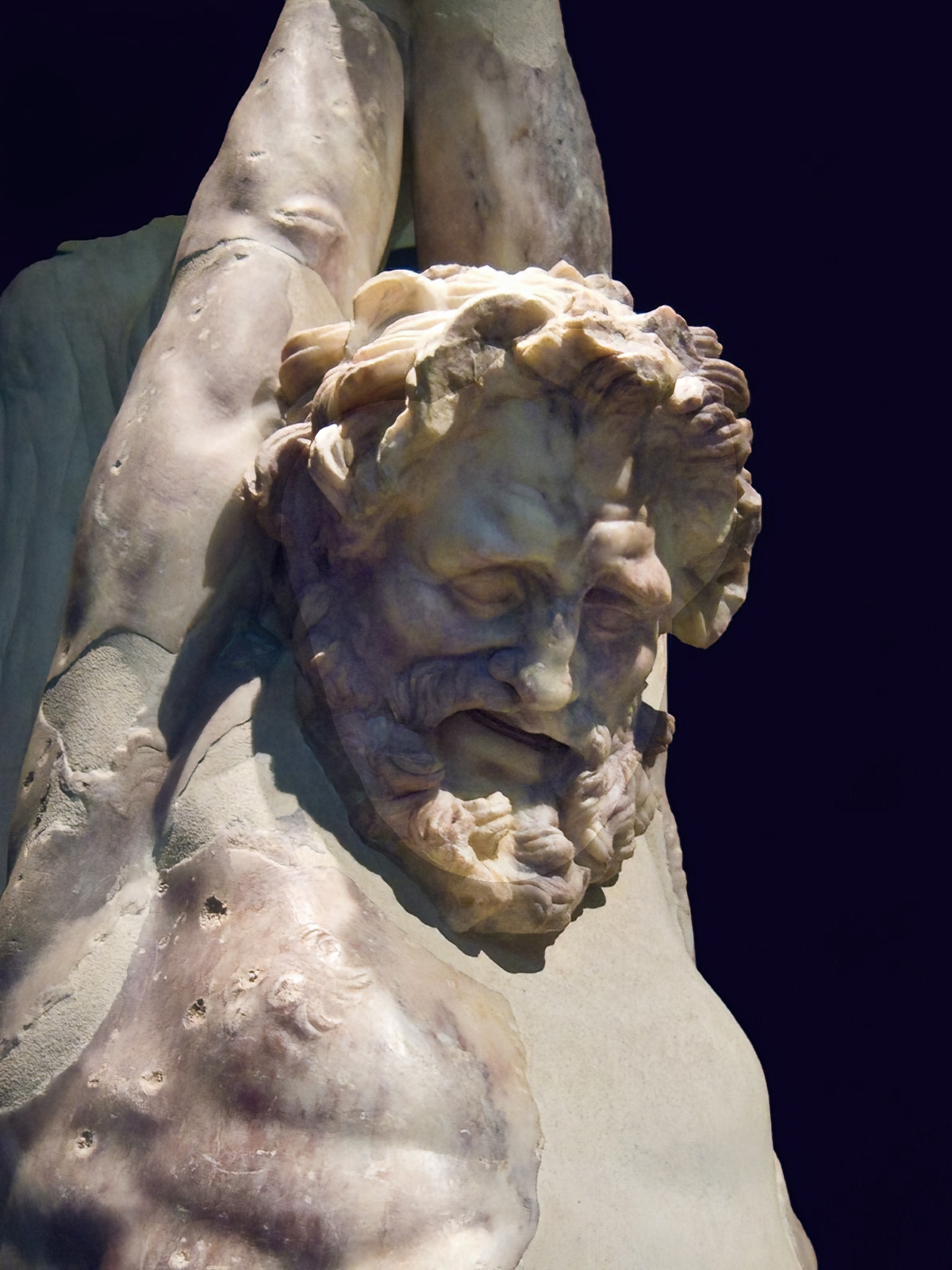
Marsyas the satyr who was flayed alive for his hubris by Apollo for challenging him to a music contest Roman imperial period copy of 2nd century BCE Greek original that I photographed at the Capitoline Museum in Rome, Italy.

Closeup of the agony of Maryas the satyr who was flayed alive for his hubris by Apollo for challenging him to a music contest Roman imperial period copy of 2nd century BCE Greek original that I photographed at the Capitoline Museum in Rome, Italy.


If you enjoyed this post, never miss out on future posts by following me by email!


Wednesday, April 7, 2021

Signal musicians in the Roman Legions

The ancient Olympic Games in Greece included contests of trumpet playing in 396 B.C.E. These contests were judged not by musicality but by volume of sound. The instrument used by the Greek trumpeters was the Salpinx, a reported copy of which is preserved in the Museum of Fine Arts in Boston. This Salpinx measures 157 cm. and is made of thirteen cylindrical parts made of ivory with a bell made of bronze, as is the mouthpiece.

But, signal musicians used as an integral part of a military organization appear first in the Roman Legion. These musicians, called aenatores, utilized a wide variety of trumpets, and signals were sounded on these instruments which the Romans inherited from the Etruscans. The Etruscans were superb metallurgists and smiths, and must have been skilled in the making of bronze or silver trumpets. A collection of forty-three signals were used in the Roman Army.

Instruments in the Roman Legion included trumpets such as the Tuba which was conical shaped and about 117 cm. long. It was a straight horn that had a slightly flaring bell with no bends. The Cornu was a long curved instrument made of bronze, in the shape of a “G,” which was more of a modern french horn shape and was played with the bell placed over the shoulder. Another was the Buccina, which was in the shape of a “J” and was more like an animal’s horn. The Lituus was also shaped like the Buccina, in the shape of a “J.” - Jari Villanueva, https://www.tapsbugler.com/history-of-the-bugle/

Vegetius described the use of these horns to give signals:

"The music of the legion consists of trumpets, cornua and buccinae. The trumpet sounds the charge and the retreat. The cornua are used only to regulate the motions of the colors. The trumpets serve when the soldiers are ordered out to any work without the colors,  but in time of action, the trumpets and cornua sound together. The classicum, which is a particular sound of the buccina or horn, is appropriated to the commander-in-chief and is used in the presence of the general, or at the execution of a soldier, as a mark of its being done by his authority. The ordinary guards and outposts are always mounted and relieved by the sound of trumpet, which also directs the motions of the soldiers on working parties and on field days. The cornua sound whenever the colors are to be struck or planted. These rules must be punctually observed in all exercises and reviews so that the soldiers may be ready to obey them in action without hesitation according to the general's orders either to charge or halt, to pursue the enemy or to retire. For reason will convince us that what is necessary to be performed in the heat of action should constantly be practiced in the leisure of peace."

My closeup of the Statuette of a Roman bugler, bronze, 100-200 CE, at the Getty Villa in Pacific Palisades, California. 

Statuette of a Roman bugler, bronze, 100-200 CE, at the Getty Villa in Pacific Palisades, California. The figure wears armor including a crested helmet and a cuirass with one row of pteryges. Over his cuirass is a cingulum, a ceremonial sash or military belt that is wrapped around the waist and tied at the front with a square knot to protect the bearer from evil. A cloak is wrapped around his left arm, which is extended to support a now-missing bugle. The figure’s right arm is bent to hold the instrument to his mouth as he moves to the right. Image courtesy of the J. Paul Getty Museum.

Cornu depicted on the Grand Ludovisi Battle Sarcophagus, 251-252 century CE, found in 1621 near the Tiburtina Gate in Rome courtesy of Wikimedia Commons contributor Marie-Lan Nguyen.

My image of the Cornu depicted on the Grand Ludovisi Battle Sarcophagus, 251-252 century CE, found in 1621 near the Tiburtina Gate in Rome.

Greek Mural painting depicting a trumpeter at the Archaeological Museum of Delos. Courtesy of Wikimedia Commons contributor Zde.

Musicians playing the salpinx (trumpet) and the hydraulis (water organ), Romano-Egyptian, 1st century BCE, from Alexandria, courtesy of Wikimedia Commons contributor Marie-Lan Nguyen.


Roman musicians on the Zilten Mosaic, 200 CE, courtesy of Wikimedia Commons contributor Dulcem and livius.org.

Relief with a scene of gladiator fight, perhaps part of a funerary monument, 1st century BC. Two trumpet players proclaim the victory of the duel. The winner raises his sword and awaits the verdict of the spectators, who decide life or death for the loser. Relief now in the collections of the Glyptothek in Munich, Germany. Image courtesy of Wikimedia Commons contributor Bibi Saint-Pol.


If you enjoyed this post, never miss out on future posts by following me by email!


Friday, December 4, 2020

Pan: Purveyor of Music and Panic

 In Greek mythology, Syrinx was a forest Nymph. In her attempt to escape the affection of the god Pan (god of the wild, shephers, and flocks with the hindquarters, legs and horns of a goat), she was transformed into a water-reed or calamos (cane-reed). Then, Pan cut several reeds, placed them in parallel one next to the other, and bound them together to make a melodic musical instrument. Ancient Greeks called this instrument Syrinx, in honour of the Muse, and Pandean, or Pan-pipes or Pan-flute, after Pan. The Syrinx, a predominantly pastoral instrument for the Greeks, was adopted by the Etruscans who played it at their festivals and banquets called it a fistula. The Romans adopted both Pan, whose Roman counterpart was Faunus, father or Bona Dea, and the Syrinx from the Greeks and the Etruscans, and they too played it at their banquets, festivals, as well as in religious and funeral processions.

Despite Homer's account of the chaste nature of Odysseus' wife Penelope in "The Odyssey", some ancient writers, including Pausanias, Duris of Samos, and the Vergilian commentator Servius, attribute the birth of Pan to Penelope's unfaithfulness while Odysseus was away at the Trojan War.  Pausanius simply claims she was unfaithful, while Duris and Servius claim she slept with all 108 suitors in Odysseus' absence, and gave birth to Pan as a result. In other accounts, Pan, like other nature spirits, appears to be older than the Olympians, considering myths where he gave Artemis her hunting dogs and taught the secret of prophecy to Apollo.  In "Rhesus," Aeschylus  distinguishes between two Pans, one the son of Zeus and twin of Arcas, and one a son of Cronus saying "In the retinue of Dionysos, or in depictions of wild landscapes, there appeared not only a great Pan, but also little Pans, Paniskoi, who played the same part as the Satyrs."

Although Pan was associated with the sweet music of his pipes, his angry shout was also known to cause panic (panikon deima).  In Zeus' battle with Typhon and the Titans, Pan let out a horrible screech, scattering the Titans in terror.  At the Battle of Marathon in 490 BCE, it was said Pan favored the Athenians so inspired panic in the hearts of the Persians.

The Romans, including Hyginus and Ovid, substituted Pan for the satyr Marsyas in the myth about a musical competition with Apollo.  But, instead of Pan being flayed alive for his hubris, his faithful friend, Midas, who disagreed with the judge, Timolus, that Apollo's lyre produced superior music to Pan's pipes, had his ears turned into those of a donkey by Apollo.


Roman statue of Pan, marble, from Argyroupoli (former Lappa), 2nd-century CE at the Heraklion Archaeological Museum by Wikimedia Commons contributor Jebulon


Pan and Daphnis or Olympus at the National Archaeological Museum in Naples photographed at an interesting angle by Wikimedia Commons contributor ho visto nina volare.


Roman fresco of Pan from Pompeii, 1st century BCE - 1st century CE, at the National Archaeological Museum in Naples courtesy of Miguel Hermoso Cuesta (white balance adjusted).


Closeup of one of the Pan figures on a 2nd century CE Roman sarcophagus depicting Dionysus preparing to resurrect and wed Ariadne 190-200 CE that I photographed at the Walters Art Museum in Baltimore, Maryland.


Pan Roman 1st-3rd centuries CE from southern Italy that I photographed at "The Body Beautiful in Ancient Greece" exhibit, assembled by the British Museum and displayed at the Portland Art Museum.


Pan Teaching Daphnis to play the flute 2nd century CE Roman copy of Hellenistic original that I photographed at the Palazzo Altemps in Rome.


Mosaic of Pan and the nymph Amadriade from the collection of the Duke Carafa of Noja that I photographed at the National Archaeological Museum of Naples.


Roman bronze of a young Pan or satyr from a garden in Pompeii that I photographed at the National Archaeological Museum in Naples.


My photography of Pan teaching Daphnis to play the flute at the National Archaeological Museum in Naples.


Table support with a marble statue of Pan Roman Imperial Period 1st or 2nd century CE that I photographed at the Metropolitan Museum of Art in New York.


Satyr "Della Valle” one of a pair depicting Pan were found near the Theater of Pompey and are thought to be part of its original decoration sculpted from a Hellenistic period original 1st century BCE that I photographed at the Capitoline Museum in Rome.


Pan pulling a thorn from the foot of a satyr. Marble, Roman copy of the 1st-2nd centuries after a Hellenistic original of the middle 1st century BCE, The Louvre by Wikimedia Commons contributor Marie-Lan Nguyen.
Pan with panpipe, ceramic, painted, Greater Greece, 5th-3rd century BCE by Wikimedia Commons contributor Helvetiker.
If you enjoyed this post, never miss out on future posts by following me by email!


Saturday, September 12, 2020

Tympanum: Instrument of Ecstasy

 The origin of the tympanum (tambourine) is unknown, but it appears in historical writings as early as 1700 BCE and was used by ancient musicians in West Africa, the Middle East, Turkey, Greece and India. The tambourine passed to Europe by way of merchants or musicians. Tambourines were used in ancient Egypt, Greece and Rome where they were known as a tympanum. Worshipers used the instrument during the rites of Dionysus, Cybele, and Sabazius. The instrument came to Rome from Greece and the Near East, probably in association with the cult of Cybele. The first depiction in Greek art appears in the 8th century BCE, on a bronze votive disc found in a cave on Crete that was a cult site for Zeus.

The tympanum is one of the objects often carried in the thiasos, the retinue of Dionysus. The instrument is typically played by a maenad, while wind instruments such as pipes or the aulos are played by satyrs to produce frenzied music to induce an ecstatic state.

The tympanum was the most common of the musical instruments associated with the rites of Cybele in the art and literature of Greece and Rome, but does not appear in representations from Anatolia, where the goddess originated. From the 6th century BCE, the iconography of Cybele as Magna Mater, "Great Mother", may show her with the tympanum balanced on her left arm, usually seated and with a lion on her lap or in attendance. The Homeric Hymn to the Great Mother says that the goddess loves the sound of the tympanum. The drum continued to feature as an attribute of Cybele into the Roman Imperial era.

 Figurine of a woman with a tympanum (tambourine), Roman, 2nd century CE at the Royal Ontario Museum in Toronto, Canada courtesy of the museum.

Bronze statuette of Cybele with tympanum on a cart drawn by lions courtesy of Wikimedia Commons contributor Peterjr1961

 Mosaic of a street musician with tympanum from the Villa of Cicero in Pompeii courtesy of Wikimedia Commons contributor Wolfgang Rieger.


If you enjoyed this post, never miss out on future posts by following me by email!


Sunday, July 19, 2020

Lyrists and Citharists

The earliest reference to the word lyre is in Mycenaean Greek ru-ra-ta-e, meaning "lyrists" and written in the Linear B script.  In classical Greek, the word "lyre" could either refer specifically to an amateur instrument, which is a smaller version of the professional cithara and eastern-Aegean barbiton, or "lyre" can refer generally to all three instruments as a family of stringed instruments. A classical lyre has a hollow body or sound-chest which, in ancient Greek tradition, was made out of turtle shell. Extending from this sound-chest are two raised arms, which are sometimes hollow, and are curved both outward and forward. They are connected near the top by a crossbar or yoke. An additional crossbar, fixed to the sound-chest, makes the bridge, which transmits the vibrations of the strings. The deepest note was that farthest from the player's body; since the strings did not differ much in length, more weight may have been gained for the deeper notes by thicker strings, as in the violin and similar modern instruments, or they were tuned by having a slacker tension.  The number of strings on the classical lyre varied at different epochs and possibly in different localities—four, seven, and ten having been favorite numbers.  Plutarch says that Olympus and Terpander used but three strings to accompany their recitation.

According to ancient Greek mythology, the young god Hermes stole a herd of sacred cows from Apollo. In order not to be followed, he made shoes for the cows which forced them to walk backwards. Apollo, following the trails, could not follow where the cows were going. Along the way, Hermes slaughtered one of the cows and offered all but the entrails to the gods. From the entrails and a tortoise/turtle shell, he created the Lyre. Apollo, figuring out it was Hermes who had his cows, confronted the young god. Apollo was furious, but after hearing the sound of the lyre, his anger faded. Apollo offered to trade the herd of cattle for the lyre. Hence, the creation of the lyre is attributed to Hermes.

Apollo Kaitharoidos from the Hadrianic Period (2nd century CE) Roman copy of Hellenistic original Marble photographed by Mary Harrsch at the Palazzo Altemps in Rome

Apollo Kaitharoidos from the late 1st century CE Roman copy of Hellenistic original photographed by Mary Harrsch at the Palazzo Altemps in Rome

Roman fresco of erotes playing with a cithara, a professional version of the lyre, from Herculaneum, possibly the basilica 1st century CE from MANN (Naples) courtesy of Wikimedia Commons


Fresco of actors with masks and a lyre from Pompeii 1st century CE MANN (Naples) courtesy of Wikimedia Commons

Lyre player. Marble, Roman copy from the 2nd century CE after a Greek bronze original of the 5th century BCE at The Louvre courtesy of Wikimedia Commons contributor Salli

The Mycenaean sarcophagus of Hagia Triada, 14th century BC, depicting the earliest lyre with seven strings, held by a man with long robe, third from the left courtesy of Wikimedia Commons contributor J. Ollé


If you enjoyed this post, never miss out on future posts by following me by email!


Thursday, May 7, 2020

Trigon or Angle Harp popular in Rome as well as Egypt

The harp, the Egyptians' favorite musical instrument, was used as early as the Old Kingdom. The harp depicted on many mastabas is an arched instrument with a long curved handle and few strings. The angle harp, also called a trigon, invented in the East during the second millennium BC, first appeared in Egypt during the New Kingdom. The two types of harps resulted in a wide variety of shapes and decoration.

The instrument grew in popularity throughout the Greek-Roman period. It was used both for private purposes, where it accompanied songs and dances, as illustrated in tomb decors, and for religious purposes, to accompany prayers to the gods.

 The musician held the harp upright, the wood frame against his chest, and plucked the strings with his fingers. These strings, a modern addition, were probably originally made of gut.

The lack of musical notation system in Egypt and the fact that we do not know the diameter or tension of the original strings means that we cannot have an accurate idea of the type of music produced by the instrument. By working with a replica, however, we were able to deduce that it had an extensive range and a low, muffled sound.

The number of notches on the suspension rod is larger than the number of dowels on the tailpiece, proof that this harp was carefully tuned. - The Louvre


Trigon or Angle Harp, Egypt, 1069-332 BCE, The Louvre. Image courtesy of The Louvre.
If you enjoyed this post, never miss out on future posts by following me by email!


Monday, January 21, 2008

The Role of Music in Ancient Civilizations Topic of New Exhibit at the Bible Lands Museum in Jerusalem


"...A new exhibit at the Bible Lands Museum in Jerusalem illustrates the role of music in the ancient Near East with an elegant display of musical instruments and iconography. Entitled "Sounds of Ancient Music," the exhibit opened on January 7 and features many noteworthy items, including some from as long ago as 12000 BCE.

As well as covering ancient Rome, Greece, Egypt and Mesopotamia, the display also has a special section examining music during the Second Temple period, and features a cornerstone from the Second Temple compound believed to be from where the priests would blow trumpets to usher in Shabbat. Also on display from the same period is an exquisite flute fragment found in a burial site in Jerusalem; due to its fine workmanship, assistant curator Moshe Piamenta speculates that it may have been actually used in the Temple itself.

ALTHOUGH THE only instruments that have survived the ages are those made from bone or metal like flutes, cymbals and rattles, the exhibit displays modern reproductions of ancient lyres, harps and drums created by closely following iconography found on vases, pottery and other implements. The iconography itself is very interesting, a fascinating gallery of mythological figures and statues playing ancient instruments. Especially noteworthy is the large number of females portrayed playing frame drums, a rare silver bowl from the Roman period showing Eros playing an ancient harp, and a cult item from 10000 BCE (found in Ashdod) depicting a five-person musical ensemble..."

If you enjoyed this post, never miss out on future posts by following me by email!