From the 1st century BCE onwards, the Roman army began to deploy "barbarians" to protect Roman frontiers. This trend continued into the Imperial Period and the expanded borders necessitated the use of increasing numbers of foederati to defend the empire. By the 4th century CE, of more than 75,000 troops stationed in Gaul, most hailed from Germania, an area stretching as far north as Scandinavia and as far east as the Vistula River.
Fortunately for historians, the grave goods of these Germanic warriors both in and outside the empire have provided a treasure trove of information about the money, gifts, and often elaborately decorated military insignia these men acquired during their service to Rome.
"Promises of Roman citizenship and military and economic support encouraged barbarian leaders to assist their wealthy neighbor, primarily by providing troops," observes Melanie Holcomb in her paper, Barbarians and Romans, published by the Metropolitan Museum of Art. "Such arrangements permitted barbarians of high status to accumulate great wealth, in the form of direct gifts of jewelry from the empire and payments in gold coin. These, in turn, could be used to commission luxury objects of personal adornment from local artists."
However, although Rome depended on these "others," Roman citizens and the state itself wished to distinguish themselves which they perceived as civilized from their more barbarous residents not only in social situations but in art. They did this through words, customs, clothing, and the use of colored marbles and brightly painted patterns in statues of barbarians or easterners in Roman art.
"The clothing we wear, and imagine others wearing, is an important way we signal who we are, and aren’t," points out Sarah Bond and Sean Burrus in their paper 'Barbarians and Sculpture's Color Barrier in Ancient Rome'. "When Romans wanted to depict other non-Roman peoples, whether on statues, reliefs, mosaics, or frescoes, they often used clothing as a way to visually signal differences between them. For example, Romans typically depicted barbarians clothed in trousers. Although we take them for granted today, pants were once highly controversial indicators of the difference between the barbarian and the Roman citizen. "
In the 2nd and 3rd centuries CE at Dura-Europas, Roman soldiers in the local garrison are portrayed in military dress while local civilians are depicted in tunics and trousers. Parthian dress including trousers, a tunic, and a Phrygian cap associated with the followers of Mithras and easterners in general, adorn depictions of individuals in the local mithraeum.
The use of distinguishing color in sculpture included colored marbles to accentuate the difference between native Romans and local residents. By so doing, sculptors could not only take advantage of the stone's ability to add a dynamic aspect to the work but communicate social context to the viewer.
In addition to clothing and color, artists used gestures and poses to transmit the subordinate nature of the conquered peoples. The vanquished are often depicted kneeling or supporting objects or structures.
Read more about it: https://hyperallergic.com/440466/barbarians-and-sculptures-color-barrier-in-ancient-rome/
 |
| Closeup of The Ludovisi Gaul thought to be a Roman copy of Greek original by Epigonus commissioned by Julius Caesar 1st century BCE that I photographed at the Palazzo Altemps in Rome |
 |
| The Ludovisi Gaul thought to be a Roman copy of Greek original by Epigonus commissioned by Julius Caesar 1st century BCE that I photographed at the Palazzo Altemps in Rome |
 |
| Statue of a conquered barbarian, likely a Dacian. He is wearing a Phrygian cap. The statue dates to the second century CE, perhaps during the reign of Trajan, and it may come from Forum of Trajan in Rome. It is made of green breccia marble from Egypt and is now at the Louvre Museum in Paris (image by Carole Raddato, CC-BY-SA-2.0) |
 |
| Closeup of Seated Captive in Phyrgian Cap Roman 1st-2nd century CE Green Egyptian Marble that I photographed at The Louvre in Paris. |
 |
| Closeup of Heroic Head of a Barbarian (probably a Gaul) 2nd century CE Roman copy of 250-180 BCE Greek original reportedly from Trajan's Forum that I photographed at "The Body Beautiful in Ancient Greece" exhibit at the Portland (Oregon) Art Museum. |
 |
| Closeup of Heroic Head of a Barbarian (probably a Gaul) 2nd century CE Roman copy of 250-180 BCE Greek original reportedly from Trajan's Forum that I photographed at "The Body Beautiful in Ancient Greece" exhibit at the Portland (Oregon) Art Museum. |
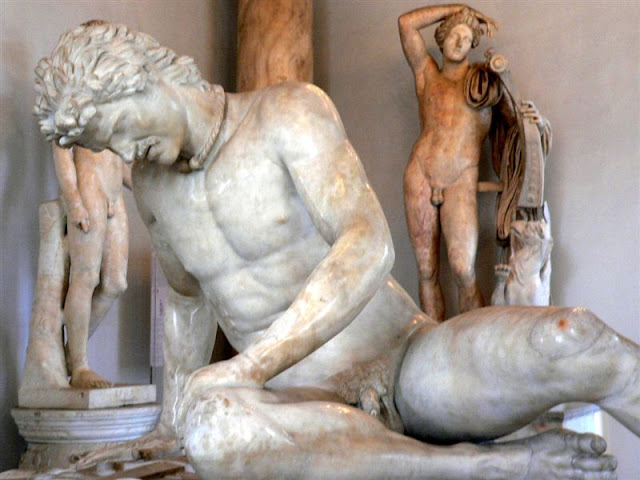 |
| Statue of “Capitoline Gaul” also known as "Dying Gaul" From a Pergamene original Marble that I photographed at the Capitoline Museum in Rome. |
 |
| Grand Ludovisi Battle Sarcophagus depicting Roman conquest of Barbarians 2nd - 3rd century CE Proconnesian Marble that I photographed at the Palazzo Altemps in Rome. |
 |
| Closeup of Colossal statue of a Dacian Roman 2nd century CE that I photographed at the Palazzo Altemps in Rome. |
 |
| Portrait Head of a Barbarian (probably a Dacian) Roman Trajanic Period 1st - 2nd century CE Marble that I photographed at the Seattle Art Museum |
 |
| Roman bronze statuette of a barbarian, 1-100 CE, now in the collections of the Cleveland Art Museum in Cleveland, Ohio, image courtesy of the museum (CC0 1.0)
|
 |
| The ‘Kneeling Barbarian’ sculpture from the Palatine Hill in Rome, dates to the first century CE, made of pavonazzo marble and nero antico, in the Naples National Archaeological Museum (image by Carole Raddato, CC-BY-SA-2.0) |
 |
| Front seated figure from the Mithraeum at Dura-Europos wearing a Phrygian cap (image courtesy of the Yale University Art Gallery and is in the public domain) |
 |
| Julius Terentius Performing a Sacrifice, paint on plaster, from Dura-Europos and dating to the third century CE (image courtesy of the Yale University Art Gallery and is in the public domain) |
If you enjoyed this post, never miss out on future posts by following me by email!


