Showing posts with label Parthian. Show all posts

Friday, June 25, 2021

Barbarians in Roman art

From the 1st century BCE onwards, the Roman army began to deploy "barbarians" to protect Roman frontiers. This trend continued into the Imperial Period and the expanded borders necessitated the use of increasing numbers of foederati to defend the empire.  By the 4th century CE, of more than 75,000 troops stationed in Gaul, most hailed from Germania, an area stretching as far north as Scandinavia and as far east as the Vistula River.  

Fortunately for historians, the grave goods of these Germanic warriors both in and outside the empire have provided a treasure trove of information about the money, gifts, and often elaborately decorated military insignia these men acquired during their service to Rome.  

"Promises of Roman citizenship and military and economic support encouraged barbarian leaders to assist their wealthy neighbor, primarily by providing troops," observes Melanie Holcomb in her paper, Barbarians and Romans, published by the Metropolitan Museum of Art.  "Such arrangements permitted barbarians of high status to accumulate great wealth, in the form of direct gifts of jewelry from the empire and payments in gold coin. These, in turn, could be used to commission luxury objects of personal adornment from local artists."

However, although Rome depended on these "others," Roman citizens and the state itself wished to distinguish themselves which they perceived as civilized from their more barbarous residents not only in social situations but in art.  They did this through words, customs, clothing, and the use of colored marbles and brightly painted patterns in statues of barbarians or easterners in Roman art.

"The clothing we wear, and imagine others wearing, is an important way we signal who we are, and aren’t," points out Sarah Bond and Sean Burrus in their paper 'Barbarians and Sculpture's Color Barrier in Ancient Rome'.  "When Romans wanted to depict other non-Roman peoples, whether on statues, reliefs, mosaics, or frescoes, they often used clothing as a way to visually signal differences between them. For example, Romans typically depicted barbarians clothed in trousers. Although we take them for granted today, pants were once highly controversial indicators of the difference between the barbarian and the Roman citizen. "

In the 2nd and 3rd centuries CE at Dura-Europas, Roman soldiers in the local garrison are portrayed in military dress while local civilians are depicted in tunics and trousers. Parthian dress including trousers, a tunic, and a Phrygian cap associated with the followers of Mithras and easterners in general, adorn depictions of individuals in the local mithraeum.

The use of distinguishing color in sculpture included colored marbles to accentuate the difference between native Romans and local residents. By so doing, sculptors could not only take advantage of the stone's ability to add a dynamic aspect to the work but communicate social context to the viewer.

In addition to clothing and color, artists used gestures and poses to transmit the subordinate nature of the conquered peoples.  The vanquished are often depicted kneeling or supporting objects or structures.

Read more about it: https://hyperallergic.com/440466/barbarians-and-sculptures-color-barrier-in-ancient-rome/


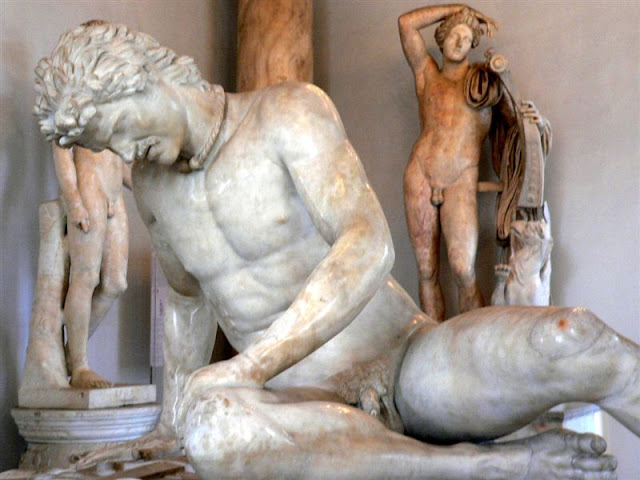
Closeup of The Ludovisi Gaul thought to be a Roman copy of Greek original by Epigonus commissioned by Julius Caesar 1st century BCE that I photographed at the Palazzo Altemps in Rome

The Ludovisi Gaul thought to be a Roman copy of Greek original by Epigonus commissioned by Julius Caesar 1st century BCE that I photographed at the Palazzo Altemps in Rome

Statue of a conquered barbarian, likely a Dacian. He is wearing a Phrygian cap. The statue dates to the second century CE, perhaps during the reign of Trajan, and it may come from Forum of Trajan in Rome. It is made of green breccia marble from Egypt and is now at the Louvre Museum in Paris (image by Carole Raddato, CC-BY-SA-2.0)

Closeup of Seated Captive in Phyrgian Cap Roman 1st-2nd century CE Green Egyptian Marble that I photographed at The Louvre in Paris.

Closeup of Heroic Head of a Barbarian (probably a Gaul) 2nd century CE Roman copy of 250-180 BCE Greek original reportedly from Trajan's Forum that I photographed at "The Body Beautiful in Ancient Greece" exhibit at the Portland (Oregon) Art Museum.

Closeup of Heroic Head of a Barbarian (probably a Gaul) 2nd century CE Roman copy of 250-180 BCE Greek original reportedly from Trajan's Forum that I photographed at "The Body Beautiful in Ancient Greece" exhibit at the Portland (Oregon) Art Museum.

Statue of “Capitoline Gaul” also known as "Dying Gaul" From a Pergamene original Marble that I photographed at the Capitoline Museum in Rome.

Grand Ludovisi Battle Sarcophagus depicting Roman conquest of Barbarians 2nd - 3rd century CE Proconnesian Marble  that I photographed at the Palazzo Altemps in Rome.

Closeup of Colossal statue of a Dacian Roman 2nd century CE that I photographed at the Palazzo Altemps in Rome.

Portrait Head of a Barbarian (probably a Dacian) Roman Trajanic Period  1st - 2nd century CE Marble that I photographed at the Seattle Art Museum

Roman bronze statuette of a barbarian, 1-100 CE, now in the collections of the Cleveland Art Museum in Cleveland, Ohio, image courtesy of the museum (CC0 1.0)


The ‘Kneeling Barbarian’ sculpture from the Palatine Hill in Rome, dates to the first century CE, made of pavonazzo marble and nero antico, in the Naples National Archaeological Museum (image by Carole Raddato, CC-BY-SA-2.0)

Front seated figure from the Mithraeum at Dura-Europos wearing a Phrygian cap (image courtesy of the Yale University Art Gallery and is in the public domain)

Julius Terentius Performing a Sacrifice, paint on plaster, from Dura-Europos and dating to the third century CE (image courtesy of the Yale University Art Gallery and is in the public domain)

If you enjoyed this post, never miss out on future posts by following me by email!


Friday, June 4, 2021

The Orphic hymns and incense use in the ancient Mediterranean World

The word incense comes from Latin incendere meaning 'to burn'.  In ancient times incense was burnt to counteract or obscure malodorous products of human habitation, but was widely perceived to also deter malevolent demons and appease the gods with its pleasant aroma. Resin balls were found in many prehistoric Egyptian tombs in El Mahasna, giving evidence for the prominence of incense and related compounds in Egyptian antiquity. One of the oldest extant incense burners originates from the 5th dynasty of Egypt dating back to the 25th century BCE.  The Babylonians also used incense while offering prayers to divining oracles and it is thought Incense spread from there to Greece and Rome. 

Incense burners, commonly known in ancient Greece as thymiateria, could take a wide variety of forms, ranging from simple earthenware pots to elaborate carved, moulded or cast items made from clay or bronze.  They were used in sacred rituals in sanctuaries and temples, during religious processions, funerals, symposiums and weddings.

The ritual use of thymiateria has been attested to in many archaeological sites including Olbia where a rich deposit of thymiateria has been found in the sanctuary of Aphrodite. These thymiateria were molded into a bust of the goddess but she is depicted as a modest matron and not nude as was typical for the goddess of love.  The inclusion of Erotes is thought to provide an emphasis on her motherhood.  They also distinguish the worshipped deity as Aphrodite and not Demeter, Hera or the Mother of the Gods as has been the case at other temple sites.

A Roman bronze thymiaterion in the form of a comic actor from the 1st century CE I have seen at the Getty Villa must have been used at dinner parties as I'm not familiar with any religious significance it may have.  They also have a terracotta lamp/incense burner  with an eagle with spread wings on it. I wonder if it was used for some military ritual? 

"Although aroma was an essential part of thymiateria culture, only the Orphic Hymns cast light on the use of particular incenses (in pure form or in compound) for each god or hero," observes Maryna Rusiaieva in her paper "On Ancient Greek Thymiateria and Their Purpose." 

For example, according to the Orphic Hymns, mánna is the recommended incense used to worship Artemis and Asclepius.  It is obtained by evaporating the sap of the manna ash, extracted by making small cuts in the bark. Athena, on the other hand, prefers incense crafted from aromatic herbs.  Dionysus, however, expects storax (sometimes marketed as styrax), a rare fragrant gum resin obtained from the Asian liquidambar tree.  If you're planning a sea voyage, an offering of myrhh should be used to appeal to Poseidon.

The Orphic Hymns are a collection of eighty-seven hymns to the Olympian gods attributed to Orpheus, but the actual authorship is unclear. The date of composition of the hymns is also disputed.  Scholars have dated the hymns to a period ranging from the 6th century BCE to the 4th century CE, although there is no evidence of any Christian influence in the poems.

You can learn much more about the Orphic Hymns here:

https://www.hellenicgods.org/projectstatement

The site provides the original Greek text and an English translation.

Silver Censer shaped like a bird, Byzantine, that I photographed at the Metropolitan Museum of Art in New York City

Stand in the Shape of an Ibex that probably held an incense burner, Iran 1000-800 BCE, Bronze, that I photographed at the Walters Art Museum in Baltimore, Maryland.

Frieze depicting two female temple attendants kneeling before an incense burner Roman 1st century CE Terracotta and slip that I photographed at the Art Institute of Chicago

Feline-Handled Bronze Incense Burner, Parthian, 100 CE, at the Cleveland Museum of Art in Cleveland, Ohio, image courtesy of the museum and Wikimedia Commons.

Incense Burner in the Form of a Female Head, probably representing Demeter, Greek, 3rd century BCE, found in Canosa, Italy, courtesy of the Walters Art Museum.

Moldmade lampstand/incense-burner consisting of a hollow body fixed on a circular spreading base and surmounted by a bowl. Upper part with two applied lamps, one on each side. On front center is an eagle in high relief with spreading wings, clawed feet resting on a platform, head turned to left; feathers carefully rendered, Roman, late 2nd century CE, now in the collections of the Getty Villa. Image courtesy of the museum.

Incense Burner (Thymiaterion) shaped as a Comic Actor Seated on an Altar Roman 1-50 CE Bronze and Silver at the Getty Villa in Pacific Palisades, California

Moldmade terracotta lampstand/incense-burner from Central Anatolia, Roman, 1st century CE at the Getty Villa in Pacific Palisades, California.  Image courtesy of the museum. 

Bronze southern Etruscan thymiaterion, 500 BCE, courtesy of Wikimedia Commons contributor Sailko.


Bronze thymiaterion (incense burner) in the form of a woman, late 6th–early 5th century BCE, Etruscan, at the Metropolitan Museum of Art in New York.  The calyx-shaped receptacle on the woman's head was probably originally surmounted by a shaft. Utensils incorporating human figures as supports or handles were as popular in Etruria as in Greece. This incense burner is exceptional, not only for the rendering of the woman, who is both statuesque and decorative, but also for the manner in which every part emphasizes her three-dimensionality.


Terracotta group of women seated around a well head, 2nd half of 4th century BCE, Greek, Tarentine, at the Metropolitan Museum of Art in New York City.  Incense burners (Greek thymiateria) were important cult implements throughout the ancient Mediterranean world. This South Italian terracotta example of the second half of the 4th century B.C.E. is exceptionally complex and rare: five women crowned with flowers are shown around a wellhead. The iconography reflects a local cult, probably that of Demeter and Kore who were widely worshipped in Southern Italy and Sicily at the time.

Vessel stand for offerings including incense with ibex support, ca. 2600–2350 BCE, Sumerian, at the Metropolitan Museum of Art.  Temple rituals during the Early Dynastic period included making offerings of food, drink, and probably incense to the gods. This stand, made using the lost-wax technique, with four rings supported by a magnificent ibex, would have supported lamps or bowls holding offerings or incense and may have been used in temple or in banquet rituals.

Incense burner, southwest Arabia, ca. mid-1st millennium BCE, at the Metropolitan Museum of Art in New York City, image courtesy of the museum.  The importance of incense in the religion of southwestern Arabia is reflected in this object; the ibex and snakes are powerful apotropaic symbols representing virility and fertility, and were frequently associated with local gods. The disk-and-crescent symbol, likewise, probably represents the moon god, the chief god of their pantheon.

Bronze censer (thymiaterion), made in Paros, 460-450 BCE. Archaeological Museum of Delphi, courtesy of Wikimedia Commons contributor Dennis Jarvis.


If you enjoyed this post, never miss out on future posts by following me by email!


Tuesday, December 29, 2020

Parthian diplomacy

Nahavand, located on the fertile Nisaean plain in the southernmost part of ancient Media (modern day Iran), has been inhabited since at least 5,000 BCE.  According to the ancient geographer and historian Strabo it was (re-)founded by Achaemenid King Xerxes the Great.  Nahavand lay about 96 kilometers from Ecbatana on the trunk road from Babylonia through Media to Bactria. In the Seleucid period, it became a Greek polis with magistrates and a Seleucid governor.

According to the polymath Abu Hanifa Dinawari, in the Parthian period, Nahavand was the seat of the Parthian prince Artabanus, who later reigned as Artabanus I of Parthia from 127 to 124/3 BCE.  After Artabanus was killed in battle, he was succeeded by his son Mithridates II (known in antiquity as Mithridates The Great) who transformed the Parthian Empire into a superpower.

Mithridates II was the first Parthian king to extend Parthian rule into Caucasus, where the kingdoms of Armenia, Iberia, and possibly Caucasian Albania became Parthian vassal states. To the east, he defeated and conquered the nomadic tribes in Bactria who had killed both of his predecessors. Sakastan was also reconquered and he seized Dura-Europos in Syria from the Seleucids, and by 95 BCE, the northern Mesopotamian kingdoms of Adiabene, Gordyene, and Osrhoene had acknowledged his authority. Under Mithridates II, the Parthian Empire at its zenith extended from Syria and the Caucasus to Central Asia and India. It was under Mithridates II that the Parthian Empire for the first time established diplomatic relations with Rome and Han China.

 In 96 BCE Mithridates II sent one of his officials, Orobazus, as an envoy to Sulla. As the Romans were increasing in power and influence, the Parthians sought friendly relations with the Romans and thus wanted to reach an agreement that assured mutual respect between the two powers. However, negotiations followed in which Sulla apparently gained the upper hand, which made Orobazus and the Parthians look like supplicants, leading to the development of enmity that, 38 years later, culminated in the death of Marcus Licinius Crassus at the Battle of Carrhae.  If only Sulla had been more diplomatic instead of arrogantly egotistical, the entire trajectory of Roman-Parthian relations, even subsequent east-west relations, could have evolved quite differently. 


Images: Belt adornment with an eagle and its prey, 1st–2nd century CE, Parthian or Kushan, at the Metropolitan Museum of Art.  Its mate from the same find spot along a gold necklace from Dailaman in the British Museum courtesy of Wikimedia Commons contributor Dominique Collon. I am a bit surprised that the bird-like figure is identified as an eagle because of its prominent ears.  Met curators point to it as an example of Parthian contacts with nomadic cultures of the Eurasian steppes. Parthian art typically displays a blend of Hellenistic and earlier Near Eastern traditions. Perhaps the figure is a zoomorphic depiction of Garuda, a legendary bird or bird-like creature in Hindu, Buddhist, and Jain faiths. Garuda is generally a protector with the power to swiftly go anywhere, ever watchful and an enemy of the serpent.

Read more about Parthian art here:

https://www.metmuseum.org/toah/hd/part/hd_part.htm


If you enjoyed this post, never miss out on future posts by following me by email!


Saturday, December 26, 2020

Roman archery

During most of the Republican period, there is little evidence that the Roman army employed the wide-spread use of archers.  This changed after the defeat of the army of Crassus by the Parthians at the battle of Carrhae in 51 BCE. By the time Pompey's troops occupied the Middle East, the Romans had introduced units of auxiliary archers, primarily from Syria, armed with composite bows and arrows with trilobate heads.   Large  quantities of these types of arrowheads, dated between the 1st and 3rd centuries CE, have been found at Masada, Herodium, and Dura-Europos.

The discovery of a grave of a late Roman sagittarius, thought to be of Germanic origin, near Augsburg included arrows with heads ranging from bolt-like bodkin heads to leaf-shaped heads to barbed heads. The more rare incendiary arrows, with basket-like heads to hold combustible materials like oil-soaked hemp fibers, have been found at Straubing, Germany and at the site of the Illyrian fortified settlement at Tilurium, Croatia.

Although wooden bows made from Yew were used for training, it is thought composite bows were used in combat, even in the wetter climates of Europe.  Bone remains from composite bows dating from the Augustan period have been documented at Oberaden, Germany and from the period of the Marcomannic Wars at Muŝov in the Czech Republic.  A weapons store excavated at Carnuntum, once the capital of Pannonia Superior, contained remnants of composite bows as well.  Another large cache of composite bow components were recovered at the Raetian Danube fort at Straubing/Sorviodurum where the Syrian archer unit cohors I Canathenorum milliaria equitata was stationed.

Wet climate would normally cause composite bows to split apart if exposed for long periods so bows were kept in leather cases when on campaign in Europe.  These cases have been depicted in artwork from the period but few examples have been recovered from the historical record.  Silver fittings thought to be from an ornate bow case/quiver was found in the grave of a Germanic prince, dated from the middle of the 3rd century, at Gommern, Germany.

Recommended reading: Army of the Roman Emperors: Archaeology and History by Thomas Fischer

Roman horse archer of the 6th century CE courtesy of Johnny Shumate.

Rare Roman incendiary arrowhead, 2nd century CE, found near Vienna, at the Metropolitan Museum of Art in New York City.
If you enjoyed this post, never miss out on future posts by following me by email!


Thursday, July 9, 2020

Roman opponents: The Parthians

Yesterday I finished the Great Courses lecture series "Between the Rivers" presented by Professor Alexis Castor, Franklin and Marshall College.  The name of the course refers to the Tigris and Euphrates rivers and covers over 3,000 years of history in the region of modern day Iraq.  One of the last lectures focused on the Parthians, originally a nomadic people from modern day Iran, that challenged the Seleucids, Alexander the Great's successors, in the region beginning in the 3rd century BCE.  The Parthians wrested control of the Silk Road from the Seleucids and finally captured their capital, Seleucia-on-the-Tigris, in 129 BCE.  The Parthians built their own capital nearby at Ctesiphon.

Although those of us who study Roman history are well aware of the dramatic Roman defeat of the legions led by Marcus Licinius Crassus at Carrhae, and the famous Parthian archers with their Parthian shot, I was not as familiar with their administration or that their coins featured Greek inscriptions.  The ruling dynasty, called the Arasacids after their first king Arsaces organized their empire rather loosely, allowing local control to remain intact and local economies to operate unmolested except for the payment of tribute, in some ways very similar to the Romans.  But, Parthian kings did not supply royal troops for defense.  Instead, they expected regional leaders to maintain their own armies.  This did result in the occasional attempt of a local leader to occasionally challenge the current king for the throne but it also provided flexibility so the Parthians could recover from military setbacks much more easily, resulting in the Parthian domination of the region for almost 500 years.

Three times in the 2nd century CE, the Romans attacked and captured Ctesiphon and the Parthians survived to fight another day.  It was not until Ctesiphon  was sacked by Septimius Severus in 197 CE who killed or enslaved the entire population of the Parthian capital were the Parthians weakened enough to allow their defeat a few decades later by the Sassanians, another Iranian people from within their own borders.

Artistically, the Parthians were skilled metalworkers and created beautiful objects in silver and gold usually featuring animal or mythological motifs.  I have photographed their artifacts at the Smithsonian's Arthur M. Sackler Gallery of Asian Art in Washington D.C., at the British Museum, at the Metropolitan Museum of Art, at the Getty Villa, and at the Los Angeles County Museum of Art.

Parthian Belt adornment with an eagle and its prey The Metropolitan Museum of Art 1st-2nd century CE

Parthian buckle bronze 150 BCE to 225 CE photographed at the Los Angeles County Museum of Art

Parthian buckle bronze 150 BCE to 225 CE photographed at the Los Angeles County Museum of Art

Closeup of a Parthian Wine Horn with Lion Protome Iran 1st century BCE - 1st century CE Silver and Gilt photographed at the Smithsonian's Sackler Gallery in Washington D.C.

Closeup of a Parthian Wine Horn with Lynx Protome Iran 1st century BCE - 1st century CE Silver and Gilt photographed at the Smithsonian's Sackler Gallery in Washington D.C.

Statue of a Parthian Prince at the National Museum in Iran courtesy of Wikimedia Commons contributor Dorieo

Parthian frieze from Ephesos 169 CE courtesy of the Ephesos Museum, Vienna.

Parthian gold earring shaped like an amphora 1st - 2nd century CE courtesy of The Metropolitan Museum of Art

Harness Disk with Lion Attacking a Stag Parthian 225-100 BCE Silver and gold photographed at the Getty Villa.

Parthian Horse headpiece (Prometopidion) with a siren and a sphinx Parthian 200-100 BCE Silver photographed at the Getty Villa.

Closeup of Rhyton with Goat Protome Iran Parthian Period (150 BCE-225 CE) Silver with mercury gilding photographed at the Los Angeles County Museum of Art

Parthian man returning the eagle standards to Augustus after they were lost by Crassus at the Battle of Carrhae in 53 BC

Parthian Wine Horns with animal protomes Iran 1st century BCE - 1st century CE Silver and Gilt photographed at the Smithsonian's Sackler Gallery

Parthian Rhyton (Drinking horn) with lion Parthian 100-1 BCE Silver Gold and Garnet photographed at the Getty Villa.

Closeup of Rhyton with a Stag Parthian 50 BCE-50 CE Silver gold glass and garnet photographed at the Getty Villa

Rhyton with a Stag Parthian 50 BCE-50 CE Silver gold glass and garnet photographed at the Getty Villa

Parthian Silver Plate showing Dionysos either late Parthian or early Sasanian 2nd - 3rd century CE Afghanistan photographed at the British Museum

Parthian Silver Plate showing Dionysos either late Parthian or early Sasanian 2nd - 3rd century CE Afghanistan photographed at the British Museum


Silver-gilt rhyton for libations or drinking Greco-Parthian Hellenistic 2nd century BCE photographed at the Metropolitan Museum of Art

Parthian Vessel 150 BCE to 225 CE bronze photographed at the Los Angeles County Museum of Art

Parthian warrior from Nysa 2nd century BCE courtesy of Wikimedia Commons contributor Zereshk

Young Man With Parthian Costume Palmyra 3rd century CE at The Louvre courtesy of Wikimedia Commons contributor World Imaging

Parthian Mounted archer courtesy of the British Museum


If you enjoyed this post, never miss out on future posts by following me by email!