Showing posts with label book. Show all posts

Tuesday, March 5, 2013

Review: The Joy of Sexus by Vicki León


Vicki León has been out collecting ancient trivia again and this time her subject is sex.  In her latest collection of the obscure, she has assembled anecdotes about ancient aphrodisiacs, wandering wombs, practitioners of erotic mysteries and victims of doomed love.

By reading her book I learned about Callipygia worship - a fixation on a person's derriere - and divine gender-bending that affected such ancient prophets as Teiresias the Seer.  I think my favorite passage from the book, though, was a retelling of the story of Pherenike of Rhodes.

I have not studied ancient Greece as extensively as I have studied Republican Rome so, although I knew that the ancient Greek Olympics were conducted in the nude and that women were not allowed to attend, I had never read any background material to explain why.  León provided me with all the information I could have hoped for in her passage about Pherenike of Rhodes.
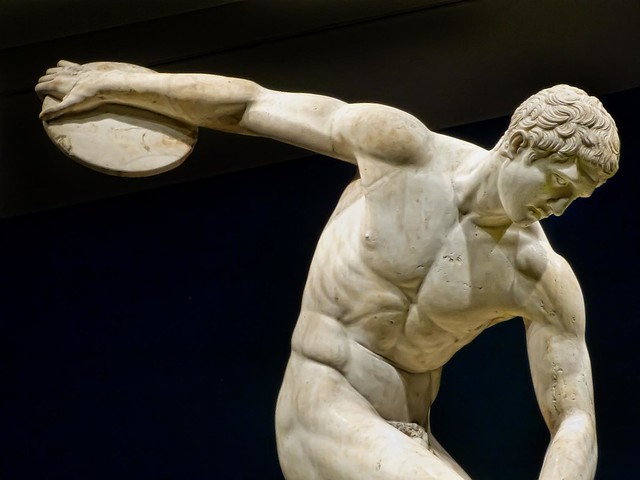
Diskobolos (discus thrower) 2nd century CE Roman copy of  450-440 BCE 
Greek bronze by Myron recovered from Emperor Hadrian's Villa in Tivoli, 
Italy.  Photographed by Mary Harrsch at the Body Beautiful exhibit at the 
Portland Art Museum, Portland, OR.
It seems that Pherenike was a young woman born into a family of Olympic victors.  Her father was a champion boxer at the Olympic Games in 464 BCE.

"Her big burly brothers continued the winning streak.  In boxing and the ferocious boxing-wrestling event called the pancratium, Pherenike's brothers swept six different Olympic Games." - Vicki León, The Joy of Sexus

León goes on to surprise me by observing that Pherenike probably watched her athletic family compete in the games when she was a young girl and later before her marriage.  Apparently, young virgins were allowed to watch the games - just not married matrons!

Then León continues saying Pherenike also married a famous athlete named Callianax and bore two sons who also trained for the Olympics.  Pherenike's older son, Eucles, won his boxing event but, because Pherenike was now married, she was not able to witness his victory.

A few years later, Pherenike's younger son Pisodorus entered his name as a contender for the boys boxing competition but before he could complete his ten months of training, Pherenike's husband died.  So, secretly Pherenike took up the mantle and resumed training her son dressed in the male garb of an official trainer.  When his time came to report for the 388 BCE Olympics, his mother went with him disguised in the full length robe of a trainer and carrying the traditional wooden staff.
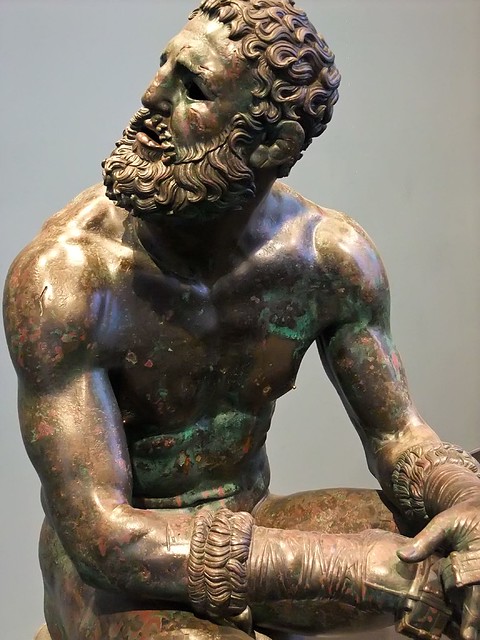
Boxer Resting 1st century BCE Roman copy of 3rd century 
Greek original by Apollonius.  Photographed at the Palazzo
Massimo in Rome, Italy by Mary Harrsch.

When her son was ultimately victorious, Pherenike, forgetting her precarious situation since a woman attending the forbidden event faced the death penalty of being thrown from the Typaeum cliffs, let out a high-pitched whoop and jumped over the fence to run and kiss her son.

"Either the high-pitched sound of her voice, or perhaps what her jump over the fence revealed, blew her disguise." - Vicki León, The Joy of Sexus

Fortunately for Pherenike, the ten Olympic judges decided not to punish her because of her illustrious family's contributions to the games, but forever after both trainers and athletes were decreed to appear in the nude.

So now I know why athletes are always depicted in the nude on all of those red and black-figure vases!

I also learned about Koan silk, a sheer see-through fabric.  I guess I hadn't kept up on all the latest discoveries and still thought silk worms were a closely guarded secret until much later in history than ancient Greece.  León reveals that some silk worms were purloined by the ancient Persians and made their way to the Greek islands of Amorgos and Kos.  Unlike the Chinese, who killed the worm to harvest the silk from their cocoons, the Greeks let the worm emerge naturally, breaking the threads as it went.  Then, using the same method they used with flax known as hackling, the women produced a gossamer silk that commanded a premium price.  The silk was so popular that Aristophanes referred to it in his play Lysistrata where women go on a sex strike to keep their men from going to war and sexually tease their husbands by prancing around "naked in their Amorgian chitons."

Apparently, in a surviving letter from Plato, the famous philosopher (and León questions "cheapskate?") orders three tunics for the daughters of a host but says "not those expensive Amorgian ones!" (I always love little tidbits that reveal what kind of person  a famous ancient was!)

The fashion eventually reached Rome and León found a quote from Pliny who called Koan silk "the vestments that cover a woman while at the same time revealing her naked charms."

These wonderful little glimpses about the truly personal lives of the ancients is what makes León's book so enjoyable.

There were only a couple of missteps that made me say "What?"  In her chapter about Alexander and Hephaestion, León explains that the Macedonians defeated the Persians at the battle of Issus. Then in the next sentence she says Persian King Darius was killed and his queen Statira captured. (p. 69 - 70) She may have been simply trying to condense the chapter but it makes it sound like Darius was killed at the battle of Issus and, of course, he wasn't.  Darius was killed some time after he fled the battle of Gaugamela and was assassinated by his own officers, who hoped to impress Alexander.  Alexander was not impressed with their treachery and ordered their execution.
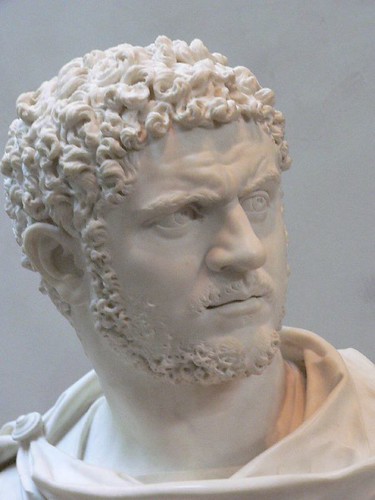
Roman emperor Caracalla by Italian sculptor
Cavaceppi 1750 CE after ancient original.
Photographed by Mary Harrsch at the
J. Paul Getty Museum in Los Angeles, CA

León made another confusing statement about the Roman emperor Caracalla.  She alluded to his death being the result of too many mistresses and a gladiator.  Although Caracalla may have dallied with too many mistresses and maybe a gladiator, too, this sounded much more like Commodus.  Caracalla was killed by a member of his own body guard when he stopped to relieve himself while marching with his army near Carrhae during a war with Parthia.  Historian Cassius Dio said the assassin, Martialis, was disgruntled for not being promoted to the rank of centurion.

But, I salute Vicki for such a revealing and fascinating look at lust, love and longing in the ancient world!

If you enjoyed this post, never miss out on future posts by following me by email!


Wednesday, May 2, 2012

Review: The Legion by Simon Scarrow


"The Legion" is the second book by Simon Scarrow I have read although it is the tenth in Scarrow's "Under the Eagle" series.  I admit I have not read its immediate predecessor "Gladiator" but I had no problem picking up the story line with the background information provided.

The other Scarrow book I read was Centurion and in it, Cato and Macro were both Centurions.  From reading other reviews, I gather that in previous novels, Macro has been the experienced teacher and Cato the young up-and-coming protégé.  In this book the relationship has changed significantly and Cato now holds the superior rank of prefect.

The two heroes are in pursuit of a nasty former gladiator named Ajax who led a slave revolt on Crete following an earthquake and tsunami.

Historically, there have been only three major Roman slave revolts documented by ancient historians - two on the island of Sicily and the famous revolt led on the Italian mainland by a Thracian slave turned gladiator named Spartacus.  Scarrow may have used these revolts to  inform his fictional narrative of a similar revolt on Crete.  Appian mentions a conflict on Crete at about the same time as the Spartacan revolt (a century before the reign of Claudius which is the time frame Scarrow uses for his "Under the Eagle" series) but I could not find anything definitive pointing to a slave uprising on Crete at the time or in a later period.

Scarrow may have pulled his villain from the first Sicilian revolt, though, that occurred on the island of Sicily from 136 - 132 BCE.  It was led by a Syrian slave named Eunus, whose reputation included an aptitude for magic and foretelling the future.  Diodorus Siculus tells us:

"...he not only gave oracles by means of dreams, but even made a pretence of having waking visions of the gods and of hearing the future from their own lips.

Of his many improvisations some by chance turned out true, and since those which failed to do so were left unchallenged, while those that were fulfilled attracted attention, his reputation advanced apace. Finally, through some device, while in a state of divine possession, he would produce fire and flame from his mouth, and thus rave oracularly about things to come.

For he would place fire, and fuel to maintain it, in a nut -- or something similar -- that was pierced on both sides; then, placing it in his mouth and blowing on it, he kindled now sparks, and now a flame. Prior to the revolt he used to say that the Syrian goddess appeared to him, saying that he should be king, and he repeated this, not only to others, but even to his own master." - Diodorus Siculus, Library, Books 34/35. 2. 1-48  

Apparently, Eunus, also called Antiochus, was not taken seriously at first and was used as entertainment at dinner parties.  But his ruthlessness was soon revealed when he was asked to lead 400 slaves against the city of Enna where his men "found their way into the houses shedding much blood, sparing not even suckling babes."

As Eunus' victories over the Romans grew more numerous, thousands of slaves flocked to his banner, much like Spartacus.  Eunus was eventually crowned king by the rebels and among those appointed to his royal council was an Achaean (Greek) who was known for his intelligence and military acumen.  Perhaps it was this Achaen that provided the model for Scarrow's rebel leader, Ajax.

Roman War Galleys were frequent subjects of Pompeii frescoes 1st century CE.
Photographed at the Museo Archaeologico in Naples, Italy by Mary Harrsch.


However, in Scarrow's novel, Ajax and his men, instead of meeting their end on the island as Eunus and Achaeus' men did, have hijacked a Roman ship and are sailing around the Mediterranean wreaking havoc, slaughtering most of the people they encounter and leaving only lone survivors here and there that have been so badly tortured they usually expire shortly after telling their rescuers that they were slaughtered by a Roman named Macro.  Of course this infuriates Macro and raises the stakes as it becomes apparent Ajax is heading for Egypt.

Arriving in Alexandria, Cato and Macro are hauled off to prison and must convince the governor of Ajax's ruse before the governor crucifies Macro.  Fortunately for Macro, one tortured survivor, an Egyptian priest, convinces the governor that Macro was not the man who butchered his fellow priests.  So the governor releases Cato and Macro and they set off in pursuit of Ajax once again with the recovered priest as guide.
But Ajax continues to elude them, slipping through one trap after the next, until the governor interrupts their chase and orders the pair to the Egyptian frontier to help fend off an invading Nubian army.  When Macro and Cato arrive, the governor's commander is acting strangely and our two heroes discover Ajax has joined the Nubians.  Now they must find a way to defeat the Nubians to end Ajax's reign of terror.

Scarrow has crafted a well-paced plot but like "Centurion", I found the characterizations of Cato and Macro quite thin.  I thought carefully about what was missing in the narrative that made the protagonists seem so flat and I realized Scarrow never gives us any insight into their thoughts.  He relates their actions but it's like viewing their activities through binoculars without any insight to what they are thinking.

I thought back on Harry Sidebottom's novels and his protagonist, the Anglo-Saxon born Roman officer, Ballista.  We hear Ballista praying to his "All Father, Death Bringer".  We experience the horror of one of his nightmarish visions of the Emperor Maximinus Thrax who always promises to see Ballista again at Aqualeia where Ballista originally broke his oath and assassinated the brutish emperor.  Dr. Sidebottom describes each character's body language, the complex emotions reflected on their faces and the way members of Ballista's familia banter with each other, filled with recollections of past battles, mistakes and triumphs as well as an understanding of each others fears.

The only indication of the depth of friendship between Cato and Macro in "The Legion" occurs when Macro touches the shoulder of his friend with concern when Cato has been wounded after a skirmish with Ajax.   I was actually appalled by a scene where an individual who has fought beside Cato and Macro is suspected of being an "embedded" spy and Cato and Macro coldly decide to crucify him in the morning without even listening to his side of the story.  Talk about cold and unfeeling!

I also did not feel immersed in the culture or geography of Egypt, the novel's setting, either.  Cato and Macro could have been in any desert.  I felt no sense of being there like I have when reading Sidebottom's books or those by Conn Iggulden (I just finished "Conqueror", a retelling of the ascension of Kublai Khan to the throne of the Mongol Empire).  I know both Sidebottom and Iggulden have traveled extensively to the locations described in their books and the realism they impart when describing the settings is palpable. Sidebottom also has a doctorate in ancient history from Oxford that is reflected in the depth of information he provides about each of Ballista's surroundings and opponents as he battles his way across the Near East of the third century.   What little information Scarrow gives about the Nubians, Cato and Macro's final opponents is sparse at best.

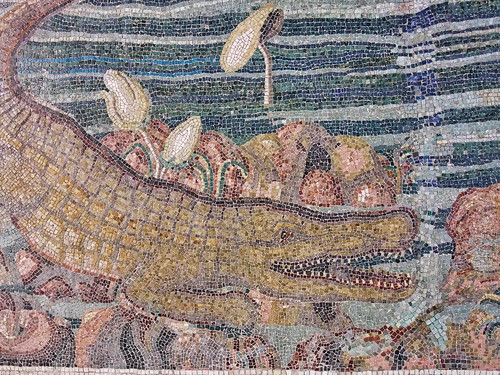
Mosaic Pavement Depicting a Nile Scene from the Maccarani vineyard 
area of the Aventine Hill Roman 2nd century CE. Photographed at the 
Palazzo Massimo by Mary Harrsch. 
Also, at one point in Scarrow's story Cato and Macro chase Ajax into the treacherous marshes of the Egyptian delta and during the pursuit, they hear something swishing past them in the water.  Macro explains it is probably a crocodile but demonstrates no real depth of fear that should have been generated by a close encounter with a ferocious creature depicted in Roman Nilotic mosaics and well known for ripping less fortunate creatures apart in Roman arenas.  It is passages like this that blunt the tension in the narrative.  If Scarrow had one of his protagonists relate a memory of seeing such a beast wreaking devastation during a numachia or something, it would have elevated the tension during the hunt and brought significantly more impact to the novel's conclusion.

I checked out Scarrow's website and he shares it with his brother Alex.  I see Alex has a time travel series with the latest installment being "TimeRiders: The Gates of Rome".  I love time travel stories so I'll have to check it out.  It will be interesting to see if the two brothers differ in their writing styles.


Enhanced by Zemanta
If you enjoyed this post, never miss out on future posts by following me by email!