Showing posts with label legions. Show all posts

Sunday, October 31, 2010

Headless Romans of Eboracum focus of new studies

Just in time for Halloween - I see that the Journal of Archaeological Science has released the results of a study of 80 headless Roman skeletons that were unearthed back in 2004 and 2005 in York - ancient Eboracum. In an effort to determine their place of origin through differences in their diet that had been transmitted to their bones, a team led by Gundula Müldner of the University of Reading in the U.K analyzed the skeletons for the presence of different elemental isotopes.

Roman Sarcophagus with Battle Scene Antonine
Period  2nd century CE Marble.  Photographed
at the  Dallas Museum of Art in Dallas, Texas.
"Based on the geology and climate of where a person grew up, their bones hold telltale traces of isotopes absorbed from the local food and water," Mülder explained.
Oxygen and strontium isotopes in the bones of the headless Romans indicate that just 5 of the 18 individuals tested came from the York area...The rest of the men came from elsewhere in England or mainland Europe, possibly from France, Germany, the Balkans, or the Mediterranean. Traces of carbon and nitrogen show that five of the headless Romans ate very different foods from York's local population. And two individuals had a carbon signature from a group of food plants—including sorghum, sugarcane, and maize—not known to have been cultivated in England at that time.
Although Mülder's team favored evidence that the men were probably Roman soldiers because Eboracum contained a large garrison and the skeletons bore evidence of contact with bladed weapons, other evidence suggests the men may have been gladiators.
Evidence for this notion includes some skeletons' unequal arm development—associated with the specialized use of single-handed weapons—and, on one skeleton, tooth marks from a large carnivore, possibly a gladiatorial lion or bear.

"If the carnivore bite mark is indeed genuine, then, why not, they may indeed have been gladiators," Müldner said. - More: National Geographic
However, if they were gladiators, I wonder why so many were decapitated? Even gladiators ritually killed in the arena were not usually decapitated. However, decapitation was a common practice by victorious Celts if you think about the evidence found by Germanicus and his troops sent to retrieve the remains of the legions massacred in the Teutoburg Forest. Celts also routinely kept and employed war dogs, quite large and capable of inflicting substantial tooth marks. As for the unequal arm development, veteran legionaries would probably exhibit the same physical trait from training and frequent use of their weapons.

A Good background series on the Roman Invasion of Britain: (Part 1 of 5 - other parts will appear in a list to the right of this clip on YouTube.)


An Imperial Possession: Britain in the Roman Empire, 54 BC - AD 409 (Penguin History of Britain)   Roman Invasion of Britain   Rome's Greatest Defeat: Massacre in the Teutoburg Forest   QUEST FOR THE LOST ROMAN LEGIONS: Discovering the Varus Battlefield  Centurion [Blu-ray] (Limited Edition + Digital Copy)
Enhanced by Zemanta
If you enjoyed this post, never miss out on future posts by following me by email!


Friday, October 5, 2007

Descendants of Crassus' Army in China

In preparing for my upcoming trip to Italy next week I was trying to clean out my email inbox and came across a message from a friend in England with a link to a fascinating article about Roman descendants in China:

Telegraph.co.uk: "Residents of a remote Chinese village are hoping that DNA tests will prove one of history's most unlikely legends — that they are descended from Roman legionaries lost in antiquity.

Cai Junnian, Roman descendants found in China?
Villager Cai Junnian with his green eyes and ruddy complexion

Scientists have taken blood samples from 93 people living in and around Liqian, a settlement in north-western China on the fringes of the Gobi desert, more than 200 miles from the nearest city.

They are seeking an explanation for the unusual number of local people with western characteristics — green eyes, big noses, and even blonde hair — mixed with traditional Chinese features.

"I really think we are descended from the Romans," said Song Guorong, 48, who with his wavy hair, six-foot frame and strikingly long, hooked nose stands out from his short, round-faced office colleagues.

"There are the residents with these special features, and then there are also historical records about the existence of these people long ago," he said.

Studies claiming that Liqian has Roman ancestry have greatly excited the impoverished county in which it is situated. The village is now overlooked by a pillared portico, in the hope of attracting tourists. A statue at the entrance of the nearby county town, Yongchang, shows a Roman legionary standing next to a Confucian scholar and a Muslim woman, as a symbol of racial harmony.

Even entrepreneurs have caught on: in "Imperial City Entertainment Street" there is a Caesar Karaoke bar.


Rome to China map, Roman descendants found in China?

The town's link with Rome was first suggested by a professor of Chinese history at Oxford in the 1950s. Homer Dubs pulled together stories from the official histories, which said that Liqian was founded by soldiers captured in a war between the Chinese and the Huns in 36BC, and the legend of the missing army of Marcus Crassus, a Roman general.

In 53BC Crassus was defeated disastrously and beheaded by the Parthians, a tribe occupying what is now Iran, putting an end to Rome's eastward expansion.

But stories persisted that 145 Romans were taken captive and wandered the region for years. Prof Dubs theorised that they made their way as a mercenary troop eastwards, which was how a troop "with a fish-scale formation" came to be captured by the Chinese 17 years later.

He said the "fish-scale formation" was a reference to the Roman "tortoise", a phalanx protected by shields on all sides and from above. Gu Jianming, who lives near Liqian, said it had come as a surprise to be told he might be descended from a European imperial army. But then the birth of his daughter was also a surprise. Gu Meina, now six, was born with a shock of blonde hair. "We shaved it off a month after she was born but it just grew back the same colour," he said. "At school they call her 'yellow hair'. Before we were told about the Romans, we had no idea about this. We are poor and have no family temple, so we don't know about our ancestors."


Another resident, Cai Junnian, 38, said his ruddy skin and green eyes meant he was now nicknamed Cai Luoma, or Cai the Roman, by friends. He has become a local celebrity, and was recently flown to the Italian consulate in Shanghai to meet his supposed relatives. The professor's hypothesis took almost 40 years to reach China. During Chairman Mao's rule, ideas of foreign ancestry were not ideologically welcome and the story was suppressed.

Mr Cai said his great-grandfather told him that there were Roman tombs in the Qilian mountains a day and a half's walk away, but he had never connected them to the unusual appearance he inherited from his father. "People thought I had a skin problem," he said."


I tried to find a followup article but came up empty handed. I would be interested to know the results of the DNA tests. The theory is certainly plausible. I found this reference to 1st century BCE contacts between the Chinese (Seres) and Rome:

"The Roman historian Florus describes the visit of numerous envoys, included Seres (Chinese), to the first Roman Emperor Augustus, who reigned between 27 BCE and 14 CE:
"Even the rest of the nations of the world which were not subject to the imperial sway were sensible of its grandeur, and looked with reverence to the Roman people, the great conqueror of nations. Thus even Scythians and Sarmatians sent envoys to seek the friendship of Rome. Nay, the Seres came likewise, and the Indians who dwelt beneath the vertical sun, bringing presents of precious stones and pearls and elephants, but thinking all of less moment than the vastness of the journey which they had undertaken, and which they said had occupied four years. In truth it needed but to look at their complexion to see that they were people of another world than ours." ("Cathey and the way thither", Henry Yule).

In 97 CE the Chinese general Ban Chao went as far west as the Caspian Sea with 70,000 men and established direct military contacts with the Parthian Empire, also dispatching an envoy to Rome in the person of Gan Ying.

Several Roman embassies to China soon followed from 166 CE, and are officially recorded in Chinese historical chronicles."

If you enjoyed this post, never miss out on future posts by following me by email!


Saturday, June 16, 2007

Gallic-Romano mythology - Tarvos Trigaranus

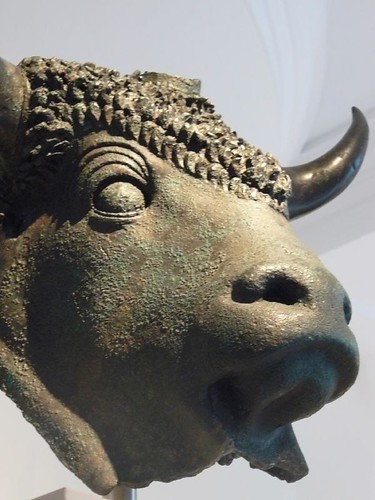
I uploaded some more images from the Met today and among them are several images of a bronze three-horned bull (unfortunately the center horn is missing) that was recovered from Octodurus, a city founded by the Emperor Claudius, in Switzerland.

It's a wonderful sculpture and I'm so glad the piece was not melted down as it appears to be part of a statue that had been rendered apart in preparation for scrapping. It made me curious about the worship of a three-horned bull so I researched it further and learned that the three-horned bull, sometimes called Tarvos Trigaranus, was worshiped by the Celts in Gaul and Britain.

According to an article by Susan Read, Martin Henig, and Leslie Cram that appeared in the journal Brittania, art depicting three-horned bulls was common in northeastern Gaul. They said it seems to have been derived from statues of two-horned bulls from Campania that were constructed with a crescent between their horns. They mention four such statues found in Britain - one in Maiden Castle at Dorset, one from the Jewry Wall Site in Leicester, one from Southbroom near Devizes in Wiltshire, and the last a pipeclay figurine, "certainly an import from Gaul", found at Colcester.

I also read an interesting description of a divination to determine a new Celtic king using a bull.

"Bulls were used in divination in both Ireland and Scotland. At Tara a new king might be chosen in the tarbfheis, `bull-feast' or `bull-sleep', in which a bull was killed and a man ate his fill of its flesh, drank its broth, and then lay down to sleep. After an incantation had been chanted over him by four druids, the dreamer would know the new king in his dream. In Scotland a person might answer an important question about the future (no king was to be selected) by wrapping himself in the warm, smoking hide of a newly slain bull in a remote place, such as near a waterfall. Upon going into a trance the person would have the answer. This method was known as taghairm." - Celtic Mythology, Oxford University Press.

Apparently the three-horned bull even found its way to the standards of the Roman Legions:

"...standards of ala Longiniana (CIL XI11 8094) and cohors I Gallica (ILS 9127) appear to have been adorned with animals popular in Gallic religious
iconography - respectively, a three-horned bull (Green 1976, 13) and a small boar.6 Such animals almost certainly appeared on signa of the type referred to by Tacitus (Germ. 7; Hist. 4.22), borne by the pagi and tribal groupings of the Gauls (Royrnans 1990,19). They appear open to different symbolic interpretations: depending on the cultural perspective of the viewer, they could have been seen primarily as traditional Gallic tribal totems or as Roman military regimental standards." - The Roman Army As A Community .
If you enjoyed this post, never miss out on future posts by following me by email!