Showing posts with label skeletons. Show all posts

Sunday, October 31, 2010

Headless Romans of Eboracum focus of new studies

Just in time for Halloween - I see that the Journal of Archaeological Science has released the results of a study of 80 headless Roman skeletons that were unearthed back in 2004 and 2005 in York - ancient Eboracum. In an effort to determine their place of origin through differences in their diet that had been transmitted to their bones, a team led by Gundula Müldner of the University of Reading in the U.K analyzed the skeletons for the presence of different elemental isotopes.

Roman Sarcophagus with Battle Scene Antonine
Period  2nd century CE Marble.  Photographed
at the  Dallas Museum of Art in Dallas, Texas.
"Based on the geology and climate of where a person grew up, their bones hold telltale traces of isotopes absorbed from the local food and water," Mülder explained.
Oxygen and strontium isotopes in the bones of the headless Romans indicate that just 5 of the 18 individuals tested came from the York area...The rest of the men came from elsewhere in England or mainland Europe, possibly from France, Germany, the Balkans, or the Mediterranean. Traces of carbon and nitrogen show that five of the headless Romans ate very different foods from York's local population. And two individuals had a carbon signature from a group of food plants—including sorghum, sugarcane, and maize—not known to have been cultivated in England at that time.
Although Mülder's team favored evidence that the men were probably Roman soldiers because Eboracum contained a large garrison and the skeletons bore evidence of contact with bladed weapons, other evidence suggests the men may have been gladiators.
Evidence for this notion includes some skeletons' unequal arm development—associated with the specialized use of single-handed weapons—and, on one skeleton, tooth marks from a large carnivore, possibly a gladiatorial lion or bear.

"If the carnivore bite mark is indeed genuine, then, why not, they may indeed have been gladiators," Müldner said. - More: National Geographic
However, if they were gladiators, I wonder why so many were decapitated? Even gladiators ritually killed in the arena were not usually decapitated. However, decapitation was a common practice by victorious Celts if you think about the evidence found by Germanicus and his troops sent to retrieve the remains of the legions massacred in the Teutoburg Forest. Celts also routinely kept and employed war dogs, quite large and capable of inflicting substantial tooth marks. As for the unequal arm development, veteran legionaries would probably exhibit the same physical trait from training and frequent use of their weapons.

A Good background series on the Roman Invasion of Britain: (Part 1 of 5 - other parts will appear in a list to the right of this clip on YouTube.)


An Imperial Possession: Britain in the Roman Empire, 54 BC - AD 409 (Penguin History of Britain)   Roman Invasion of Britain   Rome's Greatest Defeat: Massacre in the Teutoburg Forest   QUEST FOR THE LOST ROMAN LEGIONS: Discovering the Varus Battlefield  Centurion [Blu-ray] (Limited Edition + Digital Copy)
Enhanced by Zemanta
If you enjoyed this post, never miss out on future posts by following me by email!


Monday, September 28, 2009

Possible Victims of Trojan War unearthed in Turkey


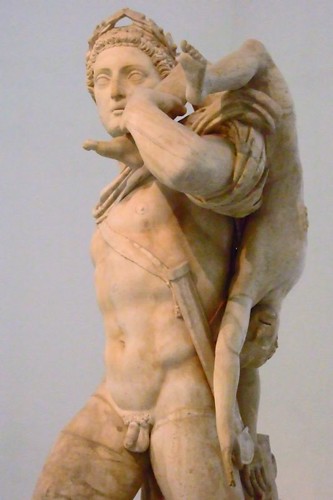
A team from the University of Tubingen, led by Ernst Pernicka, have uncovered a pair of skeletons in the ancient city of Troy near ceramic fragments dated to the period of the Trojan War. It is discoveries like this that remind us how important literature like Homer's Iliad is to understanding our ancient past. It will really blow me away if they find a skeleton of an infant with its head crushed. We could then be looking at the only corporeal remnant of the famous Hector, trainer of horses!

[Image - Warrior with captured child, Roman copy of 3rd century BCE Greek original. Photographed at the Museo Archaeologico di Napoli, Naples, Italy by Mary Harrsch.]

This discovery, though, also raises the question about disposal of "enemy" dead after a catastrophic sack. Both the Greeks and the Trojans at the time practiced cremation. If skeletons are found that could have been retrieved for burial, it makes a person wonder if the Greeks not only violated religious taboos by slaughtering people who had fled to the temples for sanctuary, but did not grant the defeated and enslaved survivors the courtesy of properly burying their dead either. Perhaps the violent deaths later visited upon the Mycenaean victors were just desserts after all.

"Pernicka said pottery found near the bodies, which had their lower parts missing, was confirmed to be from 1,200 BC, but added the couple could have been buried 400 years later in a burial site in what archaeologists call Troy VI or Troy VII, different layers of ruins at Troy. professor of archaeometry who is leading excavations on the site in northwestern Turkey, said the bodies were found near a defense line within the city built in the late Bronze age.

The discovery could add to evidence that Troy's lower area was bigger in the late Bronze Age than previously thought, changing scholars' perceptions about the city of the "Iliad."

"If the remains are confirmed to be from 1,200 B.C. it would coincide with the Trojan war period. These people were buried near a mote. We are conducting radiocarbon testing, but the finding is electrifying," Pernicka told Reuters in a telephone interview.

Pernicka said pottery found near the bodies, which had their lower parts missing, was confirmed to be from 1,200 BC, but added the couple could have been buried 400 years later in a burial site in what archaeologists call Troy VI or Troy VII, different layers of ruins at Troy.

If you enjoyed this post, never miss out on future posts by following me by email!