Showing posts with label Claudius. Show all posts

Friday, January 1, 2021

Roman emperor as pharaoh

A block that originally formed part of a screen wall that connected the four front columns and the sidewalls of the temple of Harendotes ("Horus the Avenger") on the island of Philae represents the "Baptism of Pharaoh," a purification ritual that was part of Egyptian coronation ceremonies. The gods Horus (not preserved) and the ibis-headed Thoth, god of wisdom, pours water, represented by streams of the hieroglyphs ankh (life) and was (dominion), over the head of the king. The pharaoh whose head is partially preserved is a Claudian emperor, most probably either Claudius or Nero as defined in the strip of hieroglyphs along the top of the relief.

Cornice Block with Relief Showing the Baptism of Pharaoh (either Claudius or Nero), 41–68 CE, from the Temple of Harendotes on the island of Philae, Egypt, Roman Period at the Metropolitan Museum of Art. 

As Pharaoh of Egypt, Nero adopted the royal titulary Autokrator Neron Heqaheqau Meryasetptah Tjemaahuikhasut Wernakhtubaqet Heqaheqau Setepennenu Merur ('Emperor Nero, Ruler of rulers, chosen by Ptah, beloved of Isis, the sturdy-armed one who struck the foreign lands, victorious for Egypt, ruler of rulers, chosen of Nun who loves him').  At 16 years old, Nero was the youngest sole emperor until Elagabalus who became emperor at the age of 14 in 218 CE. Perhaps this is reflected in the Egyptian relief depicting a young man with soft mouth.

According to Suetonius, at the end of his reign when his Praetorian Guard abandoned him, Nero toyed with the idea of fleeing to Parthia, throwing himself upon the mercy of Galba, or appealing to the people and begging them to pardon him for his past offences "and if he could not soften their hearts, to entreat them at least to allow him the prefecture of Egypt." Suetonius reports that the text of a speech to this effect was later found in Nero's writing desk, but that he dared not give it from fear of being torn to pieces before he could reach the Forum.


Nero as a boy 1st century CE, courtesy of Wikimedia Commons contributor Prioryman.

If you enjoyed this post, never miss out on future posts by following me by email!


Thursday, February 19, 2015

Did Claudius die accidentally of poison mushrooms or marital treachery?


A history resource article by  © 2015

Bust of the Roman Emperor Claudius
Photographed at the Museo Archaeologico
Nazionale di Napoli in Naples, Italy
by Mary Harrsch © 2007
Note: This is a crosspost of an article originally posted to my other historical blog "History's Medical Mysteries".

"He ate and drank in excess regularly, rarely leaving his dining room until he was "stuffed and soaked". This caused him to gain considerable weight in later years and produced heartburn so severe that it is reported that he contemplated suicide as his only means of relief."

Thus begins a study to determine what may have caused the Roman Emperor Claudius' death as a clinical exercise at a 2001 clinical pathologists' conference at the University of Maryland School of Medicine. Each year, a team of practicing pathologists and historical consultants select a famous individual from the past whose manner of death remains speculative and attempts to derive a definitive cause of death.

Claudius' case is examined by Drs. William A. Balente, MD, Richard J. A. Talbert, PhD, Judith P. Hallett, PhD and Philip K. Mackowiak, MD.

The researchers continue:

"Born prematurely after only 7 months of gestation, he suffered from a succession of disorders including milk allergy, malaria, measles, deafness, and colitis. He suffered from weakness in both legs to the extent that he noticeably limped and could not walk more than a short distance without assistance. He had longstanding tics and jerks of his head and hands, as well as a stammer and drooling, which were most pronounced when he was excited. He was also prone to fits of inappropriate laughter."

Claudius cowers behind a curtain after the murder of his younger brother,  the
Roman emperor Gaius (Caligula) Caesar.  He is astonished when the Praetorian
Guard declare him Emperor instead of murdering him as well.  "A Roman
Emperor AD 41" by Sir Lawrence Alma-Tadema courtesy of Wikimedia.
"A physical examination revealed that his temperature was normal butt his abdomen was mildly tender throughout."

"An attending physician induced additional vomiting by placing a feather in the back of the patient's throat. Shortly thereafter, the emperor became confused and exhibited signs of unremitting abdominal pain and fecal incontinence. He died 12 hours later."

Was it a case of the "cure" being worse than the disease? (PDF of original article reprinted with permission)

Although the team ends up suspecting that a particular variant of mushroom was a contributor to Claudius' death, surprisingly, the researchers point to Claudius' existing physical disabilities as the reason the episode is ultimately fatal.  In fact, the researchers suspect if Claudius had not be otherwise impaired, the assassination attempt probably would have failed.

I found Dr. Valente's  discussion of possible causes of Claudius' long list of physical defects to be most interesting.  He eventually arrives at a conclusion that Claudius suffered from congenital dystonia caused by abnormal basal ganglia - brain cells interconnected with the cerebral cortex, thalamus, and brainstem - the result of an extremely premature birth. Typical of this disorder, Claudius suffered from a twisting of the foot, involuntary cranial and cervical muscle contractions, an inability to control salivation at times and hypertrophy of the neck muscles as seen in some of his portrait sculptures.  Claudius' excellent cognitive function, however, enabled the researchers to eliminate a number of other conditions.


If you enjoyed this post, never miss out on future posts by following me by email!


Tuesday, November 1, 2011

Review: Claudius by Douglas Jackson


"Claudius" by Douglas Jackson really isn't about the emperor Claudius but about his invasion of Britain as seen through the eyes of his elephant handler, a slave named Rufus and the opposing chieftain of  of the Catuvellauni tribe, Caratacus.

The story begins shortly before one of the decisive battles at a crossing of the River Medway near present-day Rochester.  We learn that Rufus is not just an experienced slave but an animal trainer for the arena once mentored by one of Rome's most famous gladiators, Cupido.  His skill attracted the attention of the Roman emperor, Caligula who gives Rufus the task of caring for the emperor's elephant.  A position he was allowed to retain after Caligula is assassinated and the emperor Claudius ascends the throne.

After I had already started  reading "Claudius", I discovered it had a prequel, "Caligula".  However, enough of Rufus' back story is provided so "Claudius" can be read stand alone without any lapses in story continuity. (I was suitably impressed by "Claudius" and have now purchased "Caligula" so will review it in the near future.)

Rufus winds up in Britain along with Beersheba (the elephant) when Claudius' freedman, Tiberius Claudius Narcissus, develops an invasion strategy to provide Claudius with a crucial military victory to strengthen his hold on the imperial purple. As part of the invasion force, however, Rufus is viewed with disdain by some of the legion's veterans.  Although his position shields him from such mundane camp chores as digging defensive ditches, a disgruntled centurion assigns him to a foraging party that is subsequently ambushed by the Britons.  Rufus is knocked senseless in the fighting and wakes up in the belly of a dreaded wicker man.
A Wicker Man photographed at the 2011 Beltain festival
by AngusKirk 

But before he can be consumed by the flames made sacred by the wild gestures of a demonical Druid, he is spotted by Caratacus, recognizing Rufus as the handler of the beast so feared by his fellow tribesmen, and is wrenched from certain death.

We find Caratacus is a thoughtful leader consumed with intellectual curiosity.  Although Caratacus doubts he can learn much about the impending battle from Rufus, he questions him for hours about the Romans, particularly the Roman emperor, in an effort to learn as much as he can about his enemy.
We also discover Caratacus' position as war leader is a tenuous one with other tribal kings jockeying for position to ensure a generous portion of any spoils that might result from future clashes.  One of the most troublesome of his coalition is his own brother, Togodumnus.

In this novel Togodumnus is in an inferior position to his brother Caratacus but historically Togodumnus is thought by some scholars to have been the king of the Catuvellauni and the kingship only passed to Caratacus after Togodumnus was killed early in the invasion.  Caratacus is shrewd and calculating here where his brother, Togodumnus, is painted as brashly impulsive, thinking little of strategy. Placing little value on unit discipline and group tactics, Togodumnus is convinced that brute force alone will ensure victory.  So Caratacus must use every relationship with other tribal chieftains he can call upon to restrain the Britons until a plan can be set into motion that will give the Britons the edge they need to overcome the Roman war machine.

Sculpture of a Druid photographed at the Louvre
by Paul Kohler 


Jackson also portrays Caratacus as politically forced to tolerate the blood-thirsty Druid priests because of their influence with many tribesman, but not particularly superstitious or appreciative of their ritual sacrifices.  This may be Jackson's way of incorporating the fierce Druids into the narrative without giving them much sway with Caratacus since there are persistent legends about Caratacus' conversion to Christianity before he is ultimately taken to Rome.

The legend with the most historical evidence surrounds one Claudia Rufina, a historical British woman known to the poet Martial ( Martial, Epigrams, XI:53 (ed. & trans. D. R. Shackleton Bailey, Harvard University Press, 1993).  Martial describes Claudia's marriage to a man named Pudens thought to be Aulus Pudens, a friend of Martial's.  Since the 17th century, this pair have been identified with the Claudia and Pudens mentioned as members of the Roman Christian community in 2 Timothy of the New Testament (2 Timothy 4:21 - "Eubulus saluteth thee, and Pudens, and Linus, and Claudia, and all the brethren.") . Some biblical scholars have further claimed Claudia was Caratacus' daughter, and that the historical Pope Linus, described in an early church document as the "brother of Claudia" was Caratacus' son. These scholars point to the basilica of Santa Pudenziana in Rome, and with which St. Pudens is associated, which they say was once called the Palatium Britannicum and was the home of Caratacus and his family.

Anyway, back to our story.  Caratacus decides Rufus will best serve the Britons by setting Rufus free to return to the Roman lines so he can report the strength of the tribes in the hope that the sheer numbers will convince  Aulus Plautius, the Roman commander, to withdraw.  But Plautius does not give withdrawal a second thought and formulates a master plan with his legates the Flavian brothers, Vespasian and Sabinus.  Rufus, as a slave,  is not privy to any of the strategy and is once more subject to the whims of Narcissus who decides Rufus and Beersheba will be part of a "river rat" Batavian cohort that is being sent upriver to outflank the Britons.  Beersheba is the lynch pin in a dangerous river crossing where she will pull leather leads tied to rafts bearing the Batavian armor and equipment.  Obviously the author decided to use a ploy mentioned by Vegetius (De re militari III.7) in the 4th century describing how the Batavians were able to ford rivers with full armor (although an elephant was not mentioned).

A Batavian cavalry mask in the collections of
the Nijmegen Museum.
The flanking maneuver was to be supported by Vespasian's Legio II Augusta but Vespasian is delayed by  fierce resistance and Rufus must join the battle line as the Batavians numbers dwindle after repeated assaults.  [SLIGHT SPOILER AHEAD] Fortunately, Rufus is a skilled swordsman thanks to his earlier friendship with the gladiator Cupido and he not only stands firm but kills Togodumnus.

As for the actual historical record, there is some confusion about the fate of Togodumnus.  Cassius Dio says Togodumnus was killed in a battle along the Thames River.  Other scholars, including Barry Cunliffe of Oxford University, point to references in Tacitus that indicate a war leader with a similar name submitted to the Romans and became a client king over the territories of the Regini, the Atrebates, the Belgae and the Dobunni with a headquarters at Chichester, the site of Fishbourne Roman Palace.  (I've actually visited the Roman remains in Fishbourne and they are very impressive!) Jackson handles this discrepency by having another British leader who sided with the Romans against Togodumnus and Caratacus formally take the name Cogidumnus as part of his alliance pact.

Claudius finally makes his appearance and symbolically leads the legions in a string of followup skirmishes where he is hailed imperator and seals his place in history.  In Jackson's story, Claudius is not the drooling, stammering, frail individual portrayed in other tales.  Claudius actually assumes an imposing military posture, looking every bit the brother of the famous general Germanicus.  Jackson also portrays Claudius as able to address the Senate without a hint of a stammer and easily able to bend the assembly to his will.

The emperor Claudius photographed at
the Museo Archaeologico di Napoli by
Mary Harrsch.
Apparently, Jackson has chosen to take Suetonius' description of Claudius with a major dose of salt and instead present a character capable of drafting authoritative legislation regulating commerce, slavery, taxes and marriage, envisioning comprehensive public works such as the development of the port of Ostia  as  well as roads, canals and tunnels and utlimately dodging numerous assassination attempts while maintaining a firm grip on the reins of power.

However,  Jackson is not as generous in his portrayal of Claudius' freedman, Narcissus, who is revealed as cunning, manipulative and utterly. The ambitious courtier uses everyone around him, including Rufus, to promote his own ends although he protests that such actions are ultimately for the good of Rome.   This portrait of Narcissus as essentially faithless to all except Claudius is consistent with his behavior reported in the ancient sources.

The ancient sources say that Narcissus conspired with Messalina to convince Claudius to execute certain individuals that Narcissus may have deemed too powerful or too influential.  But later Narcissus turned on Messalina, reporting her infidelity to Claudius and when Claudius wavered about her punishment, gave the order for her execution himself.  Afterward, fearing Messalina's son, Britannicus, Narcissus tried to convince Claudius to remarry the emperor's second wife, Aelia Paetina, so Claudius would name Faustus Cornelius Sulla Felix, the husband of Claudius' daughter with Aelia, Claudia Antonia, as heir instead of Britannicus.  But when Claudius chose to marry Agrippina instead and named her son Nero to be his heir, then Narcissus allied with Britannicus against Agrippina and Nero.  So, as in this novel, he was truly a friend to no one, only an opportunistic courtier ultimately concerned only with his own future.

Jackson employs and interesting literary device in his story that I had never seen before, too.  Narcissus betrays a minor character in the novel and the way that the plot point is injected into the story reminded me of the execution of Anne Boleyn.  I have read that when the French swordsman prepared to cut off Boleyn's head, he signaled to an assistant who made a small commotion that caused Anne to turn her head in the direction of the disturbance therefore (mercifully?) distracting her at the moment the fatal blow was administered.   In this book, the author distracts the reader with a minor little battlefield drama just before assassins deal the death blow to a character not involved in the mini-drama, jarring the reader with its unexpected suddeness.  I'll have to remember that tactic if I ever write a novel myself!

The book closes with an epilogue describing Caratacus' entry into Rome.  A passage from an epic poem by William Mason came to mind:

I was born A king and 
Heav'n who bade these warrior oaks 
Lift their green shields against the fiery sun 
To fence their subject plain did mean that I 
Should with as firm an arm protect my people 
Against the pestilent glare of Rome's ambition 
I fail'd and how I fail'd thou know'st too well 
So does the babbling world and therefore 
Druid I would be any thing save what I am
Caractacus by William Mason, 1759


Despite years of defeat by superior forces and betrayal by a queen many thought may have been his former lover, Caratacus still walks proudly among the shouting crowds, awestruck by the magnificent architecture and opulence.  He courageously approaches the palace where he expects to be ritually strangled like the hapless Vercingetorix all those years before.  There he finally meets the emperor Claudius, and is surprised to find a rather frail-looking old man.   He must have thought:

Ye never felt the sharp vindictive spur 
That goads the injur'd warrior the hot tide 
That flushes crimson on the conscious cheek  
Of him who burns for glory
- Caractacus by William Mason, 1759

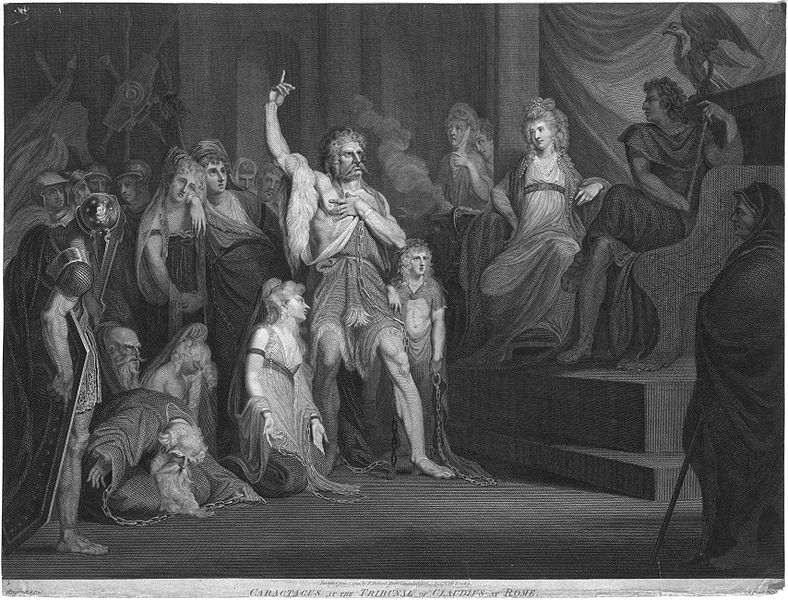
But this old man holds a defeated enemy's life in his withered hands and Caratacus has no doubt that a signal will be given to end his.   Instead Claudius gives him a chance to address the crowd expecting him to plead for his life.  But, Caratacus  simply asks "With all of this,  you covet our  huts?"

 Caractacus at the Tribunal of Claudius at Rome
Engraving by Andrew Birrell of a painting by Henry Fuseli, 1792
Historically, Caratacus was brought before the Senate where he made such an impression he was pardoned and allowed to live out his life peacefully in Rome after saying:

"If the degree of my nobility and fortune had been matched by moderation in success, I would have come to this City as a friend rather than a captive, nor would you have disdained to receive with a treaty of peace one sprung from brilliant ancestors and commanding a great many nations. But my present lot, disfiguring as it is for me, is magnificent for you. I had horses, men, arms, and wealth: what wonder if I was unwilling to lose them? If you wish to command everyone, does it really follow that everyone should accept your slavery? If I were now being handed over as one who had surrendered immediately, neither my fortune nor your glory would have achieved brilliance. It is also true that in my case any reprisal will be followed by oblivion. On the other hand, if you preserve me safe and sound, I shall be an eternal example of your clemency." - Tacitus, The Annals, translated by A. J. Woodman, 2004;

However, after he was freed, Cassius Dio says the famous Briton asked, "And can you, then, who have got such possessions and so many of them, covet our poor tents?" - Dio Cassius, Roman History, Epitome of Book LXI, 33:3c

Obiviously, the author thought a paraphrase of just the last quote would make a more elegant ending and I agree.

A note about the author:  Douglas Jackson is the assistant editor of The Scotsman in Edinburgh, Scotland.  He has spent 30 years working for various local and national newspapers around the UK.  His first up-close-and-personal experience with the Roman Empire came to him while he was a young student and spent a summer restoring a Roman marching camp at Pennymuir in the Cheviot Hills.  He has followed "Caligula" and "Claudius" with a series featuring Gaius Valerius Verrens, a tribune of the 20th Legion who faces off against Boudicca in "Hero of Rome".   In Jackson's latest novel,  "Defender of Rome,"   then Verrens is charged by Nero with capturing the leader of a new religious sect, the followers of Christus.
Enhanced by Zemanta
If you enjoyed this post, never miss out on future posts by following me by email!


Saturday, July 9, 2011

Hail Caesar: The evolution of family name to imperial title

"The princes who by their birth or their adoption belonged to the family of the Caesars, took the name of Caesar.    After the death of Nero, this name designated the Imperial dignity itself, and afterwards the appointed successor. - Footnote, Gibbon's Decline and Fall of the Roman Empire

However, scholars in Gibbon's time were unsure of the exact point in the Roman succession that the name transitioned to an imperial title.

Augustus as Pontifex Maximus
photographed at the Palazzo
Massimo in Rome by Mary
Harrsch.
"The time at which it was employed in the latter sense, cannot be fixed with certainty. Bach (Hist. Jurisprud. Rom. 304) affirms from Tacitus, H. i. 15, and Suetonius, Galba, 17, that Galba conferred on Piso Lucinianus the title of Caesar, and from that time the term had this meaning: but these two historians simply say that he appointed Piso his successor, and do not mention the word Caesar.  [Actually, Galba himself assumed the title "Servius Galba Imperator Caesar" then passed it on by adoption to his successor.]

Aurelius Victor (in Traj. 348, ed. Artzen) says that Hadrian first received this title on his adoption; but as the adoption of Hadrian is still doubtful, and besides this, as Trajan, on his death-bed, was not likely to have created a new title for his successor, it is more probable that Aelius Verus was the first who was called Caesar when adopted by Hadrian. Spart. in Aelio Vero, 102.- W."   - Footnote, Gibbon's Decline and Fall of the Roman Empire

Adoption certainly accounts for Augustus, who was adopted by Julius Caesar, and Tiberius, who was subsequently adopted by Augustus.  Claudius assumed the name of Caesar upon accession without previous adoption but he was a direct descendant of Caesar's bloodline.  Claudius later adopted Lucius Domitius Ahenobarbus (Nero) thus transmitting the name Caesar to him. So Gibbon's initial observations are correct.  However,  Gibbon seems to become a bit confused with the successions occurring in the Year of the Four Emperors.

Roman emperor Otho in 69 CE.  
Photographed at The Louvre in Paris
by Mary Harrsch.
"Galba's reign did not last long and he was soon deposed by Marcus Otho. Otho did not use the title "Caesar", but occasionally used the title "Nero" as emperor. Otho was then defeated by Aulus Vitellius who acceded with the name "Aulus Vitellius Germanicus Imperator Augustus." Vitellius did not at first adopt the cognomen "Caesar" as part of his name, and may have intended to replace it with "Germanicus" (he bestowed the name "Germanicus" upon his own son that year).

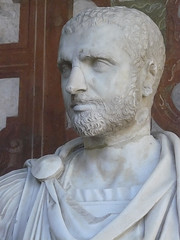
Publis Septimus Geta 3rd century CE.
Photographed at the Palazzo Altemps
in Rome by Mary Harrsch.
Nevertheless, Caesar had become such an integral part of the imperial dignity that its place was immediately restored by Titus Flavius Vespasianus ("Vespasian"), whose defeat of Vitellius in 69 [CE] put an end to the period of instability and began the Flavian dynasty. Vespasian's son, Titus Flavius Vespasianus became "Titus Caesar Vespasianus". - Wikipedia

Following the Flavians, the emperor Nerva assumed the title as well then passed it on through adoption to his heir  Caesar Nerva Traianus who, supposedly, adopted his heir Hadrian, passing the title to him.  At this point our path once more converges with Gibbon.


I thought it was also interesting to read that to further distinguish the use of the name to designate the imperial heir, the title Nobilissimus (meaning "most noble") was added in the 3rd century CE beginning with  Publius Septimius Geta.


If you enjoyed this post, never miss out on future posts by following me by email!


Thursday, July 22, 2010

Could New MIT program use Pyrgi Tablets to Decipher Etruscan?

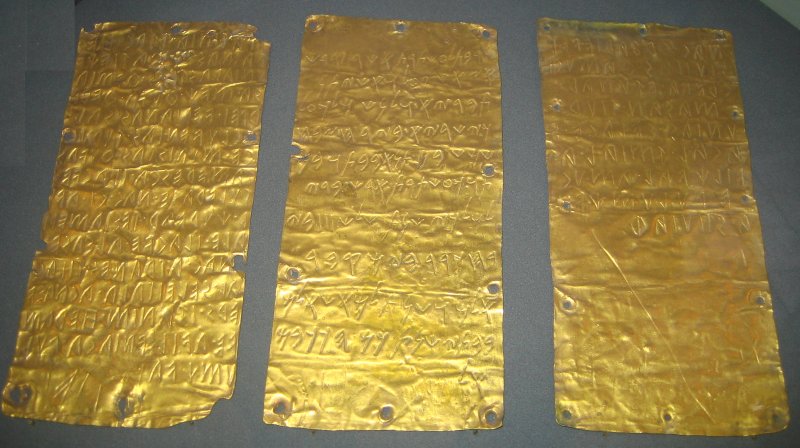
The Pyrgi tablets contain a treatise inscribed in both
Etruscan and Phoenician script.  Image courtesy of
Wikimedia user Pufacz.

Being a technology professional I couldn't help my excitement when I read that a new computer program developed at MIT had been used to decipher Ugarit, an ancient language used in Syria over three thousand years ago. Even more amazing is that the program was able to do so after only a few hours. Linguists have spent years trying to decipher it!


The program is designed to compare an unknown language with a language known to be related to it. In this case scientists set the known related language to Hebrew.


"The system looks for commonly used symbols in the two languages and gradually refines its mapping of the alphabet until it can go no further. The Ugaritic alphabet has 30 letters, and the system correctly mapped 29 of them to their Hebrew counterparts."

"Of the words that the two languages shared the program was able to correctly identify 60 per cent of them." - Read more


Critics point out that some as-yet undeciphered scripts have no known related languages so the program would not be of much use for them.  But leading researcher Regina Barzilay thinks that by scanning multiple languages at once the program could draw logical conclusions from contextual references.

Etruscan Architectural Antefix depicting a
Maenad and a Satyr 500-475 BCE. Photographed
at the Getty Villa by Mary Harrsch.

Perhaps if they used epigraphic examples from similar types of excavation sites that would increase the likelihood that the inscriptions would be discussing similar topics. For example, if they used inscriptions from tablets all found near granaries or inscriptions all found on funerary objects in tombs it may help to increase the contextual similarities. If they further limited inscriptions to those found in similar sites from roughly equivalent time periods that would narrow the comparisons even further. This may also mean that comparisons could be made with languages existing at the same time period but not necessarily from a related language group.

In the Etruscan Museum in Rome housed in the Villa Giulia, there is a treatise inscribed on the Pyrgi tablets in both Etruscan and Phoenician. Although they are not related languages, they are both obviously talking about the same thing. Perhaps their inscriptions could be used as a test with the new software.


Other critics have pointed out that the program really does not have a way to determine the beginning or ending of words either. This can be a serious problem as Etruscan did not use spacing or punctuation until the sixth century BCE and then dots or colons may have also been used to separate syllables as well as words and sentences.

It's too bad all of the emperor Claudius' work on Etruscan have been lost over the centuries.


Only a few educated Romans with antiquarian interests, such as Varro, could read Etruscan. The last person known to have been able to read it was the Roman emperor Claudius (10 BC – AD 54), who — in the context of his work in twenty books about the Etruscans, Tyrrenikà (now lost) — compiled a dictionary (also lost) by interviewing the last few elderly rustics who still spoke the language. Urgulanilla, his first wife, was Etruscan.[3]

Livy and Cicero were both aware that highly specialized Etruscan religious rites were codified in several sets of books written in Etruscan under the generic Latin title Etrusca Disciplina. The Libri Haruspicini dealt with divination from the entrails of the sacrificed animal, the Libri Fulgurales expounded the art of divination by observing lightning. A third set, the Libri Rituales, would have provided us with the key to Etruscan civilization: its wider scope embraced Etruscan standards of social and political life as well as ritual practices. According to the 4th century Latin writer Servius, a fourth set of Etruscan books existed, dealing with animal gods, but it is probably unlikely that any contemporary scholar could have read Etruscan at such a late date. The single surviving Etruscan book, Liber Linteus, being written on linen, survived only by being used as mummy wrappings. - Wikipedia
Now that we have even better technology to analyze mummy wrappings and scrolls that were reused in the Middle Ages as well maybe some of Claudius' work will be found in the future.

The Atlas of Languages: The Origin and Development of Languages Throughout the World (Facts on File Library of Language and Literature Series)   The Power of Babel: A Natural History of Language   Etruscan Civilization: A Cultural History   The Etruscan Language: An Introduction, Revised Editon   Claudius
If you enjoyed this post, never miss out on future posts by following me by email!


Sunday, July 18, 2010

Don't miss my review of Steven Saylor's "Empire"!!

Empire: The Novel of Imperial Rome (Novels of Ancient Rome)I just finished an extensive review of Steven Saylor's new novel "Empire" and posted it to my Books and Novels of the Ancient World blog.    The novel follows the fictional patrician Pinarii family from the late Augustan Age to the reign of Hadrian with particularly fascinating "behind the scenes" exploration of the reigns of Nero and Domitian.  I found the novel so fascinating that I spent hours on supplemental research after I finished reading it to learn more about some of the personalities introduced in the novel that I knew very little about.  I highly recommend it!  Five Stars!!
If you enjoyed this post, never miss out on future posts by following me by email!


Sunday, October 5, 2008

Roman cellars in Lisbon architectural mystery

Nobody knows what the galleries beneath Lisbon’s Baixa were used forTHEY OPEN but once a year and the queues to see them are so long they stretch the entire length of two blocks. They are Lisbon’s ancient Roman Cellars

Only rediscovered during the rebuilding of Lisbon in 1771 after the Great Lisbon Earthquake, nobody knows for sure what this system of Roman arched underground tunnels beneath the city’s Baixa was used for.


There are several theories. One is that they were used as storage cellars beneath the smart Roman shops that once lined Lisbon’s Roman Forum when it was the busy port of Olisypio.

Alternatively, they formed part of a Roman foundation system used to level undulating ground so that buildings above would be on a flat, if artificial, surface made from an early form of concrete.

They could, too, have been Roman thermal springs used to supply a series of wells for the Roman populace.


Whether they were the smart underground shopping galleries beneath the Roman Forum, similar to the ones one finds in Naples, or simply foundations supporting buildings up above, used as cellars for shops, town villas and public buildings, today the visible part consists of a network of perpendicular galleries, all of different heights, leading into small compartments or cells which could very well have been storage areas.

The pillow stone arches, which withstood the earthquake, date from the early part of Imperial Rome, between the Emperors Julius Cesar and Claudius.

It was only in 1859, when Lisbon’s first sewage system was being installed, that archaeologists were able to really study the Roman ruins extensively for the first time, while the first journalists allowed down to photograph and see them at first hand was only in 1909.
Technorati Tags: , , , , , , , ,
If you enjoyed this post, never miss out on future posts by following me by email!


Saturday, June 16, 2007

Gallic-Romano mythology - Tarvos Trigaranus

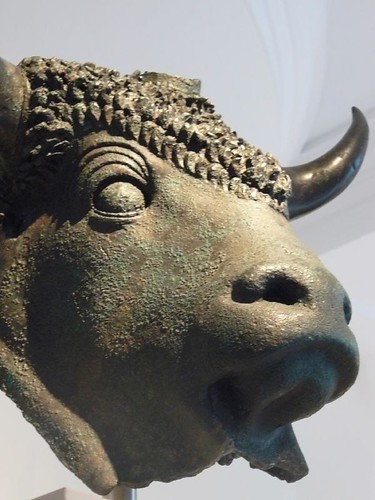
I uploaded some more images from the Met today and among them are several images of a bronze three-horned bull (unfortunately the center horn is missing) that was recovered from Octodurus, a city founded by the Emperor Claudius, in Switzerland.

It's a wonderful sculpture and I'm so glad the piece was not melted down as it appears to be part of a statue that had been rendered apart in preparation for scrapping. It made me curious about the worship of a three-horned bull so I researched it further and learned that the three-horned bull, sometimes called Tarvos Trigaranus, was worshiped by the Celts in Gaul and Britain.

According to an article by Susan Read, Martin Henig, and Leslie Cram that appeared in the journal Brittania, art depicting three-horned bulls was common in northeastern Gaul. They said it seems to have been derived from statues of two-horned bulls from Campania that were constructed with a crescent between their horns. They mention four such statues found in Britain - one in Maiden Castle at Dorset, one from the Jewry Wall Site in Leicester, one from Southbroom near Devizes in Wiltshire, and the last a pipeclay figurine, "certainly an import from Gaul", found at Colcester.

I also read an interesting description of a divination to determine a new Celtic king using a bull.

"Bulls were used in divination in both Ireland and Scotland. At Tara a new king might be chosen in the tarbfheis, `bull-feast' or `bull-sleep', in which a bull was killed and a man ate his fill of its flesh, drank its broth, and then lay down to sleep. After an incantation had been chanted over him by four druids, the dreamer would know the new king in his dream. In Scotland a person might answer an important question about the future (no king was to be selected) by wrapping himself in the warm, smoking hide of a newly slain bull in a remote place, such as near a waterfall. Upon going into a trance the person would have the answer. This method was known as taghairm." - Celtic Mythology, Oxford University Press.

Apparently the three-horned bull even found its way to the standards of the Roman Legions:

"...standards of ala Longiniana (CIL XI11 8094) and cohors I Gallica (ILS 9127) appear to have been adorned with animals popular in Gallic religious
iconography - respectively, a three-horned bull (Green 1976, 13) and a small boar.6 Such animals almost certainly appeared on signa of the type referred to by Tacitus (Germ. 7; Hist. 4.22), borne by the pagi and tribal groupings of the Gauls (Royrnans 1990,19). They appear open to different symbolic interpretations: depending on the cultural perspective of the viewer, they could have been seen primarily as traditional Gallic tribal totems or as Roman military regimental standards." - The Roman Army As A Community .
If you enjoyed this post, never miss out on future posts by following me by email!