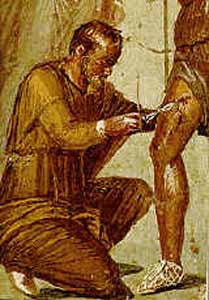
I'm researching and comparing the finds made in other houses in Pompeii designated as houses of physicians with the finds made in the House of the Prince of Naples since scattered surgical instruments were found there and came across an interesting observation in an Italian research paper describing the use of surgical instruments found in Pompeii. Michele di Gerio, in her article entitled "Study on surgical instruments of the National Archaeological Museum of Naples" published in the Rivista di Studi Pompeiani Vol. 25 (2014), pp. 93-110, observes that although cauterization was advantageous for the treatment of abscesses after the infection was drained and was sometimes applied to the bites of rabid dogs, it was rarely used in non-military settings and only if the patient was well fed and in otherwise good physical condition to limit the damage of stress. Pythagoreans, although they frequently used ointments and poultices for wound care, did not practice cauterization.
I also learned that late 19th century archaeologists divided scalpels into two categories, the flat type and the type shaped like an olive leaf. When I translated the Italian find summaries for the House of the Prince of Naples,I thought the reference to the olive leaf in regards to the scalpel found in the kitchen was a literal description of the handle and thought it may have been repurposed for use in the kitchen to disarticulate meat because I had never seen any surgical instruments in Pompeii exhibits that had olive leaves depicted on the handle. But in fact it was a common description for scalpel types used by late 19th century archaeologists. It may have ended up in the kitchen for cleaning since there was a water channel found running between the kitchen and cistern in the garden or the instrument may have fallen from the upper story where the inhabitants of the house had private rooms.
Image: Ancient Roman Surgeon's tools recovered from Pompeii at "Pompeii the Exhibit" at the Pacific Science Center in Seattle, Washington.