Showing posts with label ancient books. Show all posts

Monday, December 17, 2007

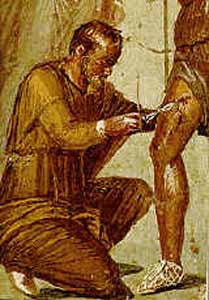
Roman surgical instruments focus of new show


One of the most complete sets of surgical instruments from the ancient world has gone on show in the Italian city of Rimini.

Archaeologists there have been excavating the house of a surgeon who operated nearly 2,000 years ago.

They found more than 150 different surgical instruments, like scalpels, scissors, weighing scales, and forceps.

The house was built in the 2nd Century AD and destroyed by fire in the barbarian invasions a century later.

Painstakingly, for 17 years archaeologists have been digging away in the centre of Rimini, a city on the Adriatic sea, laying bare the ruins of one of the world's oldest doctor's surgeries.

Greek inscriptions

One unique tool, unknown to archaeologists until now, was a device apparently designed to extract arrowheads from wounded soldiers.

They also found a pestle and mortar in which the surgeon most likely mixed compounds of herbal anaesthetics to relieve pain.

A ceramic hot water bottle in the shape of a foot is believed to have been used for treating foot pains.

The consulting rooms included a high backed chair for the doctor, who may have been a Greek, to judge from the Greek language inscriptions found.

An operating room has a bed along one wall and the name Eutyches, which may have been the doctor's name, was scratched upon the wall.

If you enjoyed this post, never miss out on future posts by following me by email!


Monday, November 5, 2007

DNA studies used to identify ancient cargo


For the first time, researchers have identified DNA from inside ceramic containers in an ancient shipwreck on the seafloor, making it possible to determine what the ship's cargo was even though there was no visible trace of it.For the first time, researchers have identified DNA from inside ceramic containers in an ancient shipwreck on the seafloor, making it possible to determine what the ship's cargo was even though there was no visible trace of it.

By scraping samples from inside two of the containers, called amphoras, the researchers were able to obtain DNA sequences that identified the contents of one as olive oil and oregano. The other probably contained wine, and the researchers are conducting further analyses to confirm this.

Many archeologists specialize in the study of amphoras, which were the cargo containers of the ancient world, used for shipping all kinds of liquid or semi-liquid goods. But the study of these containers can be frustrating, Foley said, because after centuries on the seafloor, the contents have usually been washed away and archeologists are "just left with empty bottles."

The new research points the way toward analyzing hundreds of containers, which could "tell us what was being traded, and something about the total agricultural production of a country," Foley said. Such analysis of ancient crops could even yield insights into the climate of that period.

The discovery of DNA from olive oil and oregano in one amphora came as a surprise, Foley says, because Chios was well-known in the ancient world as a major exporter of highly prized wines, and archeologists had assumed that amphoras from a ship in that area would have been carrying wine.

The other amphora from which Foley and Hansson were able to extract DNA may indeed have contained wine, although that is not yet certain. The short fragments of DNA they found may have come from pistachios or from resins used to coat the insides of amphoras that carried wine. Analysis continues, using present-day samples of plants from the island to pin down the identification.
If you enjoyed this post, never miss out on future posts by following me by email!


Saturday, October 1, 2005

Welcome To The New Roman Times!

After struggling with the constantly changing tools to convert RSS feeds to HTML using scripts that seem to hiccup every time someone makes a change to user security or the underlying javascript, I've decided to take a new approach to publishing Roman Times.

I've embedded the columns into inline frames with scroll bars to use to see more articles about each topic group. Each column title is linked to the actual blog that I use to update the articles in that group if you wish to see a full page version. You can also scroll to the right to see the links to each group's archives. I have also consolidated all of the information onto a single (long) page. I think you will find scrolling down less confusing than clicking links to move from one page to the next.

Hopefully this blogger shell will prove to be a more efficient way to bring you the latest news in the study and enjoyment of the ancient world.
If you enjoyed this post, never miss out on future posts by following me by email!