Sunday, May 24, 2009

Will Underground Rome Be Visitor Friendly?


I'm glad more of "hidden" Rome is opening to the public - just unfortunate that it didn't happen by the time of my visit in March. I can't help but wonder, though, if these new visitor viewing opportunities are motivated more by commercial interest rather than a desire to share cultural heritage.

[Image: 2nd century CE guardroom. Image courtesy of Times Online]

I was dismayed by the number of "admission" gates that have sprung up all over Rome since my first visit in 2005. Even the Forum Romanum is gated now - the symbolic gathering place for the Res Publica since ancient times. I realize conserving antiquities is expensive but some efforts to milk the tourists have really gotten to the point of ridiculous. The new museum encompassing Trajan's market has but a handful of artifacts on display but commands an admission price equal to that of the Capitoline Museum. I guess they have to pay for the new glass-doored elevator that takes people down to the lower level of the market. But most of the market was visible from the street before and the new visitor viewing areas don't let you get much closer now. I was also disappointed with the Archaeobus. The sound system for the little ear buds was so poor you couldn't hear anything above the road noise. The bus careened through the streets at a speed that made appreciation of the drive a challenge. Buses were scheduled 30 minutes apart which made coordination difficult when tours of the catacombs themselves took 30 minutes, so by the time you emerged you just missed the next bus and had to spend a lot of time waiting. The buses did not stop at each venue. You had to be prepared to buzz the driver if you wished to disembark and, if no one was standing by the bus sign, the buses just roared by. I realize this is how city buses often operate but this method is not visitor friendly for tourists who don't know exactly where to get off or are participating in tours at some of the venues.

When I was in York several years ago, I used the hop-on hop-off bus there and enjoyed the convenience and the friendly conversation of the bus driver who pointed out historical sites along the way. The drivers watched for tourists who appeared to be headed for the bus stop even if they had not yet made it and waited a few minutes. The buses were also about 15 minutes apart so even if you missed one bus you didn't have to stand around too long waiting for the next. The operators of the Archaeobus would do well to discuss service issues with the operators of the hop-on hop-off bus in York.

"Visitors to Rome will soon be able to discover a world of ancient treasures beneath their feet when the city opens dozens of previously unseen underground sites to the public.

They include the Ludus Magnus, the barracks beneath the Colosseum where gladiators assembled before entering the great arena to meet their fate; the well-preserved necropolis of Santa Rosa at the Vatican, with tombs from the 1st to the 5th centuries, and pagan temples.

Tourists can also explore the frescoed 2nd century Temple of Mithras, the pagan cult, beneath the 17th Century Palazzo Barberini, which houses one of Rome’s foremost art collections.

Francesco Marcolini, the head of Zetema, the cultural foundation in charge of the project, said that next year 15 more underground sites would be added, including a Jewish necropolis in the grounds of Villa Torlonia, formerly the Rome residence of Benito Mussolini, the Fascist dictator.- More: Times Online


If you enjoyed this post, never miss out on future posts by following me by email!


Thursday, May 21, 2009

Roman Antiquities Centerpiece of Musée des Antiquités Nationales


When I was in Paris last summer, I thoroughly enjoyed my visit to the Greek, Roman, and Etruscan galleries at the Louvre. As a photographer, I was glad I wasn't having to dodge the crowds of visitors I encountered upstairs in the gallery containing the Mona Lisa. I was able to take my time and captured some excellent shots of the beautiful antiquities displayed there. I didn't really stop to wonder why so few visitors loitered in those spacious halls.

"It’s one of the best collections in the world and hardly anyone comes,” said Ludovic Laugier, a curator at the Louvre. “I want to stop people and say, ‘Look, look at what you’re missing!’"

Now, I find that I, too, missed an entire museum dedicated to Roman artifacts of ancient Lutetia (Paris). I thought I had covered most of the major museums in Paris. I may have to plan a return trip after all!

[Image - Fibula with cameo Roman 7th century C.E., gold, garnets, glass, cameo Charnay (Saône-et-Loire). Courtesy of Musée des Antiquités Nationales]

The Musée des Antiquités Nationales (Place Charles de Gaulle, St.-Germain-en-Laye; 33-1-3910-1300; http://www.musee-antiquitesnationales.fr) is even less frequented. The museum, originally a chateau rebuilt by Francis I in the 16th century, was founded in the 1860s by Napoleon III, a history and archaeology buff who was obsessed with ancient Rome.

On display are a multitude of objects from Roman daily life: agricultural and carpentry tools, cooking pots and utensils, gold jewelry, sewing needles, surgical instruments, hunting lances, coins, musical instruments and playing dice. For a woman’s toilette, I found hand mirrors, perfume bottles, tweezers, a scraper to wipe off sweat, even an applicator for face powder in the shape of a human finger.

Patrick Périn, the museum’s director, showed me his favorite statue: a crude, grim-faced Mercury, carved not in fine marble, but in limestone. “He is the ugliest thing, a typical Gaul, in rough Gallic dress, not a Roman,” Mr. Périn said. “But look at his kind face. I love him.” - More: NY Times
If you enjoyed this post, never miss out on future posts by following me by email!


Monday, May 18, 2009

CT scans reveal Roman Mass Production Techniques


New research shows that, like so many other things in our world, mass production techniques like assembly lines were used thousands of years before Henry Ford by the ingenious Romans! Only time will tell if the manufacturing process was invented in Rome or adapted from a culture conquered by the Romans.

I have a little miniature replica of a jointed Roman doll that I purchased on my last visit to the Getty Villa. I have seen other Roman dolls in other museum collections and notice that they all have very similar faces. I wonder if the Romans had their own version of Mattel as well?

[Image: Roman ivory doll; Photo courtesy Dr. Barbara F. McManus, VRoma.org]

German scientists disclosed Friday new evidence that the ancient Romans used mass-production methods to make metalwares at lesser cost, just like modern factories do. A close study of a 28-centimetre-tall bronze figure of the god Mercury made in the 2nd century AD, found on a dig at Obernburg, showed it was hollow - an indication of cost cutting - and that its legs were made separately, indicating some kind of assembly line to exploit economies of scale. Technical University of Munich scientists at the FRM-II research nuclear reactor in Garching near Munich blasted the statue with neutrons to reveal metal joins that are invisible to X-rays. - More: EarthTimes
If you enjoyed this post, never miss out on future posts by following me by email!


Tuesday, May 12, 2009

Museum Disaster Preparedness Almost put the test in Santa Barbara


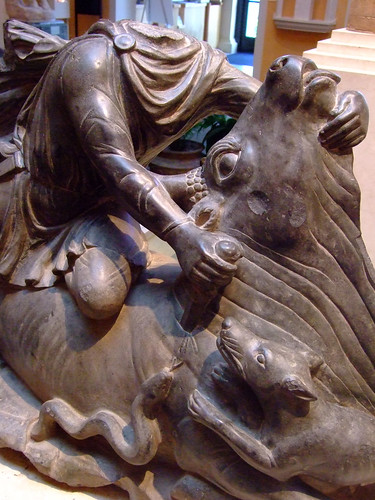
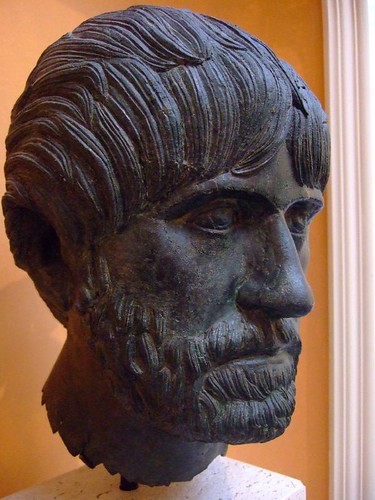
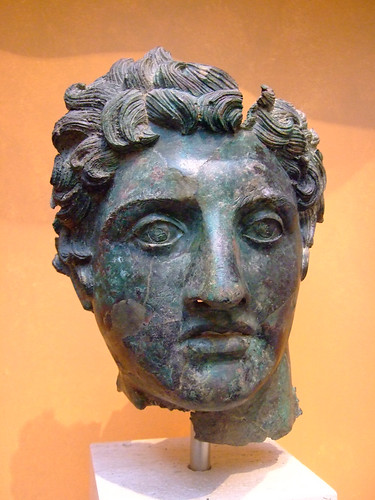
I was so relieved to read that the wildfire raging out of control and coming to within 4 miles of the city center of Santa Barbara, California was finally suppressed. The wonderful Santa Barbara Museum of Art lies at the heart of the city and I was worried about the beautiful antiquities I photographed there several years ago. Among them is a marvelous sculpture of Mithras slaying the bull from the 2nd century CE, a well-preserved bronze head of a bearded Gallic Man from the mid-3rd century CE, a lovely Fayum portrait from the 2nd century CE and even a dramatic bronze head of Alexander the Great from the 3rd century CE.

Although thousands of people in surrounding homes had been evacuated I heard nothing about any provisions to preserve the art collection. I hoped that the director of the Santa Barbara museum had attended one of the Getty's disaster preparedness workshops and that a plan was in place and activated.

The Getty held the first disaster preparedness workshop in January 1992.

The directors of eight California museums gathered at the GCI in Marina del Rey and at the J. Paul Getty Museum in Malibu to hear first-hand accounts of how institutions in Chicago, Louisiana, and San Francisco coped during real-life disasters, and to learn about the Getty's comprehensive emergency plans and drills.

The workshop included a tour of the J. Paul Getty Museum to view emergency preparations, including measures developed to protect every object in its collections, whether on display or in storage, from earthquake damage. The Museum developed its first emergency plan in 1986. A year later, it joined with the GCI [Getty Conservation Institute] and the University of Southern California in a two-year research project to evaluate the effectiveness of its seismic damage mitigation measures. The results of that study, available from the GCI Scientific Program, include general guidelines for evaluating the seismic vulnerability of objects.

In addition, the GCI, along with the National Academy of Sciences and the Earthquake Engineers Research Institute, has participated in selected emergency response missions in the wake of such disasters as Hurricane Hugo and the Loma Prieta earthquake. It has also assisted in missions organized to cope with disasters at individual institutions, including the flood in the Carillo Gil Museum in 1987, and the 1988 fires at the Louisiana State Museum and the Library of the Soviet Academy of Sciences (now the Russian Academy of Sciences) - The Getty Newsletter, Spring 1992


Much emphasis has been placed on earthquake damage prevention because of the frequency of quakes in southern California but wildfires are an annual threat there as well. Although quake damage can often be repaired, many antiquities like the Fayum portrait would be irrevocably lost in a fire so I do hope equal attention has been given to catastrophic fire preparedness.

[Images by Mary Harrsch]
If you enjoyed this post, never miss out on future posts by following me by email!


Symbols of Roman vox populi to get scrubbed

I had to shake my head and smile about this article. The Romans use antiquties for this purpose while here in Eugene, Oregon, we must be content with posting complaints on telephone poles!

The Pasquino, the remnants of a statue that once depicted Menelaus cradling the slain Patroclus, but now one of the six remaining "talking statues" of Rome, is slated for a clean up. Placed near Piazza Navona by Cardinal Carafa after it was unearthed in 1501 during excavations in Rome's Orsini Palace, the worn sculpture became the focal point of local discontents who vocally expressed their dissatisfaction with various bureaucracies, both religious and political, by festooning the work with posters and messages. The practice has continued for centuries.

[Image by Peter Heeling Courtesy of Wikimedia Commons]


The humble statue was placed near Piazza Navona by Cardinal Carafa, who held a Latin poetry contest each year and used the statue to hang and display the poems for all to see and admire. Over the years, however, more than just poetry began appearing on the statue. The work became a platform for mocking notes from the public.

Eventually, the statue became known as "Pasquino," taking its name from a neighborhood tailor with a biting wit. The tailor's and others' satirical poems and other such postings eventually became known as "pasquinate" and, in modern English, "pasquinade" now means a satirical piece of writing posted in a public place.

Among Pasquino's earliest messages was "Quod non fecerunt Barbari fecerunt Barberini (What the Barbarians did not do, the Barberini did)."

The message was addressed to the Barberini Pope, Urban VIII, who was accused of plundering Rome's artistic heritage for his own grandiose projects.

By the mid-sixteenth century, the caustic messages on the statue carried such strong anti-papal tones that religious leaders suggested dropping the statue into the Tiber River. - More: MSNBC


If you enjoyed this post, never miss out on future posts by following me by email!