Showing posts with label frescoes. Show all posts

Sunday, December 20, 2009

Exploring 1st - 4th century Roman villas in Brescia sounds fascinating!


I received a touristy little news item about the northern Italian town of Brescia that caught my interest.  The article mentioned that the area contained the largest Roman excavation in northern Italy so, of course, I had to read more about it.  I learned that Brescia, was once known as Brixia.

[Image: Mosaic floor of a 1st - 4th century Roman villa preserved at the Brescia Musei, Brescia, Italy.]

"Different mythological versions of the foundation of Brescia exist: one assigns it to Hercules, while another attributes its foundation to Altilia ("the other Ilium") by a fugitive from the siege of Troy. According to a further myth, the founder was the king of the Ligures Cidnus, who had invaded the Padan Plain in the late Bronze Age. Scholars attribute the foundation to the Etruscans." - Wikipedia

The Etruscans fell to the  Gallic Cenomani, allies of the Insubres, in the 4th century BCE.  The Celts succumbed to the Romans in 225 BCE.   But the Celts were not all satisfied with Roman rule and became part of a Celtic confederation allied with the Carthaginians in 202 BCE during the 2nd Punic War.

"...but, after a secret agreement, [Brixia] changed side and attacked the Insubres by surprise, destroying them. Subsequently the city and the tribe entered the Roman world peacefully as faithful allies, maintaining a certain administrative freedom. In 89 BC Brixia was recognized as civitas ("city") and in 41 BC its inhabitants received Roman citizenship. Augustus founded a civil (not military) colony there in 27 BC, and he and Tiberius constructed an aqueduct to supply it. The Roman Brixia had at least three temples, an aqueduct, an amphitheater, a forum with another temple built under Vespasianus, and some baths.

When Constantine advanced against Maxentius in 312, an engagement took place at Brixia in which the enemy was forced to retreat as far as Verona. In 402 the city was ravaged by the Visigoths of Alaric I. During the invasion of the Huns under Attila, the city was again besieged and sacked in 452 while, some forty years later, it was one of the first conquests of the Gothic general Theoderic the Great in his war against Odoacer." - Wikipedia

Republican-era buildings were discovered there in the 19th century under the remnants of the Capitolium, the temple built by the Emperor Vespasian.  Artifacts recovered from these excavations include Celtic arms, Roman portrait sculpture, frescoes and mosaics.  The Santa Giulia City Museum houses these discoveries as well as a collection of preserved Roman townhouses from the 1st to 4th century CE.

I'm also a big fan of armor collections and I see that the castle portion of the Museum houses an arms collection in the keep.  Over 580 swords, firearms and suits of armour, over half of the 1090 items bequeathed by industrialist Luigi Marzoli, are displayed in ten exhibit rooms.  The oldest item is a sword from the 13th century and one of the rarest is a large Venetian helmet and under-helmet with visor in the shape of a dog’s muzzle.

I had a wonderful time photographing the extensive armor collection at the Metropolitan Museum of Art in New York several years ago.  I would love to add images of  Brescia's marvelous collection to my Flickr set! I haven't yet visited Venice and I was really anxious to explore Ravenna someday too.  It looks like I need to plan a major expedition to northern Italy!


Houses, Villas, and Palaces in the Roman World     Roman Villas in Central Italy (Columbia Studies in the Classical Tradition)     Arms & Armor (DK Eyewitness Books)   Medieval Arms and Armor: A Pictorial Archive (Dover Pictorial Archive Series)   Vespasian   The Architecture of Roman Temples: The Republic to the Middle Empire
If you enjoyed this post, never miss out on future posts by following me by email!


Wednesday, July 8, 2009

Rome opens House of the Gryphons and other restricted sites to summer visitors


In attempts to lure more tourists to the archaeological sites of Rome, the Italian government has managed to divert money normally spent on staff bonuses and special projects to security details to monitor public access to sites that have been closed to the public for decades. I just hope they allow people to take time to fully appreciate the remnants of ancient art on display.

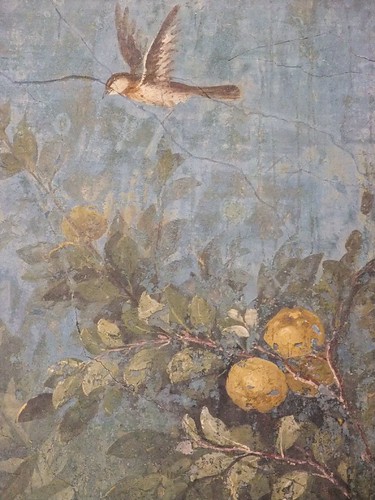
[Image - Mural from the triclinium of the Villa of Livia at Prima Porta, Roman, 1st century CE, exhibited at the Palazzo Massimo, Museo Nazionale Romano, Rome, Italy. Photograph by Mary Harrsch]

When I visited the newly excavated rooms of the Villa of Augustus on the Palatine Hill this spring, I had to stand in a long queue only to be hustled through the viewing area for the rooms, which were sealed off with glass, and denied the opportunity to photograph anything even without a flash. I could not fully appreciate the detail of the frescoes or anything else with such a quick glance. I had intentionally looked for the Egyptian motifs that I had seen discussed on a History Channel presentation but could not readily identify them without more time to examine the frescoes more carefully. I imagine the visitors who came in the height of tourist season would have been given even less time to make the tightly controlled circuit through the remains with queues probably four times as long.

At least I was able to take all the time I wanted to examine and photograph the beautiful garden frescoes that once adorned the subterranean triclinium of the Villa of Livia now displayed in the Palazzo Massimo venue of the Museo Nazionale Romano (see image above left). I had a special low-light camera with me this time so was able to take a number of detail images of the lush foliage, flowers, fruit trees and birds that comprise that stunning work. The totally encompassing painting must have truly soothed the empress' guests with its pastoral calm. I would have loved to have toured the villa itself.

Among the attractions that await visitors is the House of Livia, once the home of the wife of the emperor Augustus. The two-story structure has been closed for more than two decades, but until October it will be open every Tuesday.

Buried under the ruins of the Domus Flavia, built by Nero and Domitian, are the remains of the so-called House of Gryphons, one of the most important residences of Republican Rome. Excavated in 1912, it is virtually unknown outside academic circles. It too is now open on Tuesdays.

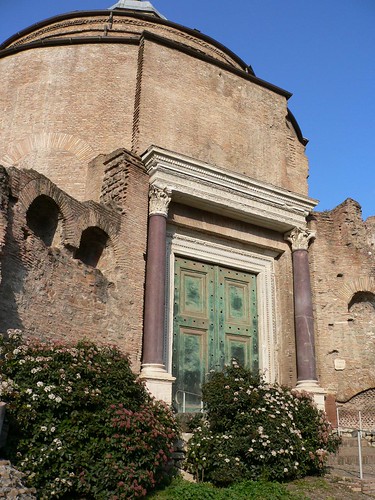
Behind its massive original bronze doors, the misnamed Temple of Romulus in the Roman Forum (it was probably the Temple of Jupiter Stator) shows evidence of the gradual merging of pagan religions with the Christian usurper. Like the so-called Oratory of the 40 Martyrs, decorated with eighth-century frescoes of soldiers who perished in frozen waters in Armenia, the temple is now open on Fridays.

[Image - Temple of Romulus in the Forum Romanum. Photo by Mary Harrsch]

One relatively modern attraction is the Loggia Mattei, which dates from the Renaissance, when some aristocratic families colonized the Palatine with landscaped gardens and small villas, often absorbing Roman ruins. Frescoes from a hall dedicated to the cult of Isis, the Egyptian goddess, have been brought here from another site on the Palatine. The loggia, built in the 16th century, was briefly open in 1997, Ms. Tomei said, “but even then we didn’t have enough custodians. Since then it’s fallen into oblivion.”

The ancient frescoes abut the newer loggia, which was painted by the workshop of Baldassare Peruzzi with mythological scenes. The decoration includes 12 roundels with signs of the Zodiac, panels that belong to the Metropolitan Museum of Art in New York. - More: New York Times
If you enjoyed this post, never miss out on future posts by following me by email!


Sunday, May 24, 2009

Will Underground Rome Be Visitor Friendly?


I'm glad more of "hidden" Rome is opening to the public - just unfortunate that it didn't happen by the time of my visit in March. I can't help but wonder, though, if these new visitor viewing opportunities are motivated more by commercial interest rather than a desire to share cultural heritage.

[Image: 2nd century CE guardroom. Image courtesy of Times Online]

I was dismayed by the number of "admission" gates that have sprung up all over Rome since my first visit in 2005. Even the Forum Romanum is gated now - the symbolic gathering place for the Res Publica since ancient times. I realize conserving antiquities is expensive but some efforts to milk the tourists have really gotten to the point of ridiculous. The new museum encompassing Trajan's market has but a handful of artifacts on display but commands an admission price equal to that of the Capitoline Museum. I guess they have to pay for the new glass-doored elevator that takes people down to the lower level of the market. But most of the market was visible from the street before and the new visitor viewing areas don't let you get much closer now. I was also disappointed with the Archaeobus. The sound system for the little ear buds was so poor you couldn't hear anything above the road noise. The bus careened through the streets at a speed that made appreciation of the drive a challenge. Buses were scheduled 30 minutes apart which made coordination difficult when tours of the catacombs themselves took 30 minutes, so by the time you emerged you just missed the next bus and had to spend a lot of time waiting. The buses did not stop at each venue. You had to be prepared to buzz the driver if you wished to disembark and, if no one was standing by the bus sign, the buses just roared by. I realize this is how city buses often operate but this method is not visitor friendly for tourists who don't know exactly where to get off or are participating in tours at some of the venues.

When I was in York several years ago, I used the hop-on hop-off bus there and enjoyed the convenience and the friendly conversation of the bus driver who pointed out historical sites along the way. The drivers watched for tourists who appeared to be headed for the bus stop even if they had not yet made it and waited a few minutes. The buses were also about 15 minutes apart so even if you missed one bus you didn't have to stand around too long waiting for the next. The operators of the Archaeobus would do well to discuss service issues with the operators of the hop-on hop-off bus in York.

"Visitors to Rome will soon be able to discover a world of ancient treasures beneath their feet when the city opens dozens of previously unseen underground sites to the public.

They include the Ludus Magnus, the barracks beneath the Colosseum where gladiators assembled before entering the great arena to meet their fate; the well-preserved necropolis of Santa Rosa at the Vatican, with tombs from the 1st to the 5th centuries, and pagan temples.

Tourists can also explore the frescoed 2nd century Temple of Mithras, the pagan cult, beneath the 17th Century Palazzo Barberini, which houses one of Rome’s foremost art collections.

Francesco Marcolini, the head of Zetema, the cultural foundation in charge of the project, said that next year 15 more underground sites would be added, including a Jewish necropolis in the grounds of Villa Torlonia, formerly the Rome residence of Benito Mussolini, the Fascist dictator.- More: Times Online


If you enjoyed this post, never miss out on future posts by following me by email!


Monday, August 25, 2008

"Pompeii and the Roman Villa" exhibit opens October 18 in Washington D.C.

In the first century BC, the picturesque Bay of Naples became a
favorite retreat for vacationing emperors, senators, and other
prominent Romans. They built lavish seaside villas in the shadow of
Mount Vesuvius where they could indulge in absolute leisure, read and
write, exercise, enjoy their gardens and the views, and entertain
friends. The artists who flocked to the region to adorn the villas also
created paintings, sculptures, and decorative arts for the residents of
Pompeii and nearby towns. Pompeii and the Roman Villa
presents some 150 works of sculpture, painting, mosaic, and luxury
arts, including recent discoveries on view in the U.S. for the first
time and celebrated finds from earlier excavations. Exquisite objects
from the richly decorated villas reveal the breadth and richness of
cultural and artistic life, as well as the influence of classical
Greece on Roman art and culture in this region. The exhibition also
focuses on the impact that the 18th-century excavations and rediscovery
of Pompeii and Herculaneum had on the art and culture of the modern
world.


Organization

Pompeii and the Roman Villa: Art and Culture around the Bay of Naples is
organized by Museum of Art, with the cooperation of the
Direzione Regionale per i Beni Culturali e Paesaggistici della Campania
and the Soprintendenza Speciale per i Beni Archeologici di the National Gallery of Art, Washington, in association
with the Los Angeles County Napoli e
Pompei.

Schedule

National Gallery of Art, October 19, 2008–March 22, 2009;
Los Angeles County Museum of Art, May 3–October 4, 2009

For those of you that cannot attend either of the venues, a DVD about the exhibit will be released October 28, 2008 from MicrocinemaDVD with a list price of $19.95.

If you enjoyed this post, never miss out on future posts by following me by email!


Sunday, March 9, 2008

Villa of Augustus on Palatine Hill Now Open To The Public

Exquisitely preserved frescoed rooms in the ruined house of Augustus, the first Emperor of Rome, were opened to the public today for the first time since they were unearthed nearly half a century ago.

Archaeologists say that the future emperor lived in the house on the Palatine Hill above the Forum in about 30BC, before he gained supreme power and built his imperial palace complex higher up the hill. The paintings have been restored at a cost of nearly €2 million (£1.5 million).

The wall and ceiling paintings in the house - discovered in the 1960s by the Italian archeologist, Gianfilippo Carrettoni - are in vivid red, blue and ochre. They include a small study, believed to have been Augustus's private retreat...

Some decorations on the walls and vaulted ceilings were found intact, while others have been pieced together from fragments. In one room, dubbed the Room of the Pines, the walls are painted to represent yellow columns.

In another, known as the Room of the Masks, a wall is painted like a stage, with narrow side doors standing ajar, comic masks peering through small windows and painted garden vistas beyond.

Visitors will enter the rooms in small groups to avoid damage to the delicate frescoes, restored after 20 years of excavation and conservation at the site by a team led by Irene Jacopi, the archaeologist in charge of the Palatine Hill.

Angelo Bottini, superintendent of archeology for Rome, said that a new combined ticket would provide access to the Roman Forum, the Colosseum, and the Palatine Hill, including the house of Augustus.

If you enjoyed this post, never miss out on future posts by following me by email!


Thursday, January 3, 2008

Roman Garden to be added to Roman Legion Museum

"Once a Roman stronghold where military features were part of the landscape, Wales’ National Roman Legion Museum at Caerleon will soon have a new, more floral and ornamental Roman feature.

Work is underway on a new Roman style garden at the museum, inspired by gardens from around the Roman Empire with traditional elements such as pergolas, ornate raised flower beds, box hedging and frescoes.

“We have been looking forward to starting work on the Roman garden for some time,” said Dai Price, Museum Manager, “and we are developing a range of resources and interpretation to help visitors find out more about Roman horticulture and its uses in everyday life.”

“Work will commence by planting 22 new cypress trees during the winter, before laying new paths, painting frescoes and planting the garden in the spring.”

If you enjoyed this post, never miss out on future posts by following me by email!