Showing posts with label Mithras. Show all posts

Thursday, September 10, 2020

The Phrygian Cap in Greek and Roman Art

 The Phrygian cap later known as a liberty cap is a soft conical cap with the apex bent over, associated in antiquity with several peoples in Eastern Europe and Anatolia, including Phrygia, Dacia, and the Balkans.  By the 4th century BCE (early Hellenistic period) the Phrygian cap was associated with Phrygian Attis, the consort of Cybele, the cult of which had by then become graecified. At around the same time, the cap appears in depictions of the legendary king Midas and other Phrygians in Greek vase-paintings and sculpture. The Phrygian cap also came to be applied to several other non-Greek-speaking peoples ("barbarians" in the classical sense). Most notable of these extended senses of "Phrygian" were the Trojans and other western Anatolian peoples, who in Greek perception were synonymous with the Phrygians, and whose heroes Paris, Aeneas, and Ganymede were all regularly depicted with a Phrygian cap. 

While the Phrygian cap was of wool or soft leather, in pre-Hellenistic times the Greeks had already developed a military helmet that had a similarly characteristic flipped-over tip. These so-called "Phrygian helmets" (named in modern times after the cap) were usually of bronze and in prominent use in Thrace, Dacia, Magna Graecia and the rest of the Hellenistic world from the 5th century BCE up to Roman times. 

The Greek concept passed to the Romans and encompassed not only Phrygians but also the other near-neighbours of the Greeks. On Trajan's Column, which commemorated Trajan's epic wars with the Dacians, the Phrygian cap adorns the heads of Trajan's Dacian prisoners. Parthians appear with Phrygian caps on the 2nd-century CE Arch of Septimius Severus and Gauls in Phrygian caps are depicted on the 2nd-century CE friezes of the 4th century Arch of Constantine. In the tauroctony images of Roman Mithraism, the figures of the god Mithras as well as those of his helpers Cautes and Cautopates are routinely depicted with a Phrygian cap. 

In later centuries, a Phrygian-looking cap became associated with liberty because of its resemblence to the Roman cap of liberty, the Roman pileus, a felt cap worn by manumitted (emancipated) slaves of ancient Rome, and an attribute of Libertas, the Roman goddess of liberty. 

Figure of male with Phrygian cap, earthenware with painted decorations possibly from Palmyra, Syria, 1st-2nd century CE at the Royal Ontario Museum in Toronto, Canada.

Paris of Troy wearing a Phrygian cap on a Roman sarcophagus dating to the Hadrianic period (117-138 CE) courtesy of Wikimedia Commons contributor Marie-Lan Nguyen.

Three wise men" with Phrygian caps to identify them as "orientals" 6th-century, Basilica of Sant'Apollinare Nuovo in Ravenna, Italy courtesy of Wikimedia Commons contributor nina-no.


If you enjoyed this post, never miss out on future posts by following me by email!


Saturday, August 8, 2020

Roman Mithraism

 Although scholars argue about whether Roman Mithraism arose in the 1st century BCE or the 1st century CE, Plutarch mentions the pirates of Cilicia were practicing secret rites of Mithras in 67 BCE. Plutarch says these pirates were especially active during the Mithridatic wars (between the Roman Republic and King Mithridates VI of Pontus) in which they supported the king. The association between Mithridates and the pirates is also mentioned by the ancient historian Appian. The 4th century commentary on Vergil by Servius says that Pompey settled some of these pirates in Calabria in southern Italy. However, the unique underground temples or mithraea appear suddenly in the archaeology in the last quarter of the 1st century CE.  

The earliest monument showing Mithras slaying the bull thought to have been found in Rome bears an inscription that tells us it was dedicated by a certain Alcimus, steward of T. Claudius Livianus, commander of the Praetorian guard in 101 CE. The first important expansion of the mysteries in the Empire seems to have happened quite quickly, but not until late in the reign of Antoninus Pius (b. 121 CE, d. 161 CE) and under Marcus Aurelius.  Mithraism reached the apogee of its popularity during the 2nd and 3rd centuries in parallel with the worship of Sol Invictus. It was a religion of redemption and taught Mithras guided souls from their earthly life back to the light from which they issued upon their death. Mithraism survived until the late 4th to early 5th century CE when Christianity became strong enough to exterminate it by force supported by the anti-pagan decrees of the emperor Theodosius.

Image: Fresco of Mithras and the bull from the Temple of Mithras in Marino, Italy dated to the 2nd century CE courtesy of Wikimedia Commons.

If you enjoyed this post, never miss out on future posts by following me by email!


Wednesday, April 26, 2017

Review: The Leopard Sword by Anthony Riches

A history resource article by Mary Harrsch © 2017

In Book 4 of Anthony Riches' Empire series, "The Leopard Sword", we find our protagonist, Marcus Tribulus Corvus, aka Marcus Valerius Aquila, and the first and second Tungrian cohorts transferred to Germania Inferior to sort out bandits operating around the town of Tungrorum (modern Tongeren in the Belgian province of Limburg). This area was the homeland for some of the original members of the Tungrian cohorts but there have been so many battle losses that only one centurion, Julius, appears to be the only one described in the novel as having once been a local in the town.

We learn from the prolog that the bandits are lead by a mysterious figure named Obduro who wears an ornate cavalry mask to obscure his face. When the bandit leader removes his mask, his victims immediately recognize him so we can assume he is either a rogue Roman officer or well-known magistrate in the area.  Obduro also carries a lethal sword with an unusual mottling on the blade. The sword cleaves the gladius of one of Obduro's victims right in two. Immediately, I thought the blade was probably made of Damascus steel but as the story unfolds in the late 2nd century CE, I thought it was probably a bit early for that innovation.

Closeup of the watered pattern of a blade made of Damascus steel.
Image courtesy of Wikimedia Commons.
I double checked the history of Damascus steel and learned that such blades were manufactured from ingots of wootz steel produced using the crucible method developed in southern India in the 6th century BCE. Wootz steel was exported to India's surrounding neighbors but was not recorded as exported to the Middle East until the 3rd century CE, although examples of weapons made of the steel could have been circulated somewhat earlier. Thinking about implications of this to the plot, I worried about our hero Marcus, heretofore the ultimate swordsman, since he does not possess any weapons that could withstand a blow from such a blade.

Despite the depredations of the bandits, the Tungrians are not particularly welcomed when they arrive to reinforce the existing legion led by an arrogant young and totally inexperienced aristocrat of the senatorial class who resents taking orders from Tribune Scaurus, a mere equestrian. Tribune Scaurus has to pry information out of the local officers and magistrates to even begin to plan for operations against the bandits, made even more difficult by the presence of a thick forest (the Ardennes) used as a haven for the outlaws. The forest is also the lair of the fierce Gallo-Roman goddess known as Arduinna represented (in the novel) as a huntress riding a boar.

Historical Note: There appears to be disagreement among scholars as to the form of Arduinna. A famous sculpture of a female goddess astride a boar found in the Jura Mountains was dubbed Arduinna in spite of the fact that it was not found in the Ardennes and was not accompanied by an inscription identifying it as the goddess. The fact that the boar is known to be a sacred animal to the Celts and the figure riding it is female with the weapons of a huntress led some scholars to identify it with Arduinna because Arduinna was recognized in Celtic mythology as the goddess of woodlands, wildlife, the hunt, and the moon. The only support for belief in this incarnation of the goddess was recorded by Gregory of Tours who described the destruction of a large stone statue of the Roman goddess Diana in the village of Villers-Devant-Orval in the Ardennes in the 6th century CE. It was thought to have replaced an original of Arduinna after Romanization of the area.

Sculpture of a headless huntress astride a boar found in the Jura Mountains
now conserved in the Musée des antiquités nationalesSt-Germain-en-Laye
We learn that Marcus has followed the example of his tribune and embraced Mithras as the object of his worship.

Historical note: The Mithraic mysteries were thought by the Romans to have been adopted from Persian or Zoroastrian sources. Worshippers of Mithras had a complex system of seven grades of initiation and communal ritual meals. These attributes in some ways paralleled early Christianity and generated a rivalry between the two cults.

A relief of Mithras slaying the bull (Tauroctony) found in
a Mithraeum in Rome, Italy.  Photographed by Mary Harrsch
at the Baths of Diocletian venue of the National Museum of Rome
in Rome, Italy © 2005

Initiates called themselves syndexioi, those “united by the handshake”. They met in underground temples, called Mithraea, which survive in large numbers. Numerous archaeological finds, including meeting places, monuments, and artifacts, have contributed to modern knowledge about Mithraism throughout the Roman Empire. The iconic scenes of Mithras show him being born from a rock, slaughtering a bull, and sharing a banquet with the god Sol (the Sun). About 420 sites have yielded materials related to the cult. Among the items found are about 1000 inscriptions, 700 examples of the bull-killing scene (tauroctony), and about 400 other monuments. It has been estimated that there would have been at least 680 Mithraea in Rome. However, no written narratives or theology from the religion survive.

So, we end up with two groups of combatants, both religiously devoted but to starkly different deities, one founded in the east and the other, the west.

Tribune Scaurus and Centurion Julius also discover the city is in the stranglehold of street gangs who extort protection money from the local taverns and brothels. This becomes a particular problem for Julius who discovers his long-lost first love running a brothel trapped in the gangsters' web. They also uncover a scam involving the grain shipments to the legions along the Rhenus (Rhine) River.

Historical note: Street gangs were a problem in larger settlements throughout the Roman Empire. We have examples of their violent nature described by none other than Marcus Tullius Cicero. Unfortunately for Cicero, in the course of his political career, he became the target of street gangs manipulated by Publius Clodius Pulcher from a Roman aristocratic family. In a letter to his friend Titus Pomponius Atticus, Cicero describes the escalating violence that engulfed him:

"On 3 November an armed gang drove the workmen from my site, threw down Catalus' portico which was in the process of restoration by consular contract under a senatorial decree and had nearly reached the roof stage, smashed up my brother's house by throwing stones from my site, and then set it on fire. This was by Clodius' orders, with all Rome looking on as the firebrands were thrown...Accordingly, on 11 November as I was going down the Via Sacra, he came after me with his men. Uproar! Stones flying, cudgels and swords in evidence. And all like a bolt from the blue.”

Of course, Cicero simply hired another gang headed by Titus Annius Milo to deal with Clodius.

Although our protagonist Marcus is not as central to the story initially as he normally is, Centurion "Two Knives", has his hands full, too, in the climactic conclusion trying to withstand Obduro's swordsmanship, that is quite formidable even under normal circumstances, and find a way to defeat Obduro's nearly invincible weapon.

Once again Riches provides us with plenty of gritty, realistic action and finely wrought characters. There is not as much interplay between Marcus' centurion brotherhood as in previous novels, which I missed, but the recurring characters of Scaurus and Julius are explored in more depth. My only reservation about the plot was a strategic blunder committed by Tribune Scaurus that I don't think, with his military acumen (as characterized in past novels), he would have made. The blunder included leaving Julius' sweetheart in a dangerous position as well, requiring Julius to risk his life in an attempt to rescue her. This situation also should have been obviously apparent to Julius from the beginning and easily avoided. Still, the pacing kept you immersed in the narrative and the climax was both thrilling and satisfying.

A Kindle Preview:


If you enjoyed this post, never miss out on future posts by following me by email!


Sunday, March 31, 2013

Review: The Bull Slayer by Bruce Machain


Pliny the Younger, now more than ten years older than the vice-prefect of Machain's first novel, Roman Games (my review), arrives in the Roman province of Bithynia-Pontus with a directive from the emperor Trajan to essentially clean house.  Rampant corruption has left the country in ruins.  Partially constructed aqueducts, temples and baths, starved of funding that has been skimmed by ambitious Greek contractors and greedy Roman procurators, are scattered across the landscape.

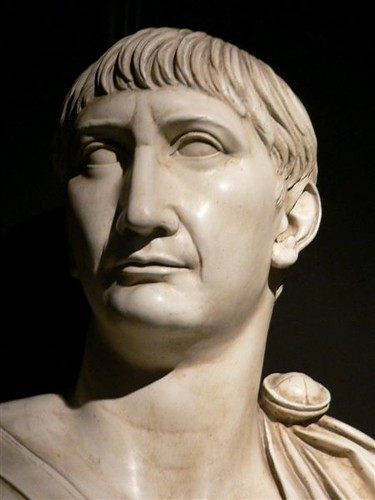
The Roman Emperor Trajan.
Photo by Mary Harrsch.


Pliny dives into this task wholeheartedly both in the novel and historically, as reflected in his first correspondence with the emperor Trajan upon his arrival:

"I am at present engaged in examining the finances of the Prusenses, their expenses, revenues, and credits; and the farther I proceed in this work, the more I am convinced of the necessity of my enquiry. Several large sums of money are owing to the city from private persons, which they neglect to pay upon various pretences; as, on the other hand, I find the public funds are, in some instances, very unwarrantably applied. This, Sir, I write to you immediately on my arrival. I entered this province on the 17th of September, and found in it that obedience and loyalty towards yourself which you justly merit from all mankind. You will consider, Sir, whether it would not be proper to send a surveyor here; for I am inclined to think much might be deducted from what is charged by those who have the conduct of the public works if a faithful admeasurement were to be taken: at least I am of that opinion from what I have already seen of the accounts of this city, which I am now going into as fully as is possible." - Pliny to Trajan, correspondence XVI.

Statue of Pliny the Younger on the façade of
Cathedral of S. Maria Maggiore in 
Como.
Photo courtesy of Wikipedia.
But, Pliny quickly learns that the local "Greeklings" have no affection for his diligence or any of their Roman caretakers.  So, when the latest procurator in charge of collecting taxes is found murdered, no one seems to want to cooperate in the investigation of his death.

Pliny begins piecing the clues together with the help of Gaius Suetonius Tranquillus.  Suetonius is often thought of as a gossip monger by modern scholars but he actually held a number of important posts in Roman administration and was Pliny's friend.  Although most famous for his literary work "The Twleve Caesars", at this point in his career Suetonius was working on a compilation of the lives of famous prostitutes, in his Pratum de rebus variis, a light natured work often referred to as the Playground.  So Suetonius' interest in the local prostitutes comes in handy when one of the clues leads Suetonius and Pliny to the wealthy madam of a local brothel.

They learn that the murder victim was a member of the mysterious cult of Mithras, the "Bull Slayer" of the novel's title.  With a doctorate in ancient history, Machain weaves the story artfully around what facts about the cult have been gleaned from the study of over 400 archaeological sites related to Mithraism.

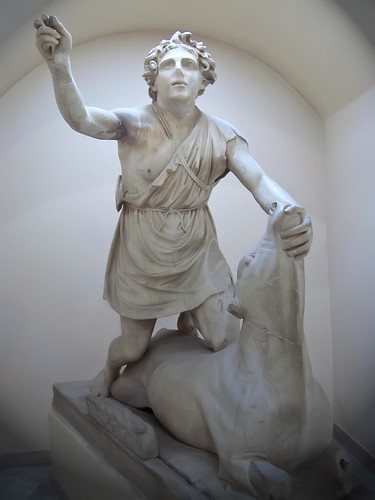
Roman sculpture of Mithras slaying the sacred bull from
a Mithraeum in Ostia Imperial Period 1st - 3rd centuries CE.
Photographed in Ostia Antica by Mary Harrsch.
"Archaeological finds indicate the extent of Mithraism included most of the Roman Empire, from Rome to Turkey to Britain. It was especially concentrated in Rome (35 Mithraic temples found) and its port of Ostia (15 temples). In total, over 400 archaeological find-spots related to Mithraism have been found, along with about 1,000 dedicatory inscriptions and 1,150 pieces of sculpture.

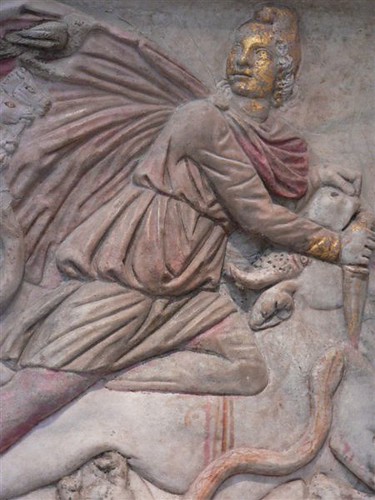
A gilded frieze depicting Mithras slaying the bull (known
as the Tauroctony) from a Mithraeum  in Rome.  Photographed
 at the Terme di Diocleziano  (National Museum) in Rome, Italy
 by Mary Harrsch.
"As in its Persian form, Roman Mithraism was a religion of loyalty, contracts and friendship between men, especially between officials and rulers. There are no known women followers of Mithraism. The cult was supported by several emperors, including Commodus (180-92), Septimius Severus (193–211), and Caracalla (211–17). As part of an effort at renewing the Roman empire, Diocletian dedicated an altar to Mithra in Carnuntum (on the Danube near Vienna) in 307, designating the god patron of their empire (fautori imperii sui)." - Mithraism

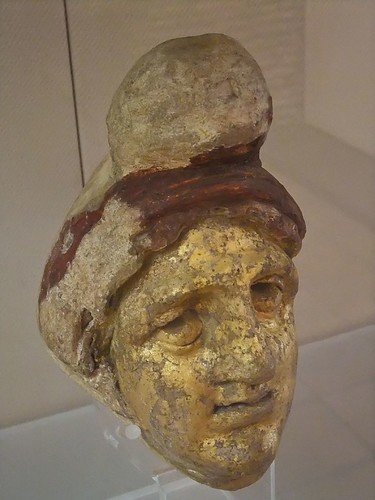
Gilt Head of Mithras found in the Mithraeum of
Castra Peregrinorum under Santo Stefano Rotondo
 2nd century CE.  Photographed by Mary Harrsch
at the  Terme di Diocleziano in Rome, Italy
The murder victim held the rank of Lion, one of the seven ranks known from frescoes in the Santa Prisca Mithraeum in Rome and the mosaic pavement of the Felicissimus Mithraeum in Ostia. As the plot unfolds we discover other members of this clandestine sect hold the ranks of  Soldier, Persian and "Sun-Runner" (Heliodromus).  The youngest initiates join the group with the rank of Raven and Machain imagines the mysterious initiation ceremony in one of the novel's opening scenes.

"Contemporary sources indicate this included ablutions (or baptism), purifications, chastisements, fetters and liberation, and ceremonial passwords. Frescoes at Capua (Italy) show the initiates blindfolded and kneeling. A simulated death and resurrection was probably part of the ceremony, as the ascent through the initiation grades was seen as prefiguring the ascent of the soul after death." - Mithraism

A reconstruction of a Mithraeum prepared for the communal meal at
Nijmegen, The Netherlands.  Photo courtesy of Wikipedia.


Tertullian tells us that the simulated death involved the refusal of a crown:

"The Christian author Tertullian sheds some light on intitiation to the third level, "Soldier," in a treatise about Christians refusing crowns in military service. He notes that a Soldier of Mithras, during his initiation in some gloomy cave, is presented with a crown at sword-point. He refuses it, saying that Mithras is his crown, and he never wears a crown after that." - Tertullian (c.200), On the Soldier's Crown 15.

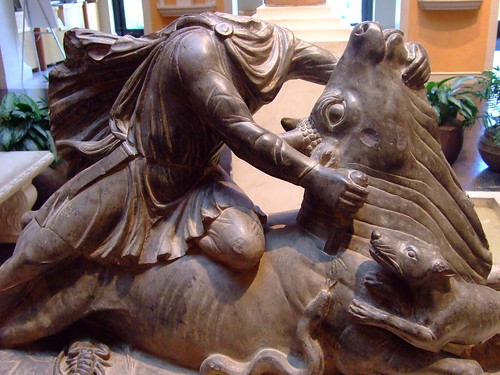
Pliny finds a book of astrology among the victim's possessions and assumes that joining the cult also involves the study of astronomy.  This is consistent with the beliefs of some modern scholars who have speculated that the typical iconography of Mithras slaying the bull found in Mithraic sites is an astrological allegory since Mithras is accompanied by a dog, snake, scorpion and raven, each representing astrological signs.

This fragmented sculpture of Mithras slaying the bull includes a dog,
snake and scorpion representing astrological signs.
Photographed at the Santa Barbara Museum of Art by Mary Harrsch.
So I found Machain's use of Mithraism as a plot point to be both entertaining and educational.

I only found one aspect of the novel troubling.  Machain uses Pliny's relatively young wife, Calpurnia, as  the foundation for a subplot.  Although the subplot was plausible, I had a hard time accepting that a proconsul's wife, and the level-headed and well educated Calpurnia in particular, could have become involved in something so foolish.  Her actions seemed to be more of a silly adolescent even though at this point in her life she was close to thirty years old.

One of the things I enjoy about Pliny's letters is his expressions of unabashed love for his wife.  Pliny clearly adored her in his letters.  One of the most poignant is his Letter LXXIV written to his wife while she is convalescing from a serious illness in Campagna.

"You will not believe what a longing for you possesses me.  The chief cause of this is my love; and then we have not grown used to be apart.  So it comes to pass that I lie awake, a great part of the night, thinking of you,; and that by day, when the hours return at which I was wont to visit you, my feet take me, as it is so truly said, to your chamber, but not finding you there, I return sick and sad at heart, like an excluded lover.  The only time that is free from these torments is when I am being worn out at the bar, and in the suits of my friends.  Judge you what must be my life when I find my repose in toil, my solace in wretchedness and anxiety.  - Pliny the Younger To Calpurnia, Letter LXXIV

Machain must have had this period of absence in mind when he was crafting the subplot although he applied a much darker undertone to the event than I would have preferred.  All marriages have their highs and lows but I would rather keep my vision of unblemished love between Pliny and Calpurnia that has endured through the centuries as revealed in the pages of his letters rather than replace it with a scene from a modern tabloid.

I assume Machain added this plot point to appeal to more female readers and maybe I am just a victim of my own streak of romanticism.

Nevertheless, Machain has once again produced an intriguing story filled with vibrant characters while, at the same time, providing a wealth of historical information about Rome in the second century CE.

Historically, Pliny disappears from the record while either in Bithynia or shortly after his return to Rome as no further correspondence between Pliny and his wide circle of friends has been found after this period leading scholars to believe he died at about the age of 50.  So, I'm unsure Machain will write another tale with Pliny at its core.  He leaves a few loose ends in "The Bull Slayer" that appear to be pointing to a sequel, though, so I am hopeful!


Enhanced by Zemanta
If you enjoyed this post, never miss out on future posts by following me by email!


Sunday, May 24, 2009

Will Underground Rome Be Visitor Friendly?


I'm glad more of "hidden" Rome is opening to the public - just unfortunate that it didn't happen by the time of my visit in March. I can't help but wonder, though, if these new visitor viewing opportunities are motivated more by commercial interest rather than a desire to share cultural heritage.

[Image: 2nd century CE guardroom. Image courtesy of Times Online]

I was dismayed by the number of "admission" gates that have sprung up all over Rome since my first visit in 2005. Even the Forum Romanum is gated now - the symbolic gathering place for the Res Publica since ancient times. I realize conserving antiquities is expensive but some efforts to milk the tourists have really gotten to the point of ridiculous. The new museum encompassing Trajan's market has but a handful of artifacts on display but commands an admission price equal to that of the Capitoline Museum. I guess they have to pay for the new glass-doored elevator that takes people down to the lower level of the market. But most of the market was visible from the street before and the new visitor viewing areas don't let you get much closer now. I was also disappointed with the Archaeobus. The sound system for the little ear buds was so poor you couldn't hear anything above the road noise. The bus careened through the streets at a speed that made appreciation of the drive a challenge. Buses were scheduled 30 minutes apart which made coordination difficult when tours of the catacombs themselves took 30 minutes, so by the time you emerged you just missed the next bus and had to spend a lot of time waiting. The buses did not stop at each venue. You had to be prepared to buzz the driver if you wished to disembark and, if no one was standing by the bus sign, the buses just roared by. I realize this is how city buses often operate but this method is not visitor friendly for tourists who don't know exactly where to get off or are participating in tours at some of the venues.

When I was in York several years ago, I used the hop-on hop-off bus there and enjoyed the convenience and the friendly conversation of the bus driver who pointed out historical sites along the way. The drivers watched for tourists who appeared to be headed for the bus stop even if they had not yet made it and waited a few minutes. The buses were also about 15 minutes apart so even if you missed one bus you didn't have to stand around too long waiting for the next. The operators of the Archaeobus would do well to discuss service issues with the operators of the hop-on hop-off bus in York.

"Visitors to Rome will soon be able to discover a world of ancient treasures beneath their feet when the city opens dozens of previously unseen underground sites to the public.

They include the Ludus Magnus, the barracks beneath the Colosseum where gladiators assembled before entering the great arena to meet their fate; the well-preserved necropolis of Santa Rosa at the Vatican, with tombs from the 1st to the 5th centuries, and pagan temples.

Tourists can also explore the frescoed 2nd century Temple of Mithras, the pagan cult, beneath the 17th Century Palazzo Barberini, which houses one of Rome’s foremost art collections.

Francesco Marcolini, the head of Zetema, the cultural foundation in charge of the project, said that next year 15 more underground sites would be added, including a Jewish necropolis in the grounds of Villa Torlonia, formerly the Rome residence of Benito Mussolini, the Fascist dictator.- More: Times Online


If you enjoyed this post, never miss out on future posts by following me by email!