Showing posts with label tourism. Show all posts

Wednesday, July 8, 2009

Rome opens House of the Gryphons and other restricted sites to summer visitors


In attempts to lure more tourists to the archaeological sites of Rome, the Italian government has managed to divert money normally spent on staff bonuses and special projects to security details to monitor public access to sites that have been closed to the public for decades. I just hope they allow people to take time to fully appreciate the remnants of ancient art on display.

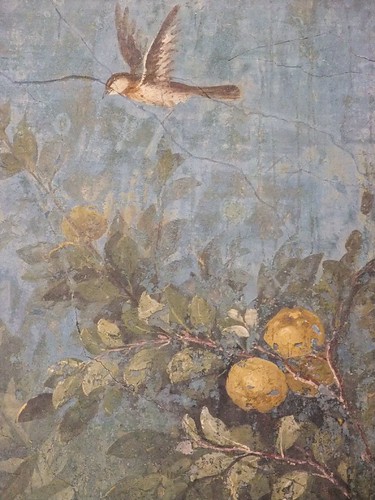
[Image - Mural from the triclinium of the Villa of Livia at Prima Porta, Roman, 1st century CE, exhibited at the Palazzo Massimo, Museo Nazionale Romano, Rome, Italy. Photograph by Mary Harrsch]

When I visited the newly excavated rooms of the Villa of Augustus on the Palatine Hill this spring, I had to stand in a long queue only to be hustled through the viewing area for the rooms, which were sealed off with glass, and denied the opportunity to photograph anything even without a flash. I could not fully appreciate the detail of the frescoes or anything else with such a quick glance. I had intentionally looked for the Egyptian motifs that I had seen discussed on a History Channel presentation but could not readily identify them without more time to examine the frescoes more carefully. I imagine the visitors who came in the height of tourist season would have been given even less time to make the tightly controlled circuit through the remains with queues probably four times as long.

At least I was able to take all the time I wanted to examine and photograph the beautiful garden frescoes that once adorned the subterranean triclinium of the Villa of Livia now displayed in the Palazzo Massimo venue of the Museo Nazionale Romano (see image above left). I had a special low-light camera with me this time so was able to take a number of detail images of the lush foliage, flowers, fruit trees and birds that comprise that stunning work. The totally encompassing painting must have truly soothed the empress' guests with its pastoral calm. I would have loved to have toured the villa itself.

Among the attractions that await visitors is the House of Livia, once the home of the wife of the emperor Augustus. The two-story structure has been closed for more than two decades, but until October it will be open every Tuesday.

Buried under the ruins of the Domus Flavia, built by Nero and Domitian, are the remains of the so-called House of Gryphons, one of the most important residences of Republican Rome. Excavated in 1912, it is virtually unknown outside academic circles. It too is now open on Tuesdays.

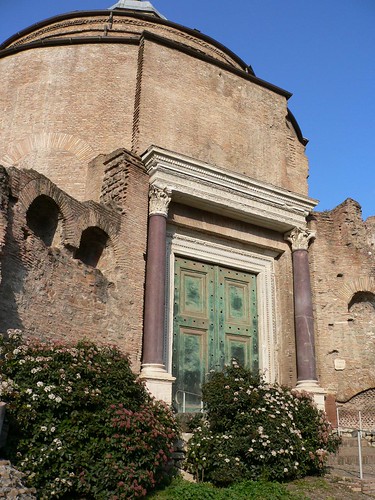
Behind its massive original bronze doors, the misnamed Temple of Romulus in the Roman Forum (it was probably the Temple of Jupiter Stator) shows evidence of the gradual merging of pagan religions with the Christian usurper. Like the so-called Oratory of the 40 Martyrs, decorated with eighth-century frescoes of soldiers who perished in frozen waters in Armenia, the temple is now open on Fridays.

[Image - Temple of Romulus in the Forum Romanum. Photo by Mary Harrsch]

One relatively modern attraction is the Loggia Mattei, which dates from the Renaissance, when some aristocratic families colonized the Palatine with landscaped gardens and small villas, often absorbing Roman ruins. Frescoes from a hall dedicated to the cult of Isis, the Egyptian goddess, have been brought here from another site on the Palatine. The loggia, built in the 16th century, was briefly open in 1997, Ms. Tomei said, “but even then we didn’t have enough custodians. Since then it’s fallen into oblivion.”

The ancient frescoes abut the newer loggia, which was painted by the workshop of Baldassare Peruzzi with mythological scenes. The decoration includes 12 roundels with signs of the Zodiac, panels that belong to the Metropolitan Museum of Art in New York. - More: New York Times
If you enjoyed this post, never miss out on future posts by following me by email!


Sunday, May 24, 2009

Will Underground Rome Be Visitor Friendly?


I'm glad more of "hidden" Rome is opening to the public - just unfortunate that it didn't happen by the time of my visit in March. I can't help but wonder, though, if these new visitor viewing opportunities are motivated more by commercial interest rather than a desire to share cultural heritage.

[Image: 2nd century CE guardroom. Image courtesy of Times Online]

I was dismayed by the number of "admission" gates that have sprung up all over Rome since my first visit in 2005. Even the Forum Romanum is gated now - the symbolic gathering place for the Res Publica since ancient times. I realize conserving antiquities is expensive but some efforts to milk the tourists have really gotten to the point of ridiculous. The new museum encompassing Trajan's market has but a handful of artifacts on display but commands an admission price equal to that of the Capitoline Museum. I guess they have to pay for the new glass-doored elevator that takes people down to the lower level of the market. But most of the market was visible from the street before and the new visitor viewing areas don't let you get much closer now. I was also disappointed with the Archaeobus. The sound system for the little ear buds was so poor you couldn't hear anything above the road noise. The bus careened through the streets at a speed that made appreciation of the drive a challenge. Buses were scheduled 30 minutes apart which made coordination difficult when tours of the catacombs themselves took 30 minutes, so by the time you emerged you just missed the next bus and had to spend a lot of time waiting. The buses did not stop at each venue. You had to be prepared to buzz the driver if you wished to disembark and, if no one was standing by the bus sign, the buses just roared by. I realize this is how city buses often operate but this method is not visitor friendly for tourists who don't know exactly where to get off or are participating in tours at some of the venues.

When I was in York several years ago, I used the hop-on hop-off bus there and enjoyed the convenience and the friendly conversation of the bus driver who pointed out historical sites along the way. The drivers watched for tourists who appeared to be headed for the bus stop even if they had not yet made it and waited a few minutes. The buses were also about 15 minutes apart so even if you missed one bus you didn't have to stand around too long waiting for the next. The operators of the Archaeobus would do well to discuss service issues with the operators of the hop-on hop-off bus in York.

"Visitors to Rome will soon be able to discover a world of ancient treasures beneath their feet when the city opens dozens of previously unseen underground sites to the public.

They include the Ludus Magnus, the barracks beneath the Colosseum where gladiators assembled before entering the great arena to meet their fate; the well-preserved necropolis of Santa Rosa at the Vatican, with tombs from the 1st to the 5th centuries, and pagan temples.

Tourists can also explore the frescoed 2nd century Temple of Mithras, the pagan cult, beneath the 17th Century Palazzo Barberini, which houses one of Rome’s foremost art collections.

Francesco Marcolini, the head of Zetema, the cultural foundation in charge of the project, said that next year 15 more underground sites would be added, including a Jewish necropolis in the grounds of Villa Torlonia, formerly the Rome residence of Benito Mussolini, the Fascist dictator.- More: Times Online


If you enjoyed this post, never miss out on future posts by following me by email!