Thursday, February 19, 2015

Did Claudius die accidentally of poison mushrooms or marital treachery?


A history resource article by  © 2015

Bust of the Roman Emperor Claudius
Photographed at the Museo Archaeologico
Nazionale di Napoli in Naples, Italy
by Mary Harrsch © 2007
Note: This is a crosspost of an article originally posted to my other historical blog "History's Medical Mysteries".

"He ate and drank in excess regularly, rarely leaving his dining room until he was "stuffed and soaked". This caused him to gain considerable weight in later years and produced heartburn so severe that it is reported that he contemplated suicide as his only means of relief."

Thus begins a study to determine what may have caused the Roman Emperor Claudius' death as a clinical exercise at a 2001 clinical pathologists' conference at the University of Maryland School of Medicine. Each year, a team of practicing pathologists and historical consultants select a famous individual from the past whose manner of death remains speculative and attempts to derive a definitive cause of death.

Claudius' case is examined by Drs. William A. Balente, MD, Richard J. A. Talbert, PhD, Judith P. Hallett, PhD and Philip K. Mackowiak, MD.

The researchers continue:

"Born prematurely after only 7 months of gestation, he suffered from a succession of disorders including milk allergy, malaria, measles, deafness, and colitis. He suffered from weakness in both legs to the extent that he noticeably limped and could not walk more than a short distance without assistance. He had longstanding tics and jerks of his head and hands, as well as a stammer and drooling, which were most pronounced when he was excited. He was also prone to fits of inappropriate laughter."

Claudius cowers behind a curtain after the murder of his younger brother,  the
Roman emperor Gaius (Caligula) Caesar.  He is astonished when the Praetorian
Guard declare him Emperor instead of murdering him as well.  "A Roman
Emperor AD 41" by Sir Lawrence Alma-Tadema courtesy of Wikimedia.
"A physical examination revealed that his temperature was normal butt his abdomen was mildly tender throughout."

"An attending physician induced additional vomiting by placing a feather in the back of the patient's throat. Shortly thereafter, the emperor became confused and exhibited signs of unremitting abdominal pain and fecal incontinence. He died 12 hours later."

Was it a case of the "cure" being worse than the disease? (PDF of original article reprinted with permission)

Although the team ends up suspecting that a particular variant of mushroom was a contributor to Claudius' death, surprisingly, the researchers point to Claudius' existing physical disabilities as the reason the episode is ultimately fatal.  In fact, the researchers suspect if Claudius had not be otherwise impaired, the assassination attempt probably would have failed.

I found Dr. Valente's  discussion of possible causes of Claudius' long list of physical defects to be most interesting.  He eventually arrives at a conclusion that Claudius suffered from congenital dystonia caused by abnormal basal ganglia - brain cells interconnected with the cerebral cortex, thalamus, and brainstem - the result of an extremely premature birth. Typical of this disorder, Claudius suffered from a twisting of the foot, involuntary cranial and cervical muscle contractions, an inability to control salivation at times and hypertrophy of the neck muscles as seen in some of his portrait sculptures.  Claudius' excellent cognitive function, however, enabled the researchers to eliminate a number of other conditions.


If you enjoyed this post, never miss out on future posts by following me by email!


Fluorosis a problem in ancient Palmyra and Herculaneum

A history resource article by  © 2015

The great archway leading to the grand collonade in Roman Palmyra.  Image
courtesy of Wikimedia Commons.
Note: This is a crosspost from my blog "History's Medical Mysteries".

A 2006 study by researchers at Kyushu University suggests residents of ancient Palmyra may have suffered from fluorosis, a chronic condition caused by excessive intake of fluorine compounds, marked by mottling of the teeth and, if severe, calcification of the ligaments.

Palmyra, today, is a World Heritage Site, a designation bestowed by the United Nation Educational, Scientific and Cultural Organization (UNESCO) in 1998. About 140 miles southeast of Damascus, the trading town once known as Tadmor (also spelled Tadmur) to the ancients, had been a center of trading since around 2000 B.C.E. But the town really bustled during the Roman Empire, and was filled with magnificent buildings throughout the 1st and 2nd century, beginning with the reign of Roman emperor Hadrian in 129 A.D. Hadrian renamed the oasis town "Palmyra Hadriana." But, the city's wealth faded with the decline of Roman influence in ancient Syria.

Starting in 1990, Japanese archaeologists began excavating the southeast necropolis of Palmyra and examined remains from the Roman era dating to the 2nd and 3rd centuries CE. Despite Palmyra's prosperity, "skeletal remains uncovered from the underground tombs of Palmyra have been found to retain an arthropathy of the joints, especially in the knee joint, bone fracture, marked bone lipping, spur formation, and eburnation (smoothed bone cavities)," reports the team led by Kiyohide Saito of the Archaeological Institute of Kashihara in the Journal of Archaeological Science. "A brown discoloration was also observed in the teeth."

Funerary Portrait of Yarkhai, Son of Ogga and Balya his Daughter
from Palmyra in Roman Syria 150-200 CE Limestone.  Photographed at the
Portland (Oregon) Art Museum by Mary Harrsch © 2012.
Fluoride in small concentrations is thought to deter microbes that cause tooth decay, the reason why about 66% of public water supplies in the United States are now fluoridated, according to the federal Centers for Disease Control and Prevention. But the Palmyrans' skeletal pathology, along with their discolored teeth, point to "fluorosis," a skeletal and enamel-damaging syndrome caused by ingesting too much fluoride over a long time, the researchers note. Looking at two large tombs for example, 25 of 33 individuals (76%) had discolored teeth in one, and 45 out of 65 (69%) had discolored teeth in the other.

Palmyrans drank, and still drink, water from wells tapped from ground water by long tunnels called "qanats" (an excellent Scrabble word). The area's geology and water table has been stable for about 7000 years, meaning water conditions now aren't greatly different from those during Roman times. In a bid to estimate the fluoride burden suffered by the town's ancient inhabitants, the researchers analyzed the water from these wells. Fluoride levels were as high as three parts per million in the water, a level that a National Academy of Sciences report in March warned could lead to fluorosis.

Archaeologists also ground up seven discolored teeth from tomb inhabitants, and compared them to seven others without discoloration, to reveal their fluoride concentration. In a chemical reaction, fluoride tends to replace some calcium in tooth enamel, making overexposure to fluoride particularly worrisome for children with growing teeth and bones. The ground-up teeth revealed that in the most discolored ones, about 22% of the calcium had been replaced by fluoride. "Thus, it was possible to directly verify that the ancient inhabitants of Palmyra did suffer from fluorosis," they conclude.

Vesuvius still hovers threateningly over the remains
of Herculaneum near Naples, Italy.
Photo by Mary Harrsch © 2007.
But, ancient Romans in Palmyra were not the only ancients to suffer from fluorosis. In 1981, when skeletal remains of victims of the Vesuvius eruption were found in the boat chambers on the shore of Herculaneum, researchers were provided with another opportunity to study dental conditions of Roman residents in a different ancient setting. In The Lancet, researchers Gino Fornaciari, M. Rognini and M. Torino reported finding only 3.8% of teeth recovered from 41 adults and 12 children damaged from tooth decay.

"This percentage is very low for both modern and ancient populations, in which values were between 8.5%, as in classic Magna Graecia and 11.4%, as in Roman Britain," the researchers stated.

However, the researchers also discovered a high percentage of individuals with calcium-deficient tooth enamel - a condition often resulting from starvation at an early age but also found in well-nourished individuals suffering from fluorosis.

"To elucidate this hypothesis, we examined thin sections of permanent teeth enamel (first molar) from 8 individuals found in the Herculaneum arches site and from a present-day patient from Pisa without evidence of fluorosis, as control," the researchers explained, "Enamel was analysed by energy dispersion system (EDS) with an SEM (Jeol) 6400 connected to a microanalysis system (EDS) (Noran-Tracor) with a detection of Z-MAX 30. Enamel fluorine concentrations were greater than 10-fold higher than normal (1500-3600 parts per million [ppm]) were recorded in 6 individuals."

Skeletal remains of 32 victims awaiting evacuation in the boat chambers of
Herculaneum.  Image courtesy of Tom Huesing via Flickr.
However, the condition was not found uniformly throughout all individuals in the sample and no fluorine was found in soil samples. But, researchers did find a strong concentration of fluorine in the water-bearing stratum of Herculaneum (3-8 mg/mL), with a calculated intake of 11.4-19.0 mg a day per person at the time of the volcanic eruption.

Researchers concluded that some of the sampled remains may have been visitors to the area, since the Roman aristocracy maintained vacation villas in the area.

References:

Torino, M., Rognini, M., & Fornaciari, G. (1995). Dental fluorosis in ancient Herculaneum. The Lancet, 345(8960), 1306. doi:10.1016/s0140-6736(95)90952-4

Yoshimura, K., Nakahashi, T., & Saito, K. (2006). Why did the ancient inhabitants of Palmyra suffer fluorosis? Journal of Archaeological Science, 33(10), 1411-1418. doi:https://doi.org/10.1016/j.jas.2006.01.016


If you enjoyed this post, never miss out on future posts by following me by email!


Sunday, February 1, 2015

Review: Hero of Rome by Douglas Jackson

A historical fiction review by  © 2015

When I first met Gaius Valerius Verrens in the opening chapters of "Hero of Rome" by Scottish author Douglas Jackson, he was leading his cohort into a Silurian hill fort bristling with Celtic spears on a hilltop in Nero's Roman Britain.  In this first novel of a new series, Jackson skillfully fleshed out his new protagonist with a backstory that included tutelage by the famous philosopher Seneca, a deep sense of honor instilled by his patrician father and a warrior's courage developed over his course of service with the XXth Legion.  It was also quickly apparent that Valerius was respected by his men because he, in turn, respected them - all except a particularly nasty centurion named Crespo, who would eventually create the flashpoint for Boudicca's famous revolt.

I had not read any summaries of the novel before I started listening to this tale (this review is based on an unabridged performance recorded for Audible.com) but I immediately knew what was going to happen to Valerius when he is sent with his cohort to winter in Colonia - Camulodunum - the scene of the first massacre of the Boudiccan Revolt.  Knowing this was a first novel in a new series, however, I just wasn't sure how Jackson would extract Valerius so he could fight another day, as the Celtic destruction of Camulodunum was quite complete according to the ancient sources and evidenced by the destruction layer found by archaeologists.

When Valerius arrives in Colonia, he finds the thriving town, then capital of Roman Britain, protected by rather aged and grizzled Roman veterans from the original invasion of the island by the emperor Claudius, equipped with rusty swords and disintegrating armor.  Falco, the veteran centurion, quickly demonstrates how tough his men can be, however, when he challenges Valerius' men to a shoving match.  Valerius also meets the local Trinovantes chieftain, Lucillus, who is trying so hard to be accepted as an equal to the other Roman residents.  Then, Valerius is instantly captivated by the chieftain's auburn-haired daughter, Mave, and begins a subtle campaign to win her heart.

Again, Jackson carefully sculpts these characters to bring them to life for the reader.  I especially liked Ciaran, an Iceni nobleman who already realized there was little hope of actually defeating the Romans so was trying his best to develop a peaceful relationship with them.

But these first attempts at reconciliation are thwarted when the greedy Roman procurator, Catus Decianus, attempts to seize all of the Iceni land when the Iceni King, Prasutagus, dies.  Leading Romans, including Seneca, had also suddenly recalled loans to the British elite resulting in brutal property seizures, just as portrayed in the novel.

Seneca by Joseph Wilton.  Photographed at the
J. Paul Getty Museum by Mary Harrsch © 2005.

Decianus, the provincial procurator of Roman Britain,  is said to have been based in Colonia at the time of the revolt but the ancient sources said he "sent" only 200 men when he received the town's plea for help, so scholars assume he must have been in Londinium at the time.  This is reflected in the novel as well. The depth of Douglas' research is obvious from the narrative's detail.

Although Decianus is villified as greedy, both in the novel and in the ancient sources, his failure to recognize any claim by Boudicca was not unusual. Both H. H. Scullard, in his 1982 work "From the Gracchi to Nero", and John Morris, in his 1982 work "Londinium: London in the Roman Empire", point out that it was normal Roman practice to allow allied kingdoms their independence only for the lifetime of their client king, who would then agree to leave his kingdom to Rome in his will. This occured in the eastern provinces of Bithynia and Galatia.  Roman law also allowed inheritance only through the male line, so Rome would not normally have allowed the ascension of a client queen.  Boudicca may have thought otherwise, however, due to the Roman support of the Brigantes queen, Cartimandua.  Of course the flogging of Boudicca and the subsequent alleged rape of her daughters was obviously over the top.

Statue of Boudicca near Westminster Pier as commissioned by Prince Albert and
executed by 
Thomas Thornycroft
 in 1905. Image by Mary Harrsch © 2006

Jackson handles this brutal event with sufficient detail to dismay the reader but does not appall the reader with excessive gore. Likewise, Jackson's battle scenes are absolutely taut with tension.  At times I felt as emotionally spent afterwards as Valerius must have been.

By the climax of the battle at Colonia where Valerius struggles shoulder to shoulder with his comrades to prevent the wildly shrieking Britons from storming the temple of Claudius, I felt such a bond with Valerius that I feared the inevitable - after all, I had read the history!

The Temple of Claudius in Camulodunum was beseiged by the Britons for
two days before it fell and defenders were massacred.
Ultimately, though, Jackson succeeds at believably extracting Valerius from the jaws of death, but at a terrible price, both physically and emotionally, leaving an imprint on his character that will obviously affect his behavior in subsequent novels.

I highly recommend this novel and have become so captivated by Valerius I have already started the second book, "Defender of Rome."

If you enjoyed this post, never miss out on future posts by following me by email!


Monday, December 29, 2014

Review: The Seven Wonders by Steven Saylor

An historical fiction review by  © 2014

I know Steven Saylor's "The Seven Wonders" came out in 2013 but my "to-read" stack has gotten so tall, I am a bit overwhelmed and only just now finally got a chance to read it.  (Listen to it actually, as I have the unabridged version from Audible.com) Several of us on Facebook's Roman History Reading Group had suggested to Steven that he go back and write more stories about Gordianus the Finder when Gordianus was a young man.  So, I was pleased to see that is exactly what he did with "The Seven Wonders."

Gordianus, the son of Gordianus the Finder (the elder) has just turned 18 and his old tutor Antipater of Sidon, an acclaimed poet, has invited him to go on a grand tour of the Seven Wonders of the Ancient World.  But first, Gordianus the younger and his father must participate in a charade where they arrange the "death" and funeral of Antipater before the journey.  Even after reading the entire book, I'm still not sure why Antipater requested this.  But, the funeral is held and young Gordianus and Antipater, now calling himself Zodicus or Zeugma, slip out of Rome without being recognized.

The first stop is Ephesus where the pair will explore the famous Temple of Artemis.  While in Ephesus, Gordianus gets involved in a local plot designed to discredit local politicians who support Rome.

1st century CE Roman copy of
the cult statue in the Temple of Ephesus
Image courtesy of
 
Pvasiliadis, Wikimedia Commons
Of course, Gordianus solves the mystery using his own natural instincts coupled with lessons in investigation that he learned from his father.  Then, Gordianus and Antipater move on to the next wonder where another mystery awaits.

So the book is like an anthology of short mysteries with the overarching narrative of a travelogue.  Each little mystery is intriguing but what I enjoyed the most was the intricate description of each wonder in the condition it must have been in during the 1st century BCE.  Saylor describes each structure so vividly I felt like I had personally visited it and seen it for myself.

As it turns out, Antipater of Sidon was a real Greek poet that lived either during the second half of the 2nd century BCE or, according to Cicero, in Rome during the time of Crassus and Catulus.  Some scholars think Cicero confused Antipater of Sidon with Antipater of Thessalonice.  But, for the purposes of this novel, Saylor uses Cicero's Antipater of Sidon. Antipater of Sidon, along with Philo of Byzantium, Strabo, Herodotus and Diodoros of Sicily are attributed with developing the list of the Seven Wonders of the Ancient World.

In the book, though, Antipater credits Alexander the Great who he said developed the list to prove that his kingdom encompassed the greatest structures in the world.  Antipater also explains the sacred significance of the number seven.

However, as I read the book, I must admit I became baffled when Gordianus and Antipater reached the Great Pyramid and proclaimed they had seen all seven since they had not yet traveled to Alexandria and seen the Pharos.  But as it turns out, Antipater's Anthology never included the famous lighthouse as we see from his poem:

I have set eyes on the wall of lofty Babylon on which is a road for chariots, and the statue of Zeus by the Alpheus, and the hanging gardens, and the Colossus of the Sun, and the huge labour of the high pyramids, and the vast tomb of Mausolus; but when I saw the house of Artemis that mounted to the clouds, those other marvels lost their brilliancy, and I said, 'Lo, apart from Olympus, the Sun never looked on aught so grand.'  — Antipater, Greek Anthology IX.58

So, Antipater counted the remains of the beautifully enameled walls of Babylon and the Hanging Gardens, only remembered from tales by the time of Gordianus, as two wonders.

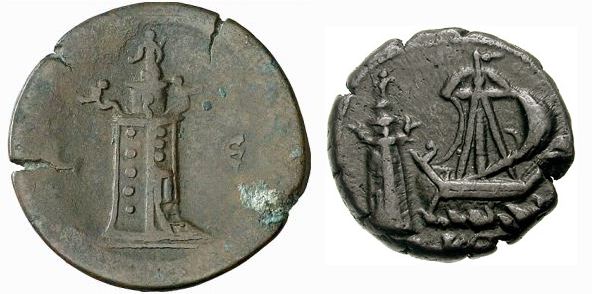
I didn't miss out on a thorough description of the Pharos in Alexandria, though, because Gordianus and Antipater have their last adventure there.  I knew the lighthouse had three tiers but I had always thought the Pharos contained only one great mirror, not a series of mirrors that could be redirected to transmit coded messages from Ptolemy to his subordinates as well as guide ships entering the harbor.  But I have never read the original descriptions by Arab authors that are said to be the most thorough and consistent.

The Pharos depicted on a coin from the reigns of Antoninus Pius
and Commodus.  Image courtesy of Wikimedia Commons.
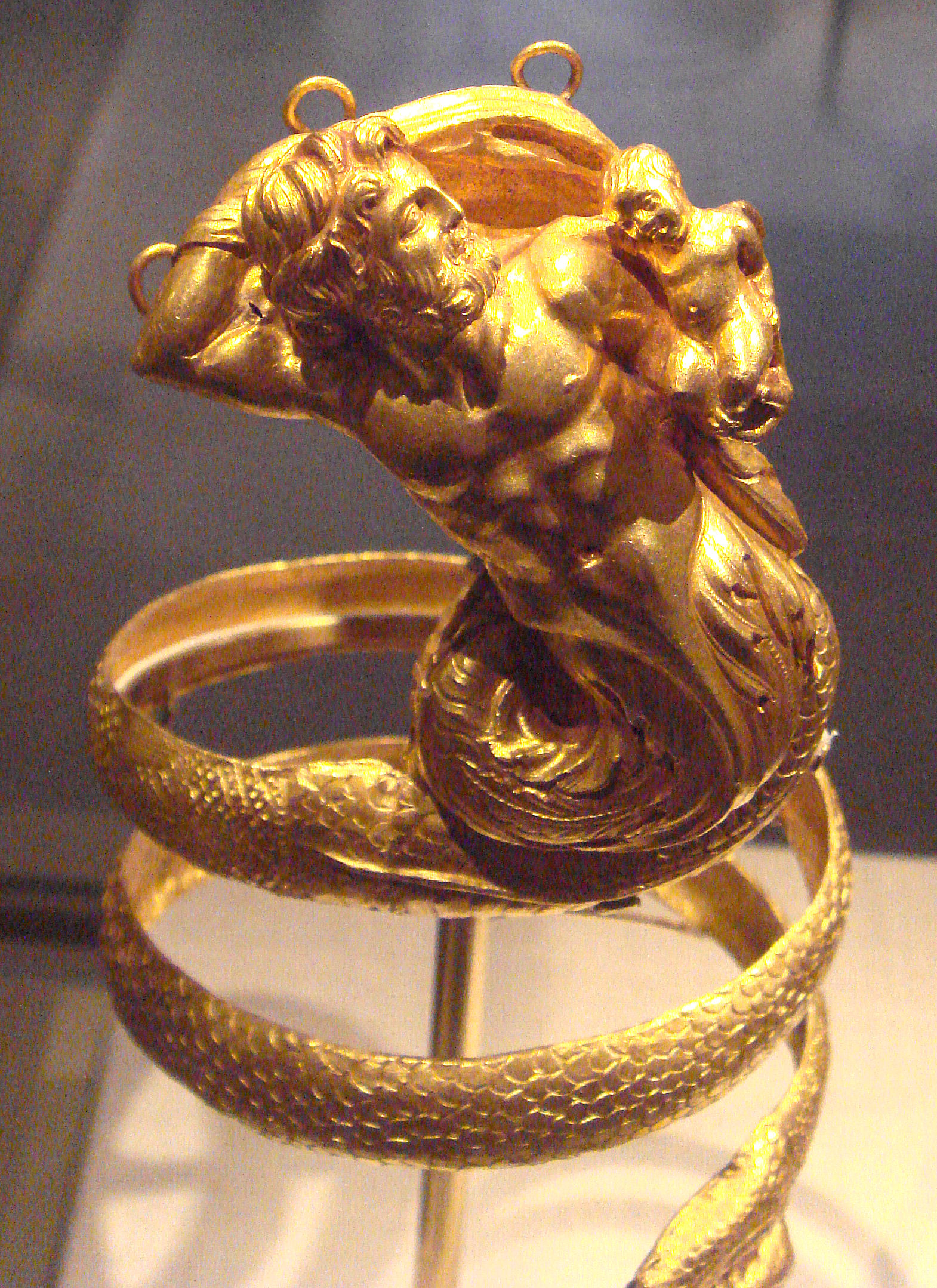
Saylor's description of the lighthouse included Tritons on each of the structure's four corners that are depicted on extant Roman coins struck by the Alexandrian mint and a statue of Zeus at the very top.  In the novel, Antipater explains that it is definitely Zeus, not Poseidon, the god of the seas, because Zeus is considered the protector of sailors.

Gold armband, with Triton holding a Putti,
Greek, 200 BCE.  Photographed at the
Metropolitan Museum of Art courtesy of
Wikimedia Commons.
So, like all of Steven Saylor's novels, "The Seven Wonders" taught me more fascinating details about the ancient world while thoroughly entertaining me.

It made me sorry I haven't seen the last surviving ancient wonder, though.  I postponed my trip to visit the Great Pyramid due to the political unrest following the Arab Spring in Egypt. But I will certainly have Steven's description in my mind if I finally get there.  At least I have seen the beautifully enameled creatures that once flanked the Ishtar Gate in Babylon at the Oriental Institute at the University of Chicago and the remains of the famous Mausoleum of Halicarnassus at the British Museum (until I visited the British Museum I didn't even realize there was anything left of the Mausoleum!).

Vibrant Striding Lion from the Processional Way of Babylon
Neo-Babylonian Period 604-562 BCE Molded and glazed brick
Photographed at the Oriental Institute of the University of Chicago
by Mary Harrsch © 2009
There's also a replica of the Parthenon with a huge statue of Athena (not Artemis but close!) in Nashville, Tennessee that I found quite impressive several years ago.

Multistory statue of Athena in a replica of the
Parthenon in Nashville, TN.  Photo by Mary Harrsch.
 I think even Antipater of Sidon would have agreed, too!

If you enjoyed this post, never miss out on future posts by following me by email!


Tuesday, November 4, 2014

Review - Soldier of Rome: The Legionary by James Mace

A history resource article by  © 2014

The first book in James Mace's Artorian Chronicles opens during the dramatic final moments of the disastrous ambush in Teutoburger Vald when Germanic tribes under the leadership of one-time Roman auxiliary officer, Arminius, wipe out the 17th, 18th and 19th legions of the first Roman emperor Augustus.  A few desperate survivors struggle through boggy marshes trying to rejoin their unit and defend their last few brethren from sacrifice to the barbarian's blood thirsty gods.

Ambush in Teutoburger Wald courtesy of Total War: Rome II by Creative Assembly
The scene changes and we meet a young Roman boy named Artorius who lives happily on his father's farm near Ostia.  His father, once a Primus Pilus in the legions, was grievously wounded and forced to retire.  But, he takes pride in his older son, Mettelus, who serves with the legions in Germania. Artorius, too, is fiercely proud of his older brother and dreams of joining the legions one day himself.
Then word arrives that Mettelus died heroically saving his Centurion at Teutoburger Vald. Artorius is crushed and vows to take revenge on the Germanic barbarians that took his brother's life.  He trains diligently to strengthen his body so he will be ready to join the legions when he assumes his manly toga.

1909 depiction of the defeat of Arminius' victory at Teutoburger Wald by Otto Albert Koch.
Image courtesy of Wikimedia Commons.
The day finally arrives for Artorius to enlist.  His father has signed the necessary documents and written a letter of introduction.  Artorius reports to the recruiting station in Ostia and soon finds himself on the way to Germania.

As Artorius undergoes training in basic weapons usage and close combat, the reader has the opportunity to learn about the proper handling and deployment of a pilum (Roman javelin), the movements to overcome the longer barabarian swords with the short, stabbing gladius and how the scutum, the distinctive rectangular shield, is maneuvered to batter an opponent or slice an enemy with its edge.

Artorius is also given instruction in the operation of siege weapons like the onager, a type of Roman catapult, and scorpion, a kind of automated cross bow.

The onager allowed the Romans to employ
fairly large projectiles at relatively long range.
It fired not only solid projectiles, but also a form
 of grapeshot made from smaller stones baked
in a clay ball. - Howtobuildcatapults.com


Artorius discovers that a childhood friend, Pontius Pilate, is one of the legion's artillery officers.  I thought that this was interesting as there is little information about Pilate's early military career. However, in the Russian satire, The Master and Margarita by Mikhail Bulgakov, it is mentioned that Pontius Pilate fought in Germania during this period.

Mace vividly describes life as a legionary recruit, including their daily chores like  cooking  a breakfast of wheat cakes and bacon, as well as daily visits to the bath house.  Artorius makes friends of the other seven men in his tent and meets his instructors, centurions and commanding officers, so we also learn about their pasts, their motivations and any ambitions they may have.  Mace does an outstanding job of characterization and clearly his own military experience has given him insight into the development of comradery within a fighting unit.

Finally, Artorius is sworn into the Legio XX Valeria Victrix 2nd cohort as a full fledged legionary. But, his comrades and training officers are concerned about his anger over his brother's death and desire for revenge.  This becomes apparent during the first raid on a Germanic village when Artorius wounds a barbarian then, rather than giving the man a quick death, grinds a flaming torch into his face.

As the novel progresses, Artorius' legendary commander, Germanicus, leads the army of the Rhine on a vicious campaign of revenge against the Cherusci, the tribe of the traitor Arminius, as well as their allied tribes.  This campaign historically occurred between 14 and 16 CE.  Mace handles the battle sequences very well and you hear, see and smell combat from the viewpoint of those fighting in the front ranks, both Roman and German.

1st century CE portrait of legendary commander
Germanicus at the Palazzo Massimo in Rome, Italy.
Image by  © 2009
Artorius also helps recover the remains of the earlier Varian disaster, tracing the final struggle described by a surviving Centurion to his brother, giving his brother proper burial and releasing his shade to eternal rest.

Gravestone of Marcus Caelius, 1st Centurion of the
18th legion killed in Teutoburger Wald at the age
of 53.  Image courtesy of Wikimedia Commons.
The final battle at Idistaviso on the banks of the Weser River was not only riveting but an excellent description of Roman battle tactics employing infantry, cavalry and both types of Roman artillery. Although Tacitus gives us a general outline of the battle, Mace filled in the details quite expertly. Finally, Artorius' desire for revenge is more than sated as the legions slaughter thousands  (10,000-20,000 according to Tacitus).

Mace has obviously done extensive research in preparation for this novel and rarely deviates from the historical record.  One exception I noticed was Artorius kills Arminius' uncle, Inguiomerus, in the final battle of Idistaviso and garners his first silver torq for valor.  But, both Arminius and Inguiomerus escaped the battle of Idistaviso.

Although the famous monument to Arminius in
North Rhine-Wesphalia, Germany depicts the
Cherusci war leader as bearded and mustached,
this portrait bust shows him clean shaven.  If this
bust is properly identified, it may depict Arminius
while he was an auxiliary Roman commander.

Tacitus says, "As for Inguiomerus, who flew hither and thither over the battlefield, it was fortune rather than courage which forsook him." (Tacitus, Book 2.21)

I see how this somewhat vague statement gives Mace an opportunity to interpret Inguiomerus' loss of fortune on the battlefield.  However, as I read Tacitus further I found that Inguiomerus could not have been killed, because Tacitus tells us he later deserted Arminius in a war with Maroboduus, king of the Marcomanni.

"For when the Romans had departed and they were free from the fear of an invader, these tribes, according to the custom of the race, and then specially as rivals in fame, had turned their arms against each other. The strength of the two nations, the valour of their chiefs were equal. But the title of king rendered Maroboduus hated among his countrymen, while Arminius was regarded with favour as the champion of freedom." 
"Thus it was not only the Cherusci and their allies, the old soldiers of Arminius, who took up arms, but even the Semnones and Langobardi from the kingdom of Maroboduus revolted to that chief. With this addition he [Arminius] must have had an overwhelming superiority, had not Inguiomerus deserted with a troop of his dependants to Maroboduus, simply for the reason that the aged uncle scorned to obey a brother's youthful son." - Tacitus, The Annals, Book 2.44-45 
Modern statue of Roman historian Tacitus at
the parliament building in Vienna, Austria.
Image courtesy of Wikimedia Commons.
However, for the purposes of drama, Mace's choice increased the esteem for the young legionary in the eyes of his comrades (important for subsequent novels) and was not disruptive to the main historical events that occurred in the narrative.

I recommend this novel not only for entertainment but as an excellent introduction to what life was like for a common soldier in the legions (so many other novels are written from the command perspective instead),   I also definitely look forward to reading the other books in this series. That is actually a pretty tall order in itself as James Mace is such a prolific author he has penned twelve books since publishing The Legionary in 2006 and only retired from a full-time career in the U.S. Army National Guard just three years ago.  Although he has now branched out into writing books about the Napoleonic Wars and the Anglo-Zulu War of 1879, he has not abandoned ancient Rome entirely and just released book 2 of a new trilogy about the Roman-Jewish War of 66 to 73 CE. 
If you enjoyed this post, never miss out on future posts by following me by email!