Showing posts with label Athens. Show all posts

Sunday, June 13, 2021

The Scythian Police Force of Athens in the 6th-4th centuries BCE

The Scythian archers, called taxotai, were a hypothesized police force of 6th-, 5th- and early 4th-century BCE Athens that is recorded in some Greek artworks and literature. The force is said to have consisted of 300 armed Scythians (a nomadic people living in the Eurasian Steppe) who were public slaves in Athens. They acted for a group of eleven elected Athenian magistrates who were responsible for arrests and executions and for some aspects of public order in the city including the Assembly and the Council. Their number is said to have swelled to 1,200 at some point, so they may have also been involved in wartime conflicts as well.

Scholars agree that a Scythian police force of some sort existed in Athens in the 5th century BCE and possibly as early as the 6th century BCE, although no one knows when it was first established or how long it lasted. Swiss archaeologist Balbina Bäbler points to 4th century BCE grave steles including the stele of Getes as well as buried Scythian arrowheads as evidence of their continued existence at that time but admits it is impossible to know whether these Scythians represent a continuation of the police force known earlier or whether Scythian families simply still lived in Athens.

Scholars are also unsure why Athenians would employ "barbarians" for such purposes, although they think it's possible that foreign slaves far from home would compose a more faithful police force than locals would. Scholars have found the Scythians' use of bows and arrows in a crowded city like Athens puzzling, too.  I suppose its is no less plausible than the use of pistols in large modern cities today, though.

As portrayed on Attic vase paintings, Scythian archers were distinguished by high pointed headdresses and wide trousers although they may have had no relationship to the Scythian police force. Scythians speaking broken Greek were comedic characters in Aristophanes' play Thesmophoriazusae, too, but again their connection to the police force is not clear. 

 Departure of the warrior in front of the home's women and his white-haired father. He is accompagnied by a Scythian archer. Side A from an Attic black-figure amphora from Vulci, 530-520 BCE now in the collections of the Staatliche Antikensammlungen in Munich, Germany.  Image courtesy of Wikimedia Commons contributor Bibi Saint-Pol.

Hoplite putting his armor on, surrounded by two Scythian warriors, Side A of an Attic red-figure belly-amphora, From Vulci now in the collections of the Staatliche Antikensammlungen in Munich, Germany.  Image courtesy of Wikimedia Commons contributor Bibi Saint-Pol.

Attic Black-Figure Psykter painted in the manner of the Lysippides painter, Attic, 530 BCE, now in the collections of the J. Paul Getty Museum.  Image courtesy of Bruce White Photography. Two chariots seen in a frontal view decorate this Athenian black-figure psykter or wine cooler. Each chariot carries a driver and a warrior whose heads are just visible over the edge of the chariot car. On one side Skythian archers, identified by their distinctive tall caps, hold the outside trace horses, and on the other side, fully armed warriors flank the chariot. The Greeks used psykters to chill the wine at a symposium or drinking party. Wine diluted with water was poured into the psykter, whose wide bulbous body was then floated inside a larger vessel filled with snow or cold water. Scholars believe that this is the earliest complete psykter to have survived from antiquity.

Archer drawing an arrow from his quiver as he turns to shoot at the enemy by Epiktetos, 520-500 BCE. Interior from an Attic red-figured plate. From Vulci now in the collections of the British Museum.  Image courtesy of Wikimedia Commons contributor Marie-Lan Nguyen.


If you enjoyed this post, never miss out on future posts by following me by email!


Tuesday, February 2, 2021

The quiet nobility of the Villa Giulia Painter

The Villa Giulia Painter decorated vases in Athens during the period from about 470 to 440 B.C. He worked primarily in the red-figure technique, but he also produced some white-ground pieces. Most of his work appears to have been on large vessels, especially kraters of various forms. The Villa Giulia Painter usually favored quiet scenes, but he also included many depictions of Dionysiac religion and unusual myths. As with most ancient artists, the real name of the Villa Giulia Painter is unknown, and he is identified only by the stylistic traits of his work. Scholars named him after a krater in the Villa Giulia Museum in Rome. - Getty Museum

According to classicist John Beazley, The Villa Giulia Painter's work was representative of the "academic wing of early classic vase-painting”, whose best works are distinguished by “a quiet nobility.”  Some of his work also includes a kalos or "love name" applied near a depicted character. Vase painters commonly added these terms of endearment to acknowledge some athlete or youth popular at the time. The names were not necessarily related to the scenes depicted.

Often when I am photographing ancient art I have found both black and red-figure scenes on ancient Greek ceramics can sometimes be a bit chaotic.  So these pieces by the Villa Giulia Painter with their "quiet nobility" really appealed to me. 

Interesting article about Greek vase painting:

https://smarthistory.org/greek-vase-painting-an-introduction2/

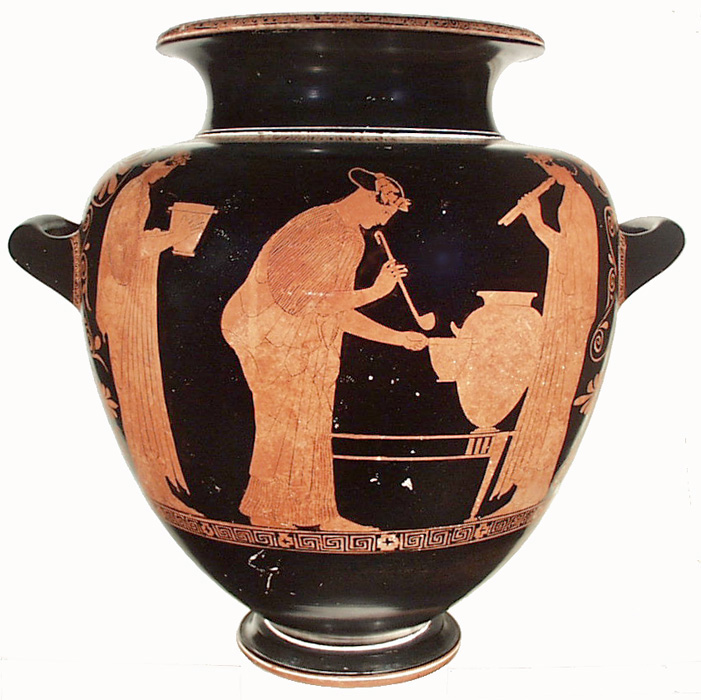
Attic red-figure stamnos by the Villa Giulia Painter, mid-5th century, at the Ashmolean Museum.  Side A. largely motionless women, heavily draped and garlanded with wine vine leaves, hold a skyphos (left) and play double pipes (right) around another who leans towards a low table supporting a large stamnos from which she has ladled wine into a skyphos. B. A woman wearing a decorated fillet around her head and holding a skyphos and thyrsus is framed by two companions, one (left) also holding a skyphos  and the other (right) with her head thrown back as if singing; all are moving as if in dance.

Attic red-figure stamnos by the Villa Giulia Painter, mid-5th century, at the Ashmolean Museum.  Side A. largely motionless women, heavily draped and garlanded with wine vine leaves, hold a skyphos (left) and play double pipes (right) around another who leans towards a low table supporting a large stamnos from which she has ladled wine into a skyphos. B. A woman wearing a decorated fillet around her head and holding a skyphos and thyrsus is framed by two companions, one (left) also holding a skyphos  and the other (right) with her head thrown back as if singing; all are moving as if in dance.

Red-figure kylix (drinking cup) attributed to the Villa Giulia Painter with a shortened form of the kalos, or "love name," eolais above the seated youth, 5th century BCE, Athens, courtesy of the Minneapolis Institute of Art.  A seated youth holding a staff, his athletic equipment--bathing sponge; an aryballos, a round, short-necked jar containing rubbing oil, and a curved metal strigil, used for scraping oil and moisture off the skin after exercising--hangs on the wall of the gymnasium.

Alabastron (oil bottle) attributed to the Villa Giulia Painter, 470-440 BCE, Athens, courtesy of the RISD (Rhode Island School of Design) Museum in Providence, Rhode Island. 

Alabastron (oil bottle) attributed to the Villa Giulia Painter, 470-440 BCE, Athens, courtesy of the RISD (Rhode Island School of Design) Museum in Providence, Rhode Island. 

White-ground Lykethos (oil flask), 460 BCE, Villa Giulia Painter, Classical Greek, Athens, A woman in a long sleeved chiton, with himation around her legs, earrings, bracelets, hair looped up, with rows of curls over forehead, seated on a diphros to right, holding up with both hands a hoop, which she grasps with thumb and finger of the left hand above and of right below. On right hangs from the upper border a saccos, on left, from an oblong object, an alabastron with cords, behind her, a large basket, courtesy of the British Museum

Red-figured pelike depicting Hera and Hebe (Side A) and Zeus and Nike at an altar (Side B), attributed to the Villa Giulia Painter, 460-450 BCE, found near the Dipylon Gate, Athens, courtesy of the British Museum

Red-figured pelike depicting Hera and Hebe (Side A) and Zeus and Nike at an altar (Side B), attributed to the Villa Giulia Painter, 460-450 BCE, found near the Dipylon Gate, Athens, courtesy of the British Museum

Terracotta lekythos (oil flask) attributed to the Villa Giulia Painter, 460 BCE, courtesy of the Metropolitan Museum of Art. From the end of the sixth century B.C., the lekythos served as a funerary vase to contain offerings of oil for the dead. During the second quarter of the fifth century, white-ground lekythoi, on which the decoration was painted over a white slip, became the typical funerary vase. While the subject here is the libation at the departure of a warrior, the shape suggests that the warrior did not return alive and that this vase was placed on his grave.

Attic Red-Figure Calyx Krater; Villa Giulia Painter Athens, Greece; 460–450 B.C.E., Terracotta,  J. Paul Getty Museum.  Side A, Orpheus attacked by Thracian Women. The woman on the left thrusts a spear towards Orpheus's throat. He staggers backwards, having dropped his lyre. A second woman attacks from the right, swinging an axe. Side B, three standing youths carrying spears and wearing distinctive Thracian helmets and cloaks. The two on the left face one another, the third walks away to the right, looking back. Lotus and palmette band on the rim; stopped meander with saltire squares below the groundline. Palmette complex above the handles.

Terracotta kylix (drinking cup) attributed to the Villa Giulia Painter, 470 BCE, courtesy of the Metropolitan Museum of Art, New York.  a goddess—identifiable by her scepter—stands by an altar to pour an offering from a phiale (libation bowl). Details such as the phiale and the figure's bracelets and necklace are rendered in added clay, which originally would have been gilded. It is likely that the vase was specially commissioned for dedication in a sanctuary.


If you enjoyed this post, never miss out on future posts by following me by email!