Showing posts with label Greece. Show all posts

Tuesday, February 2, 2021

The quiet nobility of the Villa Giulia Painter

The Villa Giulia Painter decorated vases in Athens during the period from about 470 to 440 B.C. He worked primarily in the red-figure technique, but he also produced some white-ground pieces. Most of his work appears to have been on large vessels, especially kraters of various forms. The Villa Giulia Painter usually favored quiet scenes, but he also included many depictions of Dionysiac religion and unusual myths. As with most ancient artists, the real name of the Villa Giulia Painter is unknown, and he is identified only by the stylistic traits of his work. Scholars named him after a krater in the Villa Giulia Museum in Rome. - Getty Museum

According to classicist John Beazley, The Villa Giulia Painter's work was representative of the "academic wing of early classic vase-painting”, whose best works are distinguished by “a quiet nobility.”  Some of his work also includes a kalos or "love name" applied near a depicted character. Vase painters commonly added these terms of endearment to acknowledge some athlete or youth popular at the time. The names were not necessarily related to the scenes depicted.

Often when I am photographing ancient art I have found both black and red-figure scenes on ancient Greek ceramics can sometimes be a bit chaotic.  So these pieces by the Villa Giulia Painter with their "quiet nobility" really appealed to me. 

Interesting article about Greek vase painting:

https://smarthistory.org/greek-vase-painting-an-introduction2/

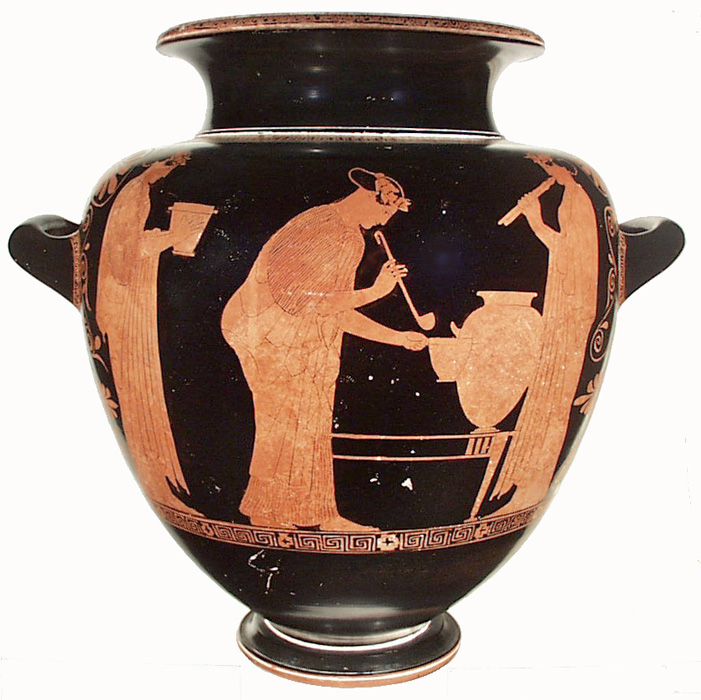
Attic red-figure stamnos by the Villa Giulia Painter, mid-5th century, at the Ashmolean Museum.  Side A. largely motionless women, heavily draped and garlanded with wine vine leaves, hold a skyphos (left) and play double pipes (right) around another who leans towards a low table supporting a large stamnos from which she has ladled wine into a skyphos. B. A woman wearing a decorated fillet around her head and holding a skyphos and thyrsus is framed by two companions, one (left) also holding a skyphos  and the other (right) with her head thrown back as if singing; all are moving as if in dance.

Attic red-figure stamnos by the Villa Giulia Painter, mid-5th century, at the Ashmolean Museum.  Side A. largely motionless women, heavily draped and garlanded with wine vine leaves, hold a skyphos (left) and play double pipes (right) around another who leans towards a low table supporting a large stamnos from which she has ladled wine into a skyphos. B. A woman wearing a decorated fillet around her head and holding a skyphos and thyrsus is framed by two companions, one (left) also holding a skyphos  and the other (right) with her head thrown back as if singing; all are moving as if in dance.

Red-figure kylix (drinking cup) attributed to the Villa Giulia Painter with a shortened form of the kalos, or "love name," eolais above the seated youth, 5th century BCE, Athens, courtesy of the Minneapolis Institute of Art.  A seated youth holding a staff, his athletic equipment--bathing sponge; an aryballos, a round, short-necked jar containing rubbing oil, and a curved metal strigil, used for scraping oil and moisture off the skin after exercising--hangs on the wall of the gymnasium.

Alabastron (oil bottle) attributed to the Villa Giulia Painter, 470-440 BCE, Athens, courtesy of the RISD (Rhode Island School of Design) Museum in Providence, Rhode Island. 

Alabastron (oil bottle) attributed to the Villa Giulia Painter, 470-440 BCE, Athens, courtesy of the RISD (Rhode Island School of Design) Museum in Providence, Rhode Island. 

White-ground Lykethos (oil flask), 460 BCE, Villa Giulia Painter, Classical Greek, Athens, A woman in a long sleeved chiton, with himation around her legs, earrings, bracelets, hair looped up, with rows of curls over forehead, seated on a diphros to right, holding up with both hands a hoop, which she grasps with thumb and finger of the left hand above and of right below. On right hangs from the upper border a saccos, on left, from an oblong object, an alabastron with cords, behind her, a large basket, courtesy of the British Museum

Red-figured pelike depicting Hera and Hebe (Side A) and Zeus and Nike at an altar (Side B), attributed to the Villa Giulia Painter, 460-450 BCE, found near the Dipylon Gate, Athens, courtesy of the British Museum

Red-figured pelike depicting Hera and Hebe (Side A) and Zeus and Nike at an altar (Side B), attributed to the Villa Giulia Painter, 460-450 BCE, found near the Dipylon Gate, Athens, courtesy of the British Museum

Terracotta lekythos (oil flask) attributed to the Villa Giulia Painter, 460 BCE, courtesy of the Metropolitan Museum of Art. From the end of the sixth century B.C., the lekythos served as a funerary vase to contain offerings of oil for the dead. During the second quarter of the fifth century, white-ground lekythoi, on which the decoration was painted over a white slip, became the typical funerary vase. While the subject here is the libation at the departure of a warrior, the shape suggests that the warrior did not return alive and that this vase was placed on his grave.

Attic Red-Figure Calyx Krater; Villa Giulia Painter Athens, Greece; 460–450 B.C.E., Terracotta,  J. Paul Getty Museum.  Side A, Orpheus attacked by Thracian Women. The woman on the left thrusts a spear towards Orpheus's throat. He staggers backwards, having dropped his lyre. A second woman attacks from the right, swinging an axe. Side B, three standing youths carrying spears and wearing distinctive Thracian helmets and cloaks. The two on the left face one another, the third walks away to the right, looking back. Lotus and palmette band on the rim; stopped meander with saltire squares below the groundline. Palmette complex above the handles.

Terracotta kylix (drinking cup) attributed to the Villa Giulia Painter, 470 BCE, courtesy of the Metropolitan Museum of Art, New York.  a goddess—identifiable by her scepter—stands by an altar to pour an offering from a phiale (libation bowl). Details such as the phiale and the figure's bracelets and necklace are rendered in added clay, which originally would have been gilded. It is likely that the vase was specially commissioned for dedication in a sanctuary.


If you enjoyed this post, never miss out on future posts by following me by email!


Tuesday, December 22, 2020

Hekate: The Dark Side of Artemis?

 Hecate or Hekate is a goddess in ancient Greek religion and mythology, most often shown holding a pair of torches or a key. In later periods she is often depicted in triple form. She is variously associated with crossroads, entrance-ways, night, light, magic, witchcraft, knowledge of herbs and poisonous plants, ghosts, necromancy, and sorcery. Her earliest appearance in literature was in Hesiod's Theogony in the late 8th century BCE as a goddess of great honor with domains in sky, earth, and sea. Her place of origin is debated by scholars, but she had popular followings amongst the witches of Thessaly and an important sanctuary among the Carians of Asia Minor in Lagina. 

Hecate was one of several deities worshiped in ancient Athens as a protector of the oikos (household), alongside Zeus, Hestia, Hermes, and Apollo.  Some scholars have suggested Hecate was originally considered an aspect of Artemis prior to the latter's adoption into the Olympian pantheon. Artemis would have, at that point, become more strongly associated with purity and maidenhood, on the one hand, while her originally darker attributes like her association with magic, the souls of the dead, and the night would have continued to be worshiped separately under her title Hecate.

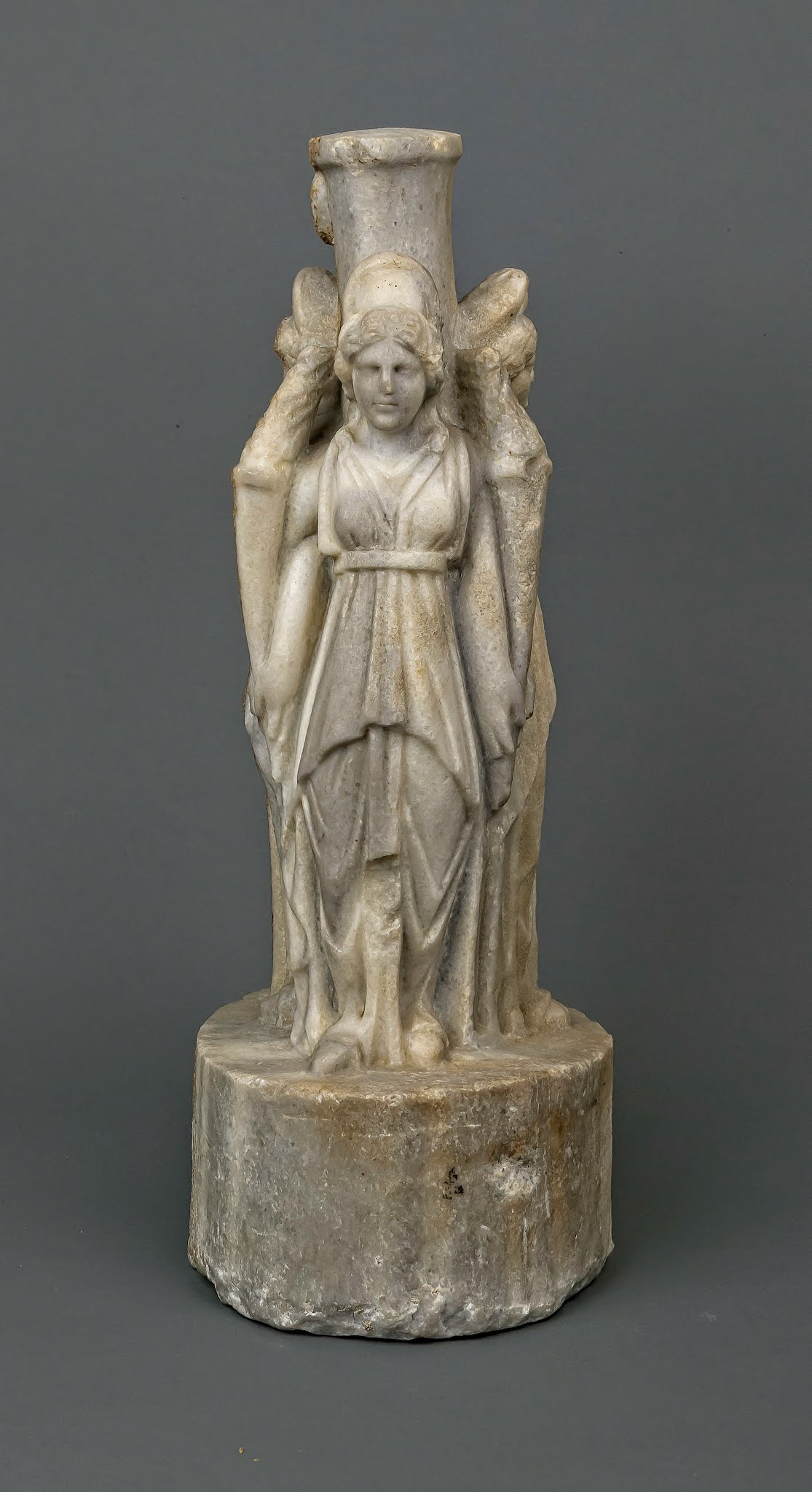
The general motif of a triple Hecate situated around a central pole or column, known as a hekataion, was used both at crossroads shrines as well as at the entrances to temples and private homes. These typically depict her holding a variety of items, including torches, keys, serpents, and daggers.  Sometimes she is depicted with Charites dancing around her.  Charites are sometimes called the Graces (Gratiae in Roman mythology) and refer to three or more goddesses of charm, beauty, nature, human creativity, goodwill, and fertility.

Hecate was closely associated with dogs and her approach was heralded by the howling of a dog. Although in later times Hecate's dog came to be thought of as a manifestation of restless souls or demons who accompanied her, its docile appearance and its accompaniment of a Hecate who looks completely friendly in many pieces of ancient art suggests that its original signification was positive and thus likelier to have arisen from the dog's connection with birth than the dog's underworld associations. 

Triple-formed representation of Hecate, Marble, Roman copy after an original of the Hellenistic period courtesy of Wikimedia Commons contributor Marie-Lan Nguyen


Gilt bronze Hekataion, 1st century CE Musei Capitolini, Rome courtesy of Wikimedia Commons contributor Daderot (digitally enhanced)


Hekataion with the Charites, Attic, 3rd century BCE at the Glyptothek, Munich courtesy of Wikimedia Commons contributor Bibi Saint-Pol.


Juniper wood Hekataion from Ptolemaic Egypt, 304–30 BCE, courtesy of the Metropolitan Museum of Art


Marble hekataion, Roman, 2nd century CE, courtesy of the Metropolitan Museum of Art


If you enjoyed this post, never miss out on future posts by following me by email!

Sunday, December 6, 2020

Social Integration in Roman Period Egypt

 The social structure in Aegyptus under the Romans was both unique and complicated. On the one hand, the Romans continued to use many of the same organizational tactics that were in place under the leaders of the Ptolemaic period. At the same time, the Romans saw the Greeks in Aegyptus as “Egyptians”, an idea that both the native Egyptians and Greeks would have rejected. To further compound the whole situation, Jews, who themselves were very Hellenized overall, had their own communities, separate from both Greeks and native Egyptians.

The Romans began a system of social hierarchy that revolved around ethnicity and place of residence. The Augustan takeover introduced a system of compulsory public service, which was based on poros (property or income qualification), which was wholly based on social status and power. Other than Roman citizens, a Greek citizen of one of the Greek cities had the highest status, and a rural Egyptian would be in the lowest class. In between those classes was the metropolite, who was almost certainly of Hellenic origin. Gaining citizenship and moving up in ranks was very difficult and there were not many available options for ascendancy. 

One of the routes that many followed to ascend to another caste was through enlistment in the army. Although only Roman citizens could serve in the legions, many Greeks found their way in. The native Egyptians could join the auxiliary forces and attain citizenship upon discharge.

Although Alexandria enjoyed the greatest status of the Greek cities in Egypt, it is clear that the other Greek cities, such as Antinoopolis, enjoyed privileges very similar to the ones seen in Alexandria and the Romans looked to Greek elites  to provide municipal officers and well-educated administrators. In contrast, the native Egyptians were treated as a conquered race.

Prior to Roman conquest, the Hellenistic Ptolemies identified Egyptian deities with their own. This continued after Roman annexation. The cult of Isis appealed even to Greeks and Romans outside Egypt, and in Hellenized form it spread around the Mediterranean and eventually across the Roman Empire. The result was the creation of hybrid deities such as those depicted on this "good luck" bracelet crafted in Roman Egypt in the late 1st century BCE or 1st century CE. 

The first known temple to Isis in Greece was built during or before the fourth century BCE by Egyptians living in Athens. Isis's cult reached Italy and the Roman sphere of influence at some point in the second century BCE.  It was one of many cults that were introduced to Rome as the Roman Republic's territory expanded in the last centuries BCE. Authorities in the Republic tried to define which cults were acceptable and which were not, as a way of defining Roman cultural identity amid the cultural changes brought on by Rome's expansion. In Isis's case, shrines and altars to her were set up on the Capitoline Hill, at the heart of the city, by private persons in the early first century BCE. 

The independence of her cult from the control of Roman authorities made it potentially unsettling to them. In the 50s and 40s BCE, when the crisis of the Roman Republic made many Romans fear that peace among the gods was being disrupted, the Roman Senate destroyed these shrines, although it did not ban Isis from the city outright.

Egyptian cults faced further hostility during the Final War of the Roman Republic (32–30 BCE), when Rome, led by Octavian, the future emperor Augustus, fought Egypt under Cleopatra VII. After Octavian's victory, he banned shrines to Isis and Serapis within the pomerium, the city's innermost, sacred boundary, but allowed them in parts of the city outside the pomerium, thus marking Egyptian deities as non-Roman but acceptable to Rome. Despite being temporarily expelled from Rome during the reign of Tiberius (14–37 CE), the Egyptian cults gradually became an accepted part of the Roman religious landscape. The Flavian emperors in the late first century CE treated Serapis and Isis as patrons of their rule in much the same manner as traditional Roman deities such as Jupiter and Minerva.


Image: Bracelet with Agathodaimon, Isis-Tyche, Aphrodite, and Thermouthis, 1st century B.C.E.–1st century CE, Roman Period at the Metropolitan Museum of Art.  

"Powerful talismans of fertility and good destiny are woven into this rich golden composition. The bodies of two snakes intertwine to form a Herakles knot, the centerpiece of this bracelet. The snake on the left represents Agathodaimon, and the cobra on the right Thermouthis, two agrarian/fertility deities associated with Serapis and Isis, respectively. On the platform between them stand two goddesses, Isis-Tyche (or Isis-Fortuna), a deity closely associated with Alexandria, and the nude Aphrodite." - Metropolitan Museum of Art

If you enjoyed this post, never miss out on future posts by following me by email!


Tuesday, April 28, 2020

Before the Gracchi - Lycurgus of Sparta: Early Land Reformer and the Father of the Great Rhetra

Image: Lycurgus, his arm bearing his shield raised above his head enters the city in a gold chariot pulled by white bulls, his soldiers around him, and a young man running with white hounds in the left foreground. This graphite, pen and grey ink detailed watercolor heightened with touches of white bodycolor and gum arabic was produced in 1797. Image courtesy of the Trustees of the British Museum.
Lycurgus was the quasi-legendary lawgiver of Sparta who established the military-oriented reformation of Spartan society in accordance with the Oracle of Apollo at Delphi. All his reforms promoted the three Spartan virtues: equality (among citizens), military fitness, and austerity and were contained in an oral constitution known as the Great Rhetra.

According to Herodotus, at some time before the reigns of Leon of Sparta and Agasicles about 590 BCE, the Spartans "had been the very worst governed people in Greece" until Lycurgus consulted the Delphic oracle and was provided with an entire constitution which Lycurgus took back and implemented. Lycurgus was the younger son of the Eurypontid king, Eunomus. He was thus passed over for the throne in favor of his brother, Polydectes, but the latter died. Although Lycurgus was offered the throne, his dead brother's wife was pregnant so Lycurgus became regent for the child when it was born. But Polydectes' wife and her relatives envied and hated Lycurgus and accused him of plotting the death of the infant, Charilaus.

So Lycurgus surrendered his position of authority and went on a legendary journey to Crete where he studied the laws of Minos and met the celebrated composer Thales, who, like Orpheus, could sooth the masses and inspire his listeners to become better people. From Crete, Lycurgus traveled to Asia Minor, Egypt, Spain, and, some say, even India. In Ionia he studied the lessons of statecraft and morality in the works of Homer and compiled fragments of them and expounded the lessons widely. According to Plutarch, Lycurgus was inspired by the Egyptians with the idea to separate the military from common laborers and this was the reason later Spartan warriors were not allowed to practice manual crafts. When Lycurgus was finally recalled to Sparta, he, like the Gracchi centuries later in Rome, prescribed land reforms to redistribute wealth more equally among Spartan citizens.

"For there was an extreme inequality among them, and their state was overloaded with a multitude of indigent and necessitous persons, while its whole wealth had centered upon a very few. To the end, therefore, that he might expel from the state arrogance and envy, luxury and crime, and those yet more inveterate diseases of want and superfluity, he obtained of them to renounce their properties, and to consent to a new division of the land, and that they should all live together on an equal footing; merit to be their only road to eminence." — Plutarch, Lycurgus.

Lycurgus was also credited with the development of the agoge for the education of children and the institution of common mess halls, the sussita, that required all Spartan men to eat together and provide the shared meals through the monthly contribution of a bushel of meal, eight gallons of wine, five pounds of cheese, two and half pounds of figs, and a small amount of money to purchase meat or fish. Even kings were not exempt from the daily ritual and expected contributions.


If you enjoyed this post, never miss out on future posts by following me by email!


Saturday, April 26, 2008

Greece and Rome: An Integrated History new course at the Teaching Company


I'm currently enjoying the Teaching Company Course "The Emperors of Rome" taught by Professor Garrett Fagan and I see they have announced another course taught by Professor Robert Garland that sounds equally fascinating.


Greece and Rome: An Integrated History of the Ancient Mediterranean
explores the many ways in which two very different cultures intersected, coincided, and at times collided. The relationship between Greeks and Romans has virtually no parallel in world history. Their contact created the extraordinary fusion that we call Greco-Roman—a unique marriage of civilizations that encompasses statecraft, mythology, language, philosophy, literature, fine arts, architecture, science, and much else.

Yet there is truth to the traditional view that parts of our cultural heritage derive specifically from Greece or from Rome. For example, the West owes its law codes to the legally oriented outlook of the Romans. By contrast, drama, which never caught on in Roman circles, is a wholly Greek invention. This is an example of how the relationship between these two cultures was like a marriage: two distinct personalities, competing in some areas, sharing in others, and creating a completely new synthesis in a third realm.

This cultural partnership began almost with the first recorded contact of Greeks and Romans in the 4th century B.C. and continued for almost 1,000 years. Consider these revealing clues:

  • Much of what we think of today as Classical Greek art is, in fact, copies commissioned by wealthy Roman connoisseurs. The common museum label "Roman copy of a lost Greek original" attests to this fusion of Roman taste and Greek artistry.
  • Romans displayed a love–hate relationship with Greece, epitomized by the Roman politician Cato the Elder, who was deeply immersed in Greek culture but who publicly denounced its corrupting influence.
  • Educated Romans were predominately bilingual in Greek. Caesar's dying words were not the Latin "Et tu, Brute?" as Shakespeare has it in Julius Caesar, but reportedly the Greek "Kai su, teknon?" meaning "You too, child?"
  • Christianity flourished and spread in the unsurpassed infrastructure of the Roman Empire. But the language of the New Testament is Greek, as is the philosophical outlook of Christianity's earliest theologians.
If you enjoyed this post, never miss out on future posts by following me by email!