Showing posts with label red-figure. Show all posts

Monday, July 19, 2021

Red-figured fish plates of the 5th century BCE

Throughout my travels to various museums around the world I have often encountered red-figured fish plates. First developed in Athens, these beautifully detailed serving pieces became especially popular in South Italy and Sicily in the 400s BCE. I stumbled across this excellent video about them and learned that fish plates produced in Magna Graecia were usually more colorful with white accents and the fish are portrayed with their bellies facing inwards towards the small central depression that is thought to have contained dipping sauce like garum. Fish on plates produced in Athens are painted with their bellies facing outwards. I thought this is quite a peculiar style difference. 

There also seems to be disagreement among scholars as to whether these plates were actually used in everyday life or produced for funerary purposes only, as almost all of the 1,000 examples that have been recovered came from ancient burials. Art historian Lucas Livingston points out that many of the recovered examples have a crack in the bottom of the dipping well produced during firing. This would indicate many of the plates were never actually used in the way they are designed.

You can see dozens of examples here:

https://www.bing.com/images/search?q=ancient+Greek+fish+plates+in+art&qs=n&form=QBIR&sp=-1&pq=ancient+greek+fish+plates+in+art&sc=0-32&cvid=B677B9B0A24547C0B59A1F1E97C1E345&first=1&tsc=ImageHoverTitle

As producer of the Ancient Art Podcast, Livingston, who has worked at the Art Institute of Chicago since 2002, has a number of other ancient video lessons available on YouTube including a discussion of Hadrian and Antinous, Medusa, the Roman Lycurgus Cup, Cleopatra's ethnic origins, and ancient astronomy.


If you enjoyed this post, never miss out on future posts by following me by email!


Sunday, June 27, 2021

The Meidias Painter: Art amidst the Peloponnesian War

The Meidias Painter was an Athenian red-figure vase painter active in the last quarter of the 5th century BCE (fl. c. 420 to c. 400 BCE). He is named after the potter whose signature was found on a large hydria, depicting the rape of the daughters of Leucippus (Leukippos), prince of Messenia, by the Dioscuri, excavated from an Etruscan tomb.  John D. Beazley, renowned connoisseur of Greek vases, said of Meidias' work, "Here there is beauty: The gleam of gold, loves and ladies with soft limbs, in soft raiment, and all that is shining, easeful and luxurious: perfume, honey and roses." 

The Meidias Painter was known for combining his theatrical “florid” style with his “flying drapery.”  He worked during the period of the Peloponnesian War and his depiction of many Attic legends, particularly those involving Erichtonios, son of Hephaistos, points to "a clear assertion of local pride prompted by the Athenians' decisive role in the fight against the barbarian" according to Jenifer Neils, Assistant Curator of Ancient Art at Case Western Reserve University.

He ranged his scenes across the entire background of most vessels, especially kraters.  This reflects the influence of monumental wall painting during this period. The Meidias Painter is thought to be one of the best pupils of the Eretria Painter, who initially popularized non-mythical scenes of Aphrodite with four to five of her richly dressed attendants, Eudaimonia (Happiness or Prosperity), Eukleia (Good Repute), Eunomia (Good Order), Eutychia (Good Luck), Harmonia (Harmony) , Hygieia (Health), Paidia (Play), and Peitho (Persuasion).   Sadly, the personification of Eirene (Peace) did not make an appearance in Greek art until the early fourth century BCE.  Instead, the Meidias Painter focused on themes of love and music instead of heroes and the battlefield, possibly as an escape from the brutality of the war engulfing his world at the time.

Read more about it: https://www.academia.edu/12707446/A_Greek_Nativity_by_the_Meidias_Painter

Attic red-figure hydria of the Leucippides depicting the Dioskuroi, Kastor and Polydeukes, in their chariots raping the Leukippides Elera and Eriphyle by the Meidias Painter, 420-400 BCE, now in the British Museum courtesy of Wikimedia contributor ArchaiOptix.

Another scene on the Attic red-figure hydria of the Leucippides by the Meidias Painter, 420-400 BCE, now in the British Museum courtesy of Wikimedia contributor ArchaiOptix.

Red-Figure Squat Lekythos (Oil Vessel) depicting the Birth of Erichthonios attributed to the Meidias Painter, 420-410 BCE, now in the collections of the Cleveland Museum of Art, image courtesy of the museum.

Attic red figure loutrophoros depicting a draped woman standing beside a groom in a wedding scene with Eros between the bride and groom painted in the "manner" of the Meidias Painter.

Attic red figure squat lekythos depicting Oedipus killing a sphinx with his spear while a seated Apollo looks on painted in the "manner of the Meidias Painter, now at the British Museum, courtesy of Wikimedia contributor ArchaiOptix.

Agamemnon seated on a rock and holding his sceptre, identified from an inscription. Fragment of the lid of an Attic red-figure lekanis by the circle of the Meidias Painter, 410–400 BCE. From the contrada Santa Lucia in Taranto. Stored in the Museo Nazionale Archeologico in Taranto (Italy), courtesy of Wikimedia Commons contributor Marie-Lan Nguyen.

Phaon and Aphrodite on an Attic red-figure clayx-krater dated from 420-400 BCE now in the collections of the Regional Archaeological Museum of Antonino Salinas courtesy of Wikimedia Commons contributor Marie-Lan Nguyen.

Attic Red-figured kylix depicting Peitho, the goddess of Persuasion, who stands addressing a woman named Demonassa, sitting in a rocky landscape looking rather dejected , 410 BCE attributed to the Meidias Painter, now in the collections of the J. Paul Getty Museum, image courtesy of the museum. 

Red-figured squat lekythos depicting female allegories with Eros in a garden, Hygieia, Pandasia with wreath and phiale, flying Eros, Eudaimonia seated, standing youth (Polyeidos or Polykles) in chlamys with 2 spears, plants. Said to be a "poor" attempt (I still thought it was beautiful) to copy the Meidias Painter by Greek ceramic expert John D. Beazley, now at the British Museum, courtesy of Wikimedia contributor ArchaiOptix.

Closeup of red-figured hydria painting depicting Phaon and women from Lesbos, 410 BCE, now in the collections of the Archaeological Museum in Florence, courtesy of Wikimedia Commons contributor Shakko.

Small hydria with Eros, carrying a tambourine, flying towards a woman, in a flowered chiton and long mantle, whose right foot is on a foot stool. Behind her a girl in a Doric chiton, seated, playing with a panther. Before the Eros an acanthus ornament. Painted in the "manner" of the Meidias Painter, end of the 5th century BCE now in the collections of the Museum of Fine Arts Boston, image courtesy of the museum.


If you enjoyed this post, never miss out on future posts by following me by email!


Saturday, June 12, 2021

The ephebeia

Just as select Spartan youth endured the krypteia, a year long trial in the wilderness to prove their worthiness to become a Spartiate, Athenian young men also took part in a training regimen known as the ephebeia.  This "college" taught them the responsibilities of citizenship and trained them as soldiers.  After admission to the college, the ephebe took the oath of allegiance, recorded in histories by Pollux and Stobaeus, in the temple of Aglaurus, and was sent to Munichia or Acte to form one of the garrison there. 

At the end of the first year of training, the ephebi were reviewed, and, if their performance was satisfactory, were provided by the state with a spear and a shield, which, together with the chlamys (cloak) and petasos (broad-brimmed hat), made up their equipment. In their second year they were transferred to other garrisons in Attica, patrolled the frontiers, and on occasion took an active part in war. 

During these two years they were free from taxation, and were generally not allowed to appear in the law courts as plaintiffs or defendants. The ephebi took part in some of the most important Athenian festivals. Thus during the Eleusinian Mysteries they were sent to fetch the sacred objects from Eleusis and to escort the image of Iacchus on the sacred way. They also performed police duty at the meetings of the ecclesia.

After the end of the 4th century BCE, the institution underwent a radical change. Enrolment ceased to be obligatory, lasted only for a year, and the limit of age was dispensed with. Inscriptions attest a continually decreasing number of ephebi, and with the admission of foreigners the college lost its representative national character. Scholars have speculated this was mainly due to the weakening of the military spirit and the progress of intellectual culture. The military element was no longer all-important, and the ephebia became a sort of university for well-to-do young men of good family, whose social position has been compared with that of the Athenian "knights" of earlier times. The institution lasted till the end of the 3rd century CE.

Roman aristocratic families often sent their young men, between the ages of 16 - 20, to Greece to learn civic virtues. Several new officials were introduced, one of special importance being the director of the Diogeneion.  The Diogeneion was essentially a gymnasium originally built in honor of Diogenes, the last commander of the Macedonian garrison in Athens that departed the city in 229 BCE.  It is assumed he funded the construction of the building and scholars therefore conclude military training was conducted there.


Image: This Attic Red-Figure Stamnos at the Getty Villa (unfortunately not currently on view), produced between 470-460 BCE, appears to depict an ephebe (ephebus in Latin) who has completed at least his first year at the the ephebeia successfully as he is now equipped with two spears and wears the trademark petasos on his back.  He appears to be bidding farewell to an old white-haired man (his father or teacher) before leaving for his assigned garrison.


If you enjoyed this post, never miss out on future posts by following me by email!


Sunday, June 6, 2021

The Eyes have it! "Eye cups" of the 6th century BCE

Just as the eyes painted on ancient ships are thought to have possessed the ability to guide them, help them avoid hazards, and even serve an apotropaic purpose to counter human frailties such as envy, eyes adorning drinking cups (kylikes) in the second half of the sixth century BCE, especially in Athens and Chalkis, were also thought to have served an apotropaic function. Some eyes were “female”, i.e. almond-shaped and without tear-ducts, as well as male, and a stylized nose was often placed centrally between the eyes. Many of the vessels also frequently bear Dionysiac imagery.

Eye-cups were painted by various painters, mostly in the black-figure style, but later also in the red-figure style. Some vessels were  bilingually painted with black-figure interior scenes and red-figure exterior scenes. Scholars have attributed this bilingual type and its specific decoration into Attic vase painting to Exekias who was active in Athens between 545 and 530 BCE.  Exekias is regarded by art historians as an artistic visionary whose masterful use of incision and psychologically sensitive compositions mark him as one of the greatest of all Attic vase painters.

The find spots of Exekias' works reveals information about the market in which Exekias positioned himself. Exekias not only enjoyed a thriving market in Athens, with fragments of his works found in the sacred sanctuary of the Acropolis, but many of his extant vases were also exported to Etruria, Italy, found at sites such as Vulci and Orvieto, where they were buried in Etruscan tombs.  

Dionysus cup, Attic black-figure kylix by Exekias, ca. 530 BCE with interior depiction of Dionysus in a ship sailing among dolphins, made in Athens but found in Vulci (Etruria) now in the collections of the Staatliche Antikensammlungen in Munich, Germany, image courtesy of Wikimedia Commons contributor Matthias Kabel. One of Exekias' most famous works, the cup is embellished with warriors fighting over a fallen man, a popular depiction on black-figured ceramics. between the eyes.   The interior shows a depiction of the god Dionysus against a background of coral-red slip, which coats the entire picture space. Exekias depicts Dionysus' initial journey to Athens by ship. Pirates had seized the ship and were planning, perhaps, to sell Dionysus into slavery. Instead, the god caused vines to grow from the mast, frightening the pirates so much that they jumped overboard and were changed into dolphins, here seen swimming around the ship. 

Dionysus cup, Attic black-figure kylix by Exekias, ca. 530 BCE with interior depiction of Dionysus in a ship sailing among dolphins, made in Athens but found in Vulci (Etruria) now in the collections of the Staatliche Antikensammlungen in Munich, Germany, image courtesy of Wikimedia Commons contributor Matthias Kabel. One of Exekias' most famous works, the cup is embellished with warriors fighting over a fallen man, a popular depiction on black-figured ceramics. between the eyes.   The interior shows a depiction of the god Dionysus against a background of coral-red slip, which coats the entire picture space. Exekias depicts Dionysus' initial journey to Athens by ship. Pirates had seized the ship and were planning, perhaps, to sell Dionysus into slavery. Instead, the god caused vines to grow from the mast, frightening the pirates so much that they jumped overboard and were changed into dolphins, here seen swimming around the ship. 

Closeup from an Attic black-figured eye cup ca 520 BCE from Vulci depicting Aeneas carrying Anchises, with Ascanius in background (legs) signed by Nikosthenes, now in the collections of The Louvre Museum in Paris, courtesy of Wikimedia Commons contributor Bibi Saint-Pol.

Eye kylix with lions and panthers biting a fawn, signed by Nikothenes, Attic, 530-520 BCE at the Archaeological Museum of Florence courtesy of Wikimedia Commons contributor Sailko.


Attic Bilingual Eye Cup, possibly by Pheidippos, Attic Greek, about 510 BCE, terracotta, now in the collections of the J. Paul Getty Museum (Villa), image courtesy of the museum.  The cup is broken and restored, executed in both red and black figure techniques Interior: The interior decoration is mostly missing. Preserved in the tondo, in black-figure, are the two feet and lower hem of a running figure, perhaps Dionysus, carrying a grapevine. Exterior: The exterior is executed in red-figure technique. Side A shows, between the eyes, a helmeted hoplitodromos with a shield decorated with a raven device. Side B shows a crouching, helmeted hoplite between two eyes with a shield decorated with a horse device . Around the handles are large closed palmettes. Added red is used for the inner circles of the irises and the pupils of the eyes.


If you enjoyed this post, never miss out on future posts by following me by email!


Thursday, March 4, 2021

The Penthesilea Painter

The Penthesilea Painter, active between 470 and 450 BCE in Athens, Greece, was named from a red-figure vase which depicts the slaying of Penthesilea by Achilles. Using the painting style of that vase, classicist John Beazley attributed 177 known vases to the painter.  His work has been found on bowls, skyphoi, kantharoi and bobbins (or possibly yoyos).

His work is characterised by large, space-filling figures whose posture is often bent so as to permit them to fit on a vessel. For the same reason, ornamental decoration around the edges is often very narrow. His works are also characterised by being very colourful, permitting several intermediate shades. Apart from dark coral red and the usual light red, he also used tones of brown, yellow, yellow-white and gold. His figures are painted remarkably meticulously in every detail.

The Penthesilea Painter's works are dominated by depictions of boys and youths engaged in athletic activity, teaching scenes, weaponry and armour, as well as scenes of people talking to horses. While he painted the occasional mythological motif, they are so rare that they should be considered an exception among his work. Throughout his career, scenes from everyday life gain an increasingly dominant share of his paintings.

Terracotta bobbin (or yoyo) ca. 460–450 B.C.E., Attributed to the Penthesilea Painter at the Metropolitan Museum of Art. This side, Nike (the personification of victory) offering fillet (band) to youth.

Terracotta bobbin (or yoyo) ca. 460–450 B.C.E., Attributed to the Penthesilea Painter at the Metropolitan Museum of Art. This side, Eros and Youth.

Achilles killing Penthesilea. Tondo of an Attic red-figure kylix, 470–460 BCE. From Vulci. Courtesy of Wikimedia Commons contributor Bibi Saint-Pol.


Zeus and Ganymede. Penthesilea Painter. 470 BCE. Ferrara Archaeological Museum courtesy of Wikimedia Commons contributor Mapk1978.


If you enjoyed this post, never miss out on future posts by following me by email!


Tuesday, February 2, 2021

The quiet nobility of the Villa Giulia Painter

The Villa Giulia Painter decorated vases in Athens during the period from about 470 to 440 B.C. He worked primarily in the red-figure technique, but he also produced some white-ground pieces. Most of his work appears to have been on large vessels, especially kraters of various forms. The Villa Giulia Painter usually favored quiet scenes, but he also included many depictions of Dionysiac religion and unusual myths. As with most ancient artists, the real name of the Villa Giulia Painter is unknown, and he is identified only by the stylistic traits of his work. Scholars named him after a krater in the Villa Giulia Museum in Rome. - Getty Museum

According to classicist John Beazley, The Villa Giulia Painter's work was representative of the "academic wing of early classic vase-painting”, whose best works are distinguished by “a quiet nobility.”  Some of his work also includes a kalos or "love name" applied near a depicted character. Vase painters commonly added these terms of endearment to acknowledge some athlete or youth popular at the time. The names were not necessarily related to the scenes depicted.

Often when I am photographing ancient art I have found both black and red-figure scenes on ancient Greek ceramics can sometimes be a bit chaotic.  So these pieces by the Villa Giulia Painter with their "quiet nobility" really appealed to me. 

Interesting article about Greek vase painting:

https://smarthistory.org/greek-vase-painting-an-introduction2/

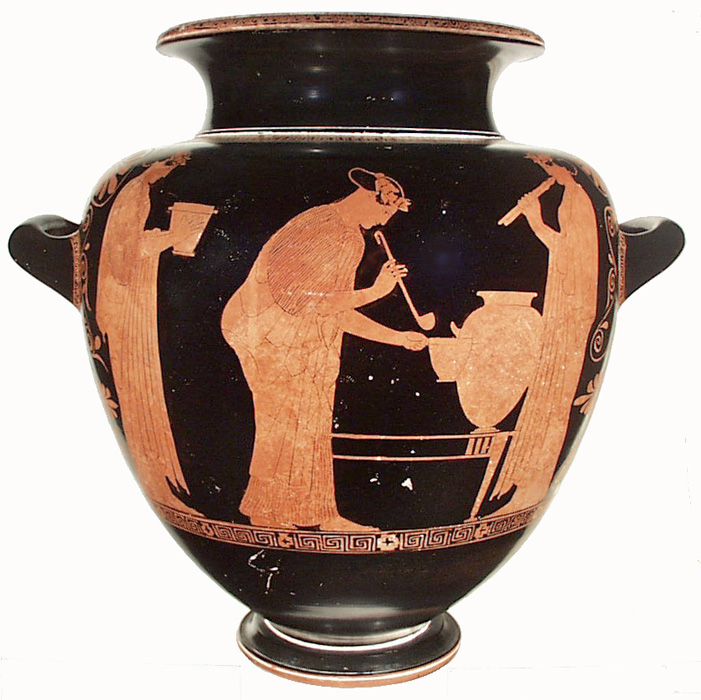
Attic red-figure stamnos by the Villa Giulia Painter, mid-5th century, at the Ashmolean Museum.  Side A. largely motionless women, heavily draped and garlanded with wine vine leaves, hold a skyphos (left) and play double pipes (right) around another who leans towards a low table supporting a large stamnos from which she has ladled wine into a skyphos. B. A woman wearing a decorated fillet around her head and holding a skyphos and thyrsus is framed by two companions, one (left) also holding a skyphos  and the other (right) with her head thrown back as if singing; all are moving as if in dance.

Attic red-figure stamnos by the Villa Giulia Painter, mid-5th century, at the Ashmolean Museum.  Side A. largely motionless women, heavily draped and garlanded with wine vine leaves, hold a skyphos (left) and play double pipes (right) around another who leans towards a low table supporting a large stamnos from which she has ladled wine into a skyphos. B. A woman wearing a decorated fillet around her head and holding a skyphos and thyrsus is framed by two companions, one (left) also holding a skyphos  and the other (right) with her head thrown back as if singing; all are moving as if in dance.

Red-figure kylix (drinking cup) attributed to the Villa Giulia Painter with a shortened form of the kalos, or "love name," eolais above the seated youth, 5th century BCE, Athens, courtesy of the Minneapolis Institute of Art.  A seated youth holding a staff, his athletic equipment--bathing sponge; an aryballos, a round, short-necked jar containing rubbing oil, and a curved metal strigil, used for scraping oil and moisture off the skin after exercising--hangs on the wall of the gymnasium.

Alabastron (oil bottle) attributed to the Villa Giulia Painter, 470-440 BCE, Athens, courtesy of the RISD (Rhode Island School of Design) Museum in Providence, Rhode Island. 

Alabastron (oil bottle) attributed to the Villa Giulia Painter, 470-440 BCE, Athens, courtesy of the RISD (Rhode Island School of Design) Museum in Providence, Rhode Island. 

White-ground Lykethos (oil flask), 460 BCE, Villa Giulia Painter, Classical Greek, Athens, A woman in a long sleeved chiton, with himation around her legs, earrings, bracelets, hair looped up, with rows of curls over forehead, seated on a diphros to right, holding up with both hands a hoop, which she grasps with thumb and finger of the left hand above and of right below. On right hangs from the upper border a saccos, on left, from an oblong object, an alabastron with cords, behind her, a large basket, courtesy of the British Museum

Red-figured pelike depicting Hera and Hebe (Side A) and Zeus and Nike at an altar (Side B), attributed to the Villa Giulia Painter, 460-450 BCE, found near the Dipylon Gate, Athens, courtesy of the British Museum

Red-figured pelike depicting Hera and Hebe (Side A) and Zeus and Nike at an altar (Side B), attributed to the Villa Giulia Painter, 460-450 BCE, found near the Dipylon Gate, Athens, courtesy of the British Museum

Terracotta lekythos (oil flask) attributed to the Villa Giulia Painter, 460 BCE, courtesy of the Metropolitan Museum of Art. From the end of the sixth century B.C., the lekythos served as a funerary vase to contain offerings of oil for the dead. During the second quarter of the fifth century, white-ground lekythoi, on which the decoration was painted over a white slip, became the typical funerary vase. While the subject here is the libation at the departure of a warrior, the shape suggests that the warrior did not return alive and that this vase was placed on his grave.

Attic Red-Figure Calyx Krater; Villa Giulia Painter Athens, Greece; 460–450 B.C.E., Terracotta,  J. Paul Getty Museum.  Side A, Orpheus attacked by Thracian Women. The woman on the left thrusts a spear towards Orpheus's throat. He staggers backwards, having dropped his lyre. A second woman attacks from the right, swinging an axe. Side B, three standing youths carrying spears and wearing distinctive Thracian helmets and cloaks. The two on the left face one another, the third walks away to the right, looking back. Lotus and palmette band on the rim; stopped meander with saltire squares below the groundline. Palmette complex above the handles.

Terracotta kylix (drinking cup) attributed to the Villa Giulia Painter, 470 BCE, courtesy of the Metropolitan Museum of Art, New York.  a goddess—identifiable by her scepter—stands by an altar to pour an offering from a phiale (libation bowl). Details such as the phiale and the figure's bracelets and necklace are rendered in added clay, which originally would have been gilded. It is likely that the vase was specially commissioned for dedication in a sanctuary.


If you enjoyed this post, never miss out on future posts by following me by email!


Saturday, January 9, 2021

Epinetrae: Women and weaving in the ancient world

 Producing cloth for garments and other fabrics needed in a household was a significant task for women. It required special equipment such as a loom and loomweights as well as this utensil, known as an onos or epinetron. It is a generally semicircular tile that is closed at one end. It was placed over the lower thigh and knee. Although its exact function is not clear, the roughened upper surface suggests that it served to prepare wool for spinning. - Metropolitan Museum of Art

 Epinetra were often decorated, sometimes depicting black figure Amazon women, as in the case of an epinetron painted by Sappho between 500-490 BCE. A female head was often placed on the closed end where the knee was covered. Because of the strong association between wool-working and the ideal woman and wife, as in the case of Penelope weaving in the Odyssey, it was associated with weddings so decorated epinetra were placed on the graves of unmarried girls, or dedicated at temples of female deities.

Black-figured decorated epinetron, 500 BCE, depicting a scene of women weaving at The Louvre courtesy of Wikimedia Commons contributor Marie-Lan Nguyen.

Red-figured decorated epinetron, 450 BCE, decorated on both sides with youths and women at the Antikensammlung in Berlin courtesy of Wikimedia Commons contributor Marcus Cyron.

Black-figured Terracotta epinetra (leg guard used in carding wool) ca. 510–500 BCE at the Metropolitan Museum of Art.

Illustration of the use of an epinetron courtesy of Wikimedia Commons contributor MM.

If you enjoyed this post, never miss out on future posts by following me by email!