Showing posts with label pottery. Show all posts

Monday, July 19, 2021

Red-figured fish plates of the 5th century BCE

Throughout my travels to various museums around the world I have often encountered red-figured fish plates. First developed in Athens, these beautifully detailed serving pieces became especially popular in South Italy and Sicily in the 400s BCE. I stumbled across this excellent video about them and learned that fish plates produced in Magna Graecia were usually more colorful with white accents and the fish are portrayed with their bellies facing inwards towards the small central depression that is thought to have contained dipping sauce like garum. Fish on plates produced in Athens are painted with their bellies facing outwards. I thought this is quite a peculiar style difference. 

There also seems to be disagreement among scholars as to whether these plates were actually used in everyday life or produced for funerary purposes only, as almost all of the 1,000 examples that have been recovered came from ancient burials. Art historian Lucas Livingston points out that many of the recovered examples have a crack in the bottom of the dipping well produced during firing. This would indicate many of the plates were never actually used in the way they are designed.

You can see dozens of examples here:

https://www.bing.com/images/search?q=ancient+Greek+fish+plates+in+art&qs=n&form=QBIR&sp=-1&pq=ancient+greek+fish+plates+in+art&sc=0-32&cvid=B677B9B0A24547C0B59A1F1E97C1E345&first=1&tsc=ImageHoverTitle

As producer of the Ancient Art Podcast, Livingston, who has worked at the Art Institute of Chicago since 2002, has a number of other ancient video lessons available on YouTube including a discussion of Hadrian and Antinous, Medusa, the Roman Lycurgus Cup, Cleopatra's ethnic origins, and ancient astronomy.


If you enjoyed this post, never miss out on future posts by following me by email!


Saturday, March 6, 2021

Animals in Ancient Art: Zoomorphic Askoi

 In her book, Animals in Roman Life and Art, the late professor Jocelyn Toynbee explains that the appearance of animals in Greco-Roman art, especially funeral art, are not allusions to a particular occupation or favorite food item but symbolize the existence of idyllic peace and plenty in paradise, either existing within the home or in the anticipated afterlife.  The Greek word for paradise derived from the eastern term "paradeisos" was first used by Xenophon to describe the extensive parks of the Persian kings that were planted with luxuriant flora and stocked with a variety of wild creatures.

This symbolism extends back as the Chalcolithic period.  Scholars have noted a marked preference for askoi of zoomorphic forms on Cyprus suggesting that, at least there, askoi had a cultic and ritual use.  They point to the vessel's ancient name reflecting an object made of animal leather as proof of further assocation with animals, enough so that the term is now primarily used to signify a terracotta imitation of such a closed vessel with a handle or cylindrical spout that is partially or totally zoomorphic in form and used for dispensation of liquids, often oil for lamps. 

Early types often fell into the classifications bag-shaped,  bird-shaped, fish-shaped, or aberrant forms with horns or other zoomorphic aspects such as a bird-shaped askos with an animal head. Those shaped like an animal skin bag gradually acquired protomes of various animal heads during the Early Iron Age. These vessels evolved still further to animal-shaped askoi which were modeled on the wheel as hollow figurines then handle and spout added.

On Cyprus the mammals depicted most often included bulls, horses and goats.  Some deer shaped vessels have also been found as well as plastically-rendered riders. A Cypriot askos in the shape of a reclining lion, now in the collections of the Metropolitan Museum of Art, is thought to be unique. 

It is thought that initial askoi shapes on Cyprus were influenced by trade relations with Crete and Mycenaean Greece. But, by the 9th century CE, Greeks in the Aegean developed a taste for exotic goods and Cypriot goods with new forms developed there were reintroduced to the Greeks.  These forms were further adapted by the Greeks and exported to other trading partners including the Etruscans and Romans. The original purpose of askoi was also adapted for other activities other than cultic or funereal and with this development the animals depicted became more whimsical, especially if the askoi were used at symposia where uniquely shaped vessels could be subtly employed as "conversation starters."

Terracotta askos in the form of a weasel, 4th century B.C.E., Greek, South Italian, Campanian at the Metropolitan Museum of Art.

Terracotta vase in the form of a lobster claw, ca. 460 B.C.E., Attributed to the Class of Seven Lobster-Claws at the Metropolitan Museum of Art. Because so many aspects of Greek life depended on the sea, a vase in the shape of a lobster claw is not surprising. It is, however, exceptional and may be a variant of the askos—a bag-shaped oil container provided with a vertical mouth and strap handle. The Dionysiac iconography of the lobster claw suggests that it was a novelty item used at symposia (drinking parties).

Terracotta vase in the form of a lobster claw, ca. 460 B.C.E., Attributed to the Class of Seven Lobster-Claws at the Metropolitan Museum of Art. Because so many aspects of Greek life depended on the sea, a vase in the shape of a lobster claw is not surprising. It is, however, exceptional and may be a variant of the askos—a bag-shaped oil container provided with a vertical mouth and strap handle. The Dionysiac iconography of the lobster claw suggests that it was a novelty item used at symposia (drinking parties).

Terracotta askos in the form of a duck, late 5th century B.C.E., Greek, Attic, at the Metropolitan Museum of Art.

Terracotta askos (flask with a spout and handle over the top) in the form of a duck, 4th century B.C.E., at the Metropolitan Museum of Art.

Zoomorphic askoi and unguentari in the shape of a stag from Tomb 83 Trebba Valley, 300-275 BCE from the Archaeological Museum of Ferrara, Italy courtesy of Wikimedia Commons contributor Sailko

Askos in the form of a bull, Greek, South Italian, Apulian, courtesy of the Metropolitan Museum of Art.

Askos in the form of a dog, Greek, 2nd - 1st century CE, , courtesy of the Metropolitan Museum of Art.

Cyprus, geometric age, Kourou Group I, askos with equine protome, from tomb 2138 of the necropolis of the pond, 770-750 BCE courtesy of Wikimedia Commons contributor Sailko

Cypriot; Askos in the form of a fish, 1200-1175 BCE, courtesy of the Metropolitan Museum of Art.

Cypriot Askos in the form of a lion, 1200-1050 BCE, courtesy of the Metropolitan Museum of Art.

Zoomorphic Askos with geometric configuration, from Rhodes, Archaic Age, courtesy of Wikimedia Commons contributor Sailko

Hellenistic Askos in the shape of a ram, courtesy of Wikimedia Commons contributor Sailko

If you enjoyed this post, never miss out on future posts by following me by email!


Thursday, March 4, 2021

The Penthesilea Painter

The Penthesilea Painter, active between 470 and 450 BCE in Athens, Greece, was named from a red-figure vase which depicts the slaying of Penthesilea by Achilles. Using the painting style of that vase, classicist John Beazley attributed 177 known vases to the painter.  His work has been found on bowls, skyphoi, kantharoi and bobbins (or possibly yoyos).

His work is characterised by large, space-filling figures whose posture is often bent so as to permit them to fit on a vessel. For the same reason, ornamental decoration around the edges is often very narrow. His works are also characterised by being very colourful, permitting several intermediate shades. Apart from dark coral red and the usual light red, he also used tones of brown, yellow, yellow-white and gold. His figures are painted remarkably meticulously in every detail.

The Penthesilea Painter's works are dominated by depictions of boys and youths engaged in athletic activity, teaching scenes, weaponry and armour, as well as scenes of people talking to horses. While he painted the occasional mythological motif, they are so rare that they should be considered an exception among his work. Throughout his career, scenes from everyday life gain an increasingly dominant share of his paintings.

Terracotta bobbin (or yoyo) ca. 460–450 B.C.E., Attributed to the Penthesilea Painter at the Metropolitan Museum of Art. This side, Nike (the personification of victory) offering fillet (band) to youth.

Terracotta bobbin (or yoyo) ca. 460–450 B.C.E., Attributed to the Penthesilea Painter at the Metropolitan Museum of Art. This side, Eros and Youth.

Achilles killing Penthesilea. Tondo of an Attic red-figure kylix, 470–460 BCE. From Vulci. Courtesy of Wikimedia Commons contributor Bibi Saint-Pol.


Zeus and Ganymede. Penthesilea Painter. 470 BCE. Ferrara Archaeological Museum courtesy of Wikimedia Commons contributor Mapk1978.


If you enjoyed this post, never miss out on future posts by following me by email!


Tuesday, February 2, 2021

The quiet nobility of the Villa Giulia Painter

The Villa Giulia Painter decorated vases in Athens during the period from about 470 to 440 B.C. He worked primarily in the red-figure technique, but he also produced some white-ground pieces. Most of his work appears to have been on large vessels, especially kraters of various forms. The Villa Giulia Painter usually favored quiet scenes, but he also included many depictions of Dionysiac religion and unusual myths. As with most ancient artists, the real name of the Villa Giulia Painter is unknown, and he is identified only by the stylistic traits of his work. Scholars named him after a krater in the Villa Giulia Museum in Rome. - Getty Museum

According to classicist John Beazley, The Villa Giulia Painter's work was representative of the "academic wing of early classic vase-painting”, whose best works are distinguished by “a quiet nobility.”  Some of his work also includes a kalos or "love name" applied near a depicted character. Vase painters commonly added these terms of endearment to acknowledge some athlete or youth popular at the time. The names were not necessarily related to the scenes depicted.

Often when I am photographing ancient art I have found both black and red-figure scenes on ancient Greek ceramics can sometimes be a bit chaotic.  So these pieces by the Villa Giulia Painter with their "quiet nobility" really appealed to me. 

Interesting article about Greek vase painting:

https://smarthistory.org/greek-vase-painting-an-introduction2/

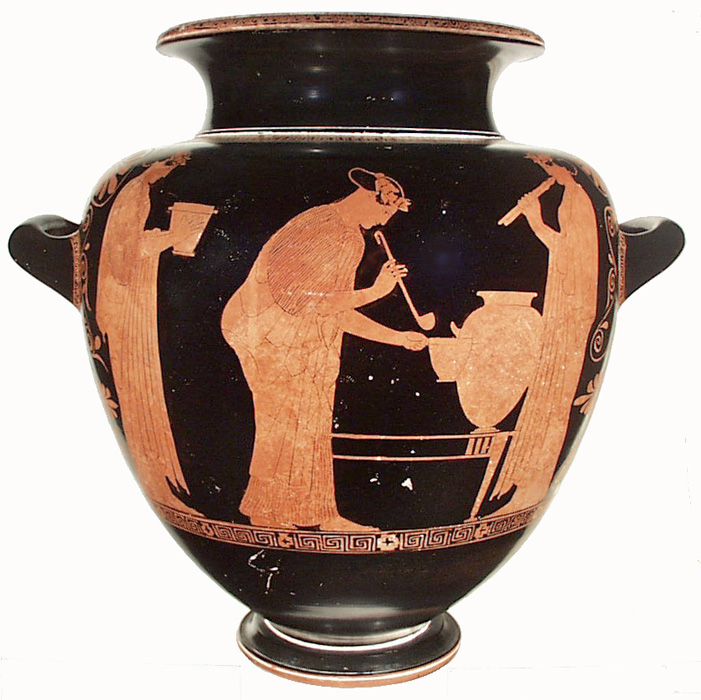
Attic red-figure stamnos by the Villa Giulia Painter, mid-5th century, at the Ashmolean Museum.  Side A. largely motionless women, heavily draped and garlanded with wine vine leaves, hold a skyphos (left) and play double pipes (right) around another who leans towards a low table supporting a large stamnos from which she has ladled wine into a skyphos. B. A woman wearing a decorated fillet around her head and holding a skyphos and thyrsus is framed by two companions, one (left) also holding a skyphos  and the other (right) with her head thrown back as if singing; all are moving as if in dance.

Attic red-figure stamnos by the Villa Giulia Painter, mid-5th century, at the Ashmolean Museum.  Side A. largely motionless women, heavily draped and garlanded with wine vine leaves, hold a skyphos (left) and play double pipes (right) around another who leans towards a low table supporting a large stamnos from which she has ladled wine into a skyphos. B. A woman wearing a decorated fillet around her head and holding a skyphos and thyrsus is framed by two companions, one (left) also holding a skyphos  and the other (right) with her head thrown back as if singing; all are moving as if in dance.

Red-figure kylix (drinking cup) attributed to the Villa Giulia Painter with a shortened form of the kalos, or "love name," eolais above the seated youth, 5th century BCE, Athens, courtesy of the Minneapolis Institute of Art.  A seated youth holding a staff, his athletic equipment--bathing sponge; an aryballos, a round, short-necked jar containing rubbing oil, and a curved metal strigil, used for scraping oil and moisture off the skin after exercising--hangs on the wall of the gymnasium.

Alabastron (oil bottle) attributed to the Villa Giulia Painter, 470-440 BCE, Athens, courtesy of the RISD (Rhode Island School of Design) Museum in Providence, Rhode Island. 

Alabastron (oil bottle) attributed to the Villa Giulia Painter, 470-440 BCE, Athens, courtesy of the RISD (Rhode Island School of Design) Museum in Providence, Rhode Island. 

White-ground Lykethos (oil flask), 460 BCE, Villa Giulia Painter, Classical Greek, Athens, A woman in a long sleeved chiton, with himation around her legs, earrings, bracelets, hair looped up, with rows of curls over forehead, seated on a diphros to right, holding up with both hands a hoop, which she grasps with thumb and finger of the left hand above and of right below. On right hangs from the upper border a saccos, on left, from an oblong object, an alabastron with cords, behind her, a large basket, courtesy of the British Museum

Red-figured pelike depicting Hera and Hebe (Side A) and Zeus and Nike at an altar (Side B), attributed to the Villa Giulia Painter, 460-450 BCE, found near the Dipylon Gate, Athens, courtesy of the British Museum

Red-figured pelike depicting Hera and Hebe (Side A) and Zeus and Nike at an altar (Side B), attributed to the Villa Giulia Painter, 460-450 BCE, found near the Dipylon Gate, Athens, courtesy of the British Museum

Terracotta lekythos (oil flask) attributed to the Villa Giulia Painter, 460 BCE, courtesy of the Metropolitan Museum of Art. From the end of the sixth century B.C., the lekythos served as a funerary vase to contain offerings of oil for the dead. During the second quarter of the fifth century, white-ground lekythoi, on which the decoration was painted over a white slip, became the typical funerary vase. While the subject here is the libation at the departure of a warrior, the shape suggests that the warrior did not return alive and that this vase was placed on his grave.

Attic Red-Figure Calyx Krater; Villa Giulia Painter Athens, Greece; 460–450 B.C.E., Terracotta,  J. Paul Getty Museum.  Side A, Orpheus attacked by Thracian Women. The woman on the left thrusts a spear towards Orpheus's throat. He staggers backwards, having dropped his lyre. A second woman attacks from the right, swinging an axe. Side B, three standing youths carrying spears and wearing distinctive Thracian helmets and cloaks. The two on the left face one another, the third walks away to the right, looking back. Lotus and palmette band on the rim; stopped meander with saltire squares below the groundline. Palmette complex above the handles.

Terracotta kylix (drinking cup) attributed to the Villa Giulia Painter, 470 BCE, courtesy of the Metropolitan Museum of Art, New York.  a goddess—identifiable by her scepter—stands by an altar to pour an offering from a phiale (libation bowl). Details such as the phiale and the figure's bracelets and necklace are rendered in added clay, which originally would have been gilded. It is likely that the vase was specially commissioned for dedication in a sanctuary.


If you enjoyed this post, never miss out on future posts by following me by email!


Thursday, January 28, 2021

Anthesteria: a precursor to Roman Saturnalia?

The three-day festival of the Anthesteria was celebrated around the time of the full moon in January or February.  It celebrated the beginning of spring, particularly the maturing of the wine stored at the previous vintage, whose pithoi were now ceremoniously opened. During the feast, small gifts were exchanged and social order was interrupted or inverted, much like Roman Saturnalia, with the household slaves allowed to participate. The Anthesteria also had aspects of a festival of the dead.  Both the Keres, female spirits who bewailed violent death on the battlefield, or the Carians were ritually entertained and thought to roam the city until they were expelled at the conclusion of the festival.  A Greek proverb, said of those who pestered for continued favors,  "Out of doors, Keres! It is no longer Anthesteria!"

On day one of the festival, known as Pithoigia, the jars of wine from the previous year were opened, libations offered to Dionysus, and the entire household (including the slaves) joining in the festivities. Spring flowers were used to decorate the rooms of the house, the home's drinking vessels, and any children over three years of age.

On day two of the festival, known as Choes, merrymaking continued: people dressed themselves gaily, some in the figures of Dionysus's entourage, and paid a round of visits to their acquaintances. Drinking clubs held contests to see who could drain their cups the most rapidly. Others poured libations on the tombs of deceased relatives. The day also marked a state occasion: a peculiarly solemn and secret ceremony in the sanctuary of Dionysus 'in the marshes' which was closed throughout the rest of the year. Despite the name, there were no actual marshes in the immediate surroundings of Athens and the sanctuary was located in the Bouleuterion in the Athenian Agora. Athens' ritual queen, the basilinna, underwent a ceremony of marriage to the god. Precisely what this entailed, and how physical was the public union, remain matters of discussion, but it may have involved intercourse. She was assisted by the gerarai, 14 Athenian matrons chosen by her husband the archon basileus, who were sworn to secrecy. Burkert regarded the ceremony as a recreation of the yielding of Ariadne to Dionysus by Theseus during their escape from Minoan Crete.

On day three, the Chytroi, considered a festival of the dead, fruit or cooked pulse was offered to Hermes in his capacity as Hermes Chthonios, an underworld figure, and to the souls of the dead, who were then bidden to depart. None of the Olympians were included and no one tasted the pottage, which was food of the dead. Celebration continued and games were held. Although no performances were allowed at the theater, a sort of rehearsal took place, at which the players for the ensuing dramatic festival were selected.

Terracotta oinochoe: chous (jug), Greek, attributed to the Meidias Painter, 420-410 BCE.  The scene depicts two women in festive dress perfuming garments. A stool suspended by chords is piled with folded clothing. On the ground below, there is a pile of wood shavings and twigs from which smoke rises. One woman carefully empties an oinochoe onto the fire. The other woman surveys the "swing" and stands beside a stately chair with a footstool over which more clothes are slung. At the far left is a wreathed boy wearing a himation (cloak). The shape of the vase associates it with the Anthesteria.  Courtesy of the Metropolitan Museum of Art in New York.

This small "chous," a vessel for wine, would have been given as a gift to a young boy during the Athenian festival known as the Anthesteria, celebrating the new wine. Such vessels depict children at play, often imitating adults. Here, a chubby Eros runs, pulling a child's toy cart behind him. He wears a wreath, a spiked headdress, and a string of amulets across his chest.  Courtesy of the Walters Art Museum in Baltimore, Maryland.

A red-figured chous depicting Dionysus and a satyr recalling drunken festivities of the first two days of the Anthesteria, 430-420 BCE, courtesy of the Ancient History Encyclopedia.

Oinochoe with Anthesteria scene, Athens, 460-450 BCE in the Martin von Wagner Museum - Würzburg, Germany. Courtesy of Wikimedia Commons contributor Daderot.


If you enjoyed this post, never miss out on future posts by following me by email!


Friday, January 22, 2021

Lebes gamikos: ceremonial wedding jars

The lebes gamikos, or "nuptial lebes," (plural - lebetes gamikoi) is a form of ancient Greek pottery used in marriage ceremonies (literally, it means marriage vase). It was probably used in the ritual sprinkling of the bride with water before the wedding. In form, it has a large bowl-like body and a stand that can be long or short. A typical lebes gamikos shows wedding scenes (including mythic weddings such as the wedding of Peleus and Thetis, but the iconography can also be related to scenes such as mimes.

One of the earliest lebetes gamikoi was painted by, apparently, a follower of Sophilos (c. 580 - 570 BCE). The lebes gamikos had the typical wedding procession, accompanied by the unique addition of chariots bearing Helen and Menelaos and the bride's brothers.

Sophilos (active about 590 – 570 BCE) was an Attic potter and vase painter in the black-figure style. Sophilos is the oldest Attic vase painter so far to be known by his true name. Fragments of two wine basins ('’dinoi’’) in Athens are signed by him, indicating that he both potted and painted them. Apart from his work for the domestic market, he was also one of the masters of major significance in the process of supplanting the dominance of Corinthian vase painting in the markets of Etruria, and Southern Italy, the most important export area for Greek vases. His works were exported as far as the Black Sea region, Syria and Egypt (Naukratis). He was one of the first painters to use additional colors at a grand scale, thus increasing the optical and artistic distinction between Corinthian and Attic vase painting. While he was conservative and traditionalist in terms of the ornamentation and animal figures he used, his intervening figural scenes, mostly of mythological motifs, were entirely innovative. He broke up established standard scenes, had figures act individually, and found clever and unconventional new ways of structuring the narrative. As his artistic style progressed, he increasingly pushed ornamental designs into the margin, as his figural scenes became more and more important.

Woman and youth. Side B from a Apulian red-figure lebes gamikos, 360–350 BCE at The Louvre by Wikimedia Commons contributor Marie-Lan Nguyen

Lebes gamikos with eros seated in front of a woman, from Apulia, 350-300 BCE at the Cincinnati Museum of Art courtesy of Wikimedia Commons contributor Sailko

Lebes Gamikos with lid in the form of a lekanis, attributed to Asteas or his workshop, Paestum, 350-340 BCE at the Martin von Wagner Museum in Würzburg, Germany courtesy of Wikimedia Commons contributor Daderot.

Gynaeceum scene. Side A of an Attic red-figure lebes gamikos, 420–410 BCE at The Louvre courtesy of Wikimedia Commons contributor Marie-Lan Nguyen.

Lebes Gamikos, ascribed to the Sabouroff painter, depicting the adornment of a bride, around 450 BCE, with another piece from a grave in Athens, Antikensammlung Berlin / Altes Museum courtesy of Wikimedia Commons contributor Marcus Cyron

Lebes gamikos with judgment of paris and marriage scene, from Attica, 520-510 BCE courtesy of Wikimedia Commons contributor Sailko

Nuptial lebes with representation of female worshippers, deposited as a grave good. Thebes, 4th century BCE at the Archaeological Museum of Thebes courtesy of Wikimedia Commons contributor Zde.

Lebes Gamikos marriage jar, Asteas-Python Workshop, Paestan red figure, 325-320 BCE, terracotta - Spurlock Museum courtesy of Wikimedia Commons contributor Daderot

Lebes gamikos with lid. Second half of fourth century B.C.E. in the Mediterranean Museum in Sweden courtesy of Wikimedia Commons contributor Lokal Profil

Terracotta lebes gamikos (jar associated with weddings) with lid, Greek from Centuripe, Sicily, 3rd century B.C.E. at the Metropolitan Museum of Art.

Two women at a bathtub on which Eros is standing. Paestum red-figure lebes gamikos, ca. 340 BCE at the National Archaeological Museum in Madrid courtesy of Wikimedia Commons contributor Marie-Lan Nguyen


If you enjoyed this post, never miss out on future posts by following me by email!


Thursday, January 21, 2021

Primitive Cypriot figurines of the Archaic Period

 Despite rule by artistically sophisticated cultures including the Assyrians and the Egyptians, some Cypriots of the Archaic Period produced simple handmade figurines with crude faces, cylindrical bodies and plain clay trail or pellets to form hats, eyes, ears, etc., known as the snowman technique. Predominantly found in a sanctuary context, these models included not only priestesses and worshipers, but scribes, actors, musicians, mythological creatures, animals, and scenes of rural life.

"Male figurines (soldiers, horsemen, charioteers, worshipers) are usually associated with sanctuaries of male divinities. A characteristic example is the sanctuary of Ayia Irini on the northwest coast of Cyprus. Here, a huge number of terracotta figurines of various sizes (even life-size) were found placed around the altar. Dated in the Cypro-Archaic period (7th-6th c. BCE), they are considered dedications associated with a male divinity that seems to have been worshiped in more than one capacity."

"Female figurines were usually related to the cult of the Great Mother Goddess. The worship of a female fertility deity, possibly identified with Astarte (Ishtar), is attested in Cyprus dating from the Bronze Age. During the Geometric and Archaic periods, the Near Eastern Astarte merged with the local Aphrodite, who was venerated in Cyprus in large temples, such as those at Kition and Palaepaphos, as well as in numerous rural sanctuaries. There are several iconographic types, all related to ritual activities associated with the cult of a fertility deity: priestesses with hieratic garments, frequently holding powerful symbols of fertility, such as birds, flowers or fruits, worshippers with uplifted arms, musicians (tambourine and flute players), and  ceremonial dancers. There is also a number of nude female figurines. This type had been extensively used in North Syria to depict Astarte but was rather strange to Cyprus, where female figures were almost always shown dressed. Female figurines are frequently found in graves, too, suggesting that the fertility goddess was also a symbol of regeneration." - Museum of Cycladic Art, Athens

Terracotta statuette of a man riding a donkey, ca. 600–480 B.C.E., Cypriot at the Metropolitan Museum of Art in New York. The man steadies two large jars that are fastened in front of him on either side of the animal's back. The jars are types that would hold wine or olive oil. The statuette captures what would have been a frequent sight, not only in ancient Cyprus but also for centuries thereafter. 

Terracotta group: making flour, ca. 600–480 B.C.E., Cypriot, at the Metropolitan Museum of Art. The figure at the right is grinding grain in a quern with an elliptical stone. Her companion stands over a sieve that is probably set on a low wicker tray or basket. At the left end is a large shallow scoop. Vignettes of daily life, particularly the preparation of bread, are common among Cypriot terracottas of the Archaic period. They have come to light mainly in tombs. Courtesy of the Metropolitan Museum of Art. 

Terracotta woman baking bread, ca. 600–480 B.C.E. Cypriot, , at the Metropolitan Museum of Art. In a representation known from only two examples, a woman is shown leaning over an oven and throwing the disks of dough onto the hot walls. The oven has a hole at the bottom for air to enter and a wide mouth at the Metropolitan Museum of Art.
Terracotta figurine tomb gift of a woman coverying her mouth 600-500 BCE, Cypriot, that I photographed at the Ashmolean Museum in Oxford. 


Terracotta horse and rider tomb gift, Cypriot, 600-600 BCE, that I photographed at the Ashmolean Museum in Oxford.
If you enjoyed this post, never miss out on future posts by following me by email!


Tuesday, January 19, 2021

Megarian bowls

Relief-decorated pottery with scenes from epic poetry and from Classical Greek tragedy became more popular than painted pottery during the Hellenistic period. The name Megarian was first given to this type of mold-made relief bowl in the late nineteenth century, because some of the first known examples were said to have come from the city of Megara. It has since been demonstrated that bowls of this type, which were produced at a number of different centers, originated in Athens in the third quarter of the third century B.C.E. - Metropolitan Museum of Art

Unlike earlier, wheelmade wares with surfaces decorated only with slip, paint, and glaze, these bowls were made in stamp-decorated molds that added decoration in relief. This method of manufacture gave the vessels an embossed effect that may have been intended to imitate metalwork. The vessels were thrown on a potter's wheel while inside the mold in order to produce a smooth and even inner surface while allowing the outside to pick up the pattern of the mold clearly.  The molds themselves were made on the wheel and decorated on the interior with stamps. These bowls functioned as drinking cups and replaced the earlier kantharos shape. - Summer Trentin and Debby Sneed, University of Colorado

Such bowls depicting mythological scenes as well as floral bowls with figures like Eros were produced in the 3rd to 2nd century BCE.  In the 2nd century BCE, though, the floral and figural bowls were replaced by a more stylized type with repeated petal-like motifs referred to as "Long-Petal Bowls." 

In Italy, these thin-walled molded bowls became known as "Popilius" bowls since a number of them signed by C. Popilius have been discovered around workshops in Umbria, north of Rome on the Via Flaminia.  However, other workshops of different potters have been found in Tivoli, Cosa, and Arezzo. Some scholars point to a shift from controlled to more dramatic naturalism in their decoration.


Terracotta Megarian bowl, 2nd century B.C.E., Boeotian, at the Metropolitan Museum of Art depicting a scene from Euripides' play "Iphigenia at Aulis", a messenger, Agamemnon, who has weakened in his resolve to sacrifice his daughter to Artemis, biding his slave to take a letter to his wife, Clytemnestra, instructing her not to send her daughter to Aulis.

 
Terracotta Megarian bowl, 2nd century B.C.E., Boeotian, at the Metropolitan Museum of Art depicting a scene from Euripides' play "Iphigenia at Aulis", Agamemnon's brother, taking the letter from the messenger by force; Menelaos, with the letter in hand, blaming Agamemnon for refusing to go through with the sacrifice.

Terracotta Megarian bowl, 2nd century B.C.E., Boeotian, at the Metropolitan Museum of Art depicting a scene from Euripides' play "Iphigenia at Aulis", a messenger, bringing news to Agamemnon that Iphigenia has arrived

Terracotta Megarian bowl, 2nd century B.C.E., Boeotian, at the Metropolitan Museum of Art depicting a scene from Euripides' play "Iphigenia at Aulis", the cart that has come from Argos, bearing Queen Clytemnestra and her children, Iphigenia and the little Orestes. The story would have been continued on additional bowls.

Terracotta Megarian bowl, Greek, 165-100 BCE at the Metropolitan Museum of Art in New York.

Terracotta Megarian bowl, Greek, 165-100 BCE at the Metropolitan Museum of Art in New York.

Megarian bowl from a Rhodian workshop depicting scenes from the Trojan War and the Odyssey, 3d/2nd century B.C.E. at the antinkensammlung Museum in Berlin, Germany courtesy of Wikimedia Commons contributor Marcus Cyron.

Nike crowning a trophy, Poseidon, Ariadne with Dionysos supported by a satyr, and Athena with shield and spear, Terracotta Megarian bowl, 2nd century B.C.E. at the Metropolitan Museum of Art in New York.

The reddish-brown glaze of this bowl suggests it was made in Asia Minor, and perhaps more specifically, Pergamon. Red-ware, as this type of pottery is called, had a relatively short period of production. It was ultimately supplanted by red-glossed Roman terra-sigillata and Arrentine pottery beginning around the middle of the 1st century B.C.E. Courtesy of the Metropolitan Museum of Art in New York.

Relief-moulded black Megarian bowl, c. 225-175 BCE at the British Museum, courtesy of Wikimedia Commons contributor AgTigress.

Megarian bowl With Dionysiac thiasos from ancient Epidaurus at the Archaeological Museum of Nafplion, 200-150 BCE, courtesy of Wikimedia Commons contributor Zde.

Megarian bowl from a Macedonian workshop depicting the homecoming of Odysseus; 3d/2nd century B.C.E. at the Antikensammlung Museum in Berlin, Germany courtesy of Wikimedia Commons. (digitally enhanced)


If you enjoyed this post, never miss out on future posts by following me by email!