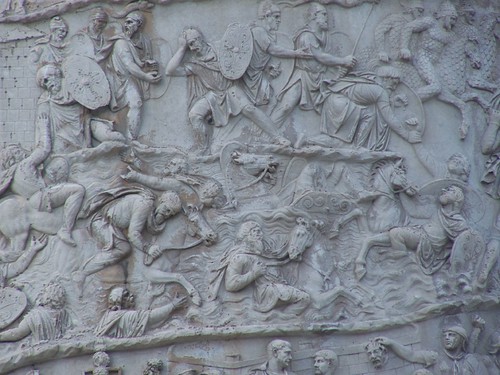
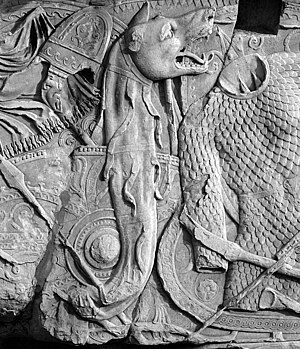
The Phrygian cap later known as a liberty cap is a soft conical cap with the apex bent over, associated in antiquity with several peoples in Eastern Europe and Anatolia, including Phrygia, Dacia, and the Balkans. By the 4th century BCE (early Hellenistic period) the Phrygian cap was associated with Phrygian Attis, the consort of Cybele, the cult of which had by then become graecified. At around the same time, the cap appears in depictions of the legendary king Midas and other Phrygians in Greek vase-paintings and sculpture. The Phrygian cap also came to be applied to several other non-Greek-speaking peoples ("barbarians" in the classical sense). Most notable of these extended senses of "Phrygian" were the Trojans and other western Anatolian peoples, who in Greek perception were synonymous with the Phrygians, and whose heroes Paris, Aeneas, and Ganymede were all regularly depicted with a Phrygian cap.
While the Phrygian cap was of wool or soft leather, in pre-Hellenistic times the Greeks had already developed a military helmet that had a similarly characteristic flipped-over tip. These so-called "Phrygian helmets" (named in modern times after the cap) were usually of bronze and in prominent use in Thrace, Dacia, Magna Graecia and the rest of the Hellenistic world from the 5th century BCE up to Roman times.
The Greek concept passed to the Romans and encompassed not only Phrygians but also the other near-neighbours of the Greeks. On Trajan's Column, which commemorated Trajan's epic wars with the Dacians, the Phrygian cap adorns the heads of Trajan's Dacian prisoners. Parthians appear with Phrygian caps on the 2nd-century CE Arch of Septimius Severus and Gauls in Phrygian caps are depicted on the 2nd-century CE friezes of the 4th century Arch of Constantine. In the tauroctony images of Roman Mithraism, the figures of the god Mithras as well as those of his helpers Cautes and Cautopates are routinely depicted with a Phrygian cap.
In later centuries, a Phrygian-looking cap became associated with liberty because of its resemblence to the Roman cap of liberty, the Roman pileus, a felt cap worn by manumitted (emancipated) slaves of ancient Rome, and an attribute of Libertas, the Roman goddess of liberty.
 |
| Figure of male with Phrygian cap, earthenware with painted decorations possibly from Palmyra, Syria, 1st-2nd century CE at the Royal Ontario Museum in Toronto, Canada. |
 |
| Paris of Troy wearing a Phrygian cap on a Roman sarcophagus dating to the Hadrianic period (117-138 CE) courtesy of Wikimedia Commons contributor Marie-Lan Nguyen. |
 |
| Three wise men" with Phrygian caps to identify them as "orientals" 6th-century, Basilica of Sant'Apollinare Nuovo in Ravenna, Italy courtesy of Wikimedia Commons contributor nina-no. |