An online magazine about current archaeology and classical research into the lives of inhabitants of the Roman Empire and Byzantium and the civilizations around them.
The Phrygian cap later known as a liberty cap is a soft conical cap with the apex bent over, associated in antiquity with several peoples in Eastern Europe and Anatolia, including Phrygia, Dacia, and the Balkans. By the 4th century BCE (early Hellenistic period) the Phrygian cap was associated with Phrygian Attis, the consort of Cybele, the cult of which had by then become graecified. At around the same time, the cap appears in depictions of the legendary king Midas and other Phrygians in Greek vase-paintings and sculpture. The Phrygian cap also came to be applied to several other non-Greek-speaking peoples ("barbarians" in the classical sense). Most notable of these extended senses of "Phrygian" were the Trojans and other western Anatolian peoples, who in Greek perception were synonymous with the Phrygians, and whose heroes Paris, Aeneas, and Ganymede were all regularly depicted with a Phrygian cap.
While the Phrygian cap was of wool or soft leather, in pre-Hellenistic times the Greeks had already developed a military helmet that had a similarly characteristic flipped-over tip. These so-called "Phrygian helmets" (named in modern times after the cap) were usually of bronze and in prominent use in Thrace, Dacia, Magna Graecia and the rest of the Hellenistic world from the 5th century BCE up to Roman times.
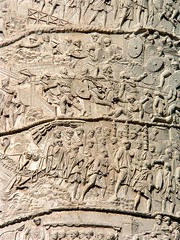
The Greek concept passed to the Romans and encompassed not only Phrygians but also the other near-neighbours of the Greeks. On Trajan's Column, which commemorated Trajan's epic wars with the Dacians, the Phrygian cap adorns the heads of Trajan's Dacian prisoners. Parthians appear with Phrygian caps on the 2nd-century CE Arch of Septimius Severus and Gauls in Phrygian caps are depicted on the 2nd-century CE friezes of the 4th century Arch of Constantine. In the tauroctony images of Roman Mithraism, the figures of the god Mithras as well as those of his helpers Cautes and Cautopates are routinely depicted with a Phrygian cap.
In later centuries, a Phrygian-looking cap became associated with liberty because of its resemblence to the Roman cap of liberty, the Roman pileus, a felt cap worn by manumitted (emancipated) slaves of ancient Rome, and an attribute of Libertas, the Roman goddess of liberty.
Figure of male with Phrygian cap, earthenware with painted decorations possibly from Palmyra, Syria, 1st-2nd century CE at the Royal Ontario Museum in Toronto, Canada.
Paris of Troy wearing a Phrygian cap on a Roman sarcophagus dating to the Hadrianic period (117-138 CE) courtesy of Wikimedia Commons contributor Marie-Lan Nguyen.
Three wise men" with Phrygian caps to identify them as "orientals" 6th-century, Basilica of Sant'Apollinare Nuovo in Ravenna, Italy courtesy of Wikimedia Commons contributor nina-no.
If you enjoyed this post, never miss out on future posts by following me by email!
There have been multiple theories proprosed for Trajan's war with Parthia that began in 113 Ce with the pretext that Rome disapproved of a puppet king placed on the throne of Armenia by the Parthians. Some scholars point to the propaganda value of an Eastern conquest that would emulate, in Roman fashion, those of Alexander the Great. An expansionist policy was supported by a powerful circle of conservative senators from Hispania, first among them being the all-powerful Licinius Sura as well. I've previously discussed theories about attempts to balance trade relations with India. Some scholars, though, think Trajan's original aims were purely military and quite modest: to assure a more defensible Eastern frontier for the Roman Empire, crossing Northern Mesopotamia along the course of the Khabur River in order to offer cover to a Roman Armenia. Whatever the motivation, Trajan succeeded in placing a client king on the Parthian throne and if he had lived to return to Rome, he probably would have celebrated a triumph.
Image: Relief depicting a deified Trajan's posthumous Parthian triumph in 118 CE, from Praeneste at the Museo Archeologico Nazionale Palestrina courtesy of Carole Raddato.
If you enjoyed this post, never miss out on future posts by following me by email!
Recently, I watched Dr. Steven Tuck's lecture on the Pompeii earthquake of 62 CE from his course "Pompeii: Daily Life in an Ancient Roman City" recorded for The Great Courses. Dr. Tuck mentioned that the Pompeii earthquake produced a tsunami that destroyed 200 of 300 grain ships in the harbor at Ostia (actually the newly constructed harbor subsequently named Portus). I was intrigued by this as Tacitus mentions a storm that destroyed 200 ships but does not seem to make the connection between the earthquake in Pompeii and that storm. Tacitus merely says they occurred in the same year.
Anyway, I was intrigued enough to research the history of Ostia further on JSTOR and stumbled across a research paper, "Nero's Quinquennium: The Ostian Connection", by Oxford scholar M.K. Thornton that appeared in the journal Historia in 1989. Although it made no mention of a tsunami-like phenomenon, Thornton mentions a quote by Trajan in which Trajan openly expresses profound admiration for Nero. I found this even more intriguing than verification of the tsunami. The quote was attributed to Trajan by Aurelius Victor and his Epitomator:
"...un merito Traianus saepius testaretur procul differre cunctos principes Neronis quinquennio." (Trajan quite often declared that all other emperors fell behind Nero in his quinquennium).
Apparently, this quote has puzzled scholars for over a century since Nero's moral shortcomings and political brutality are usually the focus of most scholarship. Thus we are regaled by stories of his initially bungled assassination of his mother, Agrippina the Younger, by collapsible boat and Nero's temper tantrum that ended in the death of his second wife, Poppaea Sabina, and unborn child. We hear of his ridiculous performances in Greece and his brutal persecution of the Christians in retribution for the Great Fire of 64 CE.
The Torches of Nero by Henryk Siemiradzki (1876). Image courtesy of Wikimedia Commons.
In fact, Nero's shenanigans are so extensive, Dr. Garrett Fagan must use three lectures to detail them in his course "Emperors of Rome" produced by The Great Courses. In contrast, Trajan who the Roman Senate voted "Optimus Princeps" and is widely recognized by scholars as one of the "good" emperors, warrants only one and a half.
So, what other aspects of Nero's reign could have prompted such an exclamation from a subsequent respectable emperor? Actually, there were a number of military conflicts, administrative challenges and major natural disasters that took place during Nero's rather short, less than 14-year, reign that was resolved successfully despite Nero's obvious moral shortcomings. Nero did not spend all of his time conspiring to murder his relatives or practicing his lyre.
Thornton discovered this question has confounded scholars since the early 20th century. He also found that the first problem that arises when attempting to resolve this issue is identifying the time period Trajan was referencing. Some scholars point to the first five years of Nero's reign when he was under the close supervision of his tutor Seneca the Younger and the aged Praetorian Prefect Sextus Afranius Burrus, considered a creature of Nero's mother Agrippina. Therefore, they dismiss any favorable outcomes attributable to Nero himself. However, an early 20th-century scholar, Professor F. Haverfield, one of the references cited by Thornton, points to the first five years of Nero's reign after Burrus died (presumably of natural causes) and Seneca resigned his court position as the period Trajan may have been referencing.
In his article "Trajan on the Quinquennium Neronis" that appeared in the 1911 Vol. 1 Issue of The Journal of Roman Studies, Professor Haverfield explains, "...Nero himself tried to divide his reign up into quinquennia by establishing in 60 a quinquennale ludicrum (Tac. Ann. xiv, 20,21) and repeating it in 65 (Ann. xvi, 2). As the second lustrum was not concluded before his death, it might be held that the period 60-65 was his [first] quinquennium."
Haverfield and his co-author J.G.C. Anderson are both convinced Trajan's admiration is directed at Nero's building programs based on a strict translation of Trajan's entire quote, in particular, the qualification "augenda urbe maxime". They dismiss a natural interpretation, "enlarging the city", pointing out "augere" may denote an increase not only in size but also greatness, splendor, and dignity of the city.
I personally agree with this point and would take this interpretation a step further since most Romans viewed their city as representative of the empire as a whole. Therefore I would include not only his building projects but his management of imperial business as well.
Looking at the years 60 - 65, we see that Nero's handling of the Boudiccan Revolt (60-61 CE) resulted in the successful retention of Britannia as a province. In 62 we know from Dr. Tuck's lecture that Nero must have successfully developed a strategy to relieve any loss of Rome's food supplies and fleet from the catastrophic tsunami that destroyed 200 ships in the newly constructed harbor at Ostia and caused another 100 ships in the Tiber to catch fire. We also know Poppaea Sabina became Nero's consort in 62 and had close family connections to Pompeii, (her villa in Oplontis still exists and is a fascinating archaeological site with many frescoes still in situ!). She would have undoubtedly insisted Nero send aid to Pompeii after its devastating earthquake and assist in its reconstruction. Dr. Tuck tells us the Pompeii quake was of a magnitude roughly equal to that of the catastrophic 1906 San Francisco earthquake. So aid sent to Pompeii would have had to have been comprehensive and very expensive.
From 58 - 63 Nero, through his talented general Corbulo, deflected an attempt by Parthia to wrest control of Armenia away from the Romans and ultimately resolved the conflict by placing a brother of the Parthian king Vologases I on the Armenian throne. However, the agreement included the requirement that Tiridates I swear allegiance to and be crowned by Nero as a Roman client king. Although some scholars dismiss this agreement as relatively short-lived (50 years), it forestalled any major confrontations with the Parthians until the Roman appointed Armenian king was deposed in 113 CE and the Parthians placed the nephew of then disputed Parthian King Osroes I on the throne. This resulted in Trajan's invasion of Parthia in 114 CE.
Rome and Parthia were the two great super powers in the region during this period. The U.S. government has certainly never been able to accomplish a period of peace lasting that long. So, I would not dismiss this accomplishment so readily.
Although Nero was not a military man, he still expanded the empire during his reign as well. In 63 CE Pontus Polemaniacus was formally annexed into the empire as a new Roman province. Between 63 and 66 CE the Cottian Alps was annexed as well.
Then in 64 CE, The Great Fire devastated Rome. Tacitus tells us of Rome's 14 districts, three districts were levelled to the ground, seven districts had only a few shattered, half-burnt relics of houses remaining, and only three escaped damage. Nero managed the aftermath of the Great Fire and began rebuilding the city on a plan that not only enhanced the city's appearance but made it easier to defend from future conflagrations.
Of Rome meanwhile, so much as was left unoccupied by his mansion, was not built up, as it had been after its burning by the Gauls, without any regularity or in any fashion, but with rows of streets according to measurement, with broad thoroughfares, with a restriction on the height of houses, with open spaces, and the further addition of colonnades, as a protection to the frontage of the blocks of tenements. These colonnades Nero promised to erect at his own expense, and to hand over the open spaces, when cleared of the debris, to the ground landlords. He also offered rewards proportioned to each person's position and property, and prescribed a period within which they were to obtain them on the completion of so many houses or blocks of building. He fixed on the marshes of Ostia for the reception of the rubbish, and arranged that the ships which had brought up corn by the Tiber, should sail down the river with cargoes of this rubbish. The buildings themselves, to a certain height, were to be solidly constructed, without wooden beams, of stone from Gabii or Alba, that material being impervious to fire. And to provide that the water which individual license had illegally appropriated, might flow in greater abundance in several places for the public use, officers were appointed, and everyone was to have in the open court the means of stopping a fire. Every building, too, was to be enclosed by its own proper wall, not by one common to others. These changes which were liked for their utility also added beauty to the new city. - Tacitus, Annals, Book XV
A fresco from Nero's Domus Aurea (Golden House). Image courtesy of Wikimedia Commons.
I knew Nero had thrown open public buildings and even his own garden to refugees from the fire but I was surprised to read in "Nero: The Man Behind The Myth" by Richard Holland that Nero took over personal leadership of the vigiles (firefighters).
"Nero now took over personal leadership of these already exhausted men, whose prefect, until recently, had been Tigellinus. The young Emperor was to be seen rushing about the city, directing operations by day and night, unprotected by his usual armed guards, whom he had presumably already pressed into temporary service as firefighters, along with any other able-bodied men he could find." - Richard Holland, "Nero: The Man Behind The Myth".
Doesn't sound much like fiddling while Rome burned, does it?
Unfortunately, I have been unable to find any ancient references to this account in the translations of Tacitus, Suetonius or Cassius Dio I have read so I'm not sure who Holland used for a source.
Nero also had to manage a plague that struck Rome and claimed 30,000 victims. Suetonius is the only source for this incident and we're not sure when it occurred other than "one autumn". But it would certainly have been a real possibility following the fire when so many people were forced to live in cramped temporary dwellings while awaiting reconstruction
In 64 CE Nero also issued a coin memorializing the completion of the great new harbor at Ostia. The harbor was begun by his adopted father Claudius in 42 CE and some scholars scoff that it was almost complete when Claudius was assassinated and Nero simply took credit for it. But, we know from Tacitus (Ann. 15.18.3) that in 62 CE a terrible storm destroyed 200 ships anchored in the new harbor and most certainly must have done tremendous damage to the harbor itself as well. This would account for a rather delayed recognition of the completion of this project.
Portus: Claudius' first harbor and hexagonal basin extension under Trajan Image courtesy of Wikimedia Commons
Thornton points out, "...Nero obviously credited himself with much of the construction: he placed the harbor of Ostia on his coins as a symbol of his reign. He would be unlikely to do that if he could not convincingly claim it as his own contribution. Trajan's remark must be construed as showing that in the minds of the Romans Nero should get credit for the harbor than we today might be inclined to give him." - - M. K. Thornton, Nero's Quinquennium: The Ostian Connection
Thornton is convinced it is the harbor at Ostia that evoked the admiring quote from Trajan.
"Who else built a harbor? Trajan did. Not only the one at Ostia but a number of others; Nero also built a harbor at Antium and was interested in other waterways which would improve the obtaining of the food supply. Trajan, having built the more easily constructed second and smaller harbor at Ostia would respect Nero's accomplishment in building the first and far more difficult outer harbor, without which the inner harbor would have been impossible. Trajan knew first hand that the building of the harbor was a difficult task. His admiration for Nero came honestly from a deep appreciation of a very large task well done." - M. K. Thornton, Nero's Quinquennium: The Ostian Connection
But then Thornton goes on to dismiss other achievements mentioned by Aurelius Victor in the complete Trajan quotation as mere citations of other accomplishments of Nero, not necessarily within his first five years. I disagree. I think Trajan, speaking out of genuine respect for Nero's multiple administrative achievements, probably considered the first five years of Nero's reign after the death of Claudius as more of a regency period rather than Nero's own. So Trajan viewed Nero's first quinquennium as really 60 - 65 CE.
Reviewing the almost overwhelming events of those five years, I no longer find Trajan's quote puzzling at all!
References:
Thornton, M. (1989). Nero's Quinquennium: The Ostian Connection. Historia: Zeitschrift Für Alte Geschichte,38(1), 117-119. Retrieved from http://www.jstor.org/stable/4436096
Victor, A. De Caesaribus.
Anderson, J., & Haverfield, F. (1911). Trajan on the Quinquennium Neronis. The Journal of Roman Studies,1, 173-179. doi:10.2307/295862
Tacitus, C. Annals. multiple references.
Holland, R. (2000). Nero: the man behind the myth. Stroud: Sutton.
If you enjoyed this post, never miss out on future posts by following me by email!
"The princes who by their birth or their adoption belonged to the family of the Caesars, took the name of Caesar. After the death of Nero, this name designated the Imperial dignity itself, and afterwards the appointed successor. - Footnote, Gibbon's Decline and Fall of the Roman Empire
However, scholars in Gibbon's time were unsure of the exact point in the Roman succession that the name transitioned to an imperial title.
Augustus as Pontifex Maximus
photographed at the Palazzo
Massimo in Rome by Mary
Harrsch.
"The time at which it was employed in the latter sense, cannot be fixed with certainty. Bach (Hist. Jurisprud. Rom. 304) affirms from Tacitus, H. i. 15, and Suetonius, Galba, 17, that Galba conferred on Piso Lucinianus the title of Caesar, and from that time the term had this meaning:but these two historians simply say that he appointed Piso his successor, and do not mention the word Caesar. [Actually, Galba himself assumed the title "Servius Galba Imperator Caesar" then passed it on by adoption to his successor.]
Aurelius Victor (in Traj. 348, ed. Artzen) says that Hadrian first received this title on his adoption; but as the adoption of Hadrian is still doubtful, and besides this, as Trajan, on his death-bed, was not likely to have created a new title for his successor, it is more probable that Aelius Verus was the first who was called Caesar when adopted by Hadrian. Spart. in Aelio Vero, 102.- W." - Footnote, Gibbon's Decline and Fall of the Roman Empire
Adoption certainly accounts for Augustus, who was adopted by Julius Caesar, and Tiberius, who was subsequently adopted by Augustus. Claudius assumed the name of Caesar upon accession without previous adoption but he was a direct descendant of Caesar's bloodline. Claudius later adopted Lucius Domitius Ahenobarbus (Nero) thus transmitting the name Caesar to him. So Gibbon's initial observations are correct. However, Gibbon seems to become a bit confused with the successions occurring in the Year of the Four Emperors.
Roman emperor Otho in 69 CE.
Photographed at The Louvre in Paris
by Mary Harrsch.
"Galba's reign did not last long and he was soon deposed by Marcus Otho. Otho did not use the title "Caesar", but occasionally used the title "Nero" as emperor. Otho was then defeated by Aulus Vitellius who acceded with the name "Aulus Vitellius Germanicus Imperator Augustus." Vitellius did not at first adopt the cognomen "Caesar" as part of his name, and may have intended to replace it with "Germanicus" (he bestowed the name "Germanicus" upon his own son that year).
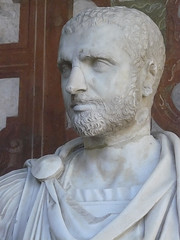
Publis Septimus Geta 3rd century CE.
Photographed at the Palazzo Altemps
in Rome by Mary Harrsch.
Nevertheless, Caesar had become such an integral part of the imperial dignity that its place was immediately restored by Titus Flavius Vespasianus ("Vespasian"), whose defeat of Vitellius in 69 [CE] put an end to the period of instability and began the Flavian dynasty. Vespasian's son, Titus Flavius Vespasianus became "Titus Caesar Vespasianus". - Wikipedia
Following the Flavians, the emperor Nerva assumed the title as well then passed it on through adoption to his heir Caesar Nerva Traianus who, supposedly, adopted his heir Hadrian, passing the title to him. At this point our path once more converges with Gibbon.
I thought it was also interesting to read that to further distinguish the use of the name to designate the imperial heir, the title Nobilissimus (meaning "most noble") was added in the 3rd century CE beginning with Publius Septimius Geta.
If you enjoyed this post, never miss out on future posts by following me by email!
When I got my five minutes worth of Gibbon today, I noticed his description of the Dacians in Trajan's time. Although it's true that the Dacians of the early 2nd century believed in an immortal soul, they were one of the last Roman provinces to accept Christianity, not doing so until the 5th century CE. Instead, the Dacians believed in a complex religious hierarchy with its priests divided into orders of “god-worshipers”, “smoke-walkers” and “founders”. Their supreme deity was known at different times as Zalmoxis,Gebeleïzis and Darzalas.
A Dacian draco standard
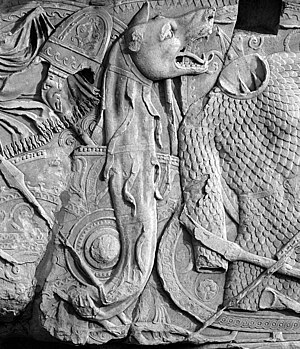
According to the historian Mircea Eliade, wolves played an important role in Dacian mythology and secret societies of young warriors were said to engage in activities in which they imitated a wolf's behavior while wearing wolf skins. It may be from these rituals that legends of lycanthropy have been derived in the Balkans-Carpathian region. Their use of wolf symbolism is beautifully rendered in this relief depicting a Dacian draco standard capped with a ferocious-looking canine.
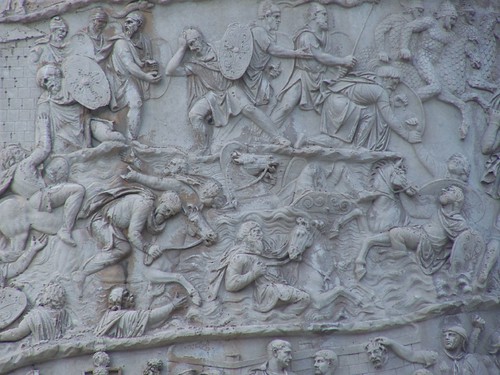
The relief also depicts the long-sleeved scale armor worn by wealthier Dacian warriors and their mounts as we see in the image from Trajan's column above left.
I noticed when I researched their religion that the Dacians were sometimes considered interchangeable with the Getae, although Strabo seemed to distinguish between the two. Whenever I think of the Getae, I envision the savage, almost inhuman warriors depicted in the pilot episode of "Spartacus: Blood and Sand". If the Getae (Dacians) were that wild in the 70s BCE, they obviously underwent a considerable social transformation before opposing Trajan in 101 CE.
If you enjoyed this post, never miss out on future posts by following me by email!
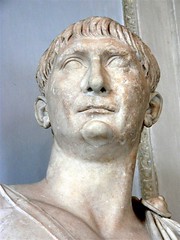
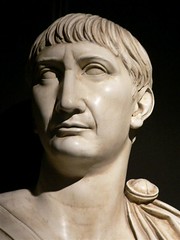
The second century Roman
Emperor Trajan. Photo by
Mary Harrsch.
Although remnants of some of the first aqueducts dating to the early Iron Age have been found in the Middle East, the Romans brought aqueduct engineering to an art form beginning with the Aqua Appia, built in 312 BCE. At the height of the Roman Empire, the city of Rome, with inhabitants numbering an estimated one million people, was served by over 500 miles of aqueducts. But, by the time of Trajan, the so-called"Optimus Princeps", the Romans' complex system of water delivery was falling into disrepair.
"...the existing aqueducts at that time came from the east of Rome, the sources were from rivers or springs providing water that carried dissolved salts that were deposited inside and eventually blocked the pipes and ducts, and also sometimes carried very large amounts of silt that blocked the ducts and reduced the water flow." - AqueductHunter.com
So Trajan commissioned his magistrate of public works, Sextus Julius Frontinus, to construct a new aqueduct sourced by fresh water springs distributed in the mountains around the volcanic lake known as the Lacus Sabatinus, known today as Lake Bracciano.
The Aqua Traiana was inaugurated in 109 CE and is thought to have supplied water to Trajan's new bath Remains of the Baths of Trajan. Image via Wikipediacomplex, a naumachia (entertainment complex where mock naval battles were reenacted) in the area that would become later known as the Vatican and grain mills high on the Janiculum Hill.
The Aqueduct arrives in Rome at the top of the Janiculum Hill at a high level above the city. In order to reach Trajan's Baths on the top of the Colle Oppio and the storage cisterns known as the Sette Sale, the aqueduct probably crossed the river Tiber on a large stone bridge or just possibly under the river in a syphon made with lead pipes.
The archaeologist Prof. Rabun Taylor from the University of Texas proposes that the aqueduct crossed the tiber on a high stone structure close to the Children's Hospice building at the Porto di Ripa Grande, and curved around the Aventine Hill before turning north towards the Colle Oppio, the hill adjacent to the Colosseum, and the site of Trajan’s baths. Some evidence of the structural arches can be seen on the 1551 map of Leonardo Buffalini. - AqueductHunter.com
The system would serve Rome, despite sporadic damage from various barbarian incursions, until the 9th or 10th centuries. Later, it would berestored in 1612 by Pope Paulo V (Borgese) and renamed the Aqua Paola.
"Various Cardinals were sent to the Lake Bracciano area to investigate the strength and value of the local water sources throughout the sixteenth century, and the result was the deed of purchase by Pope Paul V of most of the sources which had comprised the Aqua Traiana."
"However some veins of the aqueduct were specifically excluded from the purchase because by then they were supplying water for other purposes. Specifically the Aqua della Fiora was being used to supply the Bracciano grain mill which the local Duke, Paolo Giordano Orsini had caused to be constructed at Vigna Grande in 1578...The result was an aqueduct with a significantly lower yield than in Trajan’s day."
"...in its first incarnation [the Aqua Paola] was not nearly as copious as in Trajan's time, and by 1673, it was supplemented instead by dirty lake water.
For this reason, in modern Roman slang, something or someone of dubious worth is sometimes referred to as 'as good as the Acqua Paola'."- AqueductHunter.com
At some point a small church was built over one of the primary sources of water for the Aqua Traiana nearLake Bracciano and obscured the Roman constructions beneath it. But it was shown on a map from the year 1718 and it was this map found in the state archives, that peaked the interest of modern day aqueduct hunters, UK filmmakers Ted and Mike O'Neill, Lorenzo Quilici, Professor of Topographyat the University of Bologna, professor and historical map scholar Allan Ceen, archaeologistRaybun Taylor and Katherine W. Rinne, adjunct professor of architecture at the California College of the Arts. The group then decided to collaborate on a project to explore and film the second century Roman remains.
They have published much of their findings and images of their discoveries on their website AqueductHunter.com. It's a fascinating read and I encourage you to explore the site fully. The team is not sponsored by any particular institution so if you wish to become involved in their work, they welcome contributions or corporate or academic sponsorship.
Their initial explorations are also documented in the film clip below.
I just finished an extensive review of Steven Saylor's new novel "Empire" and posted it to my Books and Novels of the Ancient World blog. The novel follows the fictional patrician Pinarii family from the late Augustan Age to the reign of Hadrian with particularly fascinating "behind the scenes" exploration of the reigns of Nero and Domitian. I found the novel so fascinating that I spent hours on supplemental research after I finished reading it to learn more about some of the personalities introduced in the novel that I knew very little about. I highly recommend it! Five Stars!!
If you enjoyed this post, never miss out on future posts by following me by email!
An interesting reference to Roman clashes with the Jews on Cyprus during Trajan's reign:
[Photo: My image of a bust of Trajan at the Capitoline Museum in Rome. All of my images are freely available for noncommercial use with attribution on Flickr]
"Under Roman rule Cyprus remained in peace or "pax romana" as it was known for over three hundred years until 115 AD. At this time the Jews inspired by a belief that the coming of their Messiah was imminent started a revolt against Rome on the Island. They were led by a man called Atermion a Jew who had taken a Greek name as was the custom at the time. There were hardly any Roman troops stationed in Cyprus at this time which explains why the revolt grew so quickly. The Roman emporer Trajan dispatched one of his generals to the Island and the rebellion was quelled. Historians say that 24,000 Jews were massacred on the Island by this roman army but there is a likelyhood that the actual numbers were significantly less. Following the revolt a decree was issued that Rome would forbid any Jew to ever set foot in Cyprus ever again even if shipwrecked." - Destinations
Livius.org gives us much more details:
The revolt started in Cyrene, where one Lukuas -sometimes called Andreas- ordered the Jews to destroy the pagan temples of Apollo, Artemis, Hecate, Demeter, Isis and Pluto, and to assail the worshippers. The latter fled to Alexandria, where they captured and killed many Jews. (With a population of some 150,000 Jews, Alexandria was Judaism's largest city.) In 116, the Jews organized themselves and had their revenge. The temples of gods like Nemesis, Hecate and Apollo were destroyed; the same fate befell the tomb of Pompey, the Roman general who had captured Jerusalem almost two centuries before.
Meanwhile, the Cyrenaican Jews plundered the Egyptian countryside, reaching Thebes, six hundred kilometers upstream. The future historian Appian of Alexandria records that he made a providential escape from a party of Jews pursuing him in the Nile marshes (more...). There was nothing the Roman governor Marcus Rutilius Lupus could do, although he sent a legion (III Cyrenaica or XXII Deiotariana) to protect the inhabitants of Memphis.
Trajan sent out two expeditionary forces. One, consisting of VII Claudia, restored order on Cyprus; the other was to attack Lukuas' rebels and was commanded by Quintus Marcius Turbo. The Roman general sailed to Alexandria, defeated the Jews in several pitched battles and killed thousands of enemies, not only those in Egypt but also those of Cyrene. It is unclear what became of Lukuas, except for the fact that according to our Greek source Eusebius he had styled himself 'king' (= Messiah?). After this war, much of northern Africa had to be repopulated. The emperor Trajan and his successor Hadrian confiscated Jewish property to pay for the reconstruction of the destroyed temples.
Trajan was afraid that this revolt would spread to the Jews in the rebellious eastern provinces. Perhaps, there was some cause for his anxiousness. After the end of the revolt in Mesopotamia, someone had written the Book of Elchasai, in which the end of the world was predicted within three years. Of course, Trajan did not read this book, but he may have sensed that the Jews remained restless.
Therefore, he ordered the commander of his Mauritanian auxiliaries, Lusius Quietus, to clean the suspects out of these regions. Quietus organized a force and killed many Cypriote, Mesopotamian and Syrian Jews - in effect wiping them out; as a reward, he was appointed governor of Judaea. (He is one of the few blacks known to have made a career in Roman service.) He was responsible for a forced policy of hellenization; in response, the rabbis ordered the Jewish fathers not to teach their sons Greek (Mishna Sota 9.14).
Meanwhile, Trajan had reached his military aims and returned home. On his way back, he fell ill, and not much later, he died (8 August 117). His successor Hadrian gave up the newly conquered countries and dismissed Lusius Quietus, who was killed in the Summer of 118."
We are supplied with the following sources:
The revolt against Trajan is the subject of a book by Marina Pucci, La rivolta Ebraica al tempo di Traiano (1981 Pisa). Another discussion of this rebellions can be found in Gedaliah Alon's The Jews in their land in the Talmudic age (1980 Harvard).
If you enjoyed this post, never miss out on future posts by following me by email!
Archaeologists want to use light to recreate the brilliant colors once seen on Trajan's Column in Rome.
The chaste white of Roman temples and monuments is a product of centuries of wear that has removed the original paint. The archaeology department in Rome is discussing the technical details of creating a light beam that would temporarily repaint the column, with the power company Acea and researchers at Rome University, the Italian news agency Ansa reported.
Under the plan, the column would be illuminated on weekends for a few minutes every hour.
''Nothing acts like light to deepen our understanding, activating our emotional brain,'' said Maurizio Anastasi, head of the technical office in the city archaeology department.
If you enjoyed this post, never miss out on future posts by following me by email!
Roman mosaics are among my favorite art forms so this article made me shudder.
"Police seized some 1,000 ancient artifacts from a wealthy Italian man's country house outside Rome that were stolen from one of Emperor Trajan's villas, prosecutors said Wednesday.
Authorities contend the artifacts, which were being used to decorate the man's weekend residence, were ripped off the walls of what is believed to be Trajan's hunting retreat in Arcinazzo Romano, a town in the countryside outside Rome.
Some were stolen from boxes of fragments that archaeologists had excavated from the villa but had left at the site of the ongoing dig, prosecutors told a news conference.
Pieces of ancient Roman mosaics were inserted into the man's basement floor and his fireplace and bathroom were decorated with other pieces, authorities said.
Many of the artifacts were damaged by glue that he apparently used to stick them to transparent display supports, said Marina Sapelli Ragni, Lazio's superintendent for archaeology. Restorers would try to repair the damage, she said.
Among the loot are pieces of marble that once covered the sprawling villa in the upper Aniene River valley in Lazio. The villa has only been partially excavated."
If you enjoyed this post, never miss out on future posts by following me by email!








 I just finished an