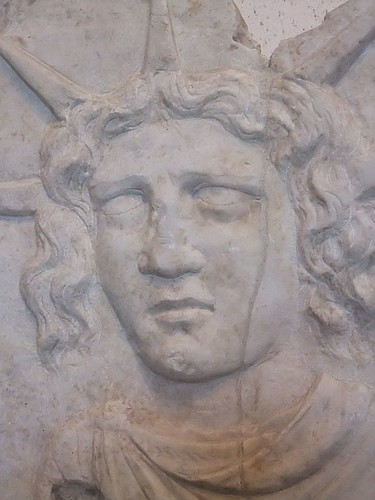
A historical resource article by Mary Harrsch © 2017
Writing sometime between AD 307 and AD 310, an anonymous Gallic panegyrist recorded that Constantine witnessed a pagan theophany of
Apollo accompanied by Victory, offering him laurel wreaths. This vision took place just two years prior to Constantine’s more famous reputed vision of a "trophy of the cross arising from the light of the sun, carrying the message,
In Hoc Signo Vinces or 'with this sign, you shall conquer', on the sixth of the kalends of November [i.e. the 27th of October], 312 CE.
 |
The Roman emperor Constantine I photographed
at the Capitoline Museum by Mary Harrsch © 2009 |
Scholars have argued about the veracity of Constantine's famous Christian theophany for hundreds of years. Believers ask why would Constantine embrace a religion whose followers represented only about 10 percent of the total population of the Roman Empire if some miraculous experience had not occurred?
Well, as a pragmatist, I think we need to examine the socioeconomic context of the period to determine if Constantine's actions were those of true devotion or, in reality, political desperation. I will explore the state of Rome's precious metal supplies during the period prior to Constantine's "conversion", sharp decreases in revenue from loss of manpower and productivity from recurring violence and plague, trade disruptions, and large payments made to threatening forces. I will also discuss the attributes of Christianity that appealed to the powerful and made it a candidate for political exploitation.
The time period I will be discussing will, for the most part, cover the period from the middle of the second century CE to the early 4th century CE. This is the period when Christianity started gaining momentum with the production of written scriptures and development of a patriarchal bishopric. Before this time, Christian spiritual experiences were merely shared orally in private homes and
egalitarianism was emphasized instead.
So, let us begin.
"Early Christianity was tiny and scattered. No precise figures survive, but best estimates suggest that there were considerably fewer than ten thousand Christians in 100 CE, and only about two hundred thousand Christians in 200 CE, dispersed among several hundred towns. The late-second-century figure equals only 0.3 percent of the total population of the Roman Empire (which was about 60 million)... The very small size of Christianity helps explain why the Roman state paid so little attention to suppressing it effectively. And the tiny size of early Christianity, relative to the empire's population, helps explain why the central Roman government for so long ignored the potential dangers which Christianity eventually posed to pagan civic religions and to the political system which they supported." -
Keith Hopkins, A World Full of Gods
So what changed so dramatically?
The Roman Empire was built upon military conquest which fueled the Roman economy with plunder, slaves and the acquisition of sources of key materials including precious metals.
"Under the
Principate the Iberian peninsula [modern day Spain and Portugal] constituted the most productive mining area of the Roman Empire. The full range of minerals was available, and exploited: gold, silver, copper, lead, tin, iron, mercury, cinnabar, sulphur and zinc...The north-west of the Iberian peninsula (
Gallaecia and
Asturia) was one of the richest gold fields known to the Romans, and its exploitation commenced soon after the final conquest of the area under
Augustus. Gold was obtained in three different ways: from low-lying
placer deposits of gold found in the silt or gravels of rivers, from high-level alluvial terraces (where the gold-bearing gravels had been forced up from the bottom of the river valley into terraces by erosion) and from hard-rock mineral deposits of gold.
Pliny talks of 20,000 lb. of gold accruing to the Roman state per year from Asturia, Gallaecia and
Lusitania from alluvial terraces alone. To this must be added gold obtained from hard-rock deposits and from placer-mining. According to a recent estimate one valley alone (the
Duerna) produced 3,000 kg of gold per annum for 130 years; in total it is estimated that the north-west provided approximately seven percent of state revenue under the Flavians." - J. C. Edmondson,
Mining in the Later Roman Empire
Edmondson tells us the mining in this region was so complex it had to be managed by a special
equestrian procurator who was assisted by imperial freedmen known as
procuratores metallorum and a sizeable military contingent. But, how long were these activities productive?
"In general the period of greatest production was from the mid-first century A.D. to the start of the third century, as recent excavations and field survey in the Duerna valley and at El Caurel suggest. Similarly, gold mines in northern Portugal (for example, Trêsminas and Jales) came into operation in the Augustan period, but the earliest pottery forms found in any abundance date to the third quarter of the first century A.D.; evidence is lacking for any exploitation after the start of the third century. The phasing out of the procuratorship of Asturia and Gallaecia at the start of the third century is seen as further confirmation of a decline in mining productivity. Thus, the consensus of scholarly opinion is that mining had effectively ceased [in this region] by the mid-third century." - J. C. Edmondson
Edmondson points out, however, that archaeological evidence for early fourth century resettlement in mining zones such as Corona de la Quintanilla, and isolated finds of late Roman coins minted by Constantine in Poço dos Romanos, Valongo, and northern Portugal is often overlooked. But, could this resurgence of limited activity be an indicator of a dearth of precious metals and soaring values in the early fourth century that prompted attempts to extract what would have been deemed economically unfeasible earlier in the Empire?
Similar evidence has been found in the silver and copper mining sites in the Andalusian Mountains.
"A decline sets in after A.D. 160-70. This has been plausibly attributed to the Moorish invasions of the 170s, which caused the temporary loss of Roman administrative control over southern parts of
Baetica and Lusitania...The conclusion to be drawn from the archaeological evidence is traditional, but seems consistent: namely that the apogee of large-scale mining of gold, silver and tin in the Iberian peninsula occurred during the first and second centuries A.D." - J. C. Edmondson, Mining in the Later Roman Empire
But the Iberian peninsula was not the only source of precious metal in the far flung Empire. What was happening elsewhere?
 |
| Some of the workforce in Roman mines were convicted criminals but not all. Epigraphic evidence reveals both free and freedmen worked the mines as well. Public domain image. |
Dacia, the next most important source of gold after northwest Spain, was lost to Rome in 270.
In Britain the
Dolaucothi gold mines were worked intensively from soon after the conquest under
Claudius until the
Antonine period, but numismatic evidence suggests only spasmodic exploitation took place thereafter. In the silver mining zone of Laurium in
Attica, late Roman mining lamps datable to the fifth and sixth centuries have been found as well as evidence of the resmelting of slag, but large scale mining ended during the reign of Augustus.
 |
Large scale mining operations required a military contingent
for security. Public domain image. |
"...Pliny talks of discoveries of gold in
Dalmatia during the reign of
Nero, while archaeological evidence exists for gold mining (both hard-rock and alluvial workings) in central
Bosnia, but unfortunately does not provide any precise dating criteria. However, in western Bosnia numismatic evidence suggests that iron, lead and copper were exploited in the third and fourth centuries, while in eastern Bosnia the argentiferous lead mines of the Drina valley have provided epigraphic evidence for their continued operation in the later third century. Thus Dalmatia is one area where mining (possibly including gold mining) continued into the later Roman Empire." - J. C. Edmondson
But, although large scale exploitation of fluvial gold took place in Serbia in Roman Dalmatia from the reign of Hadrian, mining seems to have ceased during the political upheavals and Gothic invasions of the mid-third century.
So, did all of these ore deposits simply become exhausted? In some instances, that was the case. Edmonson points out that the gold mines of Mt. Timolus in Asia Minor became totally exhausted during the reign of Augustus. But at other sites it was often a matter of higher quality, ores existing closer to the surface becoming exhausted. Deeper veins of ore that required much more labor and higher expenses for adequate ventilation and drainage were simply not profitable enough to exploit. Activities to support large-scale mining also faced shortages.
"Enormous quantities of charcoal were required to smelt raw ore into usable metal," Edmonson observes. "Over the years this will have caused substantial deforestation around the mines and, as local sources became exhausted, increasing problems of supply from outside the mining zone."
These supply problems were further exacerbated by warfare and aggressive banditry, both activities that increased dramatically during the third century.
"If production was concentrated in just one place, this would have made it an obvious target during barbarian invasions, " Edmondson observes.
Mining is also labor intensive. A decrease in available workers was another problem that plagued large-scale mining operations in the later Roman Empire.
"...Principate peoples were transported some distance to work in mines," Edmonson points out, "That there was a shortage of mining labour in the later Roman Empire is suggested by those legal measures taken by Roman emperors at the end of the fourth century not only to stem the flow of runaway miners, but also to tie the sons of miners to the profession of their fathers."
In addition to human losses from the aforementioned warfare and brigandage, widespread, repeated waves of extremely virulent pestilence swept over the Empire in the late second and third centuries as well. One of the most devastating episodes has been dubbed the Antonine Plague because it first occurred during the reign of
Marcus Aurelius and co-emperor
Lucius Verus.
In their paper "
Galen and the Antonine Plague", R. and M. Littman theorize that the pestilence involved was probably hemorrhagic smallpox based on the symptomology described, albeit incompletely, by Galen.
Cassius Dio reported up to 2,000 people perished each day in just the city of Rome itself in a later flareup in 189 CE.
"The mortality rate in a particular city would be affected by such factors as crowding, sanitary conditions, season of the year, severity of secondary infections which accompany the plague in a particular place, the methods with which the city may deal with the plague and also pure chance." - R. and M. Littman
To try to estimate the plague's impact on remote mining districts would be even more difficult. I do think the mining districts would be particularly vulnerable to an outbreak of pestilence, though, due to the transient nature of their workforce that regularly included imported convict labor. Living conditions for them would have been cramped and probably unsanitary, too. We also know little about the level of medical care, if any, that may have been provided. Although the Littmans estimate an average mortality rate across the entire Empire at approximately 13 - 15 percent, they point out that an individual outbreak of smallpox could have a mortality rate of nearly 80 percent if the more virulent forms of the disease predominated.
 |
| The Antonine plague has been compared in severity to the plague of the Athens in 430 BCE. Public domain image. |
What the precise mortality rate was may never be known for certain, but the Antonine plague resulted in a catastrophic destabilization of the Roman military, widespread famine, disruption of trade routes and trading activities, and a dramatic loss of tax revenue. Military recruitment records from Egypt reveal sons of soldiers were heavily drawn upon to augment their shrinking ranks and army discharge certificates from the Balkan region suggest that there was a significant decrease in the number of soldiers there who were allowed to retire from military service during this period. Egyptian tax documents from
Oxyrhynchus and the
Faiyum clearly reflect significant population decreases in Egyptian cities. Archaeology has confirmed this.
"At Augstodunum the inhabited area before its destruction by
Tetricus had amounted to two-hundred hectares; as rebuilt by
Constantius, it was only ten. That of Bordeaux had been reduced from about seventy hectares to twenty-three, and the reduction in other cases as well over half. Such changes could only have been the result of a vast diminution in population, even if proper allowance is made for possible congestion within the fortified areas."
"Egypt had been relatively safe from invasion and civil war; but as early as A.D. 260 Alexandria seems to have lost about sixty percent of her earlier population..." C.E. Van Sickle,
Diocletian and the Decline of the Roman Municipalities
"Epigraphic and architectural evidence in Rome indicate that civic building projects — a significant feature of second-century Rome's robust economy —came to an effective halt between 166 and 180. A similar pause in civic building projects shows up in London during the same period." - Sarah K. Yeomans,
The Antonine Plague and the Spread of Christianity
The Antonine plague was followed in the mid-Third Century by the
Cyprian plague, so-called because it was the topic of
De mortalitate, a work penned by a bishop from Carthage named
Cyprian. Thought now to be an outbreak of hemorrhagic fever or even a filovirus such as Ebola, ancient sources that include
Zosimus claim at its peak it laid waste to 5,000 people per day in the city of Rome and claimed the life of two Roman emperors,
Hostilian in 251 CE and
Claudius II Gothicus in 270 CE.
"The period in between the emperors witnessed political instability as rivals struggled to claim and hold the throne. The lack of leadership and the depletion of soldiers from the ranks of the Roman legions contributed to the deteriorating condition of the empire by weakening Rome's ability to fend off external attacks. The widespread onset of illness also caused populations in the countryside to flee to the cities. The abandonment of the fields along with the deaths of farmers who remained caused the collapse of agriculture production. In some areas, swamps re-emerged rendering those fields useless." - John Horgan,
Plague of Cyprian, 250 - 270 CE
So, due to a multitude of factors, it would appear the supply of precious metals decreased to a trickle by the third century. Furthermore, many of the causes that resulted in the decrease of precious metal production also resulted in a precipitous drop in production of all goods including foodstuffs and their related taxes, the Roman administration's main source of income.
"For the Roman Empire, it has been estimated that up to three-quarters of the population was working in the agricultural sector: the possession of agricultural land was therefore the most important source of wealth; and this makes it perfectly logical that the fiscal burden principally fell on the land...tax on agricultural land fulfilled to a large extent the needs of the Roman government...This money was mainly spent by the Roman government in the purchase of military equipment, the provisioning of the army (if stationed in a province with poor agricultural resources), donativa for the army and the people of Rome, the construction of public buildings for the capital (public buildings in the provincial towns were often paid for by euergetists) and the periodic furnishing of material aid to communities in times of crisis...Nearly constant civil warfare (with separatist states emerging in Gaul and
Palmyra) and the permanent threat of invading Germans, Goths and Persians on the northern and eastern frontiers of the empire caused an economic crisis with a tremendous inflation and a collapsing currency." - J.A. Sander Boek,
Taxation in the later Roman Empire
 |
The Roman emperor Diocletian photographed
at the Art Institute of Chicago (on loan from the
J. Paul Getty Museum) by Mary Harrsch © 2016 |
By the time Diocletian ascended to the throne in 284 CE, there had been a half century with about 35 emperors who had spent most of their reigns fighting just as many or more usurpers.
"Diocletian tried to create order out of chaos by administrative, military and fiscal reforms; The huge army he built up [400,000 to 600,000 strong] effectively defended the frontiers and suppressed internal disorders. His enlarged bureaucracy administered justice more promptly and vigorously, saw to the execution of much-needed public works, and collected the necessary revenue with ruthless efficiency..."
"During the Principate the fiscal burden was distributed according to financial capability; the richest members of a community took responsibility for paying a substantial part of the tax burden. In this way, the rich could also act as benefactors by, e.g., paying for a certain tax on behalf of the whole community. However, this display of wealth became increasingly difficult as a result of the economic crisis in the third century and the collapsing currency." - J.A. Sander Boek
Instead, Diocletian had his bureaucrats, including the
Praetorian Prefect, calculate the needs of the army and the state and just apportioned these needs relatively equally to all of the provinces. Although the new fiscal system did take into account, to some degree, differences in the quality of the land, citizens who had been declared exempt from taxes because of age or infirmity lost their immunity. Women and even children were made liable for the
munera patrimonii and young men of curial rank were forbidden to enter the army so they could fulfill their administrative responsibilities. Tradesmen were compelled to join state-run guilds and essentially locked into their professions in perpetuity. It also assessed Roman citizens living in Italy who had always been exempt from taxes. Then, when it became obvious that many non-landowning city dwellers were taxed lightly, the Edict of Aristius Optatus was issued in 297 CE to correct this inequity.
But, the top-heavy bureaucracy could not be sustained.
Lactantius, a late third to early fourth century writer and later advisor to Constantine complained that between the enlarged army and Diocletian's swollen bureaucracy, there were more tax recipients than taxpayers.
Inflation was rampant. Diocletian attempted to control prices with his Edict of Prices but the currency was so debased many price caps were ignored. A papyrus dated to 307 CE reveals that by then it took 8,328 denarii to purchase a pound of gold, 86 times the second-century price of 96 denarii to the pound. By the time Egypt fell to Constantine, the value of a pound of gold had reached over 300,000 denarii.
People began hoarding their gold and paying their taxes with nearly worthless debased denarii. So emperors began demanding tax payment in gold bullion. And, when gold coins were accepted as payment, the coins were melted down into bullion bars so the weight and purity could be checked before transportation to the imperial treasury.
"Constantine not only levied, like his predecessors, the aurum coronarium at intervals of five years, and continued to impose the gold and silver tax on land like Maximian; he also exacted the rent of imperial estates in gold, and instituted a new tax on traders, payable in gold and silver...But his principal stroke was the confiscation, late in his reign, of the temple treasures." - A.H.M Jones,
Inflation under the Roman Empire
This fourth-century confiscation of centuries of donations to pagan temples, was justified at the time by Constantine's apparent conversion to Christianity. But, of all the gods worshiped across the Roman Empire, why was Christianity chosen by the most powerful ruler in the western world?
Christianity was a monotheistic religion and one whose followers were passionately intolerant of other beliefs. This exclusivity would ensure that no charge of impiety would follow the plunder of all other religious organizations. It also provided the opportunity for rulers and subjects to share a common philosophy and inspire a sense of unification as a people.
"Theology in the later Roman Empire provided a loose ideological cohesion between rulers and subjects which had previously been lacking in a state which had started as an empire of conquest, divided between conquerors and the conquered. Theology created a complex and abstract discourse in which it was possible to find a significant variety of arguable positions."
"...Religious politics were the politics of fluid alliances, not fixed parties. From the state's point of view, adoption of Christianity achieved an empire-wide symbolic harmony at the relatively low price of religious conformism (oppression) and a tiny number of excommunicated clerics." - Keith Hopkins,
A World Full of Gods
 |
Head of a King possibly Shapur III Sassanian Period
4th century CE Iran Silver with mercury gilding.
Photographed at the Metropolitan Museum of Art in
New York City by Mary Harrsch © 2015 |
It should also be noted that one of Rome's primary antagonists,
Sassanid Persia, also adopted a single unifying religion during this time, as well, the Zurvanite form of Zoroastrianism. The Sassanids subsequently built fire temples in captured territories to promote the religion and, later, even fought their own subjects in Armenia at the
Battle of Avarayr in 451 CE to make them officially break with the Roman Church. Some scholars think the success of the Sassanid religious strategy could have influenced Constantine's decision as well.
There were other developments as the Christian church evolved as well. Although Christianity had begun as a network of believers who met informally in homes to exchange their ideas and experiences, by the third century Christianity had adopted an apostolic hierarchy of authoritative (and increasingly elite and wealthy) bishops to control and direct the activities of their respective Christian communities.
"In the early stages of Christianity, at any one time, perhaps only a few dozen Christians could read or write fluently...even by the end of the second century, although there may have been over a thousand fluently literate Christians, that still works out, on average, as only about two literates per community. The vast majority of Christians could not read or probably even understand the texts, which we now consider fundamental to reconstructing their history." - Keith Hopkins
But, as this tiny group of socially marginal men increased in number and influence, Roman politicians recognized the potential to use this patriarchal authority for widespread social control. These men could threaten eternal damnation for failure to adhere to the community's behavioral code of conduct - a far more effective means to exact compliance than political edicts enforced by increasingly reluctant civil magistrates. It also provided the means to inflict religious-based proscriptions, through charges of heresy, against one's opponents and further enrich imperial coffers.
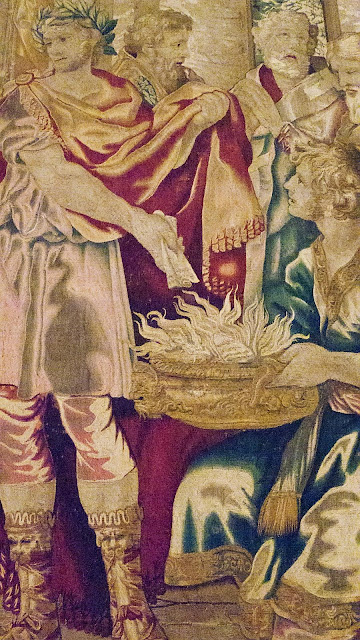 |
Detail of Tapestry Showing Constantine Burning the Memorials to give
Tax Concessions to the Christian Church by Pietro da Cartona 1634 CE
Photographed at the Philadelphia Museum of Art by Mary Harrsch © 2011 |
Hopkins points out that after Christianity was adopted by the state, bishops borrowed the oppressive powers of the state to bully, exclude and even execute doctrinal rivals. Furthermore, they began to exploit the sin and guilt of their fellow believers.
"Since sin could not be eradicated, it might as well be exploited. The careful stratification of different degrees of apostasy (voluntary/forced; thought about/done; sacrifice/incense only; official/martyrs' certificates) was an initial stage in the flotation of a new moral economy of sin and penance. Over time, the Church gradually elaborated an effective list of sin prices. To put it crudely, the Church marketed sin, and expanded into guilt. Sin was not just a matter of behavior; it could occur in the desires of thought and in the unconscious fantasy of dreams. Christian clerics were determined to make the faithful pay for their dreams, as though they could salve their conscience by generosity to the poor and to the church."
"...Christians stood out in their heroization of self-sacrifice and in their private generosity to the unfortunate. Even pagans were deeply impressed, and eventually also attempted to imitate Christian charity. But it is also worth noting that as the church grew, it grew richer. From the fourth century, church buildings (like pagan temples) were increasingly decorated with silver and gold, and bishops rose up the social scale, with incomes to match. Guilt, sin, laxity, repentance, penance, and the readmission of the fallen, to say nothing of alms and legacies, used in combination, were all important forces in the church's drive for worldly success." - Keith Hopkins
 |
Tapestry by Peter Paul Rubens depicting Constantine worshipping the
true cross. Photographed at the Philadelphia Museum of Art by
Mary Harrsch © 2011 |
So, Christianity offered Constantine not only the pretext to seize the immense wealth stored in pagan churches but a framework that could be used to extract future wealth from its own believers. In one stroke Constantine not only relieved Rome's financial exigency but had enough wealth left over to build a new capital city dubbed Constantinople and live in luxury for the remainder of his life.
But what about Constantine's inspirational vision in 312 CE? Hopkins points out that early Christians developed a new genre of literature lionizing Christian heroes and martyrs "to extort their followers to greater virtue."
"...Christians fought bitterly against, and at the same time compromised with, the Roman state, and meanwhile created their own frontier heroes and villains: martyrs, ascetic saints, bishops, and heretics..." - Keith Hopkins
Although there are a number of 4th century panegyrists that testify to the emperor's sincerity, I suspect Constantine simply became one of these embellished legends.
"Out of commitment or political self-interest, or both, they [Constantine and his successors] favored the Christian church with donations and with privileges for the clergy. They gave state support for synods of bishops to decide matters of doctrine; they also used the church as a supplementary instrument of imperial ideology and social control. It is difficult to decide whether this radical transformation of the role of Christianity, which had so much influence on the future of western culture, should be called the triumph of the Christian church or the triumph of the Roman state." - Keith Hopkins,
A World Full of Gods
Additional reading on mining in the ancient world:
The Mines That Built Empires by Barry Yeoman.
References:
Anonymous, In Praise of Later Roman Emperors: The Panegyrici Latini, page 248. Retrieved from
https://books.google.com/books?id=0WlC_UtU8M4C&pg=PA248#v=onepage&q&f=false
Belzoni, P. A. (2017, October 27). Constantine's Vision of the Cross ~ Early Accounts and Backstory. Retrieved from
http://gloriaromanorum.blogspot.com/2017/10/constantines-vision-of-cross-early.html
Hopkins, K. (2001).
A World Full of Gods: The Strange Triumph of Christianity. New York: Plume.
Littman, R., & Littman, M. (1973). Galen and the Antonine Plague.
The American Journal of Philology, 94(3), 243-255. doi:10.2307/293979
Van Sickle, C. (1938). Diocletian and the Decline of the Roman Municipalities.
The Journal of Roman Studies, 28, 9-18. doi:10.2307/296900
Yeomans, S. K. (2017, August 22). Classical Corner: The Antonine Plague and the Spread of Christianity. Retrieved November 23, 2017, from
https://www.biblicalarchaeology.org/daily/ancient-cultures/daily-life-and-practice/the-antonine-plague-and-the-spread-of-christianity/
Horgan, J. (n.d.). Plague of Cyprian, 250-270 CE. Retrieved November 23, 2017, from
https://www.ancient.eu/article/992/plague-of-cyprian-250-270-ce/
(Sander) Boek, J.A. (n.d.).
Taxation in the later Roman Empire. Retrieved from
https://openaccess.leidenuniv.nl/bitstream/handle/1887/18524/Taxation_in_the_later_Roman_Emp.pdf?sequence=1
Jones, A. (1953). Inflation under the Roman Empire.
The Economic History Review, 5(3), new series, 293-318. doi:10.2307/2591810