Showing posts with label Hannibal. Show all posts

Thursday, July 29, 2021

Hannibal's Secret Weapons

My friend Patrick Hunt from Stanford University presented this lecture in June for the Archaeological Institute of America.  Before I retired, Patrick kindly invited me to join him on one of his National Geographic-sponsored expeditions in the Alps but I had just returned to work after six months recuperation from a serious fall in Naples. I was afraid I wouldn't be able to keep up with his cohort of burly Stanford athletes at the 8,000 foot altitude of the Clapier-Savine Coche pass. I really enjoyed this lecture and learned some interesting information about the battle of Cannae that I must have overlooked.  Patrick points out that at the battle of Cannae Hannibal took advantage of a seasonal dust storm that is known to blow sand from the Sahara desert into Italy at that time of the year and positioned his troops so that the wind was at their back while it was blowing in the faces of the Romans.  He also mentioned that Hannibal used troops dressed in captured Roman armor from the battles of the Trebia River and Lake Trasimene to help trick the Romans into advancing into his concave center where they could be outflanked.  Patrick's lecture is today's featured "Antiquity Alive" presentation.

Back in 2016, I wrote about another researcher who claimed the Col de Traversette pass was used by Hannibal because of finding a large deposit of horse manure there. Obviously, Patrick disagrees with that conclusion.  You can read my article about it here:

 https://ancientimes.blogspot.com/2016/04/hannibals-route-over-alps-or-just-horse.html

If you enjoyed this post, never miss out on future posts by following me by email!


Sunday, May 16, 2021

Plautus and Roman comedy in times of war

 The comedic plays of Titus Maccius Plautus are said to be mostly adapted from the works of established Greek playwrights like Menander, referred to as Greek New Comedy. The resulting plays, thought to be around 130 works, were written between 205 and 184 BCE. Only 20 have survived to modern times.  

Unlike the Old Comedy of such playwrights as Aristophances with its critical commentary on politics and societal values, New Comedy has been described as "devoid of a serious political, social or intellectual content" and "could be performed in any number of social and political settings without risk of giving offense." Instead, there is much more of a focus on the home and the family unit—something that the Romans, including Plautus, could easily understand and adopt for themselves later in history.

However, Plautus did not ignore the Roman Republic's expansion of power and influence that was taking place during this time.  A. F. West observed that Plautus inserted patriotic passages into his work Miles Gioriosus, composed during the Second Punic War.  At the time, the general Scipio Africanus wanted to confront Hannibal, a plan "strongly favored by the plebs". Plautus apparently pushes for the plan to be approved by the senate, working his audience up with the thought of an enemy in close proximity and a call to outmaneuver him. 

Later, though, when Rome was preparing  to move on Philip V in the Second Macedonian War and there was considerable debate beforehand about the course Rome should take in this conflict considering the recent struggles with Carthage, Plautus incorporates the Roman people's antiwar sentiments into his work, Stichus.   

W. M. Owens writes in his article "Plautus' Stichus and the Political Crisis of 200 B.C.", "There is evidence that antiwar feeling ran deep and persisted even after the war was approved." Owens contends that Plautus was attempting to match the complex mood of the Roman audience riding the victory of the Second Punic War but facing the beginning of a new conflict. For instance, the characters of the dutiful daughters and their father seem obsessed over the idea of officium, the duty one has to do what is right. Their speech is littered with words such as pietas and aequus, and they struggle to make their father fulfill his proper role. The stock parasite in this play, Gelasimus, has a patron-client relationship with this family and offers to do any job in order to make ends meet. Owens puts forward that Plautus is portraying the economic hardship many Roman citizens were experiencing due to the cost of war.

With repeated references to civic responsibility while portraying the desperation of the lower class, Plautus establishes himself firmly on the side of the average Roman citizen. While he makes no specific reference to the possible war with Greece or the struggles of the previous war, he does seem to push the message that the government should take care of its own people before attempting any other military actions.

Terracotta comic mask from Tarentum in South Italy, 300-200 BCE, now in the collections of the J. Paul Getty Museum. Image courtesy of the museum. The mask features a rounded skullcap with two holes for hanging in the upper section of the head. The oval face presents a convex forehead with a cleft at center, high arched eyebrows above half-closed eyes, a long thin nose, puffy cheeks, and a broad mouth with an ambiguous smile. Fleshy lips frame the wide-open mouth; the jaw is prominent and features a full, dimpled chin. The hair is painted red and forms a crown of radial striations around the forehead. These characteristics associate the mask with the New Comedy character Colax, an adulator (or vain flatterer).

Greek Terracotta Statuette of a Comic Actor made in Apulia South Italy 325-275 BCE that I photographed at the Getty Villa in Pacific Palisades, California.

Roman Terracotta Lamp with Reclining Comic Actor 100-200 CE that I photographed at the Getty Villa in Pacific Palisades, California.

Statuette of a Comic Actor Wearing an Animal Mask Roman 100 BCE-100 CE Bronze that I photographed at the Getty Villa in Pacific Palisades, California.

Incense Burner (Thymiaterion) shaped as a Comic Actor Seated on an Altar Roman 1-50 CE Bronze and Silver BCE that I photographed at the Getty Villa in Pacific Palisades, California.

Bronze Roman Lamp in the Shape of a Comic Mask 75-125 CE that I photographed at the Getty Villa in Pacific Palisades, California.

Mosaic depicting theater masks Roman 2nd century CE that I photographed at the Capitoline Museum in Rome.

Carved Marble Relief depicting tragic and comic masks Roman 2nd century CE that I photographed at "The Body Beautiful in Ancient Greece" on display at the Portland Art Museum in Portland, Oregon.


If you enjoyed this post, never miss out on future posts by following me by email!


Wednesday, April 13, 2016

Hannibal's Route Over The Alps or just Horse S***?

Hannibal embodying perseverance at the Mausoleum of Engelbert II
of Nassau and Cimburga van Baden in the Grote Kerk or
Onze-Lieve-Vrouwekerk (Church of Our Lady) in Breda, Netherlands.
Image courtesy of Wikimedia Commons user Vassil.
Digitally enhanced by Mary Harrsch.
A history resource article by Mary Harrsch © 2016

Earlier this month the news media was whipped into a frenzy by reports that Bill Mahaney, a geologist and professor emeritus at York University in Toronto, Canada, had "found" Hannibal's route over the Alps.

Unfortunately, many of the mainstream media outlets, eager to garner a bump in pageviews by armchair historians, published the findings and inferred a resolution without attempting to verify if the information provided was, in fact, definitive or could have had an alternative explanation. Some even used the word "pinpoint" even though the findings are based primarily on the inexact process of Carbon 14 dating.


One of the less sensationalized articles appeared in The Guardian, a UK online news magazine:

https://www.theguardian.com/science/2016/apr/03/where-muck-hannibals-elephants-alps-italy-bill-mahaney-york-university-toronto

Dr. Patrick Hunt, director of the Stanford University Alpine Archaeology Project, is another researcher who has been seeking Hannibal's route across the Alps since 1994. He is quoted towards the end of the above article but he, however, is more in favor of a northerly route.

"I have spent over 20 field seasons tracking Hannibal, not only in the Alps but also in Spain, France (Gaul) and of course Italy and elsewhere including Carthage and Western Turkey. Our Stanford teams have crossed at least 30 Alps passes and we’ve always used Polybius as a guide. Polybius gives some helpful clues but never names the pass. He [Polybius] suggests it was the highest pass known at the time, which doesn't necessarily mean the highest pass known today, an obvious logical fallacy," Hunt explains.

"The Clapier-Savine Coche route—an ancient Celtic pathway with a summit around 8,500 feet—best fits Polybius in my opinion and that is shared by many others. This verified route has been used for thousands of years and while there is erosion on the precipitous descent that has taken away most of the ancient pathway, the summit valley floor is fairly stable and has been for millennia. Mammal animal mire there has also built up over a long time because the Clapier-Savine Coche summit valley has been a grazing place since at least Celtic times. I always encourage Alps explorers to weigh multiple passes against each other rather than to merely examine one pass and conclude prematurely or only read about it, which is dangerously inadequate."

Hunt has serious reservations about Mahaney's proposed route, claiming the view described by Polybius of the Po Valley and Torino itself can best be glimpsed from the Clapier-Savine Coche saddle immediately a few hundred feet above the summit campground, especially because Polybius says they camped at the summit and from there Hannibal showed the view.”

"Hannibal made a concerted effort to raise the spirits of the army, leading his men to the dramatic precipice very close by at the edge of the summit camp possibly at the broad Clapier-Savine Coche saddle around 8,500 feet altitude with an immense vista when there are no clouds or fog to obscure the view. From this height, Italy opens up before the eyes of viewers, creating a spectacle of mountains dropping away in undulating waves to the plain of the Po Valley below, especially from the south side of the Savine-Coche Valley, where humans have crossed since the Neolithic Age even with perennial snow traces here." - Patrick Hunt, Hannibal

"The route in question is too often promoted by popularists who've never climbed competing Alpine routes, of which about 10 passes need to be totally eliminated before this study has any real credibility," Hunt observes, "The fact that so many today in the popular media are claiming this now solves Hannibal's route is both sadly superficial and premature. Although they could be hypothetically right, there's no real hard material evidence presented yet. Until they find actual material artifacts, it's moot. Datable remains of elephant dung would be much better, but possibly not enough because Hannibal's brother Hasdrubal followed him a decade later. I know several other Alps passes with at least as much corroborating evidence and one pass far better in terms of fitting Polybius, the best source."

Although famed naturalist Gavin de Beer first proposed the Col de Traversette as Hannibal's crossing point in his 1955 book Hannibal's March: Alps and Elephants, eminent Polybian scholar, F.W. Wallbank rejected de Beer's theories the following year in his 1956 article Some Reflections on Hannibal's Pass published in volume 46 of The Journal of Roman Studies.

Dr. Hunt's Stanford research team thinks the Clapier-Savine Coche is at least as good and actually closer to what Polybius describes as the Col de Traversette.

"The Clapier-Savine Coche has a huge campground right by the summit as Polybius describes," explains Hunt, "If the new mire-dung spot is the campground Mahaney et al. suggest, it is on the west side of the Col de Traversette about 1500 feet below the summit, not at the summit as described by Polybius. The Traversette summit is also a knife blade scarcely capable of holding 100 people, let alone an army. There is no way Hannibal could have addressed his army encouragingly from the Traversette summit."

Hannibal shows his army the valley of the Po from the summit of the Alps by Alfred Rethel, 1842.  Image courtesy of
Wikimedia Commons
"Also, Polybius states Hannibal's forces slipped through fresh snow to ice below from the previous winter on the initial descent, not frozen ground or firnpack as interpreted by the Traversette group," Hunt continues, "Such snow traces fitting Polybius are found each year on the summit of the Clapier-Savine Cloche around 8200-8500 feet but there is still ample grass for animal foraging and cattle graze there currently as well."

Furthermore, Hunt thinks a route leading to the Col de Traversette must be twisted somewhat to make it fit the description given by Polybius.  Polybius says after Hannibal's army marched north of the point where the Rhone and Iskaras Rivers meet for approximately 800 stades (about 91 miles) the army began their ascent of the most rugged part of the Alps and found their way blocked by a fierce mountain tribe known as the Allobroges (according to Livy the most famous and powerful tribe in Gaul).  The border of the Allobroges territory was defined historically by the "Iskaras" (Polybius) or "Arar" (Livy) River, which Hunt thinks corresponds to the modern Isère River.

"Given that the Rhone delta and mouth were less extended southward in antiquity due to less alluviation buildup and that Hannibal crossed at least a day's march inland - both because there were more salt marshes (etangs) then around the Rhone mouth and in order to avoid Massilian Roman allies around Marseilles - the Rhone crossing should be around Avignon, an ancient fording place", Hunt observes. "The traditional Allobroges boundary - like that of so many tribes partly demarcated by a river confluence - would then be the Isere-Rhone junction beyond Valence, not the more southerly Drome-Rhone confluence, proposed by Mahaney's Traversette group."

Hannibal traverses the Rhône by Henri Motte, 1878, (Public Domain) 

"Mahaney's team proposes the first ambush occurred in the upper Valdrome (which was not Allobroges territory).  This would require Hannibal to make a double Alps crossing then drop down southeastward into the Durance River watershed," Hunt continues, "They then have Hannibal marching up the Durance but turning away from the perfectly accessible broad northeast Mont-Genevre route (which they claim could be blocked by hostile Celts, but isn't very likely) detouring into the narrow Guil far southward into the Queyras region and over the extremely  difficult Traversette, which takes them southward away from Torino and the Taurini tribe, the point where Hannibal eventually emerged according to Polybius."

This rather fanciful scene thought to depict Hannibal battling the Romans at Cannae adorns the shield of Henry II of France.
Today it can be viewed at the Metropolitan Museum of Art in Gallery 374.
Image courtesy of the Metropolitan Museum of Art.
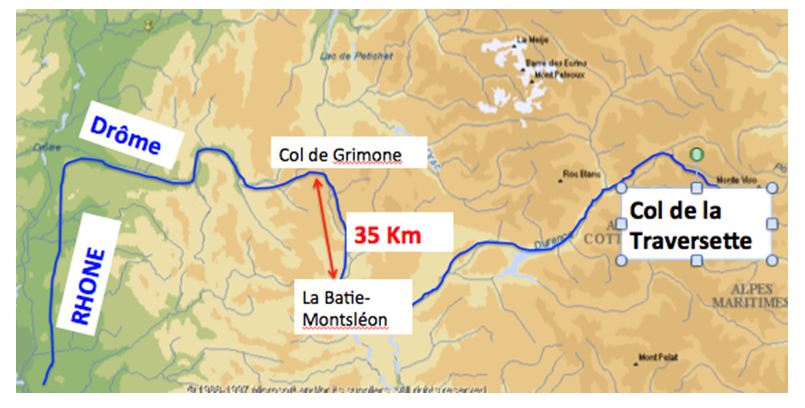
"Sir Gavin de Beer originally proposed the Grimone pass for the ambush of an Allobrogian tribe," French scholar Dr. Geoffroy De Galbert, author of Hannibal et Cesar dans les Alpes, explains.

"Furthermore, de Beer claimed their oppidum (hill fort) was located at La Batie-Montsléon. Hannibal’s companions claimed that the Allobroges spent the nights in their oppidum and returned in the morning to guard this delicate passage.  But it is 35 km between the Col de Grimone and La Batie-Montsléon.  A 35 km journey twice a day would be practically impossible."


"Livy, in describing the crossing of the river added the word “Durancia”, de Galbert continues, "claiming that it referred to the Durance river. Livy wrote: “This river, which also takes its rise in the Alps, is of all the rivers of Gaul the most difficult to cross. Though carrying down a great volume of water, it does not lend itself to navigation, for it is not kept in by banks, but flows in many separate channels.” (Livy III, XXI, 31)

"The Durance river around Embrun cannot be the most difficult river to cross of all Gaul." de Galbert states, "On the contrary, this description perfectly matches crossing the Isere at Chateauneuf-sur-Isére near Valence. The Isère river was divided into several branches at Chateauneuf-sur-Isère before being contained. The Latin historian Orosius, living in the 5th century CE, also claimed that Livy had confused the Durance with the Isère."


 "Furthermore, de Galbert adds, "Livy wrote : Hannibal, leaving the Druentia, and advancing for the most part through a champaign country, reached the Alps without being molested by the Gauls who inhabited those regions. (Book 21, 32)."

"Between the crossing of the Durance near Embrun and the Alps, there are no plains. On the contrary, after crossing the Isere at Chateauneuf sur Isere, there is a large plain leading to the entrance of the Alps," de Galbert concludes.

"Mahaney's group also claims the Po River only starts near Traversette," Hunt observes, "but that's a geographic fallacy as there is no one source for a major river and the Dora Riparia is a primary Po watershed as well and runs directly eastward into the Po west of Torino. They also say only the insanely narrow Traversette has the view for Hannibal's speech but clearly must have only tried the modern Clapier footpath and not the adjacent Savine Coche broad ridge immediately west where the ancient path ran, which has a great view of Torino and the Po plain."

"If you assess the northern route toward the Clapier-Savine Cloche, you will find a satisfying first ambush place in the Isere near Voreppe, (clearly Allobroges territory)," Hunt points out.

The likelihood that a major confrontation could have taken place there was also suggested by the recent discovery of what appears to be the remains of a large Celtic oppidum (hill fort) near there.

Significant differences in the geophysical features between the two proposed passes is discussed in an article that appeared in this 2010 post in Earth Magazine:

http://www.earthmagazine.org/article/hannibals-trail-clues-are-geology

In this article Hunt also describes a two-tier rockfall at the Clapier-Savine Coche pass a short distance from the summit.

"Polybius actually describes more of a multi-tier precipice," Hunt says, "and the Clapier-Savine Coche descent has multi-tiered rockfalls that geological weathering dates to more than a few thousands years ago."

Hannibal crossing the Alps from The illustrated history of the world for the English people, 1881.

But perhaps one of the best analyses of all candidate passes as of 1959 was prepared by John Hoyte, a British engineer whose team actually took an elephant over the Alps in an effort to settle the question in July 1959.
Hoyte first distilled a list of conditions defined by Polybius in his Histories.

(a) be large enough to camp 30,000 men and about 5,000 horses (on its French side)

(b) command a panoramic view of the Po valley

(c) have a difficult descent

(d) be high enough to have large areas of snow, from two consecutive winters on its flanks

(e) have a place for pasturing the horses immediately after the difficult stretch of the descent

(f) give a distance of three days' march, from here to the plains.

(g) lead straight down to the land of the Turini.

(h) be a day's march from a probable site for the 'bare-rock' ambush (or a day and a night for the baggage and elephants).

(i) be positioned so that the most direct route to it from the Rhône passes by the 'Island' (where the river 'Skaras' meets the Rhône) seven days' march from the sea (three days from the sea to the crossing of the Rhône and four from the crossing to the Island).

He then scored each pass on a scale of 0-5 for each of these parameters with 5 awarded for a complete fit and less for more doubtful cases.


Hoyte's group launched their attempt from Montmelian, France and followed the valley of the Arc River with the goal of crossing the Col de Clapier, since that pass scored the highest in Hoyte's comparison study of Polybian parameters.  However, the pass had become narrowed and dangerous due to rockfall so the group retracted down into the valley and crossed the Petit Mon Cenis, which branches off the Clapier route at ~7150 ft a short distance before the final Clapier ascent, a route proposed by Napoleon.  After 10 days of travel, the expedition successfully reached Susa in Italy.
Details of the expedition and a wonderful series of photographs can be viewed on Hoyte's website (http://johnhoyte.com/alpine-elephant/).

Hoyte also published an account of the expedition in his book, Trunk Road for Hannibal - with an elephant over the Alps, in 1960.  It was republished in 1964 under the title Alpine Elephant - In Hannibal's Tracks.

Geoffroy de Galbert, also points out that later supply trains were unable to use the proposed route across the Traversette.

"During the 14th and 15th centuries, the Maurienne and Gresivaudan valleys of the Alps were swept by the Black Death," de Galbert points out, "These valleys had been the traditional routes used to ship salt from mines in the south of France to Italy's Po valley.  The Traversette pass lay within a region unaffected by the plague but was so narrow a heavily laden mule could not cross there. Mule convoys had to be unloaded at the foot of the pass and reloaded onto the backs of men who then carried the cargo across the pass.  Finally, in 1480, a tunnel 75 meters long and 1.5 meters in height was built under the Traversette pass to provide a navigable route for salt shipments."

"If the mules could not cross the Alps through the Traversette pass in the fifteenth century, they could not do it in Hannibal's time," de Galbert concludes.

"In fact, in pre-Roman antiquity, there was only one wide road from Spain to the Po Valley," de Galbert continues, "This road crossed the Alps by the Maurienne valley.  Hannibal with his huge army could not have used a simple mountain trail.  This is further supported by the fact that no neolithic or Iron Age remains have been found on the roads from Durance to the Traversette pass."

A map showing the locations of Iron Age remains found in the Maurienne region of the French Alps.  Dr. Geoffroy de Galbert points out that no neolithic or Iron Age remains have been found between the Durance and the Traversette pass.  Image courtesy of Geoffroy de Galbert.
But in the latest research, Mahaney tackles the question from a different perspective.  The new findings most recently reported are based primarily on the discovery of a layer of soil disturbance and the findings of "a mass animal deposition event" -  bacterial remains indicating the presence of a large number of equines in the vicinity.  Although the articles currently circulated by the media claim the Carbon 14 dates obtained for the material in the disturbed layer point to 218 BCE.

"The C14 dating of an object from 218 B.C. does not result in a date. It gives two time intervals: one comprised between 231 and 97 B.C. with 66 % probability; the other between 355 and 292 BC with a 30 % probability," explains de Galbert. "These results have been calculated by the Oxford Radiocarbon Unit’s software OXCAL and may be seen on the graph below:


Contamination is always a concern too and testing waste from ruminants can also be problematic as vegetation can have varying amounts of carbon that could impact test results as well.

"The new hypothesis places the boggy dung mass on the eastern side at 2580 meters," Hunt points out, "Given the warmer climate around Traversette, since it's further south, vegetation is more lush there, so Alpine tribes have grazed animals there for thousands of years."

Andrew Wilson of Oxford's Institute of Archaeology, apparently agrees.  In a recent New Yorker article he expressed doubt about Mahaney's claims pointing out that, due to the wide date range encompassed by the Carbon 14 analysis, the disturbed layer probably accumulated over a considerable period of time, perhaps from animals drinking at the mire rather than a single event during the passage of an army.

In fact, Hannibal's expedition through the Alps, although truly legendary in its scope and military context, was not the first mass migration across the mountain range that could have left sizable animal waste deposits.

When Hannibal harangues his troops about their fear of crossing the Alps, Livy says Hannibal himself describes earlier mass migrations.

"What on earth do you think the Alps are except a collection of high mountains? Perhaps you think they are even higher than the Pyrenees? So what?  Nothing on earth can ever reach the sky; no mountain is too high for man to conquer. People actually live in the Alps, for goodness’ sake! They till the ground; animals breed and grow fat there. If a small group of natives can cross them, so can an army.  Look at these delegates from the Boii – they didn’t grow wings and fly here over the top. Even their ancestors were not born here; they came here as immigrant peasants from Italy; they crossed these selfsame Alps in huge migrating hordes, with all their women and children – and lived to tell the tale." - Livy, Book 21, Chapter 30.6 - 30.8 


A reconstructed late La Tène Period (3rd-1st century BCE) Celtic settlement in Havranok,Slovakia.
Image courtesy of Wikimedia Commons

In fact, activities preceding the Gallic War of 225 BCE culminating in the Battle of Telamon had involved large scale movements of Gauls across the Alps.

"After their defeats by Rome in the 280s, the Gauls were quiescent for forty-five years; but eventually a younger generation took their place, 'full of unreflecting passion and without experience of suffering or peril' (Polybius' Histories 2.21.1-2).  They began to disturb the existing equilibrium with Rome, and invited Gauls from across the Alps to participate in a new war...The leaders of the Po Valley peoples held out to the leaders of the Gauls beyond the Alps the promise of the rich loot that awaited them in Italy, along with assurances that Gallic military power could easily overcome the Romans; after all, this had happened before, when Rome itself had been taken and held for seven months by Gallic warriors (Polyb. 2.22.4-5)." - Arthur M. Eckstein, Polybius, the Gallic Crisis, and the Ebro Treaty. 

Hannibal's crossing was also followed by more than twelve years of war-related traffic, again mentioned in Livy:

"He [Hannibal] had believed, indeed, that his brother [Hasdrubal] would come over into Italy that summer; but when he recalled what he had himself endured during five months, in crossing first the Rhone, and then the Alps, in conflicts with men and the nature of the country, he looked forward to a crossing by no means so easy and so soon accomplished. This accounted for his slowness in leaving winter quarters. But for Hasdrubal everything moved more quickly and more easily than had been expected by himself and others. For not only did the Arverni, and then in turn other Gallic and Alpine tribes, receive him, but they even followed him to war.  And not merely was he leading an army through country for the most part made passable by his brother's crossing, although previously trackless, but, thanks to the opening up of the Alps by twelve years of habitual use, they were also crossing through tribes now less savagely disposed.  For previously, being never seen by strange peoples and unaccustomed themselves to see a stranger in their own land, they were unfriendly to the human race in general. And at first, not knowing whither the Carthaginian was bound, they had believed that their own rocks and fastnesses and booty in cattle and men were the objects of attack.  Then reports of the Punic war, with which Italy had been aflame for eleven years, had made it quite plain to them that the Alps were merely a route; that two very powerful cities, separated from each other by a wide expanse of sea and land, were contending for empire and supremacy." - Livy, The History of Rome, Book 27.39


Replica of a Celtic warrior's garb
In the museum Kelten-Keller, Rodheim-Bieber, Germany
Image courtesy of Wikimedia Commons.
De Galbert explains, "At least five armies crossed the Alps between 231 and 97 BC. In 231 B.C., the Insubres and the Boii asked some Gallic tribes of the Alps and the Rhone Valley to come and help them fight the Romans. (Polybius, II, 22). Hannibal’s army crossed the Alps in 218 B.C. Hasdrubal, Hannibal’s brother, crossed the Alps in 207 B.C. with an army larger than Hannibal’s. The consul Fulvius Falcus crossed the Alps in 125 B.C. to help Marseilles when it was attacked by Salyens. Then the consul Marius crossed the Alps around 125 B.C."

These activities all occurred within the time encompassed by the Carbon 14 dating period of the Col de Traversette equine waste remains.

In fact, Hasdrubal's crossing of the Alps in 207 BCE, significantly complicates the search for Hannibal's crossing.  Although Livy makes it sound like Hasdrubal followed in the path of Hannibal, Polybius uses the word "shorter" in his fragmentary reference to Hasdrubal's easier crossing  in Polybius' Histories.  Much of the easier aspect can be attributed to Hasdrubal's much more friendly reception by native tribesmen who have, by then, decided to join the Carthaginian's war efforts.  But to have a reportedly shorter journey suggests a deviation from Hannibal's original route at some point.  Furthermore, Hasdrubal brought war elephants with him as well, so even finding pachyderm waste or remains may not definitely prove a route was Hannibal's and not Hasdrubal's.

"To a viewer in the Val di Susa, three passes (Mont-Genevre, Clapier-Savine Coche, and Mont-Cenis) all converge in the Dora Riparia river watershed en route to Torino. If an ancient observer had known Hannibal came through here via the higher middle route of the Clapier-Savine Coche and if also knowing Hasdrubal came through here via the shorter and lower Mont-Genevre, it would still appear they came through the same Val di Susa before it joins the Po Valley," Hunt observes.

Apparently,The London Times has expressed their skepticism about the latest claims, too, as have noted historian Tom Holland and others.

"We are unlikely to know definitively but the literature of ancient military campaigns has an allure regardless of strict accuracy. Caesar's Gallic War recounts a fantastical tale of how German tribesmen caught elks through a cunning plan reminiscent of Piglet's heffalump trap. Polybius and Livy tell of how Hannibal's elephants crossed the Rhone by walking along the riverbed and using their trunks as snorkels; evidently no one told these historians that elephants can swim. There is a pleasing symmetry that the latest scholarship of the ancient world is literally rather than metaphorically a pile of manure." - Elephantine Enigma: Scientists believe they have identified Hannibal's route over the Alps, Editorial, The Times (London), April 5, 2016

Tom Holland was a little more succinct, "The evidence is s***," he said.

"The amount of evidence needed is substantial indeed across multiple parameters; this new claim just does not have the kind of support required despite sounding so scientific," Hunt observes.

The bottom line as I see it is that, despite our wishful thinking, none of the current findings are truly definitive without the discovery of supporting archaeological remains.

Perhaps we should take the advice of Polybius, who once cautioned his readers about fully embracing statements by another Roman historian, Q. Fabius Pictor, "My own opinion is that one must not treat his authority as being of little weight, but at the same time one should not regard it as final."

A Numidian horseman by Hocine Ziani, an Algerian artist who is a founding member of the Central Army Museum in Algiers.  Other examples of his amazing work can be viewed on Pinterest.
I must admit I was intrigued with the possibility of finding ancient equine DNA from a breed originating in North Africa, though.  Hannibal's elite Numidian cavalry probably would have brought their own mounts with them so that does pose an opportunity for further study. However, finding the whereabouts of ancient equine DNA from North Africa for comparison, possibly locked away in some museum or research institution's dusty basement, may prove as challenging as trying to find a crated Ark of the Covenant in a government warehouse!

References:

Polybius, Histories

Ball, P. (2016, April 3). The truth about Hannibal’s route across the Alps. The Guardian. Retrieved April 8, 2016, from https://www.theguardian.com/science/2016/apr/03/where-muck-hannibals-elephants-alps-italy-bill-mahaney-york-university-toronto

Walbank, F. W.. (1956). Some Reflections on Hannibal's Pass. The Journal of Roman Studies, 46, 37–45. http://doi.org/10.2307/297963

Hoyte, J. (1960). Trunk road for Hannibal; with an elephant over the Alps. London: G. Bles.

Livy, The History of Rome

Eckstein, A. M.. (2012). Polybius, the Gallic Crisis, and the Ebro Treaty. Classical Philology, 107(3), 206–229. http://doi.org/10.1086/665622

Elephantine Enigma: Scientists believe they have identified Hannibal's route over the Alps. (2016, April 05). The Times (London). Retrieved April 12, 2016, from http://www.thetimes.co.uk/

A Kindle preview of related reading:


Other suggested reading:

If you enjoyed this post, never miss out on future posts by following me by email!


Wednesday, September 3, 2014

Review: Hannibal: Enemy of Rome by Ben Kane

A history resource article by  © 2014


It's been a busy summer but I finally finished the first book in bestselling author Ben Kane's series about the Hannibalic Wars entitled "Hannibal: Enemy of Rome".  As in his popular "The Forgotten Legion", Kane has used young men on the cusp of manhood as his primary characters.

We first meet Hanno, a young Carthaginian who hopes to become a soldier like his father, Malchus, once was.  Now, Malchus serves on the council in Carthage and, although Malchus drags Hanno to the council meetings so he may learn statecraft, Hanno finds the meetings a bore and prefers to skip out and go fishing with his best friend, Suniaton, the son of a high priest.

We also briefly meet Hanno's two older brothers, Sapho and Bostar who presently serve as officers in the Carthaginian army.  We discover that Sapho, the eldest, is jealous of Bostar because Bostar has been promoted above him because of Bostar's superior tactical acumen.  Sapho's jealousy also extends to a lesser degree to Hanno, who, as the youngest, has captured his father's heart after the death of Hanno's mother.

A painting of the intricate harbor and ancient city of Carthage.  Image
courtesy of the Carthage Archaeological Museum, Tunis, Tunisia.
Kane provides a vivid description of the capital of Carthage, still majestic even after suffering defeat at the hands of the Romans in the First Punic War.  But all is not well as Carthage and Rome have once more butted heads in Iberia where Carthage has conquered most of the peninsula and the town of Saguntum, fearful of the growing Carthaginian presence in the region, has appealed to Rome for help.

Malchus supports the Barca family and clearly expects Hannibal, the senior Barca commander, to exact "payback" from the Romans for their past offenses to Carthage.

Meanwhile, Hanno and Suniaton hear of a large run of tunny (tuna), and can't resist trying their luck so they can earn a little spending money.  They set off in a small boat that they soon fill with fish.  Suniaton has pilfered a bottle of wine from his father's wine cellar and they decide to celebrate their good luck.  Soon they fall asleep in the warm sun so do not see an approaching storm.  When the violence of the storm finally awakens them they find they have been swept far out to sea and cannot see the outline of Carthage in any direction.  As they were only on an afternoon outing they have no supplies and soon are famished from thirst and hunger.  Finally they see a ship on the horizon and think they are saved.  But the ship is manned by pirates who see the two boys as nothing more than slaves that can be sold for a profit.

To make matters worse, a patrol ship makes the pirate captain decide to avoid Sicily and steer to Italy instead.  When the ship arrives in Italy the two boys are marched off towards Capua where it is hoped they will be sold to a gladiator school.

But Hanno is purchased by a Roman equestrian family that runs a farm near Capua instead.  Then we meet Quintus and Aurelia, the son and daughter of Fabricius, once a Roman cavalry officer and now a landowner who raises grain and livestock.

A Roman villa rustica excavated near the ancient town of Boscoreale
north of Naples, Italy
.  Photo by  © 2007.
Now we find out what Roman life is like for this semi-retired military veteran and his family. I really like the way Kane gives us thorough backgrounds on all of these characters so we have a solid understanding of the similarities and differences that separate the two cultures.

Hanno and Quintus who are almost the same age become friends and as the plot unfolds, each saves the other's life, making their bond even stronger.

In the meantime, since Rome does not send assistance, Saguntum subsequently falls to Hannibal's forces. So talk of war with Carthage soon dominates the conversations at the villa.  Quintus begins cavalry training and Quintus' father, Fabricius is soon ordered to join Roman forces in southern Gaul marching towards Iberia where the Romans plan to confront Hannibal.

With Fabricius gone, the villa overseer, who lost his wife and children to Carthaginians on Sicily and harbors hatred for Hanno, attempts to drag Hanno away to Capua where he plans to sell the youth to the lanista at the gladiator school for an arranged fight to the death with Hanno's friend Suniaton.  But I don't want to give away much more of the plot so you'll have to read it for yourselves to find out what happens.

Remains of the amphitheater at Capua.  Image courtesy of
Flickr user .
Eventually, Hanno and Quintus both end up serving in their respective armies after Hannibal successfully crosses the Alps and the two armies end up camped across the Trebia River from each other.
Having studied the Second Punic War to some extent, I was wondering how Quintus and his father were going to escape the slaughter that I knew was about to befall them.  Kane does such a good job of characterization that at this point in the book I cared about both the Carthaginian family and the Roman family equally.

The climactic battle sequence was nothing short of breathtaking.  What I liked the most was Kane's description of the scenes and terror each character saw around them and felt as the epic struggle unfolded - Hanno and his father fighting with the Libyan spearmen near the center of the Carthaginian line while Quintus and his father struggled with the Roman cavalry on the flanks.

The Gauls, who had been previously allied with the Romans, joined Hannibal at the Battle of the Trebia River and were placed at the Carthaginian center.  Although fierce, the Gauls could not hold back the disciplined Roman legionaries who fought through the center then retreated back to Placentia (Modern day Piacenza).  Image courtesy of Total War: Rome II by .
I appreciate the fact that Kane does not attempt to "take sides" on the historical controversy over whether Scipio tried to warn Sempronius Longus against the ill-fated attack or not.  Polybius claims he did but many scholars look askance at this report since Polybius and the Scipios were closely allied.  These scholars also point to the reported number of Roman troops involved in the engagement as problematic.  Livy records there were 18,000 Romans and 20,000 Italic allies involved.  Polybius claims there were 16,000 Romans and 20,000 Italic allies.

"The numbers stated to have fought the battle are problematic: a combined Roman army should have had 5 legions of 20,000 men and all 30,000 allies authorized by the Senate and yet if the armies were not combined Sempronius should have had only two legions of 8,000 men. One answer is that Scipio gave up two legions and kept one and 20,000 auxiliaries in his own camp as a reserve. Livy seems to think that Scipio's wound gave the entire authority to Sempronius, but immediately after the battle Scipio commanded an army marching from his camp to Placentia. If Scipio could command after the battle then he was not so incapacitated as to be removed from command before it. Both authors agreed that the two consuls had sharp differences of opinion and that Sempronius acted on his own." 
"It is possible that the authors doubled the number of Roman legions fighting the battle and that Sempronius had only 8,000 or 9,000 Roman infantry. The authors both relate, however, that a mass of 10,000 men broke out of the Carthaginian encirclement and fell back on Placentia. Tiberius apparently did have more than two legions. Scipio argues in the story that Sempronius' men needed the winter to train, suggesting that on the way to north Italy Sempronius may have raised two more legions of recruits, throwing them into battle under difficult physical circumstances against expert advice without training. There is no mention of any such events, however." 
"Yet another hypothesis for reconciling the numbers cited by Livy for combined strength of the two consular armies and the actual number of participants in the battle of the Trebia would be that Sempronius detached part of his allied contingents for garrison duty on Sicily and for naval service with Marcus Aemilius and Sextus Pomponius. Some allowance should also be made for non-combat losses. The strength of this hypothesis lies in the maximum use of ancient evidence." - The Battle of the Trebia, Wikipedia
Since this crucial bit of evidence relies on theory rather than certainty, Kane's decision to sidestep the issue was certainly reasonable.  He does, however, relay to us the impatience expressed by the troops themselves over Scipio's apparent hesitance to act while recuperating from his wounds.

A beautiful 17th century ivory rendering of Scipio fighting Hannibal by  currently on display at the royal castle in Warsaw, Poland. This is probably a depiction of the Battle of Zama where Scipio Africanus defeated Hannibal. Publius Cornelius Scipio (the elder) lost to Hannibal at the battle of the Ticinus River but that was primarily a cavalry engagement and war elephants were not involved.  This work has also been called Alexander's defeat of Porus.  Image courtesy of S.F. Burgerer via Wikimedia Commons.  Digitally enhanced by Mary Harrsch.
I am definitely looking forward to the next book in this exciting trilogy.  The only criticism I would have is that the title makes it sound like the book is about Hannibal himself.  Although the key events in the latter part of the book are the result of Hannibal's orders, Hannibal himself appears only infrequently in the narrative.  It perhaps would have been somewhat more accurate to name the series "The Hannibalic Wars" with the subtitle "Enemy of Rome" (Book One).  But I can certainly understand the choice of title from a marketing perspective since some people may not actually make the connection between "Hannibalic Wars" and Hannibal.

If you enjoyed this post, never miss out on future posts by following me by email!


Tuesday, August 13, 2013

Review: Pride of Carthage by David Anthony Durham


I began reading a hard copy of David Anthony Durham's "Pride of Carthage" several years ago and never seemed to get around to finishing it until an audio version was recently released on Audible.com.  I am one of the unfortunate individuals that becomes unbearably sleepy if I attempt to read a traditional book for more than about 45 minutes but I listen to books while I exercise each morning on my exercise bike, so if an audio version of a book becomes available, I'll usually finish it in due course as long as I don't have other activities interfering with my exercise routine.  Thankfully, this was the case with Durham's novel of Hannibal after switching to the audio version.

I have studied Hannibal to some extent and was quite familiar with his military conquests during the Second Punic War. But most history texts say little about his personal life and that was what I was most interested in.  I realize the ancient sources tell us little about the Barcas as a family so I knew much of Durham's characterizations would have to come from his own imagination.  But still, I wanted to have some images to cling to as I learn more about Hannibal in the future and this is the reason I chose to read this book.  So let's examine the cast of characters Durham has crafted for us.

Polybius tells us that a leader's true character is often obscured by actions he must take in response to circumstances created by his own undertaking.

"His [Hannibal's] circumstances were so extraordinary and shifting, his closest friends so widely different, that it is exceedingly difficult to estimate his character from his proceedings in Italy." - Polybius, The Histories, Book IX, Chapters 22-26

So, Durham takes the relatively safe route and introduces us to a quintessential warrior - finely muscled, an astute judge of character, a family man who welcomes his infant son with tenderness and a bit vain.  In one of the opening scenes, Hannibal stands nude before his wife, Imilcea, demonstrating to her that he has maintained his flawless body despite the latest battle he has fought at Arbocala.  (That image soon fades, though, as Hannibal suffers first a devastating spear wound then loses the sight in one eye slogging through mosquito-infested marshes in Italy.)

Family to Hannibal, however, is first and foremost a responsibility to maintain the ancestral "dignitas", if I may use a Roman term to define it, of the Barcids who were legendary even in Hannibal's own time.  His father, the revered Hamilcar Barca, though now dead, is a shadowy presence that Hannibal, sometimes consciously and sometimes unconscieously, defers to in almost every decision Hannibal considers.

And, if friends are so influential, what forces do we see swirling about Hannibal in his council chambers that will propel him to the apex of victory or foreshadow his eventual defeat?

This is where Durham chooses to diverge a little from historical sources.  We meet Hannibal's brother Hasdrubal, a luxury-loving but fiercely loyal lieutenant to his older brother.  Since Durham has read Polybius, he is certainly aware that the Barcids were reputed to love wealth.

"Fond of money indeed he does seem to have been to a conspicuous degree, and to have had a friend of the same character---Mago, who commanded in Bruttium. That account I got from the Carthaginians themselves; for natives know best not only which way the wind lies, as the proverb has it, but the characters also of their fellow-countrymen. But I heard a still more detailed story from Massanissa, who maintained the charge of money-loving against all Carthaginians generally, but especially against Hannibal and Mago called the Samnite. Among other stories, he told me that these two men had arranged a most generous subdivision of operations between each other from their earliest youth; and though they had each taken a very large number of cities in Iberia and Italy by force or fraud, they had never taken part in the same operation together; but had always schemed against each other, more than against the enemy, in order to prevent the one being with the other at the taking of a city: that they might neither quarrel in consequence of a thing of this sort nor have to divide the profit on the ground of their equality of rank." -Polybius, The Histories, Book IX, Chapters 22-26

However, greed is not an endearing trait to modern readers so I can understand Durham redirecting a love of wealth to Hannibal's brother rather than the commander himself to maintain reader empathy with his protagonist.  We must also consider the possibility that Massanissa, though initially loyal to the Barcas, was eventually forsaken by the Carthaginians in favor of Syphax, another Numidian chieftain.  So, Massinissa's criticism must be viewed skeptically.  I thought Durham's choice to introduce this aspect to the Barca family without sacrificing respect for Hannibal was reasonable.

Durham's decision to make Hasdrubal a composite figure of Hasdrubal Barca and Hasdrubal Son of Gisco is likewise understandable.  Having two Hasdrubals running around could get really messy and an author could risk losing readers partway through the narrative.

The death of Sophonisba by Giambattista Pittoni 18th century CE.
Courtesy of Wikimedia Commons
The reason I am sure Hasdrubal is a composite figure is based on a plot development later in the novel. Hasdrubal (Barca) agrees to give his youngest sister, Sophonisba, in marriage to the dastardly Syphax of Numidia in return for Syphax' Carthaginian support.  This famous tragedy (Sophonisba had been previously promised to Massinissa) was initiated historically by Hasdrubal Son of Gisco, not Hasdrubal Barca.  Sophonisba was known to be a Carthaginian noblewoman but not a Barca, although Hamilcar is thought to have had three daughters.  However, by making Sophonisba the youngest of Hannibal's sisters, Durham strengthens the reason for Scipio's insistence that after Massinissa's defeat of Syphax, his wife march in Scipio's victory triumph in Rome.

Then we meet Hannibal's brother Mago, who is portrayed as level headed and strategically skilled - a strong right arm who has a knack for thinking outside the box.  This personality appears consistent with the historical Mago who courageously stood by his brother's side in the crucial center of the Carthaginian line at Cannae and who traveled back to Carthage with the gold rings of the defeated Roman aristocracy to plead for support for Hannibal's continued success.

Closeup of the shield of King Henry II of France that depicts Hannibal at the
battle of Cannae. Image courtesy of Wikimedia Commons.


The next choice Durham makes, however, is much more of a leap.  He introduces us to a third brother, Hanno.  In all of my research, I found only a casual reference to the possibility that there was a fourth Barcid lion in Hamilcar's brood.  Hanno is portrayed as skilled but sourly envious of Hannibal's success and favored position as eldest in the family.  Hanno's sexual appetites are directed at other men.  These attentions were viewed as beneath his exalted position as a Barca and an element that promoted his anxiety toward Hannibal and his other brothers.

I could not find any specific references to the Phoenician view of homosexuality although the home country that spawned Carthage was under the influence of the Persians for centuries and Persia had a long history of antihomosexual tradition.  Rome at this point in history, although condoning homosexual relations with participants of lesser social status (slaves, captives, freedmen, etc.) prosecuted homosexuals in the military sphere, considering it damaging to the soldier's image as the supreme example of masculinity.  If the Roman viewpoint was shared by other military organizations around the Mediterranean, then Hanno's low self-esteem as portrayed by Durham would have been a probable outcome.

I must admit, though, I found it hard to accept the name of Hanno as a Barca.  Although Hanno is one of the few noble Carthaginian names, it is associated in history with the Barca family's strident opposition in the Carthaginian senate so I would have hesitated to use it for a Barca sibling.

However, once again, Durham creates this character as a composite of an historical Hanno who was, in fact, an officer (not brother) under Hannibal.  Durham probably chose to create this composite figure to reduce the confusion created by Livy in his history.  Livy identifies a Hanno who was a cavalry commander at Capua, another in command at Metapontum in 207 BC who was sent to Bruttium to raise fresh troops by Hannibal, and yet another Hanno who was sent to Spain in 206 BC by the Carthaginian senate, where he was defeated and captured by the Romans under Marcus Silanus in 207 BCE.  Durham's Hanno is defeated and captured in Spain then transported to Italy as a prisoner.  There he is sereptitiously freed and reappears fighting in Africa as indicated later by Livy in 203 BCE.

Actually, I found Durham's composite device quite effective in keeping the story line relatively continuous.  It also served as a counterbalance to the heroic aspects of the other Barcas.

Durham introduces another particularly dark character that kept cropping up throughout the book with a blood lust that Hannibal found difficult to check.  Monomachus, (historically named Hannibal Monomachus - those Carthaginians used only a handful of names for their noble families that makes reading Punic history really confusing!) is a warrior who worships the blood-thirsty god, Moloch, and is constantly urging Hannibal to unleash absolute horror upon the Romans.  Polybius gives us a specific example of this man's approach to total war:

"At the time that Hannibal was meditating the march from Iberia to Italy with his army, he was confronted with the extreme difficulty of providing food and securing provisions, both because the journey was thought to be of insuperable length, and because the barbarians that lived in the intervening country were numerous and savage. It appears that at that time the difficulty frequently came on for discussion at the council; and that one of his friends, called Hannibal Monomachus, gave it as his opinion that there was one and only one way by which it was possible to get as far as Italy. Upon Hannibal bidding him speak out, he said that they must teach the army to eat human flesh, and make them accustomed to it. Hannibal could say nothing against the boldness and effectiveness of the idea, but was unable to persuade himself or his friends to entertain it. It is this man's acts in Italy that they say were attributed to Hannibal, to maintain the accusation of cruelty, as well as such as were the result of circumstances."Polybius, The Histories, Book IX, Chapters 22-26

Durham's Hannibal resists the level of cruelty Monomachus suggests most of the time but later in the Italian campaign, when Hannibal struggles to maintain the loyalty of cities that waiver in their support of the Carthaginian cause, Durham's Hannibal allows Monomachus to perpetrate a number of atrocities.  This may or may not have occured in antiquity although Polybius points out some Roman cities suffered "treacherous violence" at this point in the campaign.

"...as soon as Capua fell into the hands of the Romans, the other cities naturally became restless, and began to look round for opportunities and pretexts for revolting back again to Rome. It was then that Hannibal seems to have been at his lowest point of distress and despair. For neither was he able to keep a watch upon all the cities so widely removed from each other---while he remained entrenched at one spot, and the enemy were maneuvering against him with several armies---nor could he divide his force into many parts; for he would have put an easy victory into the hands of the enemy by becoming inferior to them in numbers, and finding it impossible to be personally present at all points. Wherefore he was obliged to completely abandon some of the cities, and withdraw his garrisons from others: being afraid lest, in the course of the revolutions which might occur, he should lose his own soldiers as well. Some cities again he made up his mind to treat with treacherous violence, removing their inhabitants to other cities, and giving their property up to plunder; in consequence of which many were enraged with him, and accused him of impiety or cruelty. For the fact was that these movements were accompanied by robberies of money, murders, and violence, on various pretexts at the hands of the outgoing or incoming soldiers in the cities, because they always supposed that the inhabitants that were left behind were on the verge of turning over to the enemy." Polybius, The Histories, Book IX, Chapters 22-26

A depiction of a child sacrifice to the gold Moloch (sometimes referred to
as Molech).
Whether children were singled out for sacrifice is not specified.  Of course Roman propoganda is always a concern whenever you study Roman history.  But, we do know that Roman parents used to frighten their children with stories of Hannibal at the gates.  So, Durham makes the connection to these stories clear.  In the novel, during Monomachus' raids of villages and towns in the southern Italian peninsula, Monomachus seeks out Roman children to sacrifice to his god Moloch providing the reason those stories have persisted through the centuries.

In the opening chapters of the book we also meet one of Hannibal's sisters, Sapanibal.  Sapanibal is tall and athletic with a keen mind.  We are told she often served as a sounding board for Hannibal on matters of diplomacy and tribal relations.  She is the widow of Hasdrubal "The Handsome" or "The Fair",  the man who took over command of Iberia after the death of Hannibal's father, Hamilcar, until his own assassination.  Hasdrubal the Handsome is portrayed as an arrogant brute who apparently  resented his high-born wife and used every excuse to humiliate and psychologically wound her.  In the novel his womanizing is legendary much to her embarassment.

Of course ancient scholars seldom bothered themselves with the treatment of famous men's wives so we can assume Durham embellished this relationship for the purposes of drama.  We do know, though, that Hasdrubal the Handsome personally negotiated a treaty with Rome that established the Ebro river as the northern-most border of Carthaginian influence.

"The treaty had been concluded between the Romans and Hasdrubal, not Carthage. This is remarkable, because other Roman-Carthaginian treaties were concluded between the two states. This suggests that Hasdrubal was considering his position as if he were some sort of king. Several ancient sources even suggest that he wanted to become independent. This is probably incorrect, but his acts may have caused some raised eyebrows in Carthage." - Jona Lendering, Livius.org, 2004

So, it is not much of a stretch to associate a man "who would be king" with the personality Durham has created for him.  The resulting impact on Sapanibal was to make her unwilling to enter into close friendships and to make her skeptical of the motivations of those around her, both traits certainly understandable given the circumstances.

We also meet Hannibal's wife, Imilce, a beautiful Celtic princess who loves Hannibal passionately but seems somewhat mystified by the legacy of war and need for conquest and martial success that rules the Barca family.  Hannibal's marriage to her was arranged by Hasdrubal the Handsome to strengthen Carthaginian ties to the local populace.  But Hannibal seems to truly love and admire her for her intelligence and comprehension of tribal politics as well as her devoted care of their son, little Hamilcar nicknamed Hammer.

So the stage is set for the epic drama that is to come as Hannibal sets his sight on the conquest of Rome. With Durham's vibrantly drawn characters, his subsequent retelling of the victories and later defeats of Hannibal's army have a more human quality to them than most dry textbook accounts I have read in the past.

To see a reenactment of the final battle for Carthage, check out this trailer for the upcoming game Rome: Total War II due for a September release:


But I was most touched by the story of Sophanisba and Massinissa.  Although Durham heightened the tale by making Sophanisba Hannibal's youngest sister (she was actually the daughter of Hasdrubal Gisco as previously stated), Durham's details of the tragedy were taken straight from  the pages of Livy (and Polybius, Appian, Diodorus and Cassius Dio!).  I have to confess, though, that I had never read anything about Sophanisba before and I found the story of her doomed love for Massinissa as compelling as the famous romance of Antony and Cleopatra.

So all in all, I think David Anthony Durham created an engaging narrative, solidly based on factual accounts but with creative choices that made sense from both a dramatic perspective and to preserve a reader's overall understanding of events without tripping over too many characters with the same name.  My only regret is that Durham stopped with Hannibal's defeat at the battle of Zama and did not attempt to speculate on Hannibal's subsequent role in the resurrection of his nation, his political challenges and ultimate betrayal by the greedy Carthaginian opposition that lacked the vision to foresee the death of their own civilization.

Enhanced by Zemanta
If you enjoyed this post, never miss out on future posts by following me by email!