Showing posts with label Punic War. Show all posts

Wednesday, April 13, 2016

Hannibal's Route Over The Alps or just Horse S***?

Hannibal embodying perseverance at the Mausoleum of Engelbert II
of Nassau and Cimburga van Baden in the Grote Kerk or
Onze-Lieve-Vrouwekerk (Church of Our Lady) in Breda, Netherlands.
Image courtesy of Wikimedia Commons user Vassil.
Digitally enhanced by Mary Harrsch.
A history resource article by Mary Harrsch © 2016

Earlier this month the news media was whipped into a frenzy by reports that Bill Mahaney, a geologist and professor emeritus at York University in Toronto, Canada, had "found" Hannibal's route over the Alps.

Unfortunately, many of the mainstream media outlets, eager to garner a bump in pageviews by armchair historians, published the findings and inferred a resolution without attempting to verify if the information provided was, in fact, definitive or could have had an alternative explanation. Some even used the word "pinpoint" even though the findings are based primarily on the inexact process of Carbon 14 dating.


One of the less sensationalized articles appeared in The Guardian, a UK online news magazine:

https://www.theguardian.com/science/2016/apr/03/where-muck-hannibals-elephants-alps-italy-bill-mahaney-york-university-toronto

Dr. Patrick Hunt, director of the Stanford University Alpine Archaeology Project, is another researcher who has been seeking Hannibal's route across the Alps since 1994. He is quoted towards the end of the above article but he, however, is more in favor of a northerly route.

"I have spent over 20 field seasons tracking Hannibal, not only in the Alps but also in Spain, France (Gaul) and of course Italy and elsewhere including Carthage and Western Turkey. Our Stanford teams have crossed at least 30 Alps passes and we’ve always used Polybius as a guide. Polybius gives some helpful clues but never names the pass. He [Polybius] suggests it was the highest pass known at the time, which doesn't necessarily mean the highest pass known today, an obvious logical fallacy," Hunt explains.

"The Clapier-Savine Coche route—an ancient Celtic pathway with a summit around 8,500 feet—best fits Polybius in my opinion and that is shared by many others. This verified route has been used for thousands of years and while there is erosion on the precipitous descent that has taken away most of the ancient pathway, the summit valley floor is fairly stable and has been for millennia. Mammal animal mire there has also built up over a long time because the Clapier-Savine Coche summit valley has been a grazing place since at least Celtic times. I always encourage Alps explorers to weigh multiple passes against each other rather than to merely examine one pass and conclude prematurely or only read about it, which is dangerously inadequate."

Hunt has serious reservations about Mahaney's proposed route, claiming the view described by Polybius of the Po Valley and Torino itself can best be glimpsed from the Clapier-Savine Coche saddle immediately a few hundred feet above the summit campground, especially because Polybius says they camped at the summit and from there Hannibal showed the view.”

"Hannibal made a concerted effort to raise the spirits of the army, leading his men to the dramatic precipice very close by at the edge of the summit camp possibly at the broad Clapier-Savine Coche saddle around 8,500 feet altitude with an immense vista when there are no clouds or fog to obscure the view. From this height, Italy opens up before the eyes of viewers, creating a spectacle of mountains dropping away in undulating waves to the plain of the Po Valley below, especially from the south side of the Savine-Coche Valley, where humans have crossed since the Neolithic Age even with perennial snow traces here." - Patrick Hunt, Hannibal

"The route in question is too often promoted by popularists who've never climbed competing Alpine routes, of which about 10 passes need to be totally eliminated before this study has any real credibility," Hunt observes, "The fact that so many today in the popular media are claiming this now solves Hannibal's route is both sadly superficial and premature. Although they could be hypothetically right, there's no real hard material evidence presented yet. Until they find actual material artifacts, it's moot. Datable remains of elephant dung would be much better, but possibly not enough because Hannibal's brother Hasdrubal followed him a decade later. I know several other Alps passes with at least as much corroborating evidence and one pass far better in terms of fitting Polybius, the best source."

Although famed naturalist Gavin de Beer first proposed the Col de Traversette as Hannibal's crossing point in his 1955 book Hannibal's March: Alps and Elephants, eminent Polybian scholar, F.W. Wallbank rejected de Beer's theories the following year in his 1956 article Some Reflections on Hannibal's Pass published in volume 46 of The Journal of Roman Studies.

Dr. Hunt's Stanford research team thinks the Clapier-Savine Coche is at least as good and actually closer to what Polybius describes as the Col de Traversette.

"The Clapier-Savine Coche has a huge campground right by the summit as Polybius describes," explains Hunt, "If the new mire-dung spot is the campground Mahaney et al. suggest, it is on the west side of the Col de Traversette about 1500 feet below the summit, not at the summit as described by Polybius. The Traversette summit is also a knife blade scarcely capable of holding 100 people, let alone an army. There is no way Hannibal could have addressed his army encouragingly from the Traversette summit."

Hannibal shows his army the valley of the Po from the summit of the Alps by Alfred Rethel, 1842.  Image courtesy of
Wikimedia Commons
"Also, Polybius states Hannibal's forces slipped through fresh snow to ice below from the previous winter on the initial descent, not frozen ground or firnpack as interpreted by the Traversette group," Hunt continues, "Such snow traces fitting Polybius are found each year on the summit of the Clapier-Savine Cloche around 8200-8500 feet but there is still ample grass for animal foraging and cattle graze there currently as well."

Furthermore, Hunt thinks a route leading to the Col de Traversette must be twisted somewhat to make it fit the description given by Polybius.  Polybius says after Hannibal's army marched north of the point where the Rhone and Iskaras Rivers meet for approximately 800 stades (about 91 miles) the army began their ascent of the most rugged part of the Alps and found their way blocked by a fierce mountain tribe known as the Allobroges (according to Livy the most famous and powerful tribe in Gaul).  The border of the Allobroges territory was defined historically by the "Iskaras" (Polybius) or "Arar" (Livy) River, which Hunt thinks corresponds to the modern Isère River.

"Given that the Rhone delta and mouth were less extended southward in antiquity due to less alluviation buildup and that Hannibal crossed at least a day's march inland - both because there were more salt marshes (etangs) then around the Rhone mouth and in order to avoid Massilian Roman allies around Marseilles - the Rhone crossing should be around Avignon, an ancient fording place", Hunt observes. "The traditional Allobroges boundary - like that of so many tribes partly demarcated by a river confluence - would then be the Isere-Rhone junction beyond Valence, not the more southerly Drome-Rhone confluence, proposed by Mahaney's Traversette group."

Hannibal traverses the Rhône by Henri Motte, 1878, (Public Domain) 

"Mahaney's team proposes the first ambush occurred in the upper Valdrome (which was not Allobroges territory).  This would require Hannibal to make a double Alps crossing then drop down southeastward into the Durance River watershed," Hunt continues, "They then have Hannibal marching up the Durance but turning away from the perfectly accessible broad northeast Mont-Genevre route (which they claim could be blocked by hostile Celts, but isn't very likely) detouring into the narrow Guil far southward into the Queyras region and over the extremely  difficult Traversette, which takes them southward away from Torino and the Taurini tribe, the point where Hannibal eventually emerged according to Polybius."

This rather fanciful scene thought to depict Hannibal battling the Romans at Cannae adorns the shield of Henry II of France.
Today it can be viewed at the Metropolitan Museum of Art in Gallery 374.
Image courtesy of the Metropolitan Museum of Art.
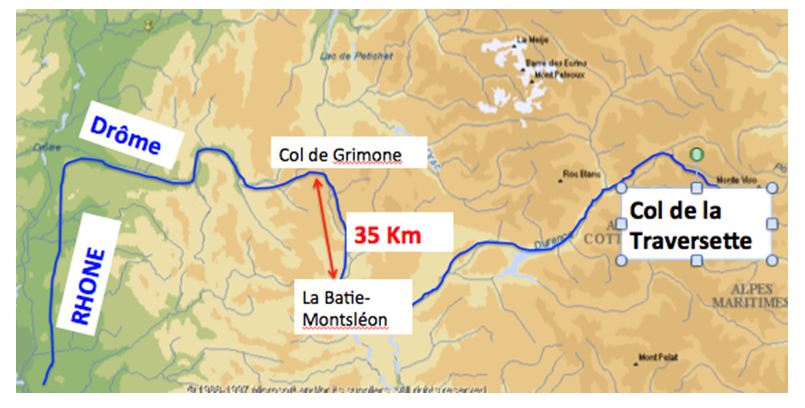
"Sir Gavin de Beer originally proposed the Grimone pass for the ambush of an Allobrogian tribe," French scholar Dr. Geoffroy De Galbert, author of Hannibal et Cesar dans les Alpes, explains.

"Furthermore, de Beer claimed their oppidum (hill fort) was located at La Batie-Montsléon. Hannibal’s companions claimed that the Allobroges spent the nights in their oppidum and returned in the morning to guard this delicate passage.  But it is 35 km between the Col de Grimone and La Batie-Montsléon.  A 35 km journey twice a day would be practically impossible."

"Livy, in describing the crossing of the river added the word “Durancia”, de Galbert continues, "claiming that it referred to the Durance river. Livy wrote: “This river, which also takes its rise in the Alps, is of all the rivers of Gaul the most difficult to cross. Though carrying down a great volume of water, it does not lend itself to navigation, for it is not kept in by banks, but flows in many separate channels.” (Livy III, XXI, 31)

"The Durance river around Embrun cannot be the most difficult river to cross of all Gaul." de Galbert states, "On the contrary, this description perfectly matches crossing the Isere at Chateauneuf-sur-Isére near Valence. The Isère river was divided into several branches at Chateauneuf-sur-Isère before being contained. The Latin historian Orosius, living in the 5th century CE, also claimed that Livy had confused the Durance with the Isère."


 "Furthermore, de Galbert adds, "Livy wrote : Hannibal, leaving the Druentia, and advancing for the most part through a champaign country, reached the Alps without being molested by the Gauls who inhabited those regions. (Book 21, 32)."

"Between the crossing of the Durance near Embrun and the Alps, there are no plains. On the contrary, after crossing the Isere at Chateauneuf sur Isere, there is a large plain leading to the entrance of the Alps," de Galbert concludes.

"Mahaney's group also claims the Po River only starts near Traversette," Hunt observes, "but that's a geographic fallacy as there is no one source for a major river and the Dora Riparia is a primary Po watershed as well and runs directly eastward into the Po west of Torino. They also say only the insanely narrow Traversette has the view for Hannibal's speech but clearly must have only tried the modern Clapier footpath and not the adjacent Savine Coche broad ridge immediately west where the ancient path ran, which has a great view of Torino and the Po plain."

"If you assess the northern route toward the Clapier-Savine Cloche, you will find a satisfying first ambush place in the Isere near Voreppe, (clearly Allobroges territory)," Hunt points out.

The likelihood that a major confrontation could have taken place there was also suggested by the recent discovery of what appears to be the remains of a large Celtic oppidum (hill fort) near there.

Significant differences in the geophysical features between the two proposed passes is discussed in an article that appeared in this 2010 post in Earth Magazine:

http://www.earthmagazine.org/article/hannibals-trail-clues-are-geology

In this article Hunt also describes a two-tier rockfall at the Clapier-Savine Coche pass a short distance from the summit.

"Polybius actually describes more of a multi-tier precipice," Hunt says, "and the Clapier-Savine Coche descent has multi-tiered rockfalls that geological weathering dates to more than a few thousands years ago."

Hannibal crossing the Alps from The illustrated history of the world for the English people, 1881.

But perhaps one of the best analyses of all candidate passes as of 1959 was prepared by John Hoyte, a British engineer whose team actually took an elephant over the Alps in an effort to settle the question in July 1959.
Hoyte first distilled a list of conditions defined by Polybius in his Histories.

(a) be large enough to camp 30,000 men and about 5,000 horses (on its French side)

(b) command a panoramic view of the Po valley

(c) have a difficult descent

(d) be high enough to have large areas of snow, from two consecutive winters on its flanks

(e) have a place for pasturing the horses immediately after the difficult stretch of the descent

(f) give a distance of three days' march, from here to the plains.

(g) lead straight down to the land of the Turini.

(h) be a day's march from a probable site for the 'bare-rock' ambush (or a day and a night for the baggage and elephants).

(i) be positioned so that the most direct route to it from the Rhône passes by the 'Island' (where the river 'Skaras' meets the Rhône) seven days' march from the sea (three days from the sea to the crossing of the Rhône and four from the crossing to the Island).

He then scored each pass on a scale of 0-5 for each of these parameters with 5 awarded for a complete fit and less for more doubtful cases.


Hoyte's group launched their attempt from Montmelian, France and followed the valley of the Arc River with the goal of crossing the Col de Clapier, since that pass scored the highest in Hoyte's comparison study of Polybian parameters.  However, the pass had become narrowed and dangerous due to rockfall so the group retracted down into the valley and crossed the Petit Mon Cenis, which branches off the Clapier route at ~7150 ft a short distance before the final Clapier ascent, a route proposed by Napoleon.  After 10 days of travel, the expedition successfully reached Susa in Italy.
Details of the expedition and a wonderful series of photographs can be viewed on Hoyte's website (http://johnhoyte.com/alpine-elephant/).

Hoyte also published an account of the expedition in his book, Trunk Road for Hannibal - with an elephant over the Alps, in 1960.  It was republished in 1964 under the title Alpine Elephant - In Hannibal's Tracks.

Geoffroy de Galbert, also points out that later supply trains were unable to use the proposed route across the Traversette.

"During the 14th and 15th centuries, the Maurienne and Gresivaudan valleys of the Alps were swept by the Black Death," de Galbert points out, "These valleys had been the traditional routes used to ship salt from mines in the south of France to Italy's Po valley.  The Traversette pass lay within a region unaffected by the plague but was so narrow a heavily laden mule could not cross there. Mule convoys had to be unloaded at the foot of the pass and reloaded onto the backs of men who then carried the cargo across the pass.  Finally, in 1480, a tunnel 75 meters long and 1.5 meters in height was built under the Traversette pass to provide a navigable route for salt shipments."

"If the mules could not cross the Alps through the Traversette pass in the fifteenth century, they could not do it in Hannibal's time," de Galbert concludes.

"In fact, in pre-Roman antiquity, there was only one wide road from Spain to the Po Valley," de Galbert continues, "This road crossed the Alps by the Maurienne valley.  Hannibal with his huge army could not have used a simple mountain trail.  This is further supported by the fact that no neolithic or Iron Age remains have been found on the roads from Durance to the Traversette pass."

A map showing the locations of Iron Age remains found in the Maurienne region of the French Alps.  Dr. Geoffroy de Galbert points out that no neolithic or Iron Age remains have been found between the Durance and the Traversette pass.  Image courtesy of Geoffroy de Galbert.
But in the latest research, Mahaney tackles the question from a different perspective.  The new findings most recently reported are based primarily on the discovery of a layer of soil disturbance and the findings of "a mass animal deposition event" -  bacterial remains indicating the presence of a large number of equines in the vicinity.  Although the articles currently circulated by the media claim the Carbon 14 dates obtained for the material in the disturbed layer point to 218 BCE.

"The C14 dating of an object from 218 B.C. does not result in a date. It gives two time intervals: one comprised between 231 and 97 B.C. with 66 % probability; the other between 355 and 292 BC with a 30 % probability," explains de Galbert. "These results have been calculated by the Oxford Radiocarbon Unit’s software OXCAL and may be seen on the graph below:


Contamination is always a concern too and testing waste from ruminants can also be problematic as vegetation can have varying amounts of carbon that could impact test results as well.

"The new hypothesis places the boggy dung mass on the eastern side at 2580 meters," Hunt points out, "Given the warmer climate around Traversette, since it's further south, vegetation is more lush there, so Alpine tribes have grazed animals there for thousands of years."

Andrew Wilson of Oxford's Institute of Archaeology, apparently agrees.  In a recent New Yorker article he expressed doubt about Mahaney's claims pointing out that, due to the wide date range encompassed by the Carbon 14 analysis, the disturbed layer probably accumulated over a considerable period of time, perhaps from animals drinking at the mire rather than a single event during the passage of an army.

In fact, Hannibal's expedition through the Alps, although truly legendary in its scope and military context, was not the first mass migration across the mountain range that could have left sizable animal waste deposits.

When Hannibal harangues his troops about their fear of crossing the Alps, Livy says Hannibal himself describes earlier mass migrations.

"What on earth do you think the Alps are except a collection of high mountains? Perhaps you think they are even higher than the Pyrenees? So what?  Nothing on earth can ever reach the sky; no mountain is too high for man to conquer. People actually live in the Alps, for goodness’ sake! They till the ground; animals breed and grow fat there. If a small group of natives can cross them, so can an army.  Look at these delegates from the Boii – they didn’t grow wings and fly here over the top. Even their ancestors were not born here; they came here as immigrant peasants from Italy; they crossed these selfsame Alps in huge migrating hordes, with all their women and children – and lived to tell the tale." - Livy, Book 21, Chapter 30.6 - 30.8 


A reconstructed late La Tène Period (3rd-1st century BCE) Celtic settlement in Havranok,Slovakia.
Image courtesy of Wikimedia Commons

In fact, activities preceding the Gallic War of 225 BCE culminating in the Battle of Telamon had involved large scale movements of Gauls across the Alps.

"After their defeats by Rome in the 280s, the Gauls were quiescent for forty-five years; but eventually a younger generation took their place, 'full of unreflecting passion and without experience of suffering or peril' (Polybius' Histories 2.21.1-2).  They began to disturb the existing equilibrium with Rome, and invited Gauls from across the Alps to participate in a new war...The leaders of the Po Valley peoples held out to the leaders of the Gauls beyond the Alps the promise of the rich loot that awaited them in Italy, along with assurances that Gallic military power could easily overcome the Romans; after all, this had happened before, when Rome itself had been taken and held for seven months by Gallic warriors (Polyb. 2.22.4-5)." - Arthur M. Eckstein, Polybius, the Gallic Crisis, and the Ebro Treaty. 

Hannibal's crossing was also followed by more than twelve years of war-related traffic, again mentioned in Livy:

"He [Hannibal] had believed, indeed, that his brother [Hasdrubal] would come over into Italy that summer; but when he recalled what he had himself endured during five months, in crossing first the Rhone, and then the Alps, in conflicts with men and the nature of the country, he looked forward to a crossing by no means so easy and so soon accomplished. This accounted for his slowness in leaving winter quarters. But for Hasdrubal everything moved more quickly and more easily than had been expected by himself and others. For not only did the Arverni, and then in turn other Gallic and Alpine tribes, receive him, but they even followed him to war.  And not merely was he leading an army through country for the most part made passable by his brother's crossing, although previously trackless, but, thanks to the opening up of the Alps by twelve years of habitual use, they were also crossing through tribes now less savagely disposed.  For previously, being never seen by strange peoples and unaccustomed themselves to see a stranger in their own land, they were unfriendly to the human race in general. And at first, not knowing whither the Carthaginian was bound, they had believed that their own rocks and fastnesses and booty in cattle and men were the objects of attack.  Then reports of the Punic war, with which Italy had been aflame for eleven years, had made it quite plain to them that the Alps were merely a route; that two very powerful cities, separated from each other by a wide expanse of sea and land, were contending for empire and supremacy." - Livy, The History of Rome, Book 27.39


Replica of a Celtic warrior's garb
In the museum Kelten-Keller, Rodheim-Bieber, Germany
Image courtesy of Wikimedia Commons.
De Galbert explains, "At least five armies crossed the Alps between 231 and 97 BC. In 231 B.C., the Insubres and the Boii asked some Gallic tribes of the Alps and the Rhone Valley to come and help them fight the Romans. (Polybius, II, 22). Hannibal’s army crossed the Alps in 218 B.C. Hasdrubal, Hannibal’s brother, crossed the Alps in 207 B.C. with an army larger than Hannibal’s. The consul Fulvius Falcus crossed the Alps in 125 B.C. to help Marseilles when it was attacked by Salyens. Then the consul Marius crossed the Alps around 125 B.C."

These activities all occurred within the time encompassed by the Carbon 14 dating period of the Col de Traversette equine waste remains.

In fact, Hasdrubal's crossing of the Alps in 207 BCE, significantly complicates the search for Hannibal's crossing.  Although Livy makes it sound like Hasdrubal followed in the path of Hannibal, Polybius uses the word "shorter" in his fragmentary reference to Hasdrubal's easier crossing  in Polybius' Histories.  Much of the easier aspect can be attributed to Hasdrubal's much more friendly reception by native tribesmen who have, by then, decided to join the Carthaginian's war efforts.  But to have a reportedly shorter journey suggests a deviation from Hannibal's original route at some point.  Furthermore, Hasdrubal brought war elephants with him as well, so even finding pachyderm waste or remains may not definitely prove a route was Hannibal's and not Hasdrubal's.

"To a viewer in the Val di Susa, three passes (Mont-Genevre, Clapier-Savine Coche, and Mont-Cenis) all converge in the Dora Riparia river watershed en route to Torino. If an ancient observer had known Hannibal came through here via the higher middle route of the Clapier-Savine Coche and if also knowing Hasdrubal came through here via the shorter and lower Mont-Genevre, it would still appear they came through the same Val di Susa before it joins the Po Valley," Hunt observes.

Apparently,The London Times has expressed their skepticism about the latest claims, too, as have noted historian Tom Holland and others.

"We are unlikely to know definitively but the literature of ancient military campaigns has an allure regardless of strict accuracy. Caesar's Gallic War recounts a fantastical tale of how German tribesmen caught elks through a cunning plan reminiscent of Piglet's heffalump trap. Polybius and Livy tell of how Hannibal's elephants crossed the Rhone by walking along the riverbed and using their trunks as snorkels; evidently no one told these historians that elephants can swim. There is a pleasing symmetry that the latest scholarship of the ancient world is literally rather than metaphorically a pile of manure." - Elephantine Enigma: Scientists believe they have identified Hannibal's route over the Alps, Editorial, The Times (London), April 5, 2016

Tom Holland was a little more succinct, "The evidence is s***," he said.

"The amount of evidence needed is substantial indeed across multiple parameters; this new claim just does not have the kind of support required despite sounding so scientific," Hunt observes.

The bottom line as I see it is that, despite our wishful thinking, none of the current findings are truly definitive without the discovery of supporting archaeological remains.

Perhaps we should take the advice of Polybius, who once cautioned his readers about fully embracing statements by another Roman historian, Q. Fabius Pictor, "My own opinion is that one must not treat his authority as being of little weight, but at the same time one should not regard it as final."

A Numidian horseman by Hocine Ziani, an Algerian artist who is a founding member of the Central Army Museum in Algiers.  Other examples of his amazing work can be viewed on Pinterest.
I must admit I was intrigued with the possibility of finding ancient equine DNA from a breed originating in North Africa, though.  Hannibal's elite Numidian cavalry probably would have brought their own mounts with them so that does pose an opportunity for further study. However, finding the whereabouts of ancient equine DNA from North Africa for comparison, possibly locked away in some museum or research institution's dusty basement, may prove as challenging as trying to find a crated Ark of the Covenant in a government warehouse!

References:

Polybius, Histories

Ball, P. (2016, April 3). The truth about Hannibal’s route across the Alps. The Guardian. Retrieved April 8, 2016, from https://www.theguardian.com/science/2016/apr/03/where-muck-hannibals-elephants-alps-italy-bill-mahaney-york-university-toronto

Walbank, F. W.. (1956). Some Reflections on Hannibal's Pass. The Journal of Roman Studies, 46, 37–45. http://doi.org/10.2307/297963

Hoyte, J. (1960). Trunk road for Hannibal; with an elephant over the Alps. London: G. Bles.

Livy, The History of Rome

Eckstein, A. M.. (2012). Polybius, the Gallic Crisis, and the Ebro Treaty. Classical Philology, 107(3), 206–229. http://doi.org/10.1086/665622

Elephantine Enigma: Scientists believe they have identified Hannibal's route over the Alps. (2016, April 05). The Times (London). Retrieved April 12, 2016, from http://www.thetimes.co.uk/

A Kindle preview of related reading:


Other suggested reading:

If you enjoyed this post, never miss out on future posts by following me by email!


Thursday, December 9, 2010

The Tunica Molesta: Roman Execution Ad Flammas

Nero's Torches (1876) by Henryk Siemiradzki

Warning: the following passage contains a very graphic description of the execution of four criminals condemned for arson by Commodus in the 2nd century CE.  Reader discretion is advised.

Bust of Commodus as Hercules, hence the lion s...Image via Wikipedia
The Roman Emperor Commodus dressed as Hercules
"Upon each platform had been erected a wooden cross, from which hung a condemned man.  All four were arsonists, whose crimes had been committed at Brundisium and Capua in the south, Aquileia in the north, and at Rome.  They each wore a tunic, but it was no ordinary tunic: it was black, and glistened in the sunlight.  Each of the condemned wore the tunica molesta: the garments had been soaked in pitch.  The arsonists were to be punished according to the nature of their crimes; they were condemned ad flammas...they were to be burned alive in the arena.

When they saw the four convestores entering the arena, the condemned started to scream and moan, begging the crowd for mercy.  The crowd screamed back at them.  They turned to the Emperor, their faces contorted in terror.  Commodus merely smiled, gave them a friendly wave, and sat back comfortably.

Each confector carried a burning torch, which would be touched to the tunica molesta of each criminal.  As they watched the approach of the confectores, two of the condemned lost control of their bowels.  When he saw the faeces running down their legs, Commodus turned to those nearest him with an indulgent smile, as if sharing in some witticism at a theatrical performance.

The time of their death was now upon them.  The torches of the confectores touched their pitch-soaked clothes, and the flames sprang to them, as if escaping imprisonment.  Wrapped in cloaks of fire, the condemned began to scream as the burning pitch closed upon their flesh.  Four columns of black smoke rose into the air above the arena.  In revolting agony the bodies of the condemned writhed; in excitement and hilarity writhed those of the spectators.  Skulls split with the heat, revealing the grey pulp within; stomachs burst, disgorging boiling entrails.  The awful stench of roasting flesh filled the arena.  Presently, the screams ceased, and the only sound that could be heard, other than the shouts of the crowd, was the crackle of the ravenous flames. - Alan Baker, .The Gladiator: The Secret History of Rome's Warrior Slaves

I came upon this horrific description of death by tunica molesta when I was researching the history of this form of execution after reading about it in Adrienne Mayor's text "Greek Fire, Poison Arrows, and Scorpion Bombs: Biological & Chemical Warfare in the Ancient World.  Although many of us have read about Nero executing Christians suspected of arson after the Great Fire in 64 C.E. by using them as human torches, I didn't realize that this method of execution, like crucifixion, had been used routinely for such crimes as arson and treason in the Roman world before that time.

I don't know why I had not considered this before because I knew that the Romans often used mythological reenactments with criminals to entertain the crowds at Roman games and certainly the death of Hercules, one of the most revered demigods of the Roman pantheon, by a burning poison garment would have figured prominently as a choice.

Heracles, Deianira and Nessus. Attic black-fig...Image via Wikipedia
Heracles, Deianira and Nessus. Attic black-figured
hydria, ca. 575–550 BC.
"Intending to offer sacrifice, [Hercules] sent the herald Lichas to Trachis to fetch fine raiment. From him Deianira learned about Iole, and fearing that Hercules might love that damsel more than herself, she supposed that the spilt blood of Nessus was in truth a love-charm, and with it she smeared the tunic. So Hercules put it on and proceeded to offer sacrifice. But no sooner was the tunic warmed than the poison of the hydra began to corrode his skin; and on that he lifted Lichas by the feet, hurled him down from the headland, and tore off the tunic, which clung to his body, so that his flesh was torn away with it. In such a sad plight he was carried on shipboard to Trachis: and Deianira, on learning what had happened, hanged herself. But Hercules, after charging Hyllus his elder son by Deianira, to marry Iole when he came of age, proceeded to Mount Oeta, in the Trachinian territory, and there constructed a pyre, mounted it, and gave orders to kindle it. When no one would do so, Poeas, passing by to look for his flocks, set a light to it. On him Hercules bestowed his bow. While the pyre was burning, it is said that a cloud passed under Hercules and with a peal of thunder wafted him up to heaven. - Apollodorus Lib. 2.7.7


Execution "ad flammas" was actually one of the specified methods of execution in ancient Rome's governing XII Tables.

"According to the XII Tables men might be bound, beaten, and burned alive (vivicomburium, damnatio ad flammas, vivus uri, crematio) as an ancient penalty for treachery and arson.  This was rare under the Republic, but the Roman masses knew the violent use of fire as a threat and as vengeance.  More common under the Empire, execution by fire was mostly for slaves and the lower orders (humiliores) for arson, desertion, magic, and treason, and it was an especially common punishment for Christians." - Donald G. Kyle, Spectacles of Death in Ancient Rome (Approaching the Ancient World).

Politically capitalizing on the spectacular nature of this mode of execution  probably did not occur, though,  until the "age of senatorial ascendancy" during the Punic Wars.

"Elite Romans had long used elaborate funerals to reinforce familial claims to status, and they would later use imposing monuments and tombs as more enduring symbols.  Just as the feasting and circus and theatrical games of triumphal ludi were vindications of awarded dignitas, the innovation of the gladiatorial munus on a limited almost experimental basis in 264 [BCE] allowed families, under the pretext of honoring a dead relative to display their claim to status.  With the wars against Carthage and with elite families vying for consulships and thus generalships, demonstrations of the destruction of foreign captives, rebel slaves or deserters, or exotic beasts from the expanding limits of Roman power seemed entirely appropriate fro the military leaders of a burgeoning empire.  Through the era of the Punic Wars, often called "the age of senatorial ascendancy", the nobles entrenched their control.  From the magnitude of the Punic Wars to the Roman atrocities in Spain, Romans fought "total' wars against non-Italians and became more tolerant and even expectant of public brutality.  In the same period munera [funeral games] and venationes [beast hunts] expanded in scope and frequency as the provision of spectacles of death was becoming more and more politically advantageous." - - Donald G. Kyle, Spectacles of Death in Ancient Rome (Approaching the Ancient World).

The adoption of many aspects of Greek culture that occurred after the conquest of Syracuse in 212 BCE might have also had an influence on the introduction of criminal execution in public spectacles.

Plato taught punishment in the form of pure retribution should be condemned as animalistic and pointless. As Roman nobility began to study the works of the Greek philosophers perhaps they rationalized these spectacles were a means to invoke humiliation in the miscreants thereby restoring social order, a loftier ideal than simple retribution.  This viewpoint was later expressed outright in the writings of the Middle Platonist L. Calvenus Taurus of the 2nd century CE but could have been shared earlier by Roman adopters of Greek philosophy, especially since it socially justified these activities and drew attention away from the political benefits reaped by these Roman magistrates.

In her paper, Fatal Charades: Roman Executions Staged as Mythological Enactments, K. M. Coleman also points out that the mockery of criminals at such public spectacles also served to dissociate and distance the onlookers from the individual whose behavior had been declared unacceptable by the state.


But, without properly equipped permanent facilities for these entertainments before the 1st century BCE, large scale reenactments of mythological narratives could not be properly presented.  Perhaps this explains why the use of the tunica molesta was relatively rare until then.


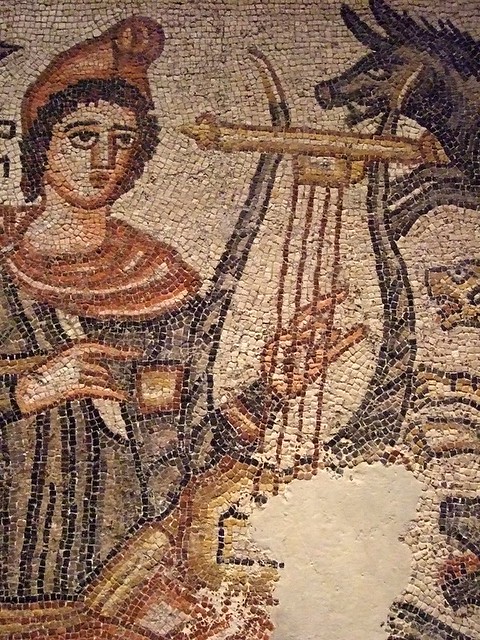
A reenactment of the Orpheus myth was a
popular "fatal charade" used to execute
people sentenced to death ad bestias
Roman mosaic of Orpheus circa 204 CE
Photographed at the Dallas Museum of Art
by Mary Harrsch © 2006.
"Underground passageways excavated below the Forum Romanum bear witness to an attempt to create adequate facilities, but it was the adoption during the first century of a Campanian architectural design, the amphitheater, which greatly increased the potential for sophisticated displays, made permanent accommodation available for seating a large audience and allowed easier control and handling of the animals, with a corresponding guarantee of safety of the audience." - K.M. Coleman, Fatal Charades: Roman Executions Staged as Mythological Enactments

When the Flavian amphitheater was finally completed under the reign of Titus, the son of Vespasian certainly took full advantage of the degree of spectacle that could be presented in the new facility.

 "...Titus celebrated his brother's birthday with great splendour, reserving in his honour for this festival much of the punishment of his Jewish captives.  For the number of those destroyed in contests with wild beasts or with one another or in the flames exceeded two thousand five hundred." - Josephus, VII.37-40
 
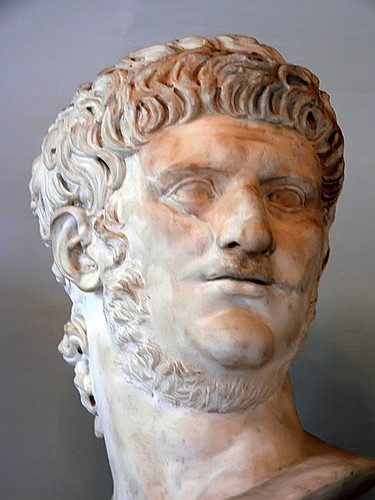
The Roman Emperor 1st century CE.
Photographed at the Capitoline Museum in
Rome, Italy by Mary Harrsch © 2005
Some writers claimed many of the Roman people had objected to the cruelty of Nero's executions ad flammas but the people must have had a short memory!

Coleman also pointed out that executions ad bestias were the real crowd pleasers but acquiring beasts was expensive and there was always a degree of uncertainty about the willingness of animals to "do the job".  Death by crucifixion, on the other hand, was usually too slow, taking hours or even days.  So the tunica molesta could have been an alternative means of execution that still provided a certain degree of entertainment while being relatively cheap with a guaranteed result.

Coleman mentions that evidence of ongoing  "fatal charades" disappears after the Severan dynasty but executions by fire certainly continued.  Ironically, it was a Christian emperor,  Justinian (r. 527-565 CE) who decreed that heretics would be put to death by fire as part of his Codex Iustiniani (CJ 1.5.), ratifying the decrees of his predecessors the Emperors Arcadius and Flavius Augustus Honorius.  Burning was also deemed the appropriate punishment for Zoroastrians in the Byzantine Empire for their worship of fire.


If you enjoyed this post, never miss out on future posts by following me by email!


Friday, February 26, 2010

Routine Child Sacrifice Not Practiced by Ancient Carthaginians After All

Although Hannibal was used as a "boogey man" to scare misbehaving Roman children, Carthaginians did not, contrary to popular myth, actually wantonly sacrifice their children according to a new report by researchers from the University of Pittsburg.

The scientists examined the remains of children found in Tophets, structures on the margins of Punic cemetaries where urns containing the remains of young children and animals were placed.  The contents of 348 urns were inspected for developmental markers that would reveal the children's age at death.

[Image: Medea Killing Her Sons by Delacroix, 1862.  Courtesy of Wikimedia Commons]

"Schwartz [Jeffrey H. Schwartz, a professor of anthropology and history and philosophy of science in Pitt's School of Arts and Sciences and president of the World Academy of Art and Science] and Houghton [Frank Houghton of the Veterans Research Foundation of Pittsburgh] recorded skull, hip, long bone, and tooth measurements that indicated most of the children died in their first year with a sizeable number aged only two to five months, and that at least 20 percent of the sample was prenatal."

"Schwartz and Houghton then selected teeth from 50 individuals they concluded had died before or shortly after birth and sent them to Macchiarelli and Bondioli, who examined the samples for a neonatal line. This opaque band forms in human teeth between the interruption of enamel production at birth and its resumption within two weeks of life. Identification of this line is commonly used to determine an infant's age at death. Macchiarelli and Bondioli found a neonatal line in the teeth of 24 individuals, meaning that the remaining 26 individuals died prenatally or within two weeks of birth, the researchers reported."

"The team's report also disputes the contention that Carthaginians specifically sacrificed first-born males. Schwartz and Houghton determined sex by measuring the sciatic notch&'a crevice at the rear of the pelvis that's wider in females&'of 70 hipbones. They discovered that 38 pelvises came from females and 26 from males. Two others were likely female, one likely male, and three undetermined." - More: Spero News

Carthage: A Journey Back in Time (Lost Treasures of the Ancient World)    History - Engineering An Empire: Carthage   The Punic Wars: Rome, Carthage, and the Struggle for the Mediterranean   Dying for the Gods: Human Sacrifice in Iron Age & Roman Europe   Some Inquiries Concerning Human Sacrifices Among the Romans
If you enjoyed this post, never miss out on future posts by following me by email!


Thursday, February 26, 2009

Ancient Piracy explored in new exhibit "Knights of the Black Flag"


Having just finished reading Paul Waters' outstanding first novel "Of Heroes and Merchants" in which ancient pirates under the command of the real historical figure Dicaearchus (Dicearchus, or Diceärch - d.196 BC), an Aetolain rogue employed by Philip V of Macedon to raid the Cyclades and Rhodian ships after the second Punic War, this announcement of a major exhibit in North Carolina about piracy, including ancient piracy, caught my eye.

Marauders. Plunderers. Bloodthirsty sea-thieves. Whatever their name, pirates have wreaked havoc on the high seas since waterway travel began. These seafaring scoundrels command attention in a major exhibit opening Friday, March 6, at the N.C. Museum of History in Raleigh. Knights of the Black Flag will explore the legacy of pirates, from ancient times to the present, through intriguing artifacts, legends and history that bring their ruthless adventures to life. The interactive exhibit will be an exciting experience for all ages.

Showcasing many objects related to pirates, Knights of the Black Flag includes the largest collection of artifacts ever exhibited from the shipwreck believed to be Blackbeard's flagship, Queen Anne's Revenge. Legends surround another compelling artifact on loan from the Peabody Essex Museum in Salem, Mass.: the alleged skull of Blackbeard. The exhibit will be on view through July 6, 2009.

Knights of the Black Flag traces the history of piracy from ancient Egypt, Greece and Rome through today's pirates in Somalia. Artifacts, some dating to the early centuries A.D., represent tangible links to a violent past. For example, a Roman amphora (storage jar) from southern Jordan may have been seized by ancient pirates on a ship in the Red Sea. Other artifacts speak to the Golden Age of Piracy, from 1689 to the 1720s. These include Queen Anne-style pistols and items discovered in the ruins of Blackbeard's purported house in Bath. Objects related to modern-day piracy in Somalia include an AK-47, gas masks and knapsacks.

This excellent web page explained the oldest documents (inscription on a clay tablet) describing pirates dates back to Pharo Echnaton (1350 BC). It goes on to say that Roman conquest and the resultant weakening of other governments in the Mediterranean accelerated the predation of pirates in Mare Nostrum:

"As a result of the weakening of Rhodes, piracy became rampant in the eastern Mediterranean . During the next century Roman senators did not find the political will to suppress the piracy, perhaps in part because it served their interests; pirates supplied tens of thousands of slaves for their Italian estates and disrupted the grain trade, thus raising prices for their produce in Rome.

Although the pirates ranged over much of the navigable Mediterranean, they concentrated their raids on major shipping lanes. Upon these lanes goods were transported between the far western provinces of Spain and Africa, Rome and the rest of Italy, and the eastern provinces including Macedonia, Greece, Syria and Egypt. Preferred area to set base or home port, was on the coast of present day Turkey, in an area known as Cicilia Tracheia. This area afforded great protection for the pirates. The coastline was complicated and full of twists and turns and hidden ports. As Roman influence rose the influence of the native powers, such as Seleucid Syria and Rhodes, declined. Some historians argue that because Romans destroyed Mediterranean kingdoms there was nobody to keep law and order on the seas. Especially after Romans destroyed the powerful fleet of Carthage which kept in check piracy on the shores of North Africa pirates flourished and practically dominated big parts of Mediterranean. With Rome reluctant to crack down on the pirates Mediterranean cities began to form alliances with the pirates to avoid being plundered and terrorized since they received little protection from Rome. Many port cities provided their services and facilities to the pirates, while others paid tribute as if they were conquered. In effect, these cities became centers of piracy.

Interestingly there was a Piracy Law during Roman Times. An inscription found at Delphi is a 100BC document that set the rules for dealing with pirates. The law stated that Roman citizens should be able to "conduct, without peril, whatever business they desire," presumably wherever they desire. A copy of the law was to be sent by messengers of Rhodes to the kings of Cyprus, Alexandria, Egypt, Cyrene, and Syria informing them that no pirate is to "use the kingdom, land, or territory of any Roman ally as a base of operation. No official or garrison will harbor pirates and should be considered zealous collaborators for the safety of all ".

Another inscription found at Cnidos seems to be either an extension or a lost portion of the Delphi text. The Cnidos text is quite broken in the beginning, but does exhibit certain similarities. This text states that the kings of Syria, Alexandria, Egypt, Cyrene and Cyprus were to prevent the harboring of pirates. There was even a fine of 200,000 sestertii for non compliance with the law. This law gave Rome the basis for prosecution of pirates.

According to Roman writer Plutarch in 102BC, Marcus Antonius was given a command to reduce the pirates. It seemed to be more an effort to reduce capture of Romans and provincials by pirates primarily by making a deal with a certain pirate known as Nicomedes . Between the years of 77BC and 75BC, Servilius Roman commander was sent to assist the allies of Roman province Lycia in another attempt by Rome to curtail piratical escapades. However he did not do much to damage the hard core pirates in the area of Cilicia Tracheia because little evidence has been found to support him even entering the waters off that coast (Roman writer Ormerod). In 74BC preparations were made for an all-out assault on the Cilician coast under the command of Marc Antonius. These were abandoned with the coming of the third Mithradatic War ( according to Plutarch).

The number of pirates grew substantially during the wars created by Mithradates. While Mithradates was fighting on land, his navy and the pirates under his influence roamed the sea, plundering and pillaging. They even began to intercept the Roman shipments especially grain from Africa and in one instance destroyed Roman fleet in Ostia. During his first war against Rome, Mithradates assisted the pirates by providing materials and expertise to begin coastal raiding . After the conclusion of the conflict, Mithradates' influence with the pirates declined, but the pirate menace continued. However, Mithradates surfaced twice more, and each time was closely allied with pirate forces. By the third war, the pirates were organized more like regular fleets, and less like bands of robbers. During that time, the pirates captured Iassus, Samos, Clazomenae, and Samothrace. They even plundered the temple at Samothrace and received the equivalent of 1000 talents.

Roman historian Appian suggests that the oppressive conditions set up by Rome's constant warfare prompted many to renounce their hopeless lives and join the pirate forces . Thus pirates gained detailed knowledge of many ports and coastlines, providing a wider range of profitable raids. The pirates had become quite brash by this point, owning garrisons and supply depots manned by "fine crews and expert pilots" (Plutarch)."

If you enjoyed this post, never miss out on future posts by following me by email!


Wednesday, July 2, 2008

First Punic War Rostrum Found Off The Coast of Sicily


"Italian researchers say a rostrum, used by ancient Romans to ram enemy ships, was found off the coast of Sicily.

The rare bronze appendage may have been used in the final naval battle of the First Punic War, ANSA reported Tuesday. The rostrum was recovered about 230 feet below the surface by divers aided by remotely operated vehicles.

Sicily's maritime affairs department department head, Sebastiano Tusa, said the Egadi rostrum confirms his theory that a battle took place northeast of the island of Levanzo between fleets from Rome and Carthage during the Battle of the Egadi in 241 B.C., the Italian news agency said."

It was the ancient custom for Roman senators and victorious generals to give speeches from the captured prows, or bows of enemy ships. The ships would then be drawn up on the beach and destroyed except for the prow.

"When you won a naval victory, you cut off the enemy rostra, brought them home, and mounted them on new ships of your own. The bronze prow was the most costly part of the ship, so bringing home the other guy's rostra meant that you could expand your fleet. After really great victories, you could do some serious bragging by mounting some of the rostra for public display rather than reusing them -- "We beat them so bad we have rostra to spare!" So Duilius mounted six "spare" captured rostra on the face of the forum tribunal after his fleet demolished the Latin fleet at Antium in 338 BC. In 260 BC, C. Duilius Nepos added several more after beating the Carthaginians at Mylae. Julius Caesar's plan to expand what by then was called "the Rostrum" was carried out by Augustus, but Augustus's rostra were decorative fakes -- real bronze showing wealth, but not from enemy ships. (The brick Rostrum seen today is a modern restoration.)

Augustus mounted real rostra from the naval battle of Actium on the front platform of the temple that he built to honor his assassinated uncle, "The Divine Julius (Caesar)", and that was particularly significant for two reasons. First, the Actium rostra were Roman, not foreign: they came from Marc Anthony's fleet. Second, Augustus was proclaiming the dominance and divinity of what was to become the Julio-Claudian dynasty both by putting a temple to his uncle Julius in the forum and by placing trophies on its front. He thus established a new Julio-Claudian Rostrum, and during that dynasty you had to be brave or silly to use the old one. The Flavian Emperors took over after Nero ended the Julio-Claudian line in disgrace, and use of the original Rostrum at the other end of the forum resumed." - Tom Wukitsch, Arlington Learning in Retirement Institute

Our English word rostrum, for the wooden stand used by a public speaker, comes from the Latin word for ship's prow.


For coin collectors in the crowd, the presence of a ship's prow on a coin reverse was used to signify victory, the importance of the grain supply (which was carried from Egypt in ships) or an emperor's care in ensuring an adequate grain supply."

If you enjoyed this post, never miss out on future posts by following me by email!