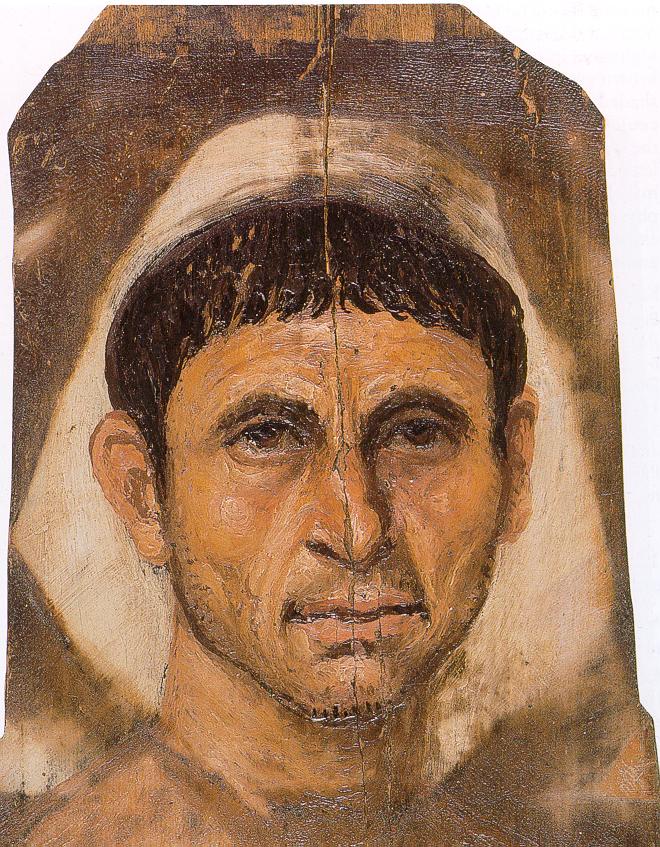
This exhibition uses mummies from the collections of the Manchester Museum (England) to allow visitors to examine life for the wealthy in multicultural Roman Egypt, where diverse Egyptian, Roman, and Greek communities and cultural influences were blended. The exhibition journey traces expectations for the afterlife and introduces cultural constructions of identity, strikingly demonstrated by haunting painted panel portraits. The practices of preservation and decoration of the body, and the transformation of the deceased into a god, are explored by the mummies on display.
Eight gilded mummies and more than 100 related objects are presented in the display, including papyri, jewelry, ceramics, and artworks depicting deities that connect the daily lives of these Greco-Roman Egyptians to the religious world of the gods in a series of lavishly illustrated thematic sections covering the period from 300 BCE to 200 CE. The youngest of the preserved individuals is a 2 or 3 year-old child wrapped in strips of linen in an intricate diagonal pattern adorned with golden studs. Elaborate wrappings and decorated cartonnage were popular during the Roman period because sarcophagi were no longer used for many inhabitants. Interactive radiographic studies and multidirectional CT scans from three of the mummies will allow visitors to see underneath the wrappings.
“Using art and science together, we’re able to explore concepts around humanity, divinity, and ideals of eternal beauty,” explains Museum Director Valerie Hillings.
Visitors are also encouraged to explore the Greco-Roman objects in the North Carolina Museum of Art's own collection that includes a gilded mummy covering, circa 300 B.C.E, an Aphrodite-Isis sculpture from the first to second century CE, and the plaster portrait head of a coffin, circa 100 to 150 C.E.
For those (like me) that will be unable to attend the exhibit, I hope to post images taken by my friend Allan Gluck who will be exploring the exhibit shortly.
A large cache of gilded mummies were found in The Valley of the Golden Mummies at Bahariya Oasis in the Western Desert of Egypt, dating to the Greco-Roman period. Discovered in 1996 by Zahi Hawass and his Egyptian team, approximately two hundred fifty mummies approximately two thousand years old were recovered over the period of several seasons. Excavations have continued and the excavator estimates the site contains a total of more than ten thousand such mummies.
Many of the mummies were still in good condition when they were discovered by Hawass and his team. They were decorated in different styles. There were four general styles of the mummies at Bahariya. The first style, which was found on approximately sixty mummies, has a gilded mask covering the face and a gilded waistcoat depicting different scenes of gods and goddesses across the chest. The second style is covered with cartonnage, depicting scenes of gods such as Anubis, the god of mummification, and his four children. The third style was not decorated with gold or cartonnage, but rather was placed inside an anthropoid, a pottery coffin. The fourth style was covered in linen.
I found Dr. Hawass' book, "Valley of the Golden Mummies," absolutely riveting!
 |
| Egyptian, from Hawara, Mummy of a woman called Isaious, 1st century C.E., human remains, linen, plaster, and gold leaf, Manchester Museum, © 2019 Manchester Museum / Michael Pollard Photographer |
 |
| Egyptian, from Lahun, Mummy mask for a woman, circa 50 C.E., gilded and painted cartonnage JULIA THORNE 2020/TETISHERI MANCHESTER MUSEUM, UNIVERSITY OF MANCHESTER |
 |
| Egyptian, from Hawara, Mummy mask, 332–30 B.C.E., plaster and linen, Manchester Museum. This is one of a series of mold-made masks, built up from layers of linen and plaster. Michael Pollard 2020 Manchester Museum |
 |
| Egyptian, possibly from Hawara, Portrait of a woman, circa 138–160 C.E., wood, Manchester Museum, © 2019 Manchester Museum/Michael Pollard Photographer |
 |
| Gilded Mummy Covering, 300 BCE, Linen with gesso, paint, and gilding, now in the collections of the North Carolina Museum of Art, image courtesy of the museum |
 |
| Greco-Roman Plaster Portrait Head from a coffin, 100-150 CE, now in the collections of the North Carolina Museum of Art, image courtesy of the museum |
 |
| Aphrodite-Isis, copper alloy, 1st-2nd century CE, now in the collections of the North Carolina Museum of Art, image courtesy of the museum |