This morning while I was researching a Fayum portrait of a priest of Serapis in the collections of the British Museum, I came across this encaustic portrait of what appears to be just a common Romano-Egyptian. Although his face is painted with skill, he wears no adornments or displays even a hint of status from his clothing. Because of the quality of the portrait, he must have been somewhat successful in whatever occupation he practiced, whether it was that of a tradesman or even a legionary.
The British Museum points out that his mummy, found in the necropolis of Hawara, was simply wrapped in coarse linen. His closely cropped hair is similar to Roman court portraiture of the Trajanic period and he is said to confront the viewer directly in the Roman manner. The portrait appears to be an example of what became known during Trajan's rule as the portrait of the decennial, an image seemingly devoid of emotion with firm, calm features emanating authority and dignity. Scholars view this portrait style as a detachment from Hellenistic influence and a merging between two previously separate types of portraiture - the official, honorary, portrait, and the private, often funerary, portrait.
Trajan himself is depicted in this style on Trajan's column where he is shown in conversation with one of his commanders. With simplicity, the emperor is depicted nonchalant while explaining a plan to the general, fixing him in the eyes and relaxing the palms of hands in front of him, illustrating a relationship of trust and respect between him and the subordinate, devoid of any orchestrated rhetoric or gestures of courtesy.
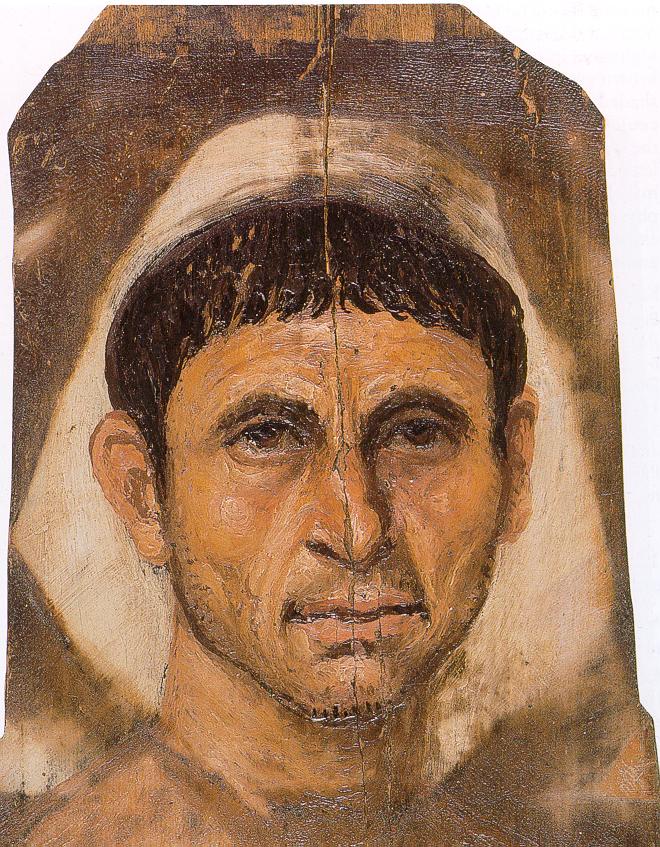
Image: Mummy portrait of a man in encaustic on limewood found in the necropolis of Hawara in the Fayum region of Egypt, 100-120 CE, at the British Museum in London. Image courtesy of the museum and Wikimedia Commons. The portrait emphasizes maturity and physical strength, the latter expressed in the rugged physique and sunburned countenance.


