Showing posts with label encaustic. Show all posts

Monday, April 12, 2021

A Trajanic Period Roman in Egypt

This morning while I was researching a Fayum portrait of a priest of Serapis in the collections of the British Museum, I came across this encaustic portrait of what appears to be just a common Romano-Egyptian.  Although his face is painted with skill, he wears no adornments or displays even a hint of status from his clothing.  Because of the quality of the portrait, he must have been somewhat successful in whatever occupation he practiced, whether it was that of a tradesman or even a legionary.  

The British Museum points out that his mummy, found in the necropolis of Hawara, was simply wrapped in coarse linen.  His closely cropped hair is similar to Roman court portraiture of the Trajanic period and he is said to confront the viewer directly in the Roman manner. The portrait appears to be an example of what became known during Trajan's rule as the portrait of the decennial, an image seemingly devoid of emotion with firm, calm features emanating authority and dignity.  Scholars view this portrait style as a detachment from Hellenistic influence and a merging between two previously separate types of portraiture - the official, honorary, portrait, and the private, often funerary, portrait.

Trajan himself is depicted in this style on Trajan's column where he is shown in conversation with one of his commanders.  With simplicity, the emperor is depicted nonchalant while explaining a plan to the general, fixing him in the eyes and relaxing the palms of hands in front of him, illustrating a relationship of trust and respect between him and the subordinate, devoid of any orchestrated rhetoric or gestures of courtesy.
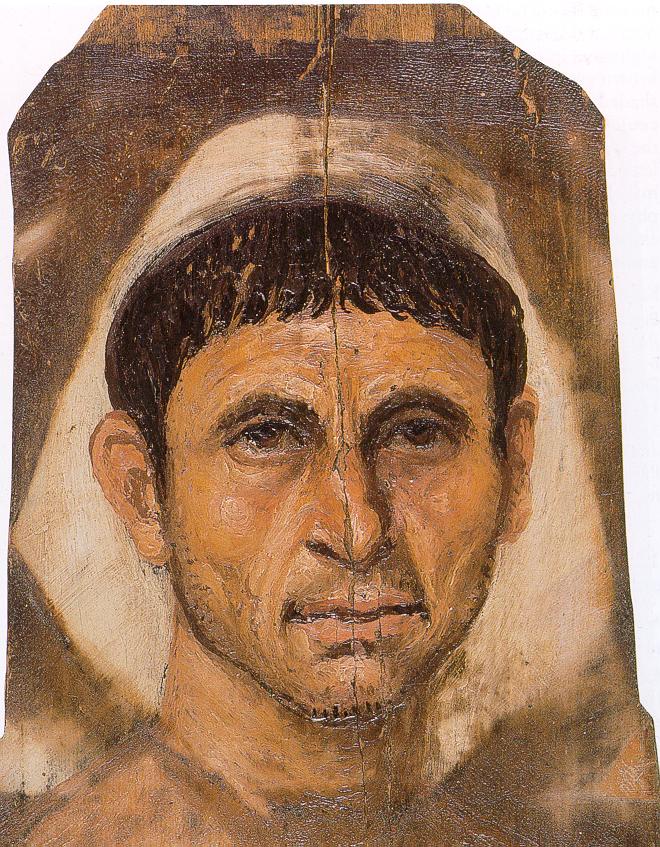

Image: Mummy portrait of a man in encaustic on limewood found in the necropolis of Hawara in the Fayum region of Egypt, 100-120 CE, at the British Museum in London.  Image courtesy of the museum and Wikimedia Commons. The portrait emphasizes  maturity and physical strength, the latter expressed in the rugged physique and sunburned countenance.


If you enjoyed this post, never miss out on future posts by following me by email!


Tuesday, October 2, 2007

Encaustic Art Makes Comeback


I was interested to note that a major art museum is featuring an exhibit of encaustic art. My favorite ancient application of the art form is, of course, the Fayum mummy portraits of Egypt. I also read that Julius Caesar once paid the equivalent of 1/4 of a million dollars for an encaustic painting for his villa.

"The new Marin Museum of Contemporary Art is sponsoring Re-Newal, an exhibition that focuses on contemporary art using wax. Juried by Bob Nugent, Re-Newal includes more than fifty works from artists who are members of International Encaustic Artists.

Enkaustikos-the name means "to burn in." The ancient Greeks gave the art of painting with hot beeswax more than a name, they gave it a form. The exact timeline is unclear, but at a point some three thousand years ago, Greek shipbuilders began experimenting with uses for heat and wax other than simple hull caulking. By adding pigments for color, and resin for hardness, they created a painting medium like no other. Before long, encaustic could be found everywhere, from painted ships to depictions of everyday life on urns and lifelike colors applied to statuary.

Encaustic painting weaves in and out of art history, gaining prominence for a time, then slipping back into the shadows for centuries. A thousand years after the Greek shipbuilders discovered it, Egyptian painters resurrected the medium, crafting exquisite portraits to decorate the mummy after a patron's death. In the seventh century, veneration of a Byzantine icon made of beeswax, using the ashes of Christian martyrs for pigment, was credited with saving Constantinople from attack by the Persians.

Fast-forward to the mid-twentieth century. Almost single-handedly, artist Jasper Johns reintroduced encaustic to the art world. Since that time, it has steadily gained acceptance. The medium's popularity has begun picking up momentum rapidly in the last decade. It's no wonder that we keep revisiting this ancient art form-few others can match its versatility, both in technique and result.

Re-Newal will be on view at MarinMOCA at 500 Palm Drive, Novato, CA from September 29-October 27."

I found a website for aspiring encaustic artists that sells supplies and features a gallery of modern encaustic art. I notice modern encaustic artists have incorporated the use of a hot air blow dryer to create unusual effects. I found this image entitled "Purple Dawn" particularly interesting.
If you enjoyed this post, never miss out on future posts by following me by email!