Showing posts with label Herakles. Show all posts

Friday, April 30, 2021

Bust of a Boy or Eros with the Attributes of Herakles, 150-100 BCE, Roman Period Greece

This thinly-cast bust depicts a youth wearing a lion-skin over his head and a quiver strap across the chest. The figure has delicate features and fine hair that is drawn up in a braid with tendrils falling onto his forehead. The figure may depict a young Herakles, or an unidentifiable youth in the guise of the great hero. A third possibility is that this young man is Eros, who was often depicted with attributes associated with Herakles. Two small holes at the bottom edge may have been used to attach this bust to a piece of furniture. 

While in wealthy households beds were used for sleeping in the bedrooms (lectus cubicularis), and couches for banqueting while reclining were used in the dining rooms (lectus tricliniaris), the less well off might use the same piece of furniture for both functions. The two types might be used interchangeably even in richer households, and it is not always easy to differentiate between sleeping and dining furniture. The most common type of Roman bed took the form of a three-sided, open rectangular box, with the fourth (long) side of the bed open for access. While some beds were framed with boards, others had slanted structures at the ends, called fulcra, to better accommodate pillows. The fulcra of elaborate dining couches often had sumptuous decorative attachments featuring ivory, bronze, copper, gold, or silver ornamentation.


Bust of a Boy with the Attributes of Herakles, 150-100 BCE, Greek, now part of the collections of the J. Paul Getty Museum on view at the Getty Villa in Pacific Palisades, California.  Image courtesy of Bruce White Photography.

If you enjoyed this post, never miss out on future posts by following me by email!


Monday, March 15, 2021

Hercules and the Cretan Bull

According to Jeremy McInerney, the iconography of the bull permeates Minoan culture. The cult of the bull was also prominent in southwestern Anatolia. Bernard Clive Dietrich notes that the most important animal in the Neolithic shrines at Çatalhöyük was the bull. The bull was a chthonic animal associated with fertility and vegetation. It figured in cave cults connected with rites for the dead.  

According to Greek myth, to confirm his right to rule, King Minos of Crete prayed to Poseidon to send him a snow-white bull as a sign. Poseidon sent Minos the bull, with the understanding that bull would be sacrificed to the god. Deciding that Poseidon's bull was too fine of a specimen to kill, Minos sent the bull to his herds and substituted another, inferior bull for sacrifice. Enraged, Poseidon had Aphrodite cause Pasiphaë, wife of Minos, to fall in love with the bull. She subsequently gave birth to the half-man, half-bull, Minotaur. Poseidon passed on his rage to the bull, causing him lay waste to the land.

As his seventh labor, Heracles was sent to capture the bull by Eurystheus.  Heracles sailed to Crete and King Minos gave Heracles permission to take the bull away as he had been wreaking havoc on Crete by uprooting crops and leveling orchard walls. Heracles captured the bull, and then shipped him to Eurystheus in Tiryns. The bull later broke loose and wandered into Marathon, becoming known as the "Marathonian Bull" who was later captured and sacrificed by Theseus.

McInerney observes that the story of Pasiphaë and the Cretan Bull was not written until after Crete had come under Greek control, however, and despite the fact that the palace at Knossos displays a number of murals depicting young men and women vaulting over a bull, scholars are divided as to whether or not this reflects an actual practice.  There is also no recorded evidence that has been recovered there of any Minoan legend of the famous Cretan Bull or the Minotaur either.


Hercules and the Cretan Bull at Schwerin Castle, Germany courtesy of Wikimedia Commons contributor Jens Burkhardt-Plückhahn


Heracles fighting the Cretan bull, while a siren perches on a branch. Laconian black-figure kylix in the manner of the Arkesilas Painter, ca. 550 BCE at the Metropolitan Museum of Art, New York, courtesy of Wikimedia Commons contributor ClaireH. (glare removed)


Ivory figure of Hercules capturing the Cretan bull, probably used to decorate a piece of furniture or a box, Roman 1st century CE, ivory, courtesy of the British Museum


Detail of the Mosaic with the Labors of Hercules (Seventh Labour: Cretan Bull), 3rd century AD, found in Llíria (Valencia), National Archaeological Museum of Spain, Madrid courtesy of Wikimedia Commons contributor Carole Raddatto


Heracles and the Cretan Bull - a metope from the Temple of Zeus at Olympia, in the Archaeological Museum of Olympia, Greece courtesy of Wikimedia Commons contributor Nicholas Hartmann


Detail of a Roman sarcophagus from Perge, Turkey depicting the capture of the Cretan Bull, 2nd century CE (?) courtesy of Wikimedia Commons contributor Mourad Ben Abdallah


Heracles binds the Cretan bull. Attic black-figure amphora in the manner of the Antimenes Painter, ca. 510 BCE From Vulci, Italy at the Staatliche Antikensammlungen in Munich, Germany courtesy of Wikimedia Commons contributor Bibi Saint-Pol.


Architectural terracotta plaque (so-called Campana plaque) representing Hercules capturing the Cretan bull, 1st half of the 1st century CE, discovered in 1828 in Quadraro (Roma Vecchia), Gregorian Etruscan Museum, Vatican City, courtesy of Wikimedia Commons contributor Jean-Pol Grandmont


If you enjoyed this post, never miss out on future posts by following me by email!


Thursday, February 18, 2021

Tales of Telephus

In Greek mythology, Telephus (also Telephos - meaning "far-shining") was the son of Auge, a priestess of Athena who was raped by Heracles.  When her father, King Aleus of Tegea learned of her violation, he attempted to dispose of mother and child. But they ended up in Asia Minor at the court of Teuthras, king of Mysia, where Telephus was adopted as the childless king's heir.

How mother and son ended up in Asia Minor is explained in a variety of versions. In the oldest extant account from a fragment of Hesiod's "Catalogue of Women, 6th century BCE, Auge goes to Mysia, is raised as a daughter by Teuthras, raped by Heracles when he arrives seeking the horses of Laomedon, and Telephus is born there. In some accounts Telephus arrives in Mysia as an infant with his mother, where Teuthras marries Auge, and adopts Telephus. In still another tale, while Auge (in various ways) is delivered to the Mysian court where she again becomes wife to the king, Telephus is instead left behind in Arcadia, having been abandoned on Mount Parthenion, either by Aleus, or by Auge when she gave birth while being taken to the sea by Nauplius to be drowned. However Telephus is suckled by a deer found and raised by King Corythus, or his herdsmen. Seeking knowledge of his mother, Telephus consulted the Delphic oracle which directed him to Mysia, where he was reunited with Auge and adopted by Teuthras.

It is this last version that found favor with Romans in Herculaneum where a fresco depicting Heracles finding Telephus suckled by a deer, with Arkadia, Pan and a winged Virgo looking on was recovered from the Augusteum and is now at the National Archaeological Museum in Naples.

Various plays were centered on the birth of Telephus including a tragedy by Sophocles entitled "Aleadae" (Sons of Aleus) and a play by Euripedes named "Auge," both of which only fragments survive. In Sophocles' play as recounted by 4th century BCE orator Alcidamas, Auge's father Aleus had been warned by the Delphic oracle that if Auge had a son, then this grandson would kill Aleus' sons, so Aleus made Auge a priestess of Athena, telling her she must remain a virgin, on pain of death. But Heracles passing through Tegea, being entertained by Aleus in the temple of Athena, became enamored of Auge and while drunk had sex with her. Aleus discovered that Auge was pregnant and gave her to Nauplius to be drowned. But, on the way to the sea, Auge gave birth to Telephus on Mount Parthenion, and according to Alcidamas, Nauplius, ignoring his orders, sold mother and child to the childless Mysian king Teuthras, who married Auge and adopted Telephus, and "later gave him to Priam to be educated at Troy".  Alcidamas' version of the story must have diverged from Sophocles in at least this last respect, though. For, rather than the infant Telephus being sold to Teuthras, as in Alcidamas, an Aleadae fragment seems to infer that in the Sophoclean play, the new-born Telephus was instead abandoned (on Mount Parthenion?), where he is suckled by a deer. 

It is Sophocles that includes the connection to Troy where, eventually, Telephus, was reportedly wounded by the Greek hero Achilles during the Greeks' first offensive against Troy. 

"The Delphic oracle told Telephos that he could be healed only by the offending weapon. In an attempt to secure Achilles' help, he sought out Orestes, the young son of Agamemnon, and threatened to kill him. Achilles finally heeded Telephos' entreaties and furnished scrapings of his spear that healed the festering wound. - Metropolitan Museum of Art

Representations of various events of the Telephus myth have been depicted on red-figure pottery from as early as 510 BCE and east-Ionian engraved gems from about 480 BCE. As at Herculaneum, scenes showing Telephus suckled by a deer or holding Orestes hostage were particularly popular. Roman depictions of Telephus suckled by a deer were popular through the 3rd century CE.

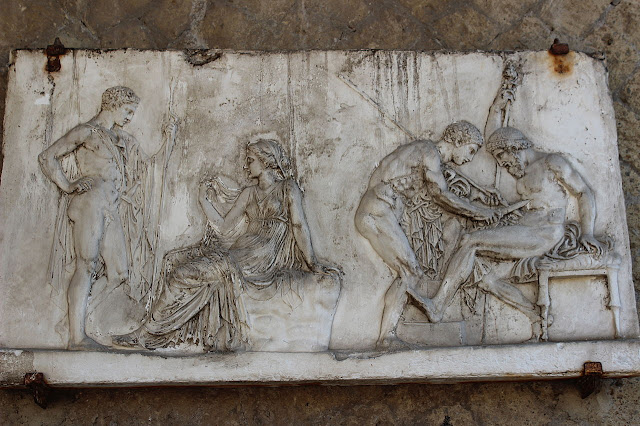
Other scenes include either his wounding or his healing by Achilles. In the House of the Relief of Telephus, also from Herculaneum, we see a seated Telephus being healed by Achilles who scrapes rust from his spear on the festered wound.

The most complete single account of the life of Telephus is depicted in the first-century BCE Telephus frieze, a decorative relief from the Pergamon Altar produced between 180 and 156 BCE now reconstructed in the Pergamon Museum in Berlin.  

Fresco from the Augusteum in Herculaneum depicting Heracles finding Telephus suckled by a deer, now in the National Archaeological Museum in Naples.

Marble statue of Hercules holding baby Telephus in his arms. Ancient Roman copy from a Greek original of 4th century BCE. Found in the 16th century in Campo de’ Fiori in Rome, courtesy of Wikimedia Commons contributor Jean-Pol Grandmont.

Heracles with the infant Telephus and deer, Roman, mid second century CE at The Louvre, courtesy of Wikimedia Commons contributor Marie-Lan Nguyen.


Roman relief from the House of the Relief of Telephus depicting Achilles (right) scraping rust from his spear on the wound of the seated Telephus, c. first century BCE, now in the National Archaeological Museum in Naples, courtesy of Wikimedia Commons contributor Miguel Hermoso Cuesta


Terracotta lekythos (oil flask), with raised relief depicting Clytemnestra pleading with Telephos for the life of her child Orestes, Greek, late 4th century BCE at the Metropolitan Museum of Art

Telephus threatens the infant Orestes, at Agamemnon's altar. Telephus frieze (panel 42), second century BCE from the Pergamon Altar now in Berlin at the Antikensammlung , courtesy of Wikimedia Commons contributor Marcus Cyron.


If you enjoyed this post, never miss out on future posts by following me by email!


Wednesday, September 23, 2020

The ancient city of Tiryns in history and myth

 Tiryns is the site of a Mycenaean palace and city where the hero Heracles is thought to have resided while he performed his twelve labors.  Although it originated before the Bronze Age, it reached its height between 1400 and 1200 BCE and was considered one of the most important centers of the Mycenaean world, especially in Argolis.  Tiryns is first referenced by Homer, who praised its massive walls. Ancient tradition held that the walls were built by the Cyclopes because only giants of superhuman strength could have lifted the enormous stones.  Tradition also associates the walls with Proetus, the sibling of Acrisius, king of Argos. According to the legend Proetus, pursued by his brother, fled to Lycia. With the help of the Lycians, he managed to return to Argolis. There, Proetus occupied Tiryns and fortified it with the assistance of the cyclopes.

The city's  acropolis was constructed in three phases, the first at the end of the Late Helladic II period (1500–1400 BCE), the second in Late Helladic III (1400–1300 BCE), and the third at the end of the Late Helladic III B (1300–1200 BCE).  The palace of the king inside the citadel was similar in construction to that of Mycenae. The walls were decorated with alabaster slabs along the lower zones with rosettes and flowers in relief with frescoes embellishing the upper zones. Mycenaean frescoes were similar in style to those of Minoan Crete and depicted religious ceremonies, processions, hunters, and warriors.

Tiryns was affected by the social collapse at the end of the Bronze Age but survived and was inhabited continuously until the middle of the 8th century BCE. Then in the 5th century BCE, when Cleomenes I of Sparta defeated the Argives, their slaves occupied Tiryns, according to Herodotus.  The Argives eventually avenged their defeat, though, in 468 BCE when they  completely destroyed both Mycenae and Tiryns, and, according to Pausanias, transferred the residents to Argos.

Tiryns was one of the sites excavated by Heinrich Schliemann in 1884-1885. Schliemann initially thought the ruins were medieval and almost destroyed them to excavate deeper seeking Mycenaean treasures.  Excavations continue today under the  direction of the German Archaeological Institute at Athens and the University of Heidelberg. 

Watercolor of a fresco depicting a Mycenaean hunt scene from the palace of Tiryns, Greece at the Royal Ontario Museum in Toronto, Canada courtesy of the museum (enlarged with AI software).

Fragment of a fresco depicting a female figure participating in a procession, carrying offerings to the goddess. Her elegant head is shown in profile, while her body is shown frontally. She is holding a lily in her hand as an offering to the goddess at the National Archaeological Museum in Athens courtesy of Wikimedia Commons contributor Marsyas

Tiryns wall-painting fragments with a representation of a procession of women bearing offerings, from the later Tiryns palace, 14-13th century BCE, National Archaeological Museum of Athens courtesy of Carole Raddato.

Tiryns wall-painting fragments with a representation of wild-boar hunt, from the later Tiryns palace, 14-13th century BCE, National Archaeological Museum of Athens courtesy of Carole Raddato.
If you enjoyed this post, never miss out on future posts by following me by email!


Wednesday, July 1, 2020

Herms of Herakles

This type of bronze pillar herm of Herakles wrapped in a lion skin  and wearing an ivy wreath, found in the sea off the coast of Halikarnassos, was often used as a boundary marker for gymnasia and palaestrae (exercise yards).  Marble examples have been found on the island of Delos.  Similar reliefs of Herakles have also been found  in east Greece on Hellenistic graves.

I photographed this herm on my last visit to the British Museum in 2016.  It is dated between 200-100 BCE.

Bronze herm of Herakles Greek 200-100 BCE Halikarnassos.  Photographed at
The British Museum in London.

If you enjoyed this post, never miss out on future posts by following me by email!


Saturday, June 13, 2020

Philoctetes and Compassion for Hercules on the Pyre

According to the most common legend of Hercules' death, no one but Hercules' friend Philoctetes,  son of King Poeas of the city of Meliboea in Thessaly, would light his funeral pyre. For his compassion, Philoctetes  received Hercules' bow and arrows.

Later, Philoctetes as one of the many eligible Greeks who competed for the hand of Helen, the Spartan princess, was required to participate in the Trojan War to reclaim Helen for Menelaus when she was stolen away by Paris.  On his way to the Trojan War, Philoctetes was bitten by a snake that Hera sent to molest him as punishment for his service to Hercules. The wound festered and began to smell so his Greek companions stranded Philoctetes on the island of Lemnos. 

When the Greeks reached Troy, Helenus, the prophetic son of King Priam, revealed under torture that one of the conditions for the Greeks to win the war was that they needed the bow and arrows of Hercules as some of the arrows were those dipped in the poison blood of the hydra. So Odysseus led a group back to Lemnos to retrieve Hercules' weapons and discovered Philoctetes was still alive. Odysseus tricked the weaponry away from Philoctetes, but Diomedes refused to take the weapons without the man. A deified Hercules came down from Olympus and told Philoctetes to go with them and he would be healed by the son of Asclepius and win great honor as a hero of the Achaean army. In some versions of the legend, Philoctetes is the archer, using Hercules bow and poisoned arrows, that ultimately killed Paris.


Image: Hercules on the Pyre by Guillaume Coustou the Elder, 1704, The Louvre, courtesy of Wikimedia Commons contributor Marie-Lan Nguyen (2006)

If you enjoyed this post, never miss out on future posts by following me by email!